Your brand could rank at the top of page one of Google but simultaneously be invisible when a prospective buyer asks ChatGPT which software to use. The problem is: 51% of B2B software buyers now start their research in an AI chatbot more often than in Google, with G2’s research showing this percentage sitting at 29% less than a year earlier.
For a while there, AI visibility was a murky thing. Now, a growing category of AI visibility tools tracks how brands appear across LLM-generated answers. They monitor mentions, citations, and share of voice across ChatGPT, Perplexity, Gemini, and Google AI Mode and more. This guide covers five reputable options and what to look for before you pick one.
Table of contents
- At a glance: The 5 best AI visibility tools
- The 5 best AI visibility tools
- 1. Peec AI: Best for clean, multi-engine tracking
- 2. Profound: Best for deep analytics and built-in content workflows
- 3. SE Visible: Best for high-level AI brand visibility snapshots
- 4. 4. Arobis AI Visibility Checker: Best for free, instant AI visibility diagnostics
- 6. Otterly: Best for GEO audits at an affordable entry point
- Honorable mention: Beamtrace
- What are the top features to look for in an AI search visibility tool?
- AI visibility data is only as useful as what you do with it
- Frequently asked questions about AI visibility tools
At a glance: The 5 best AI visibility tools
| Tool | Best for | Starting price | Key differentiators |
| Peec AI | SEO and marketing teams wanting clean multi-engine tracking | $95/mo | Fast setup, unlimited seats on Starter, six-engine coverage |
| Profound | Enterprise teams needing deep analytics + content workflows | $99/mo | Prompt Volumes shows real-user query data across 10+ engines |
| SE Visible | CMOs wanting a high-level brand visibility snapshot | $99/mo | Strategic dashboard with sentiment tracking; clarity over complexity |
| Arobis | Teams seeking a free diagnostic of what may be limiting their brand’s visibility in AI search before investing in a paid monitoring platform. | Free | Quick and free diagnostics report, no subscription. |
| Scrunch AI | Enterprise SEO teams needing multi-engine monitoring + site auditing | $250/mo | Broad engine coverage + AXP infrastructure layer for AI crawlers |
| Otterly | Teams wanting structured GEO audits at an affordable entry point | $29/mo | SWOT-based GEO audit across 25+ technical and content factors |
How we evaluated these AI visibility tools
Each tool was assessed across a mix of five criteria:
- Multiple supported AI engines
- Competitor benchmarking capabilities
- Depth of citation and source URL data
- Verified user ratings and independent review presence
- Pricing transparency
No tools were included based on vendor claims alone.
The 5 best AI visibility tools
Below are the agencies we found to be viable options for AI visibility tracking based on our research, as well as our own experience testing and using the tools in some cases.
1. Peec AI: Best for clean, multi-engine tracking
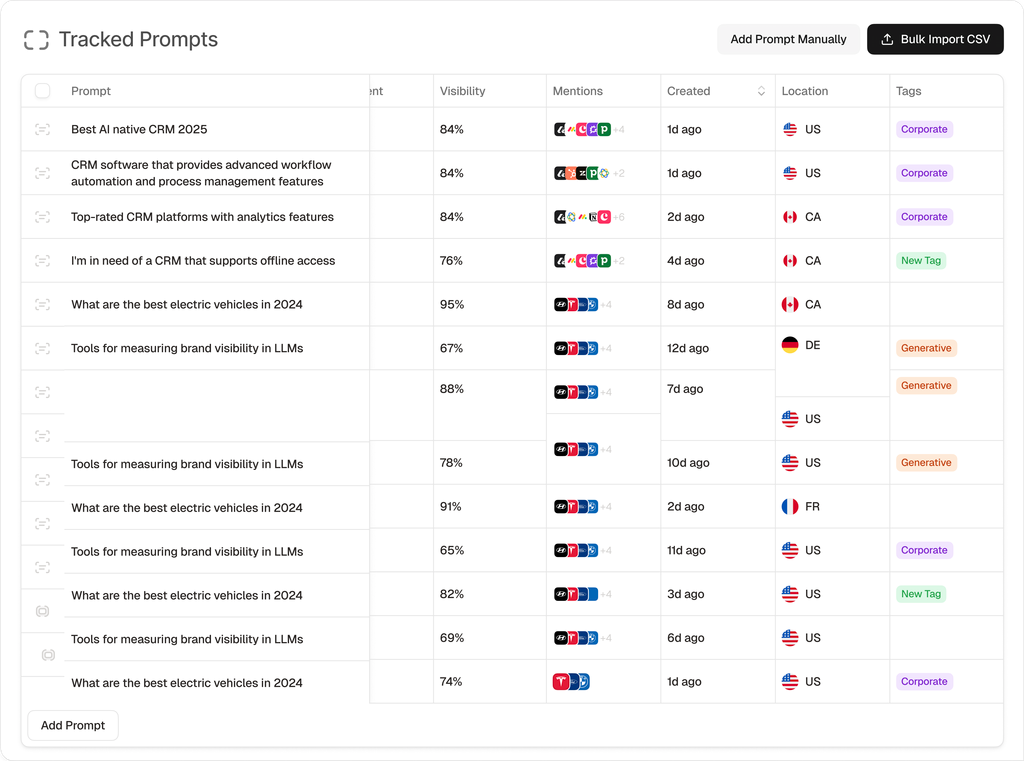
Best for: SEO and marketing teams that want reliable multi-engine AI visibility data without a steep learning curve or per-seat costs.
Peec AI is an AI search analytics platform with a clean, user-friendly interface. It’s quick to set up and monitors brand mentions and citations across multiple AI engines. The unlimited-seats policy on the Starter plan is a noteworthy differentiator for distributed teams since most platforms gate user seats by tier.
Pros:
- Multi-engine coverage from the entry-level tier. The Starter tier includes a choice of three supported models, including options such as ChatGPT, Perplexity, Google AI Overviews, and more.
- Competitor benchmarking tracks how rivals perform across the same prompt sets
- Sentiment monitoring is also available for teams on the Pro tier
Pricing: Pricing starts at $95/month for 40 prompts, 3 models, and unlimited seats; custom monthly or annual enterprise pricing also available.
Social proof: Peec AI is trusted by over 2,000 marketing teams, spanning major brands like Squarespace and agencies including ours. The Omniscient Digital team uses it across B2B SaaS GEO programs where prompt-level multi-engine data informs content and citation strategy. Peec currently has a 4.9 G2 rating.
2. Profound: Best for deep analytics and built-in content workflows
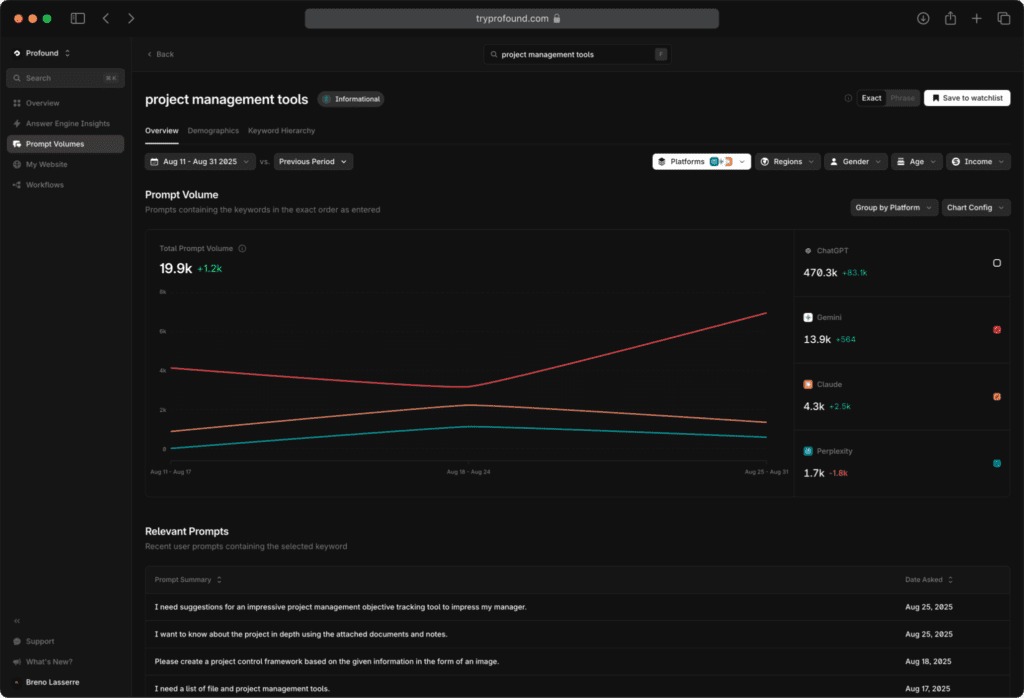
Best for: Enterprise and growth-stage B2B SaaS teams that want comprehensive AI answer engine data alongside content creation and optimization capabilities in one platform.
Profound raised a $96M Series C at a $1B valuation in February 2026. This platform tracks brand visibility across 10+ AI engines: ChatGPT, Perplexity, both Google AI formats, Gemini, Copilot, Meta, Grok, DeepSeek, and Claude. What separates it from most tools in the category is that it builds on real user query data rather than preset prompt libraries, giving teams a clearer picture of what buyers are actually asking before deciding what to monitor. They can then carry that insight through to content execution.
Pros:
- Prompt Volumes shows actual search demand across AI engines (one of very few tools to offer this)
- Agent Analytics connects AI crawler behavior to content decisions and traffic attribution
- Built-in content workflows connect visibility data to content action without platform switching
Pricing: Pricing starts at $99/month for both brand and agency plans, with growth and custom enterprise plans also available.
Social proof: Kevin M., CEO of a GEO agency, wrote in a G2 review: “I find it to be the most robust data platform that exists for AI visibility. It provides actionable insights you won’t find elsewhere and helps operationalize strategies around AI visibility.” This platform’s G2 rating sits at 4.5 across nearly 1,000 reviews.
3. SE Visible: Best for high-level AI brand visibility snapshots
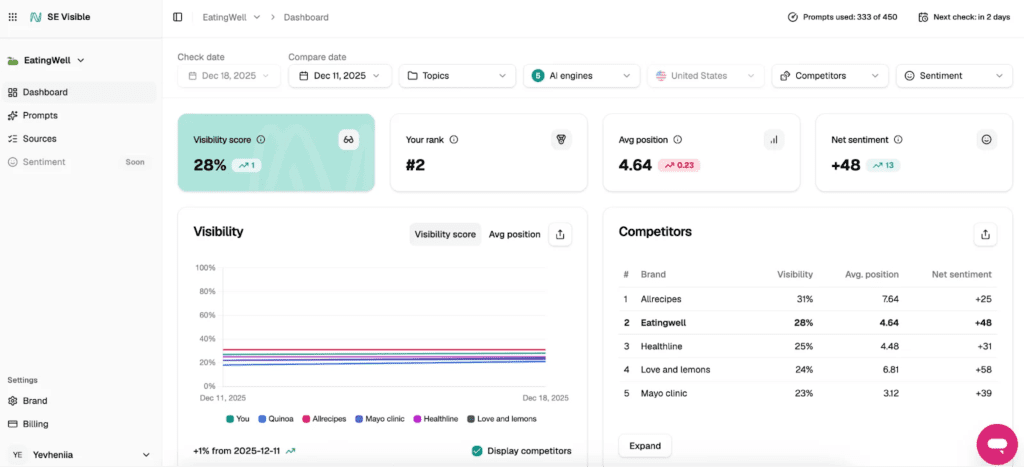
Best for: CMOs, brand marketers, and marketing leaders who need a clear strategic picture of AI brand perception and competitive sentiment, without managing prompt-level complexity.
SE Visible is SE Ranking’s standalone AI visibility product, built primarily for brand‑level monitoring and executive‑friendly reporting rather than deep, technical data exploration. Currently, it tracks visibility across ChatGPT, Gemini, Google AI Mode, Google AI Overviews, and Perplexity. It then presents visibility score, rank, average position, and net sentiment in a clean dashboard designed for executives.
Pros:
- Source analysis surfaces which domains and URLs are influencing AI answers about your brand
- Competitive benchmarking shows which brands appear alongside yours and how their sentiment compares
- Weekly sentiment tracking makes reputation shifts easy to catch before they compound
Pricing: Monthly plans start at $99 for 200 prompts and 3 projects; two other plans are also available with custom pricing for enterprise needs.
Social proof: SE Visible draws on the 10+ years of experience of the SE Ranking team, which has a 4.7 rating on G2 across over 1,500 reviews. This tool is cited in several independent reviews as one of the most accessible entry points for brand-level AI visibility tracking.
4. 4. Arobis AI Visibility Checker: Best for free, instant AI visibility diagnostics
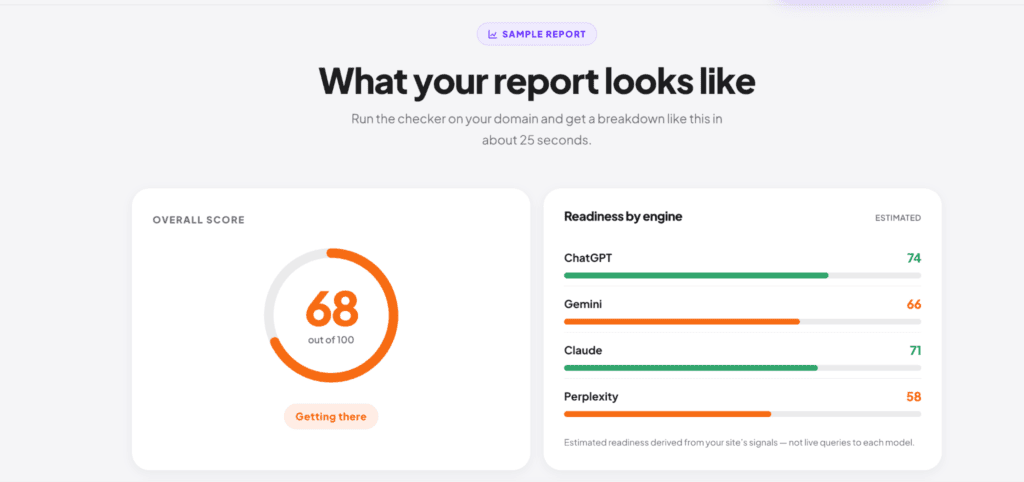
Best for: SaaS and marketing teams that want a quick, free diagnostic of what may be limiting their brand’s visibility in AI search before investing in a paid monitoring platform.
The Arobis AI Visibility Checker takes a different approach from traditional AI visibility trackers. Rather than monitoring a fixed library of prompts over time, it analyzes the signals that influence whether AI engines can understand, trust, and recommend a brand. Enter a domain and, without creating an account, the tool returns an AI Visibility Score along with a prioritized list of issues to address.
Pros:
- Free to use with no signup or credit card required
- Evaluates entity clarity, structured data, content answerability, llms.txt readiness, and third-party authority signals
- Provides prioritized recommendations for improving AI visibility rather than only reporting a visibility score
Pricing: Free.
Social proof: Arobis AI specializes in AI Search Demand Generation and AI Visibility for SaaS, using buyer-intent prompt analysis and AI recommendation data to help brands understand where they are being overlooked and what signals need to improve.
5. Scrunch AI: Best for comprehensive multi-engine monitoring and site audits
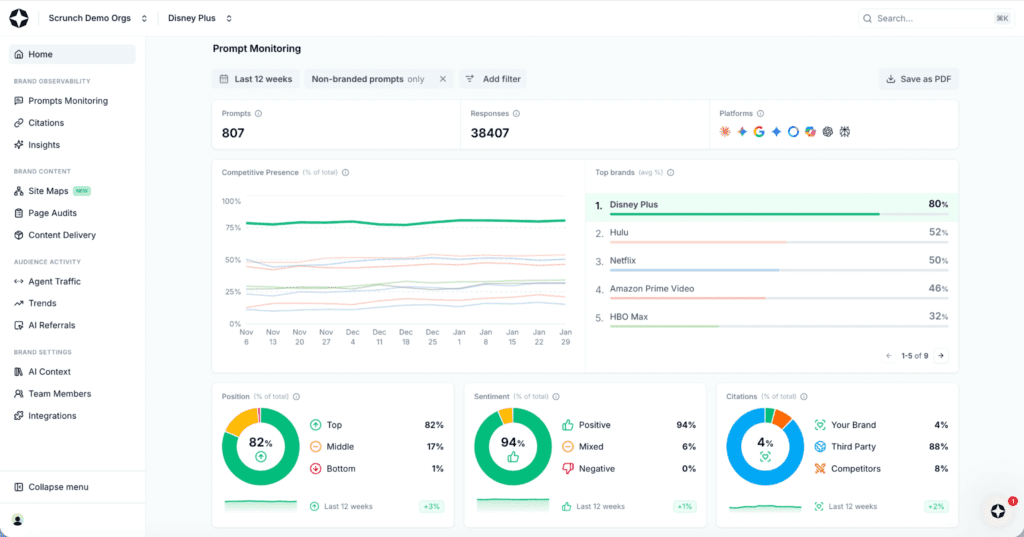
Best for: Enterprise SEO and content teams that need detailed multi-engine monitoring, prompt-level segmentation by persona and funnel stage, and a technical layer for optimizing how AI crawlers read their site.
Scrunch monitors brand visibility across a broad engine set, ranging from ChatGPT and Claude to Perplexity, Google AI Overviews, and Meta AI. Engine coverage varies by plan. One nice touch for GA4 users: Scrunch’s persistent GA4 OAuth integration connects AI referral traffic to site-performance data, while its separate Agent Traffic capability provides visibility into AI crawler activity. The company also has an agency plan and partner program with pitch environments and agency-focused enablement.
Pros:
- Among the broadest engine coverage on this list with citation-level tracking that shows exactly which URLs are being sourced in AI-generated answers
- Prompt-level segmentation by persona, location, and funnel stage enables granular SOV analysis
- Its Agent Experience Platform (AXP) sits between a website and AI crawlers, delivering structured content optimized for LLM consumption
Pricing: Pricing for brands starts at $250 per month, and pricing for agencies starts at $500; Enterprise is custom.
Social proof: Over 500 companies use Scrunch, including ADP, Lenovo, and Paychex. It currently has a 4.5 rating on G2.
6. Otterly: Best for GEO audits at an affordable entry point
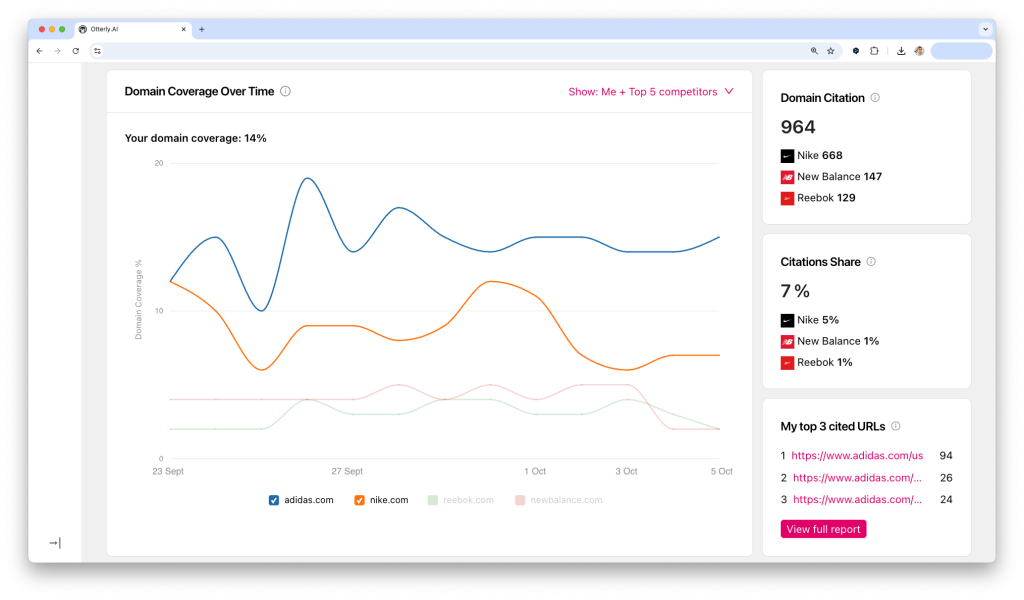
Best for: Agencies and in-house teams that want specific, prioritized GEO recommendations alongside AI visibility tracking, with a starting price that doesn’t require executive sign-off.
Otterly‘s differentiator is its GEO audit engine. It analyzes 25+ AI visibility factors including schema markup, crawl accessibility, page structure, and multilingual content, returning recommendations ranked by impact. In contrast to most AI visibility tracking tools that only tell you how your brand is doing, Otterly helps you identify ways to improve your presence.
Pros:
- SWOT-based GEO audit across 25+ factors with prioritized recommendations: the most structured optimization guidance at this price
- All of Otterly plans offer unlimited brand reports, unlimited seats, and daily tracking frequency
- A proprietary AI-powered keyword research tool helps identify which prompts are actually worth monitoring
Pricing: Its $29/month Lite plan is the lowest entry price on this list. Besides two other transparently priced plans, custom agency pricing is also available.
Social proof: Otterly earned a spot on G2’s Rookies of the Year list — a result of ranking within the top 10 of its Best Software Awards. Though it’s a newer platform, it holds a 4.8 rating across 50 reviews at the time of writing.
Buyers are already using AI to shortlist vendors before any sales touchpoint. Omniscient’s B2B Buyer Behavior in 2025 report maps how B2B decision-makers now navigate through channels, build trust, and make purchase decisions in the LLM era.
Honorable mention: Beamtrace
Though still an early tool, Beamtrace deserves a mention since it has one of the most accessible on-ramps we’ve seen in this category. Here are a few highlights:
- $20/mo billed yearly covers prompt-level tracking, an AI Visibility Score, share-of-voice trends, and five competitors, on a 14-day trial with no card required.
- It tracks ChatGPT today, with Gemini, Claude, Perplexity, DeepSeek, and Grok on the published roadmap.
- Beamtrace comes from Elfsight, rated 4.8 on G2 across 900+ reviews.
- At this stage, users still have leverage over what ships thanks to the public wishlist board.
Worth a look if you want to test whether AI visibility earns a line item before committing real budget.
What are the top features to look for in an AI search visibility tool?
As you can see from the list above, each AI visibility tool has its own features and strengths, though they do have similarities. Before comparing plans and pricing, it helps to know which capabilities actually matter and what you’re giving up without them.
Multi-engine tracking across major LLMs
Different AI engines emphasize different sources and surface brands differently, even when they draw from overlapping datasets. So a tool that tracks one platform only gives you a single slice of a larger picture. In other words, if a competitor is winning share in the engines you’re not watching, you have no way to know.
Understanding how LLMs source brand information starts with knowing which engines are doing the sourcing.
Citation and source URL identification
A brand mention means an AI engine named you. A citation means the answer links to, or clearly references, a specific URL on your site as a source for its answer (even if your brand is not mentioned by name).
Knowing which competitor pages are being cited instead of yours on a given topic gives you a content problem you can actually solve.
Mention data shows you that your brand is absent from an answer. Citation data shows you which pages are filling that gap and which ones you’d need to outperform to close it.
Share of voice and competitor benchmarking
An absolute AI visibility score is less useful than a relative one. Your brand appearing in 40% of relevant AI answers doesn’t tell you much in isolation. That number looks very different if the category leader appears in 70% versus if the next-closest competitor is at 15%. Share of voice benchmarking makes it easier to prioritize effort and communicate AI visibility progress in terms that resonate with leadership.
Trend tracking and historical data
LLM outputs are not static. Models and retrieval systems evolve, the underlying indexed content changes, and citation patterns shift as the content ecosystem changes. This means a point-in-time snapshot can’t tell you whether a content change improved your position or whether a competitor gained ground after a model update you never knew happened.
Measuring brand visibility in LLMs over time is what turns one-off monitoring into a reliable feedback loop.
Prompt volume and query intelligence
Choosing which prompts to track is as consequential as tracking them. If the prompts in your monitoring library don’t reflect what buyers are actually typing, the data isn’t useful; it just looks like it is.
AI brand visibility tools that approximate real-user query demand across platforms using search and behavioral data help teams focus on the conversations where buyers are forming purchase opinions.
Are your organic metrics telling you what’s actually driving growth, or just what’s easy to count? Measuring Organic Growth in 2025 is Omniscient’s original research on how marketing leaders are navigating AI’s impact on metrics, attribution, and confidence in organic strategy.
AI visibility data is only as useful as what you do with it
Ultimately, adopting an AI search visibility tool gives you the measurement layer:
- Where you stand across LLMs
- Which prompts you’re missing
- How competitors are positioned
- And how those numbers shift over time
But numbers don’t move themselves.
G2’s research on “the answer economy” found that 69% of buyers chose a different vendor than they initially planned based on an AI chatbot’s recommendation. One in three purchased from a vendor they’d never previously heard of.
The brands consistently winning those buyers aren’t just watching dashboards. They’re actively working to improve how AI engines represent them. That work is what generative engine optimization covers: building the right content, earning citations from sources LLMs trust, strengthening the entity associations AI models rely on when constructing answers.
The specific LLM optimization tactics that move the needle differ enough from traditional SEO that a dedicated, GEO-focused playbook adds real value.
For B2B SaaS teams that want measurable lift without running a GEO program internally, a managed service closes the gap. Our analysis of 23,000+ AI citations informs how we approach that work. For instance, Convert saw 81% LLM visibility growth and 140% AI citation growth in just 60 days. See how Omniscient’s managed GEO services could do the same for your brand.
Frequently asked questions about AI visibility tools
How is measuring AI visibility different from traditional SEO?
Traditional SEO measures position in a deterministic index: a keyword maps to a ranked list, and you track whether you rise or fall. AI visibility measurement is probabilistic. LLMs don’t return the same answer every time: outputs vary by prompt phrasing, model version, and the content ecosystem at query time. There’s no “rank one” for a ChatGPT answer.
This is why trend data, share-of-voice benchmarking, and multi-engine coverage matter more than any single snapshot score. The methodologies also vary across tools: some track live sessions, others use synthetic prompts; those differences produce significantly different numbers for the same brand.
How do AI visibility tools actually track brand mentions in LLMs?
Most tools work by running a library of prompts through major AI engines on a regular cadence and analyzing responses for brand mentions, citations, and sentiment. More sophisticated platforms, like Profound, emphasize tracking actual user interfaces (not just raw API calls), aiming to produce results closer to what buyers see in product UIs.
The prompt library is where the meaningful variation sits. A tool running 25 generic prompts produces very different data from one running 500 buyer-specific queries informed by real search volume. This is one of the sharpest differences between entry-level and enterprise tools in the category.
Can I use my existing SEO platform for AI visibility?
Partially. Some major platforms like Semrush and Ahrefs have added AI monitoring features, but these are bolt-on additions to infrastructure built for traditional search. However, they tend to cover one to three engines with limited prompt sets and lack the citation depth and trend data of purpose-built tools.
If AI visibility is a meaningful strategic priority, or if you’re building a GEO program, a dedicated tool will give you the engine coverage, prompt depth, and historical data that integrated add-ons typically don’t.