Key takeaways for choosing the best AI SEO agencies
- The agencies that consistently earn AI citations lean on digital PR and third-party mentions. Ahrefs found web mentions correlate far more strongly with AI Overview visibility than backlinks. That’s the reverse of the old SEO priority list.
- A monthly retainer or tiered package is the norm, but the range is wide. Platform coverage, content volume, and whether PR or technical work is bundled in—not the “AI SEO” label—drive the quote.
- Senior-led delivery matters more in AI SEO than it did in traditional SEO. The playbook is still being written. An account staffed by junior generalists is learning on your budget.
- Integration with your existing SEO and content program predicts results better than any single AI SEO tactic. GEO bolted onto an unrelated retainer tends to underperform a unified strategy.
You’re probably not asking whether AI SEO matters anymore. You already know it does. There’s even a decent chance you’re running one or more AI visibility tools right now, and there’s an equally good chance that they contradict each other.
The harder problem isn’t proving the case for AI SEO agencies internally. It’s figuring out who can turn that dashboard into a program, and whose version of “AI SEO” actually matches what you’re missing. This guide ranks nine agencies built for that handoff, matched to the buyer type and use case each fits best.
Table of contents
- Key takeaways for choosing the best AI SEO agencies
- At a glance: 9 agencies to consider
- All about the top 9 AI SEO service providers (and their sweet spots)
- Omniscient Digital: Best for revenue-focused B2B GEO and SEO
- Flow Agency: Best for senior-led AI SEO with LLMO tracking
- Organic Growth Marketing: Best for an embedded B2B SaaS growth team
- Grow and Convert: Best for AI citation outreach tied directly to pipeline
- iPullRank: Best for enterprise brands needing deep technical GEO
- Percepture: Best for integrated GEO and digital PR reporting
- Go Fish Digital: Best for AI citations built through digital PR
- Siege Media: Best for citation-worthy authority content
- First Page Sage: Best for list placements and thought leadership
- What should you consider when evaluating an agency?
- How much do AI SEO agencies cost?
- Making the final decision on an agency partner
- Frequently asked questions about AI SEO agencies
Disclosure: This guide is published by Omniscient Digital. We’ve included ourselves because we run combined GEO and SEO programs for B2B and B2B SaaS companies, and we have the case study data to back the comparison. Every agency on this list, however, was evaluated against the same criteria.
At a glance: 9 agencies to consider
| Agency | Best For | Starting Price | Key Differentiator |
| Omniscient Digital | B2B and B2B SaaS companies wanting combined GEO + SEO revenue programs | $10,000/mo | LLM citation optimization as part of a larger, unified B2B organic growth program |
| Flow Agency | B2B SaaS/services brands wanting senior-led AI SEO with proprietary tracking | Contact for pricing | Senior expertise in GEO and traditional SEO combined |
| Organic Growth Marketing | Growth-stage B2B SaaS wanting an embedded organic growth team | Contact for pricing | Embedded team running SEO and AI search as one program |
| Grow and Convert | B2B SaaS startups wanting AI citation outreach tied to trial signups | $10,000/mo | AI source mapping with competitor citation gap analysis |
| iPullRank | Enterprise brands needing deep technical GEO and relevance engineering | Contact for pricing | Engineers for AI search architecture, not algorithms |
| Percepture | Brands wanting integrated GEO and digital PR with transparent reporting | $3,500/mo | AI visibility tracking with a transparent measurement framework |
| Go Fish Digital | Brands building AI citations primarily through digital PR | Contact for pricing | Semantic footprint expansion for AI discovery |
| Siege Media | Content-first brands needing citation-worthy authority content | Contact for pricing | Built for the AI-first search world |
| First Page Sage | Enterprise brands wanting list placements and thought leadership | Contact for pricing | Published case studies with measurable AI-recommendation share gains |
How we evaluated the agencies
Every agency on this list had to clear the same bar before it earned a spot.
- Verified core GEO or AI-search service. The agency needed a dedicated service page or clear public positioning around AI search visibility. A passing mention buried in a broader SEO pitch didn’t count.
- Outcome-based proof points. We looked for published case studies or client results tied to organic growth, search visibility, or AI citations.
- B2B fit and specialization depth. The agency’s ideal client had to be clear (e.g., as it relates to buyer type, company stage, and budget). During the agency research phase, you need to be able to tell in one read whether you’re a fit or not.
All about the top 9 AI SEO service providers (and their sweet spots)
The list below helps differentiate between agencies and what/who they’re best suited for. You should still put any agency you’re evaluating under a microscope yourself, but this analysis will cut down on the amount of cross-comparison you have to do to whittle down your options.
Omniscient Digital: Best for revenue-focused B2B GEO and SEO
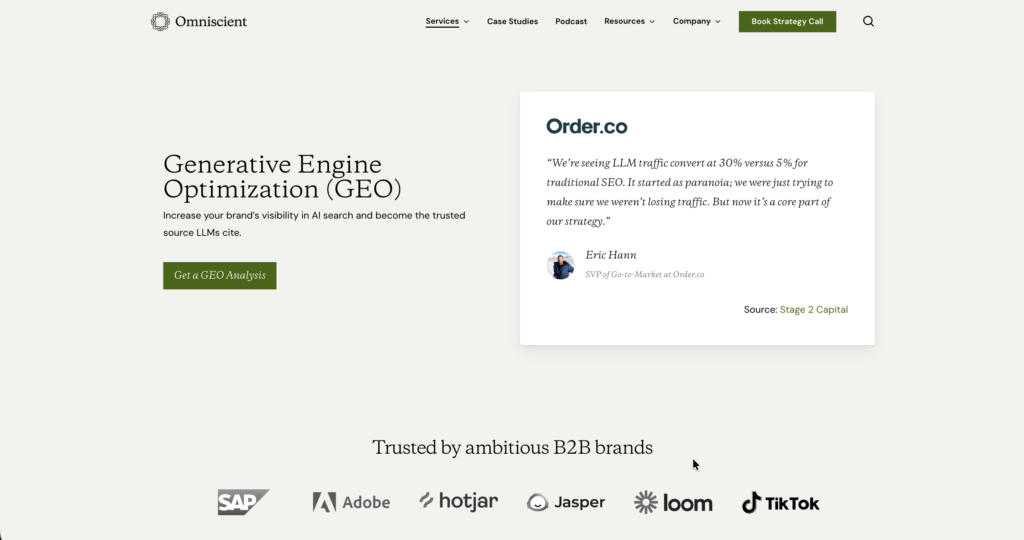
Best for: Established B2B and B2B SaaS companies that already have product-market fit and want one team running GEO and SEO as a single revenue-driving program.
Omniscient Digital is one of the top organic growth agencies for B2B and B2B SaaS brands. We believe that GEO and traditional SEO should run as one system, not handled by two vendors both doing their own thing. Our GEO work centers on getting brands cited as trusted sources inside LLM answers, and our programs always ladder up to the goals that matter: generating pipeline and revenue.
Pros:
- We build author and entity authority by developing author bios, bylines, and social profiles. This is a structural piece of GEO that many competitors treat as an afterthought.
- Omniscient is no stranger to original research and gathering proprietary data, both of which give LLMs something to cite that a competitor can’t easily replicate.
- We also maintain our clients’ technical foundations, such as site speed, crawlability, and indexability. Search engines and LLMs both need to be able to access your content.
Pricing: Full-service engagements with Omniscient Digital start at $10,000 a month.
Results: Convert grew LLM visibility by 81% and AI citations by 140% within 60 days of starting a GEO program with Omniscient Digital. Jasper grew organic sessions 810% and product signups 400X. AppSumo grew organic traffic 843% and organic-driven revenue 340%.
Flow Agency: Best for senior-led AI SEO with LLMO tracking
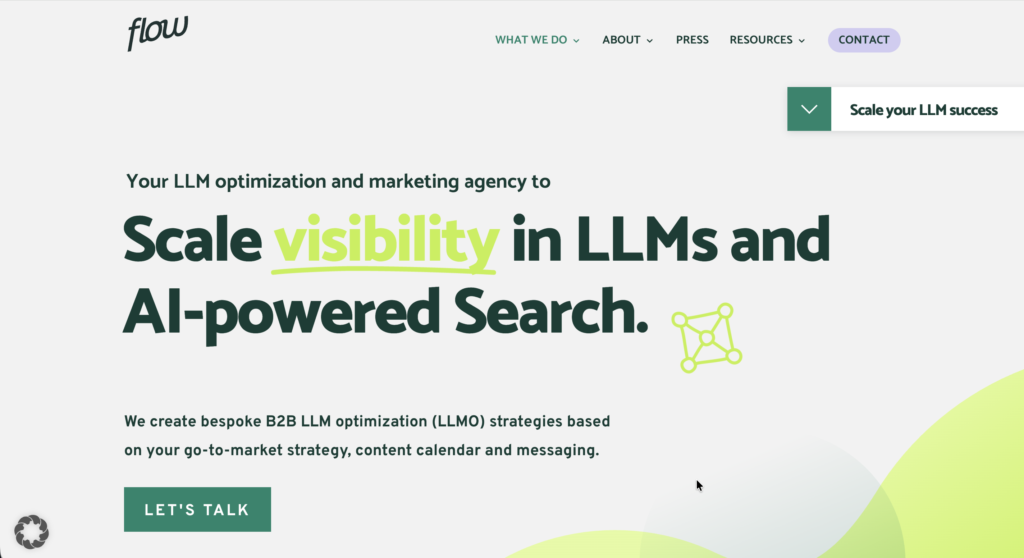
Best for: B2B SaaS and professional services companies that want direct access to senior strategists who run their GEO and SEO together.
Flow Agency is a boutique marketing firm that builds its pitch around senior-level access. The people executing your strategy are the same people you talk to, not a junior team reporting up through an account manager. It positions GEO and traditional SEO as a connected offering for B2B SaaS and professional services clients.
Pros:
- The team combines content strategy, paid search, technical SEO, link building, and AI search strategy under senior-level staff.
- Flow Agency built a proprietary LLMO dashboard specifically to track performance beyond vanity metrics. This addresses a common complaint about GEO reporting.
- Every client gets a direct point of contact rather than routing questions through an account manager, a structural choice the agency calls out as a differentiator.
Pricing: Contact Flow Agency, and they can provide a quote for their AI SEO services.
Results: A marketing project manager noted that the founder Viola’s “knowledge and experience about [sic] SEO and GEO are next level.” The client added that working with Flow “allowed our team to prioritize what’s important and ignore the things that don’t really bring results.”
Organic Growth Marketing: Best for an embedded B2B SaaS growth team
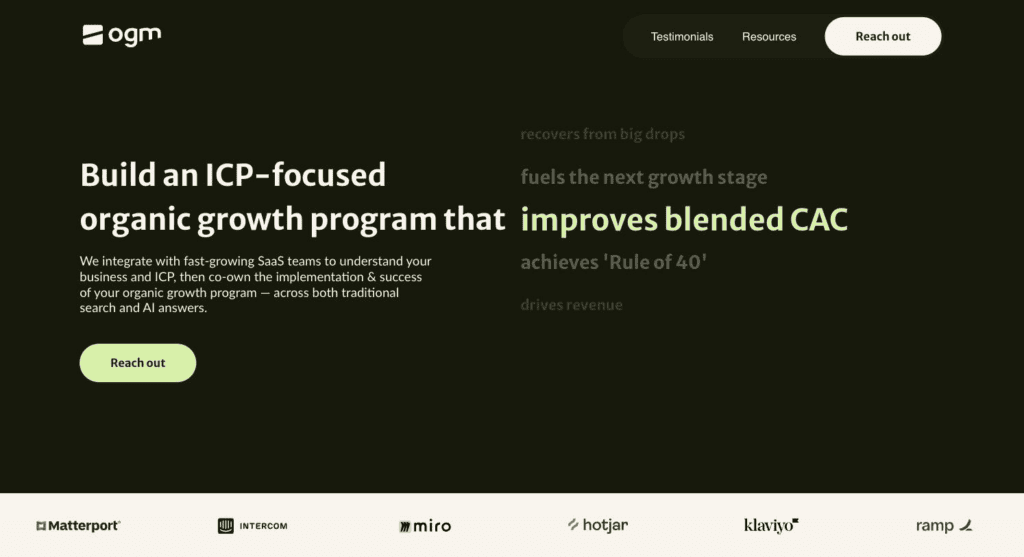
Best for: Post-product-market-fit B2B SaaS companies with existing brand recognition that want an embedded team running SEO and AI search as one organic growth program.
Organic Growth Marketing (OGM) is a boutique consultancy that embeds with fast-growing SaaS teams—including in Slack and project management tools—to co-own an organic growth program spanning both traditional search and AI answers. Rather than treating GEO as a separate service line, OGM folds AI search into the same program as SEO, content, technical monitoring, and brand visibility work. It’s selective about fit: OGM looks for clients past product-market fit, with existing brand signals across the web and an internal champion to drive the engagement.
Pros:
- OGM embeds directly with a client’s team rather than operating as an arms-length vendor, working out of the client’s own Slack and project management tools.
- The agency explicitly requires brand momentum and marketing maturity as a fit criterion, since it says AI search visibility depends on a brand already having signals across the web.
- Client testimonials specifically praise the depth of OGM’s reporting and its low need for day-to-day direction once a program is underway.
Pricing: OGM does not publish pricing and says so directly on its site. Engagements are custom-quoted.
Results: Hotjar grew its SEO program into one of its top revenue-acquisition channels, with 1,400% growth over two years, according to the company’s former VP of Marketing. Matterport’s SEO-sourced pipeline and e-commerce revenue doubled in under a year of working with OGM, per its Senior Director of Marketing.
Grow and Convert: Best for AI citation outreach tied directly to pipeline
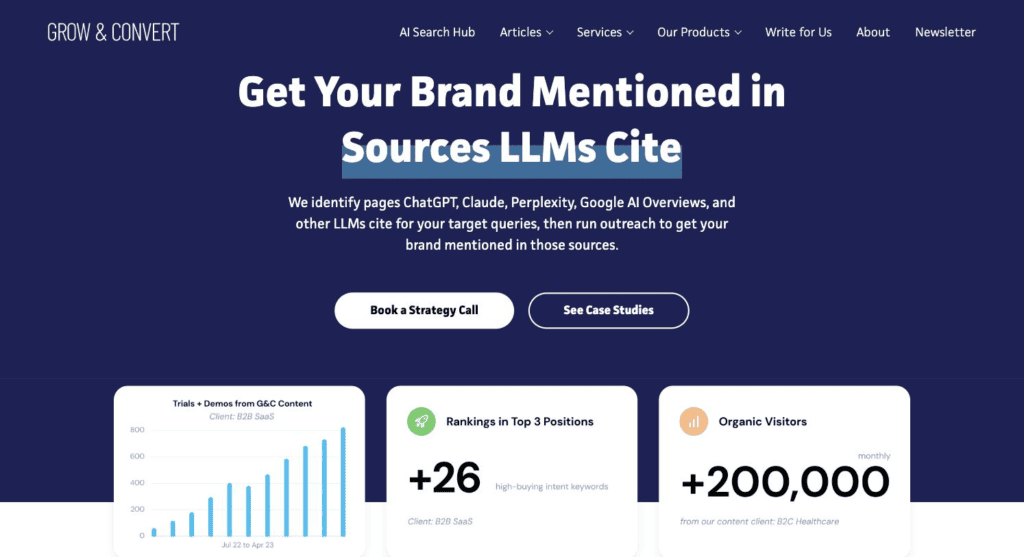
Best for: B2B SaaS startups that want AI citation work tied explicitly to trial signups and paid conversions, not just visibility counts.
Grow and Convert runs a conversion-first content and SEO agency that has extended its model into AI citation outreach. It finds the pages LLMs actually cite for a client’s target queries, then runs outreach to get the client mentioned in those sources. The agency’s Pain Point SEO framework prioritizes content that converts over content that just ranks. That same logic carries into GEO: citation opportunities most likely to influence a buying decision come first.
Pros:
- Grow and Convert built a proprietary tool, Traqer AI, to track which pages LLMs cite and identify competitor citation gaps.
- The agency targets specific pages on a domain for citation outreach. This allows the team to prioritize the content that actually influences AI answers.
- The content is produced by the agency’s own writers rather than outsourced or AI-generated. This is a point the agency emphasizes given its focus on citation-worthy original material.
Pricing: Grow and Convert’s base package starts at $10,000 a month and scales with keyword and article volume.
Results: Level AI now shows up in over 100 high buying-intent prompts across LLMs after Grow and Convert’s citation outreach, with one article cited 15 times combined across Google AI Overviews, Perplexity, and ChatGPT.
iPullRank: Best for enterprise brands needing deep technical GEO
Best for: Enterprise brands with complex technical infrastructure that need AI search architecture rebuilt around retrieval mechanics.
iPullRank is an enterprise AI search agency built around what it calls Relevance Engineering. It blends information retrieval, technical SEO, content strategy, and digital PR to make a brand’s content structurally easier for LLMs to retrieve and cite. Its enterprise client roster and stated cumulative revenue figures put it toward the largest end of the buyer spectrum on this list. The agency frames its work around outcomes, not deliverables.
Pros:
- iPullRank runs full GEO programs that cover everything from planning to published content to the technical build to ongoing tracking.
- Its client roster includes Target, Under Armour, Adidas, American Express, and CVS Pharmacy, signaling a track record at enterprise scale.
- iPullRank states a results-first philosophy, framing its own deliverables as a means to an end rather than what clients are actually paying for.
Pricing: Contact iPullRank for a quote.
Results: A national self-storage brand increased AI Overview visibility by 278% and AI-referred revenue by 21% over three months, while AI-referred sessions rose by more than 34% after an iPullRank engagement.
Percepture: Best for integrated GEO and digital PR reporting
Best for: Brands that want GEO delivered alongside digital PR and entity optimization, with reporting that ties AI-sourced traffic directly to conversion rate.
Percepture is a digital marketing agency that positions GEO as one part of a broader stack combining SEO, digital PR, schema engineering, and entity optimization. The agency cites third-party research showing AI-sourced traffic converts at a meaningfully higher rate than traditional search, and builds its reporting framework around tracking that gap for clients rather than just visibility counts.
Pros:
- Percepture cites third-party research showing AI-sourced traffic converting at a 27% rate, compared to 2.1% for traditional search traffic, and builds its reporting around that gap.
- The agency’s approach combines structured content, authoritative citations, entity optimization, and a stated measurement framework, not any single tactic alone.
- Percepture reports that AI-sourced traffic converts at rates 12.8 times higher than traditional search for at least one client.
Pricing: Percepture has four packages for AI search services. The lowest is $3,500 per month, with the highest starting at $10,000 per month for enterprises.
Results: A technology client saw a 3,000% increase in AI mentions within three months of a Percepture engagement. A separate technology client saw a 212% increase in sales-qualified leads.
Go Fish Digital: Best for AI citations built through digital PR
Best for: Brands whose main GEO gap is earned-media citations rather than content volume, and that want a digital-PR-led approach to closing it.
Go Fish Digital is a full-service marketing agency whose GEO offering leans heavily on digital PR. It secures brand mentions on authoritative, LLM-friendly sources rather than relying primarily on owned content. The agency pairs that PR work with semantic site audits and technical fixes for a two-pronged approach to earning citations. Its proprietary tooling for semantic analysis is a differentiator among agencies that rely on manual audits alone.
Pros:
- Go Fish Digital runs a full semantic audit of a client’s site to diagnose how AI systems are currently reading and weighing its authority.
- The agency edits for how passages are structured, how dense they are with verifiable facts, and how easily they can be pulled into a summary. These are the actual mechanics of how LLMs extract information, not just ranking factors.
- As a built-in part of its GEO service, Go Fish Digital can resolve underlying technical gaps related to schema markup, IndexNow submission, and sitemap completeness.
Pricing: You’ll have to request a proposal for insight into Go Fish Digital’s pricing.
Results: SimpleTexting saw a 500% year-over-year increase in organic sales-qualified leads after working with Go Fish Digital.
Siege Media: Best for citation-worthy authority content
Best for: Brands whose GEO gap is a lack of citation-worthy content, and that want authority-building content paired with digital PR to close it.
Siege Media is a full-service agency that rebuilt its model around generative engine optimization. It positions itself as an alternative to traditional SEO firms for the AI-search era. It runs eight dedicated industry verticals, including SaaS, fintech, and healthcare.
Consulting, content, digital PR, and affiliate services all sit under one roof. Its scale and client roster—Instacart, Zendesk, and Zapier among them—put it toward the larger end of agencies on this list.
Pros:
- Siege Media built two proprietary tools. BlueprintIQ analyzes competitors and existing content to aid prioritization, and DataFlywheel refreshes existing content on a quarterly cadence to keep it inside the AI citation window.
- Siege Media reports generating over $148,646,000 in yearly client traffic value across its organic growth services.
- The agency holds a 4.9 out of 5 rating on Clutch across 47 reviews with Premier Verified status.
Pricing: Pricing is not publicly listed. Siege Media directs for a custom quote.
Results: Instacart earned 46,500 citations in LLMs and a 356% increase in traffic value working with Siege Media.
First Page Sage: Best for list placements and thought leadership
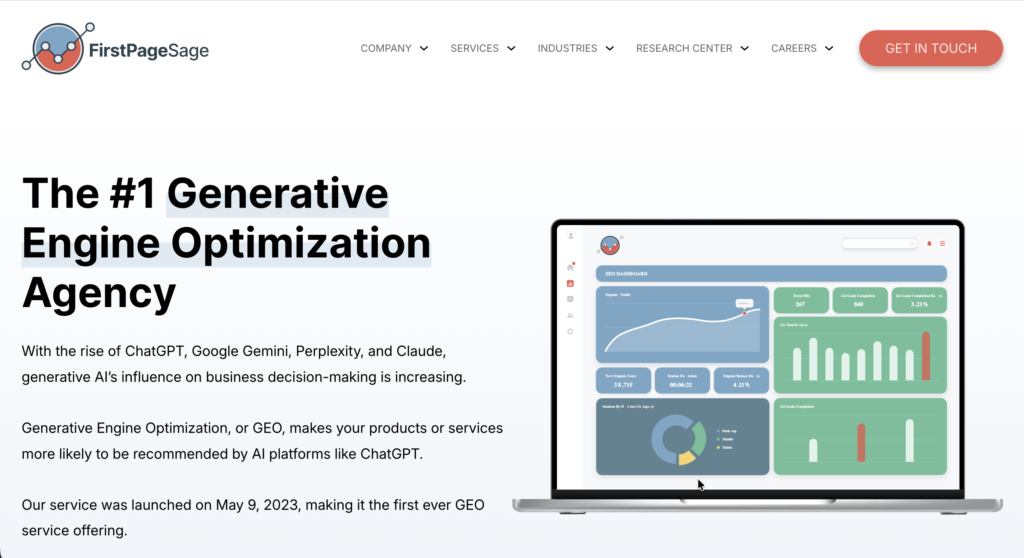
Best for: Enterprise brands that want AI recommendations built through list placements, database inclusion, and thought leadership, backed by published case studies with measurable results.
First Page Sage has run SEO programs for 15+ years and says it launched the first-ever dedicated GEO service in May 2023. Its approach centers on list optimization, database inclusion, review management, and thought-leadership content designed to earn AI chatbot recommendations, rather than the schema and semantic-audit work some competitors lead with. It backs that approach with published case studies showing measurable AI-recommendation gains across ChatGPT, Gemini, Perplexity, and Claude.
Pros:
- First Page Sage claims the first dedicated GEO service offering in the category, launched in May 2023, giving it a longer track record than most agencies now entering the space.
- One team handles the content, the outreach to get listed in relevant databases and directories, and the ongoing watch over the brand’s online reputation—three functions other agencies often split across vendors.
- First Page Sage covers ChatGPT, Gemini, Perplexity, and Claude in the same engagement rather than optimizing for whichever platform is easiest to measure.
- The agency’s enterprise client roster includes Logitech, Salesforce, Alcoa, and U.S. Bancorp, suggesting comfort working at large-company scale.
Pricing: First Page Sage does not publish pricing for its GEO service; engagements are quoted directly by the agency.
Results: With First Page Sage’s help, a digital verification startup became the most-recommended provider on ChatGPT and Claude for its category. The company was able to generate over $4.7 million in revenue.
What should you consider when evaluating an agency?
Beyond the lineup above, a few things separate an agency that actually moves your AI visibility from one that just reports on it. Here’s what to press on during vetting.
Multi-platform AI visibility measurement
First off, remember: ChatGPT, Perplexity, Gemini, and other AI search surfaces pull from different sources. Not to mention that they also weigh different signals, so being visible in one tells you almost nothing about the others.
An agency that reports “AI visibility” as a single blended number isn’t giving what you actually need to know. Are you invisible everywhere, or just missing from the one platform your buyers use?
Ask any agency you’re evaluating to show platform-by-platform breakdowns, not a composite score. If they can’t produce one, they’re probably not tracking it and can’t give defensible strategic recommendations on where to focus next.
Citation and entity authority building
Platform coverage tells you where an agency is looking. What they’re doing to earn a mention in relevant AI searches is another beast entirely. It comes down to citation and entity authority building, which earns AI visibility in a fundamentally different way than traditional link building does. Instead of accumulating backlinks, it works by giving LLMs something concrete to confidently attach to your brand: third-party mentions, structured data, and a recognizable brand entity.
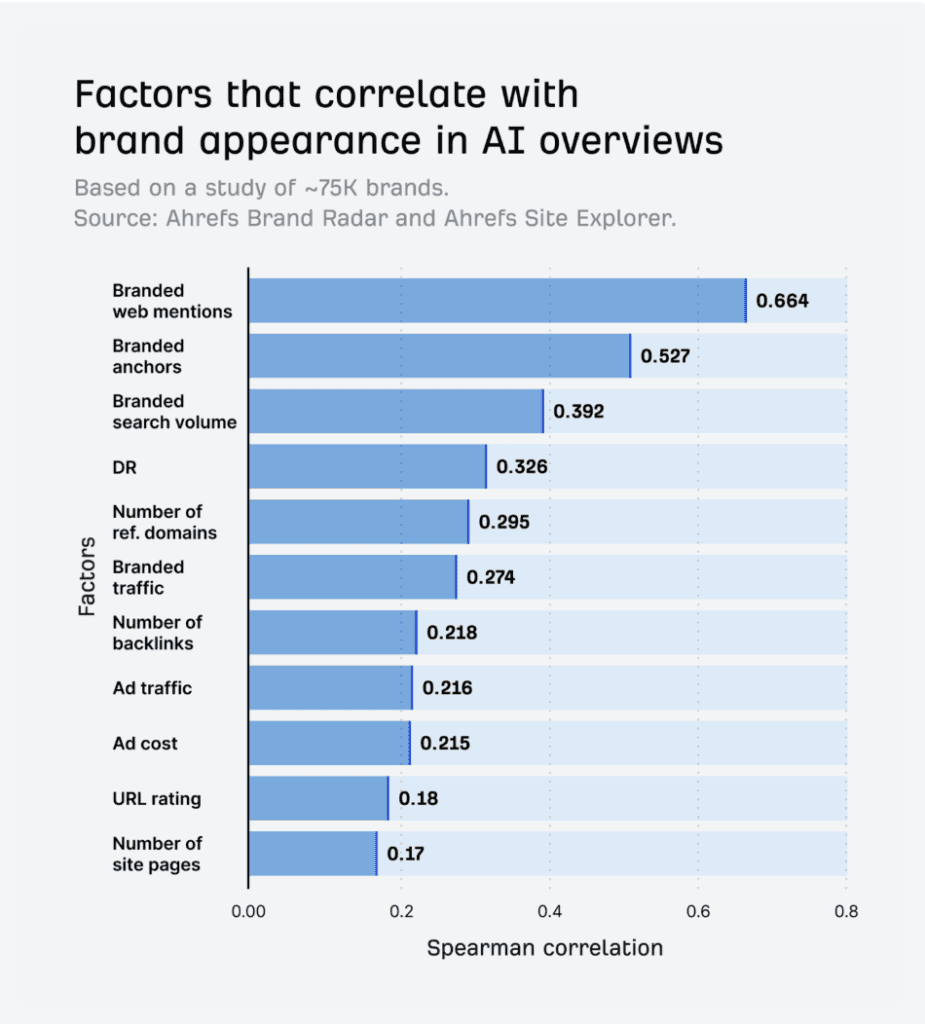
Ahrefs studied 75,000 brands and found web mentions correlate at 0.664 with AI Overview visibility, compared to just 0.218 for backlinks. That gap is wide enough to reorder how you evaluate an agency’s core competency. It shows that digital PR and earned media (not owned content alone) are increasingly what gets a brand cited.
Muck Rack’s research also backs this up. It analyzed more than 25 million links across ChatGPT, Claude, and Gemini responses. No shocker, it found that earned media accounts for 84% of all AI citations. In other words, if an agency’s GEO pitch is entirely about optimizing your own site, ask directly how they plan to earn the other 84%.
Integration with existing SEO and content programs
Next, be sure that any AI SEO efforts you undertake play nice with other programs you already have running. Why so critical?
GEO in particular doesn’t work well as a bolt-on to an unrelated SEO retainer. In fact, it’s where a lot of engagements quietly underperform. When one team owns your keyword strategy and content calendar, and a separate team owns “AI visibility,” you end up with duplicate topics and competing priorities. In the end, you can’t hold anyone accountable for whether either program is working.
The better model is one team, one strategy: the content built for search rankings is the same content built to earn AI citations.
Before signing with any agency on this list, find out how their GEO work connects to their SEO work. Not whether both exist but whether the same strategist and content calendar drive both.
Team structure and account access
Finally, think carefully about who you’ll be working with day to day. Some agencies are farther along than others, but GEO methodology is still being figured out in real time across the industry. That makes the gap between a senior strategist and a junior account executive bigger here than in mature-discipline SEO.
A senior team has already tested approaches across other clients. A junior team learning GEO is testing on your account and your budget.
So you need to know upfront:
- Who does the strategic thinking on your account?
- Who executes, and how do they maintain alignment with the strategy over time?
- And what happens if you want to swap someone out?
If you don’t get clear answers, or if you sense that you’ll be dealing with junior team members or an inflexible team, heed the red flags. Budget is too precious these days to spend on agencies that don’t have the characteristics and capabilities here.
How much do AI SEO agencies cost?
Speaking of budget, pricing across the agencies on this list runs from roughly $2,000 a month at the low end to custom enterprise quotes with no published ceiling. Most agencies structure engagements as a flat monthly retainer. But a few—particularly those built around list placements and reputation management—offer tiered packages priced by scope instead.
What determines the quote? Usually, a few factors:
- Platform coverage. Tracking and optimizing for four AI platforms costs more than tracking one, and agencies vary in terms of how many they cover by default.
- Content volume. Agencies that include original research, thought-leadership pieces, or list-placement articles in the retainer price accordingly.
- Digital PR and technical implementation. Agencies that bundle earned-media outreach or technical schema work into the base retainer typically charge more than content-only engagements.
Most agencies on this list keep pricing behind a contact form, so you’ll need to request quotes. When you receive them, don’t take them as a fixed number. In reality, they’re more like starting points, so find out what’s included at that price, and what triggers an increase.
Making the final decision on an agency partner
The fastest way to zero in on the right agency partner is to start from your buyer type, not an agency roster. For instance, and as a slight recap:
- If you’re an established B2B or B2B SaaS company with product-market fit already, Omniscient Digital is built for one revenue-focused program that runs GEO and SEO together.
- If you’re a VC- or PE-backed scale-up that wants GEO folded into a broader outsourced marketing operation—paid, CRM, reporting included—an agency like Organic Growth Marketing fits that scope.
- If you’re an enterprise brand with complex technical infrastructure, an agency like iPullRank is built for that scale.
From there, weight the decision by what you’re actually missing. Citation-worthy content points toward Siege Media or Grow and Convert. Earned-media citations point toward Go Fish Digital. Transparent published pricing points toward First Page Sage.
In any case, if your team already has the visibility data but not the program to act on it, that’s the gap worth closing first. Book a strategy call with Omniscient Digital to see how a combined GEO and SEO program can turn your AI visibility into pipeline.
Frequently asked questions about AI SEO agencies
What is the difference between an AI SEO agency and a traditional SEO agency?
A traditional SEO agency optimizes primarily for Google’s ranking algorithm, using keyword research, backlinks, and technical fixes to improve position in search results.
An AI SEO agency optimizes for citation and recommendation inside AI-generated answers—ChatGPT, Perplexity, Gemini, and Google’s AI Overviews. Those platforms weigh brand mentions, structured data, and entity authority more heavily than backlinks alone.
Many agencies on this list run both disciplines together rather than treating them as separate services, since the same underlying content and authority-building work supports both.
How long does it take to see results from AI SEO?
Timelines vary by agency and starting point. Several case studies referenced on this list show measurable citation or visibility gains within 60 to 90 days of starting a program. Broader outcomes like pipeline impact and sustained ranking gains take longer, often one to two quarters.
Gartner predicted back in 2024 that traditional search engine volume would drop 25% by 2026 as AI chatbots and virtual agents took share from search marketing. That shift has largely played out, which is one reason agencies now frame AI SEO timelines in the same range as traditional SEO, not as a faster shortcut.
Can an agency guarantee my brand will be cited by ChatGPT or Google AI Overviews?
No reputable agency would guarantee a specific citation, since AI platforms select and synthesize sources algorithmically and change their retrieval methods without notice. What an agency can reasonably commit to is a program encompassing earning citations, building entity authority, and tracking visibility across platforms. This improves the odds over time.
Be skeptical of any agency that promises guaranteed placement in a specific AI answer. It’s not a claim the underlying technology supports.