Press releases are one of the oldest ways to push company news onto the open web.
They are easy to publish, widely syndicated, and often indexed almost immediately.
But that does not tell us much about whether AI systems actually use them.
We’ve already seen in our buyer behavior research that people use LLMs to discover and evaluate brands. We’ve also found that when LLMs answer questions about a brand, much of the information they cite comes from outside the brand’s own website.
That made press releases worth isolating. Do AI answers actually retrieve wire-service releases? And when a release does make it into the source set, does it keep showing up or disappear a week later?
We looked at more than 70,000 AI answers across 23 Peec projects, then followed a smaller cohort of press release URLs over four weekly runs.
The short version: press releases are a small part of the source landscape overall, but they show up much more often in branded queries.
The URLs themselves turn over considerably from week to week, although releases that appear repeatedly are much more likely to come back.
And one result surprised us: many of the releases AI systems retrieved were not new at all.
Key Takeaways
- Press releases are a small part of the AI source landscape overall. Across more than 70,000 AI answers, wire-service URLs were retrieved in about 1.2% of responses and cited inline in 0.6%.
- They matter much more for branded queries. When a prompt explicitly named a brand, press releases were retrieved 5.0% of the time, versus just 0.7% for non-branded prompts. Press release distribution may help reinforce brand specific information, but it is not a broad shortcut to AI visibility.
- AI systems do not rely on a stable set of press releases. The source pool rotates significantly from week to week. Only 38% of the original URLs were still being retrieved four weeks later, while 56% of the press release URLs appearing in the final week were new to the cohort.
- A press release disappearing once does not mean it is gone for good. 71% of the original URLs resurfaced at least once during the four-week study, showing that AI retrieval can be intermittent rather than following a simple decay curve.
- Repeated retrieval is a much stronger signal than a one-off citation. Releases retrieved across multiple answers initially were nearly three times as likely to still appear four weeks later: 67% versus 24% for releases that appeared only once.
- Freshness matters less than expected. More than half of the press releases retrieved were over a year old, while only 3% were less than 30 days old. Old company information can remain part of the AI source ecosystem long after the original news cycle ends.
- That persistence cuts both ways for brands. Accurate press releases can continue reinforcing company facts over time, but outdated or misleading information can also remain retrievable.
- The research does not prove that publishing a press release creates AI visibility. It shows how already-retrieved releases behave. A separate pre/post publication experiment would be needed to measure whether releases cause visibility, how quickly they enter the source set, and how long that visibility lasts.
Methodology
For the source-share analysis, we looked at 70,666 AI answers across 23 active Peec projects from September 14 to October 18, 2026. We counted URLs from 20 press release distribution domains, including PR Newswire, Business Wire, GlobeNewswire, PRWeb, Accesswire, and others.
We measured two things. Retrieval means the AI system pulled a wire-domain URL as a source. Citation means the URL was shown inline to the user as a source in the answer.
For the recurrence analysis, we used five anonymized B2B software accounts with substantial prompt sets and enough press release retrievals to follow over time. We took the 78 press release URLs retrieved in the baseline week and checked whether those same URLs appeared again in each of the next four weekly runs.
There are two important caveats.
- First, the five-account panel was selected partly because it had enough wire activity to study, so its recurrence rate should not be treated as a universal benchmark (there is, definitionally, a sampling bias in choosing the accounts that had the most press releases show up).
- Second, this is a recurrence study, not a lifespan study: we started with URLs that were already being retrieved. We cannot tell from this data how long a newly published release takes to appear, or how long it remains visible from publication onward.
Finally, this, like most AEO research, is a snapshot of a few dozen accounts, mostly in B2B, tracking a subset of prompts. Our findings are isolated to these parameters and may not apply broadly to AI search across industries or different prompt sets.
One smaller counting caveat: the source-share data is summed by wire domain, so an answer that retrieves two different wire domains can count twice. The reported percentages therefore run slightly high. We treat them as approximate source-use rates rather than exact unique-answer shares.
Press releases are retrieved in about 1.2% of AI answers
Across all 70,666 answers, wire service URLs were retrieved at a reported rate of 1.2% and cited inline at a rate of 0.6%.
That changes when the user explicitly names a brand. Branded prompts retrieved a wire source 5.0% of the time, compared with 0.7% for non-branded prompts.
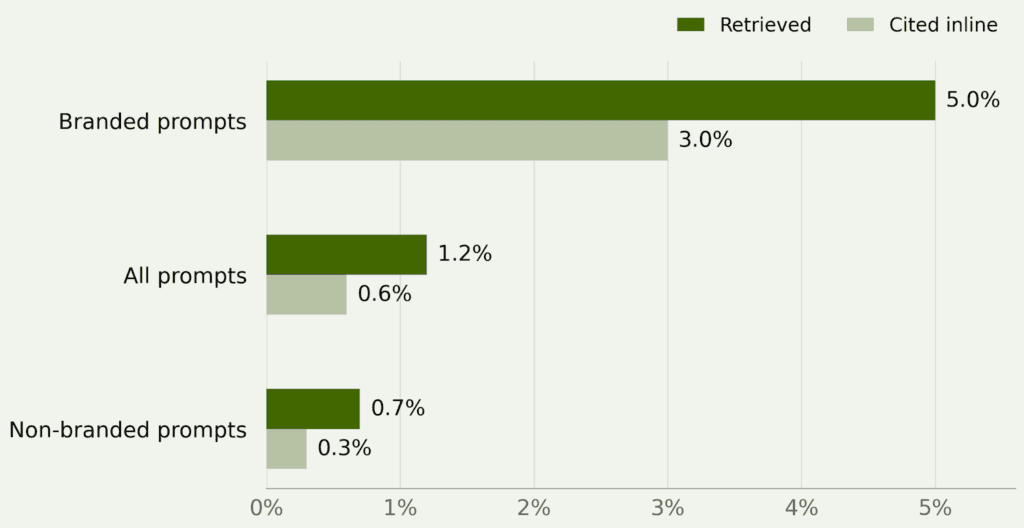
So press releases are not a major source category across AI answers in general.
But they become more relevant when the prompt is about a specific company. The data does not support treating press release distribution as a broad shortcut to AI visibility.
The press release source set changes a lot from week to week
We started with 78 press release URLs retrieved in the baseline week.
One week later, 47% were retrieved again.
After two weeks, 46%.
After three weeks, 38%.
Four weeks later, 38% of the original cohort was still showing up.
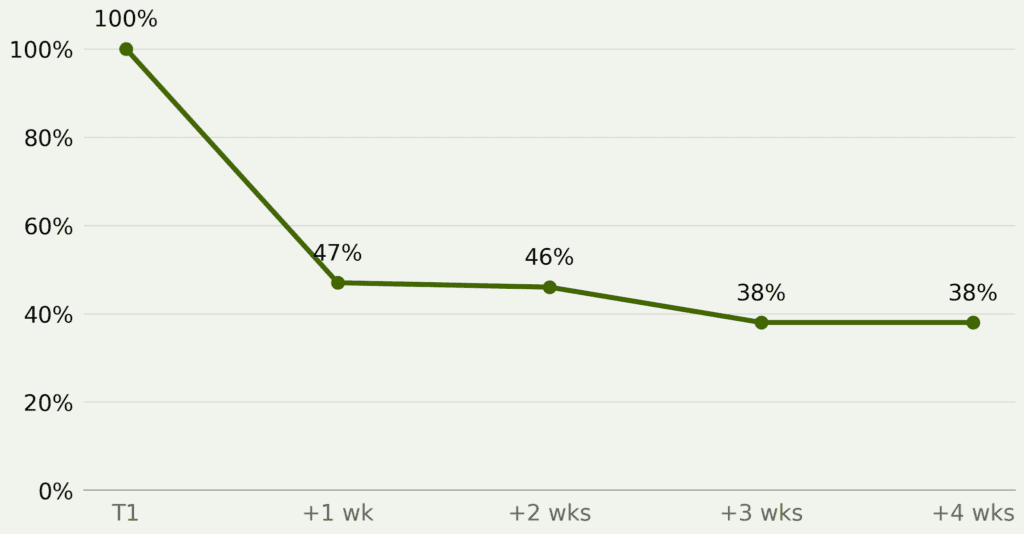
That looks like decay at first glance, but the full picture is messier.
71% of the original URLs reappeared at least once during the four week window. Some sources disappeared and later came back.
At the other end, the source set kept adding new material. Of the 68 press release URLs retrieved in the final week, 38 – or 56% – had not appeared in the baseline week.
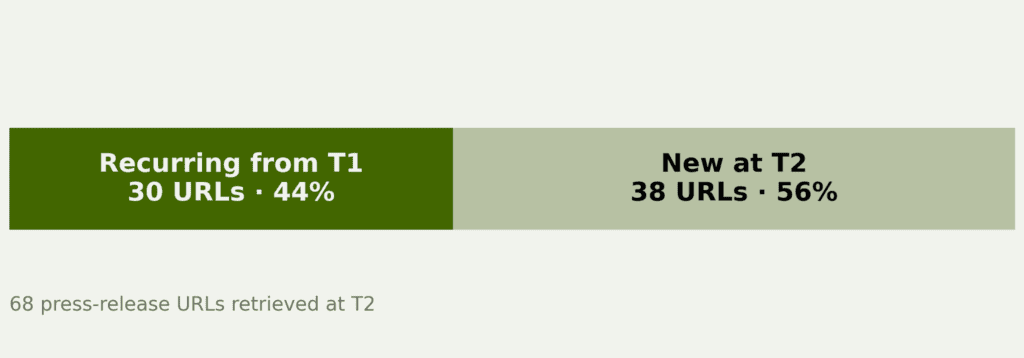
In other words, AI systems were not working from one stable set of press releases. The source pool was rotating. Some URLs kept resurfacing, others disappeared, and new ones entered the mix. This generally pattern matches to citation drift research we’ve seen ourselves and in external studies.
Repeated retrieval is a much stronger signal than a one-off appearance
Not every retrieval carried the same signal.
Among URLs that appeared in only one AI answer during the baseline week, 24% were retrieved again four weeks later. Among URLs that appeared in two or more prompts, 67% came back.
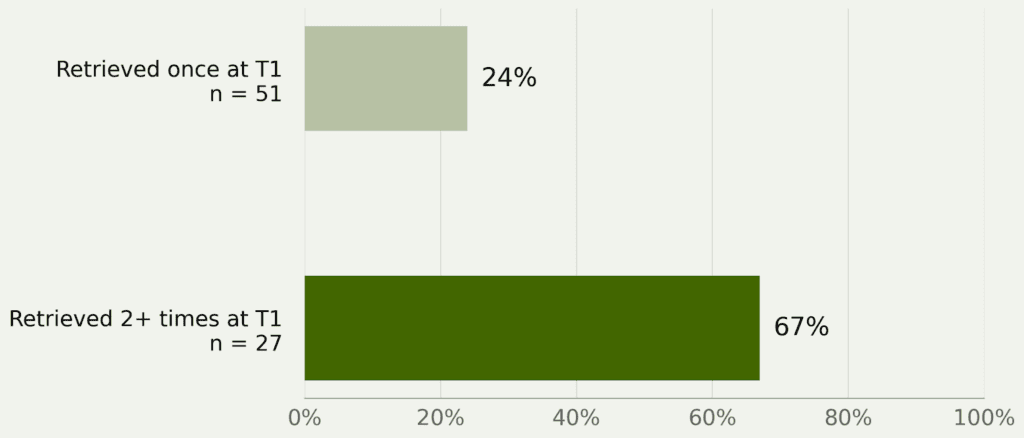
That is nearly a threefold difference in this sample. It does not prove that repeated retrieval causes future visibility – in fact, it may be an artifact of the prompt tracking itself – but it does suggest that a one-off source appearance and repeated retrieval should not be treated as equivalent signals.
For AEO reporting, that is probably the more useful distinction: not simply whether a press release appeared, but whether the same release keeps getting pulled across multiple answers and multiple runs.
AI systems still retrieve old press releases
Press releases also do not have to be fresh to show up.
We could identify a publication date for 74 of the 78 baseline URLs. Half were more than 411 days old. 51% percent were more than a year old, while only 3% were less than 30 days old.
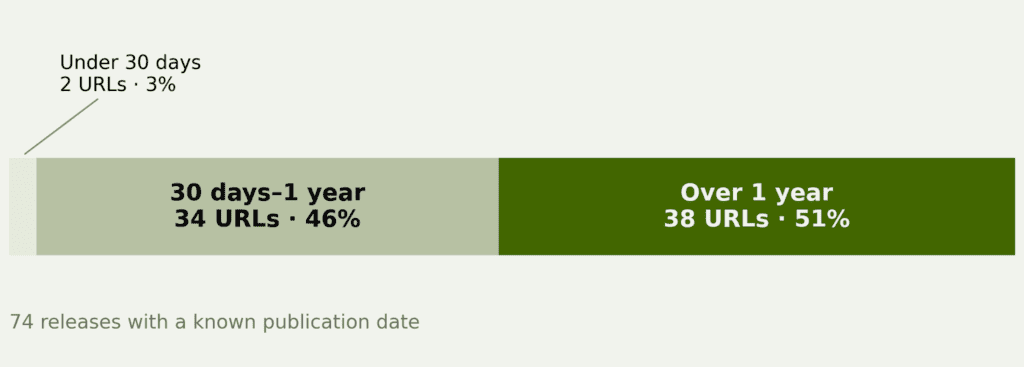
That does not mean those releases stayed continuously visible for a year. We did not track them from publication.
It means something narrower, but still useful: older releases can remain part of the source pool long after the news cycle has moved on.
For brands, that cuts both ways. A factual release can remain retrievable long after publication. So can an outdated one.
What this means for PR and AEO
The simplest conclusion is that press releases matter less – and last differently – than the usual AEO narrative implies.
Direct wire URLs are a small share of the sources AI systems retrieve. They are much more common when the query/prompt directly names a brand, but even then they are far from dominant.
At the same time, a press release appearing in an AI answer is not necessarily a one-day event. Some URLs recur for weeks, older releases can still surface, and repeated retrieval at the start of the window was strongly associated with showing up again later.
The practical implication is to measure press releases like any other AEO source: look for repeated retrieval, not just a single appearance. A one-off citation is interesting. A URL that keeps showing up across prompts and runs is a stronger signal.
What this study does not tell us is whether publishing a press release creates AI visibility in the first place. Answering that would require a different experiment: start before publication, run the same prompts repeatedly, and follow a cohort of new releases from day zero. That would let us measure time to first retrieval, peak visibility, decay, and whether the release disappears for good or resurfaces later.
That is the next question worth answering.
And of course, there are many reasons outside of AI search to publish press releases, some of which may indirectly impact AEO. Logically, a press release launch can result in social shares, interview and quote requests, general brand awareness, all of which could impact AI search. But following that logic, anything that causes awareness could impact AI search, right? So we kept the parameters of the research here fairly limited, along with the implications.