AI search skills are the new norm in SEO hiring. In previous research, we learned that about 6 in 10 of SEO jobs mention AI search (AEO/GEO) skills. This is up nearly double from last year.
So we wondered, “what about other roles in organic growth?”
As we’ve discussed, AEO is a team sport involving content, public relations and comms, customer marketing, affiliate, brand, and product marketing.
While org charts and team structures are still evolving, and the question around ownership and metrics is still settling, we wanted to see if current job postings reflected an increasing need for AI search skills in roles like PR and comms, content marketing, or general marketing jobs (e.g. director of marketing)
Summary of Previous SEO Jobs Study
Before jumping into the new research, here’s a quick summary of our findings with SEO jobs conducted in August 2026:
In August 2026, we found that 62.2% of SEO jobs postings we analyzed on LinkedIn mention AI search skills as a desired skill for new hires.This was roughly double the number when we first ran the study in November 2025, showing a fast growth rate of AI search requirements. Note: in our August research, we found 29.1% of all SEO postings (201 of 690) had an AI-specific title, and nearly all of them mention AI search.
Key Takeaways
- AI search is becoming a core SEO competency. 62.2% of SEO job postings mention AI search skills, nearly double the rate from the prior year. Even after excluding AEO-specific job titles (e.g. “SEO/AEO Manager”), 47% of traditional SEO roles mention AEO/AI search.
- Content marketing is the next closest function. About 31% of content marketing postings mention AI search or AEO, while roughly 62% mention AI more broadly. AEO is becoming relevant to content roles, but adoption still trails SEO significantly.
- PR and general marketing leadership are far behind. Only 2.9% of PR roles and 2.7% of Director of Marketing roles mention AI search, despite both functions playing an important role in influencing the sources and brand signals AI systems rely on.
- The gap is specifically about AI search, not AI adoption generally. AI appears in 32% of PR postings, but only 3% mention AI search. Most PR-related AI requirements focus on using AI for research, writing, editing, and workflow efficiency—not improving brand visibility in AI answers.
- Software companies may be slightly ahead, particularly in PR. 12% of PR postings at software companies mention AI search versus 2% elsewhere, although the sample is small enough that this should be treated as an early signal rather than a settled trend.
- The research doesn’t definitively answer who “owns” AEO, but it shows who is being asked to understand it today. Hiring demand currently points strongly toward SEO first and content second, while PR and broader marketing leadership represent a substantial capability gap—and potentially an opportunity to claim greater ownership of AI visibility.
Approximately 47% of SEO postings mention AI search, versus 31% in content and 3% in PR and marketing director roles.
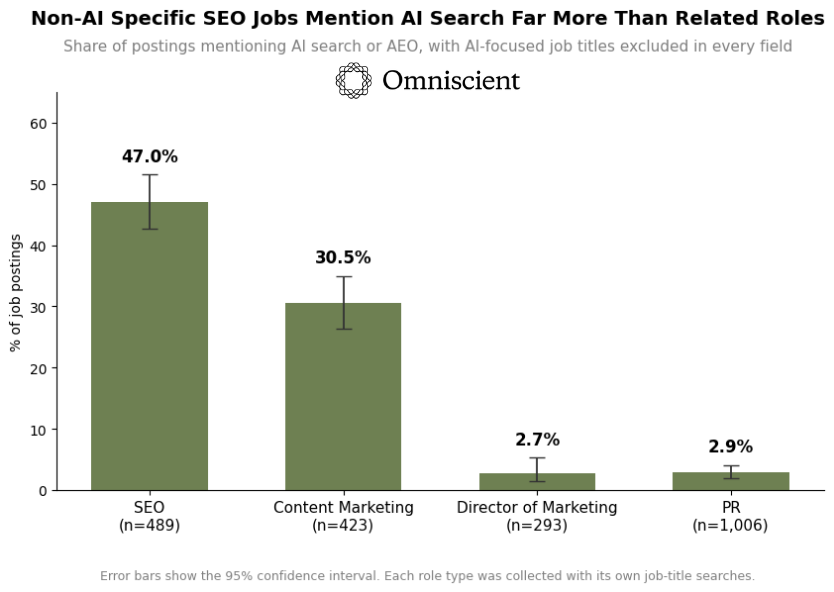
In content marketing, 30.5% of postings with traditional job titles (129 of 423) mention AI search or AEO, while 61.5% (260) mention AI in some form.
Director of Marketing and PR postings lag far behind, at 2.7% and 2.9%, respectively. The thin lines on each bar represent 95% confidence intervals, indicating the range in which each rate could plausibly fall across similar batches of postings.
Because the intervals for SEO, content marketing, and the roughly 3% categories don’t overlap, these differences are unlikely to be due to chance.
Postings with AEO-focused titles (such as “GEO Specialist”) were excluded from the charts because they were only searched for within SEO.
Five content marketing postings had AEO-focused titles, leaving 423 for comparison. For context, the share of SEO postings with traditional titles that mentioned AI search was about 27% in November 2025.
AI appears in 1 in 3 PR postings, but AI search in only 3 in 100
Of 1,006 PR postings, 323 (32.1%) mention AI, while 29 (2.9%) mention AI search.
That means roughly 1 in 10 of the PR postings that mention AI do so in an AI search context.
In a hand read of the postings that mention AI, about half asked candidates to use or know AI tools, usually for things like research, drafting, workflows, and analyzing results.
Nearly 4 in 10 mentioned AI only to describe the company, its clients, or its hiring process. In these postings, AI is mostly a tool employers want PR people to use, not a place they want brands to show up.
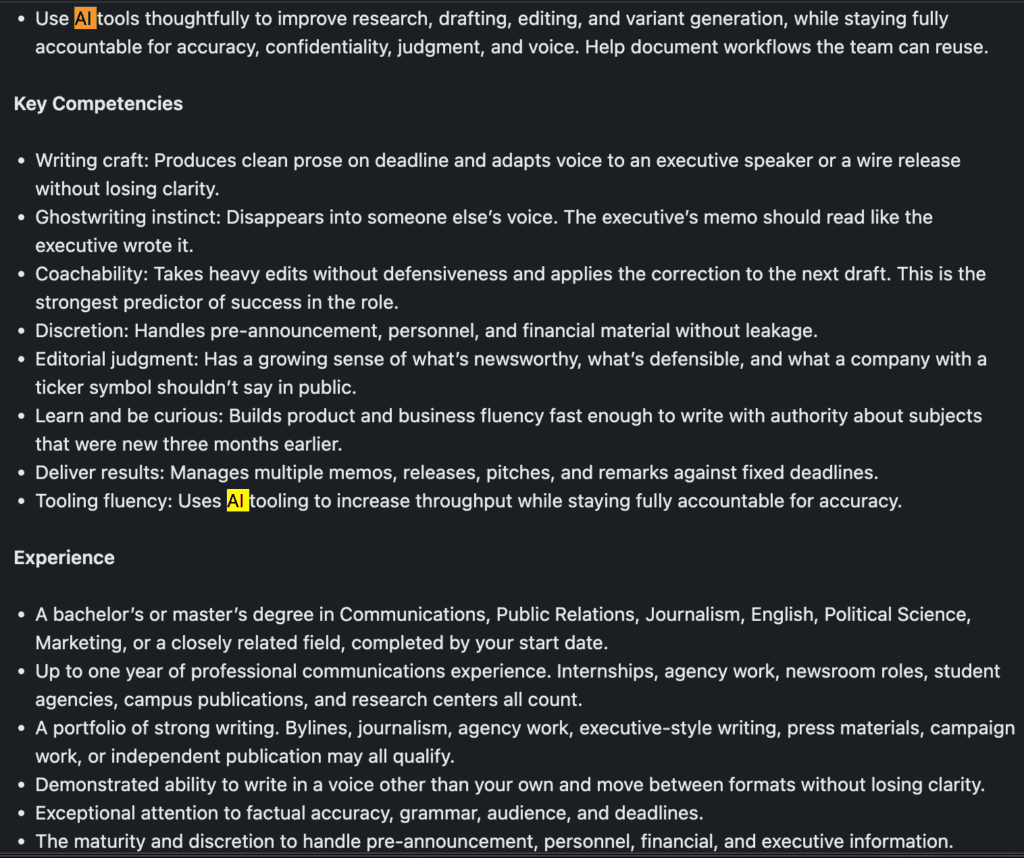
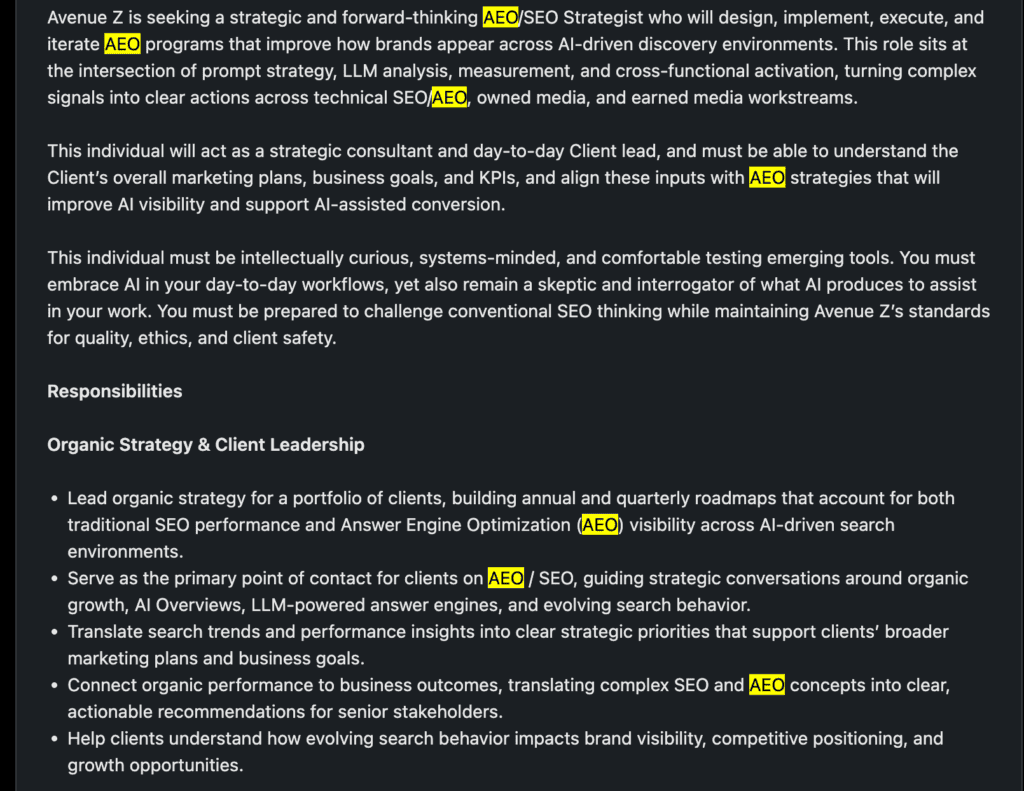
Only one PR posting named an AI visibility tool. Below are examples of where a PR job posting may ask for AI skills versus AI search skills/ AEO:
About 3 in 10 content marketing postings mention AI search skills
In content marketing, 133 of 428 postings (31.1%) mention AI search or AEO, and 265 (61.9%) mention AI in some form.
Five of the 428 have AI-focused titles. Leaving them out, as we do in the charts, 129 of the remaining 423 (30.5%) mention AI search and 260 (61.5%) mention AI at all.
Unlike in SEO, the rate barely depends on job titles that name AI. Among those 129 postings, 65% mention AEO, 39% mention GEO, and 5% mention Google AI Overviews.
SEO jobs mention AI search skills more than related marketing roles
In our SEO sample, we collected the SEO postings with AI-focused titles on purpose (such as “GEO Specialist”), and they make up 29% of the sample, while the other fields have almost none.
With those titles left out, the SEO rate is still 47%, far above content marketing (31%), PR (3%), and Director of Marketing (3%). SEO is also where AI visibility tools show up most often: 43 postings (6.2%) name one, with Profound the most common.
Seniority Alone Doesn’t Bring AI-Search Skills: Director-Level Marketing Jobs Rarely Mention Them
Only 8 of 293 Director of Marketing postings (2.7%) mention AI search or AEO, and 62 (21.2%) mention AI at all.
Nearly all the postings in this sample are director-level by title, so this tells us about those roles specifically. It doesn’t isolate the effect of seniority. Four postings (1.4%) name a specific AI tool such as ChatGPT or Claude.
AI skills get mentioned widely, but AI search stands out much more in SEO than anywhere else.
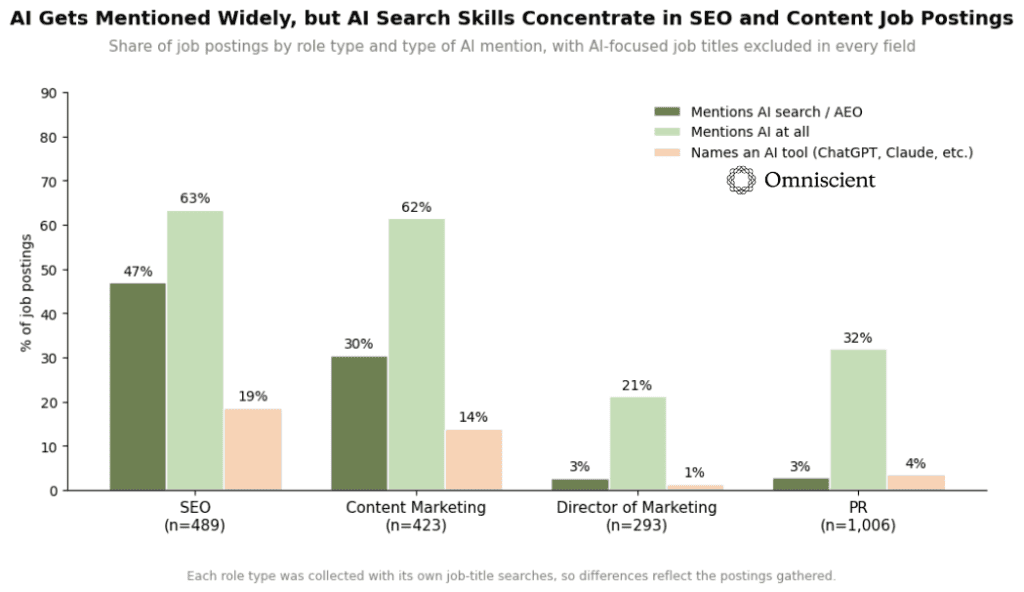
For each field, the bars show how often postings mention AI search or AEO, mention AI at all, and name a specific AI tool such as ChatGPT or Claude.
SEO and content marketing postings mention AI at nearly the same rate (63% and 62%), but SEO mentions AI search far more often (47% vs. 30%).
PR shows the sharpest gap: 32% of postings mention AI, and only 3% mention AI search. In a preliminary hand read of PR postings that mention AI, about half asked candidates to use or know AI tools for editing and writing assets.
Director of Marketing postings rarely mention any of the three.
Putting the four side by side
AI language is common, but AI search language is concentrated.
Mentions of AI in some form run from 73% in SEO and 62% in content marketing to 32% in PR and 21% in Director of Marketing.
As with any analysis of job postings, “mention” doesn’t mean “require,” each field was collected with its own searches, and the three newer samples are single snapshots.
The percentages for PR and Director of Marketing carry wide margins, because they rest on 30 and 8 postings.
Software employers mention AI search more often in PR postings, while the SEO and content marketing gaps could be chance.
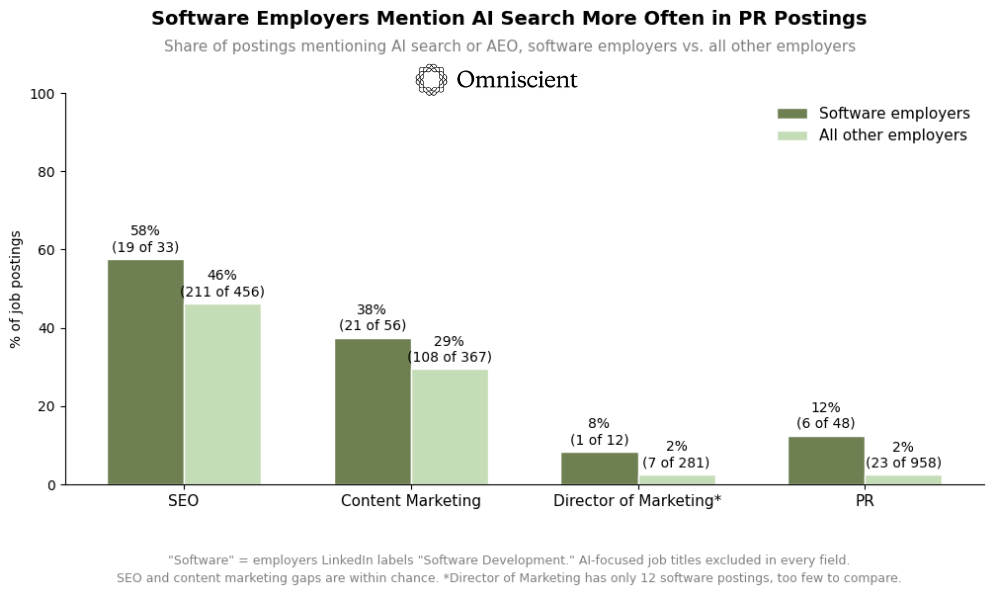
We compared employers’ LinkedIn labels “Software Development” with all other employers in each field.
In PR, 12% of software postings (6 of 48) mention AI search, against 2% of all others (23 of 958).
That’s the only gap clear enough to rule out chance. In SEO (58% vs. 46%) and content marketing (38% vs. 29%) the software postings are higher, but there are only 33 and 56 of them, so the difference could be chance.
Director of Marketing roles has just 12 software postings, so we did not draw a conclusion from it.
Even the PR result rests on 6 postings, so we’d call it something to watch rather than a settled finding.
Methodology
We scraped three additional job roles in organic marketing: public relations, content marketing, and director-level marketing titles. All postings came from LinkedIn, collected with Browse AI. We measured them exactly as we measured the SEO postings in our original study.
We removed postings with no job description (6 in PR, 2 in content marketing, 0 in Director of Marketing). Overlapping searches often returned the same job under different links, so we removed duplicates using LinkedIn’s job ID. This cut the Director of Marketing sample from 423 rows to 293 postings. All three samples are US-based, and no posting listed Canada or Mexico.
A posting counts as AI search if its description includes AI search language such as AEO, GEO, Google AI Overviews, LLM optimization, AI visibility, or AI citations. We used the same dictionary for every field and for both SEO waves, and a posting counts once however many terms it contains. A mention alone does not establish whether AI search is a required skill, a preferred qualification, or background information about the employer. We therefore report mentions rather than requirements.
The SEO collection deliberately included searches for AI-focused job titles, such as “GEO Specialist.” The other groups were not collected through equivalent searches. To reduce this imbalance, our main comparison excludes AI-focused titles from every group.
We also tracked whether a posting mentions “AI” at all and whether it names an AI tool (ChatGPT, Claude, Gemini, Copilot, or Perplexity). “Software employers” are those LinkedIn labels “Software Development.”
We manually reviewed PR postings flagged for AI language and Director of Marketing postings flagged by the dictionary. The review identified false positives, including “geo” used to mean geographic targeting, and additional AI-search wording the dictionary had missed. We revised the dictionary accordingly. For PR, we also classified mentions by context: candidate use of AI tools, the company or its clients, the hiring process, or AI search.
CI ranges are 95% confidence intervals, which show how far a percentage could plausibly move with a different batch of similar postings.
Conclusion
Does this answer the question, “who owns AEO?”
Not really.
It does, however, show that adoption of AI search skills cluster in SEO jobs followed by content and editorial jobs. General marketing roles and PR roles lag when it comes to AI search skill requirements, despite these jobs playing a critical role in AEO success.
Generally, AI skills are mentioned across the board. This isn’t surprising, and we would expect this to grow or to become a default assumption.
For hiring and career planning, the practical read is narrow:
- SEO professionals: AI search is now mentioned in the majority of postings and is very likely a requirement for modern SEO roles.
- Content marketers: AEO language is showing up in roughly 3 in 10 postings, showing a growing need for content marketers who understand AI search and retrieval
- PR and marketing leaders: AI search experience isn’t yet something most postings mention, which, to us, represents an opportunity for PR and comms leaders, and marketing leaders generally, to claim a seat at the AI search table