As more buyers turn to LLMs to discover products and form opinions about brands, the AEO question evolves from “are we showing up in AI answers?” to “how are we showing up in AI answers?”
Marketers are now accustomed to using metrics like AI visibility and share of voice to understand how often models mention their brands in outputs.
But just because you are visible in an answer does not necessarily mean you are favorably recommended for a user.
John-Henry Scherck tweeted this in June 2026:
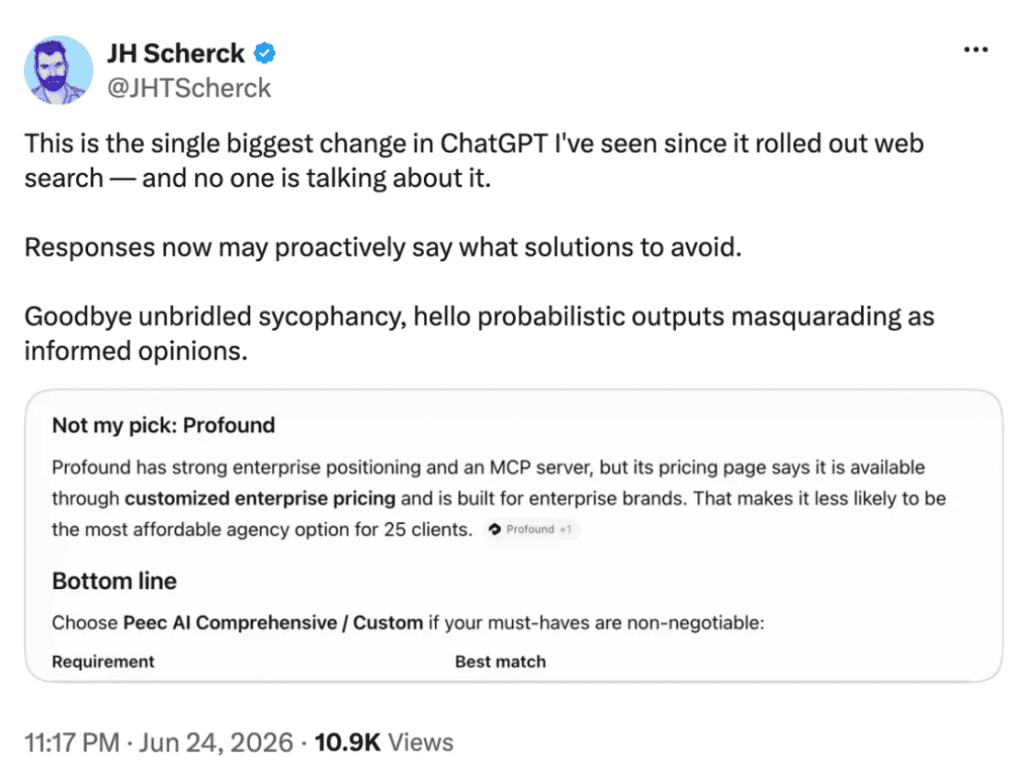
Most of us have also experienced this anecdotally, so we wanted to research the relationship between brand visibility, sentiment, and being truly recommended in AI search.
Summarized Methodology
We analyzed 8,392 AI responses to 300 non-branded buying prompts across ChatGPT, Claude, Google AI Mode, and Google AI Overviews. Across those responses, models mentioned brands 44,003 times. We labeled sentiment and recommendation separately so we could distinguish being visible, being described positively, and actually being recommended.
The prompt set covered eight product and service categories across B2B software, consumer products, financial services, and professional services, and three stages of the buyer journey: discovery, evaluation, and recommendation.
Nearly half the prompts were matched comparisons where we changed one buyer detail – such as budget, team size, location, intended use, or required features – while holding the rest of the prompt constant.
We defined sentiment as how the model described the brand within its response:
- Positive: Describes the brand favorably without a substantive drawback.
- Mixed: Includes both substantive praise and drawbacks.
- Neutral: States facts without a favorable or unfavorable judgment.
- Negative: Describes the brand unfavorably without substantive praise.
We defined recommendation as whether the model directed the buyer to pursue or avoid the brand or its product:
- Recommended directly: Directs the buyer to pursue the brand through a named pick, shortlist, trial, or quote request.
- Recommended with a condition: Recommends the brand only if the buyer meets an additional condition not established in the prompt.
- Listed as an option: Names the brand without directing the buyer to pursue or avoid it.
- Advised against: Steers the buyer away from the brand or states that it fails a requirement in the prompt.
We ran every prompt once a day for seven consecutive days, from September 30 to October 6, 2026, using English-language, US settings. Each brand counted at most once per answer.
Full methodology, including label validation, statistical checks, and limitations, is at the end of the article.
Key Takeaways
- Visibility is not the same as recommendation. Models named at least one brand in 97.0% of answers, but directly recommended one in only 47.6%. Across individual brand mentions, just 18.8% were direct recommendations, 23.3% were conditional recommendations, and the remaining 57.9% were either neutral options or advised against.
- Positive sentiment is not a reliable proxy for recommendation. Models described 55.7% of brand mentions positively, yet 72.9% of those positive mentions did not include a direct recommendation.
- Equal visibility can hide very different treatment. Asana and monday.com both appeared in 87% of project management responses, but Asana was directly recommended in 38% of its appearances versus 18% for monday.com.
- Recommendation behavior varies by platform. ChatGPT directly recommended 29.9% of the brands it mentioned, compared with 18.0% for Claude, 14.5% for AI Overviews, and 10.7% for AI Mode.
- What the buyer asks changes the answer. Direct recommendations appeared in 33.6% of brand mentions for recommendation stage prompts, compared with 11.6% for evaluation prompts and 16.4% for discovery prompts.
- Buyer context changes which brands get favored. In matched prompts, details like team size, budget, location, and intended use changed how models treated the same brands.
- The practical takeaway: measure visibility, sentiment, recommendation, and context separately. Getting into the answer matters; understanding what the model does with your brand once it is there tells you much more.
Only 18.8% of brand mentions were directly recommended to the users prompt
Our analysis found that models directly recommended brands in 18.8% of mentions.
Another 23.3% included a conditional recommendation, where the model recommended the brand only if the buyer met an additional requirement or preference not established in the prompt. For example, “Choose this CRM if keeping costs low is your priority.”
In the remaining 57.9% of mentions, models listed the brand as an option or advised the buyer against it.
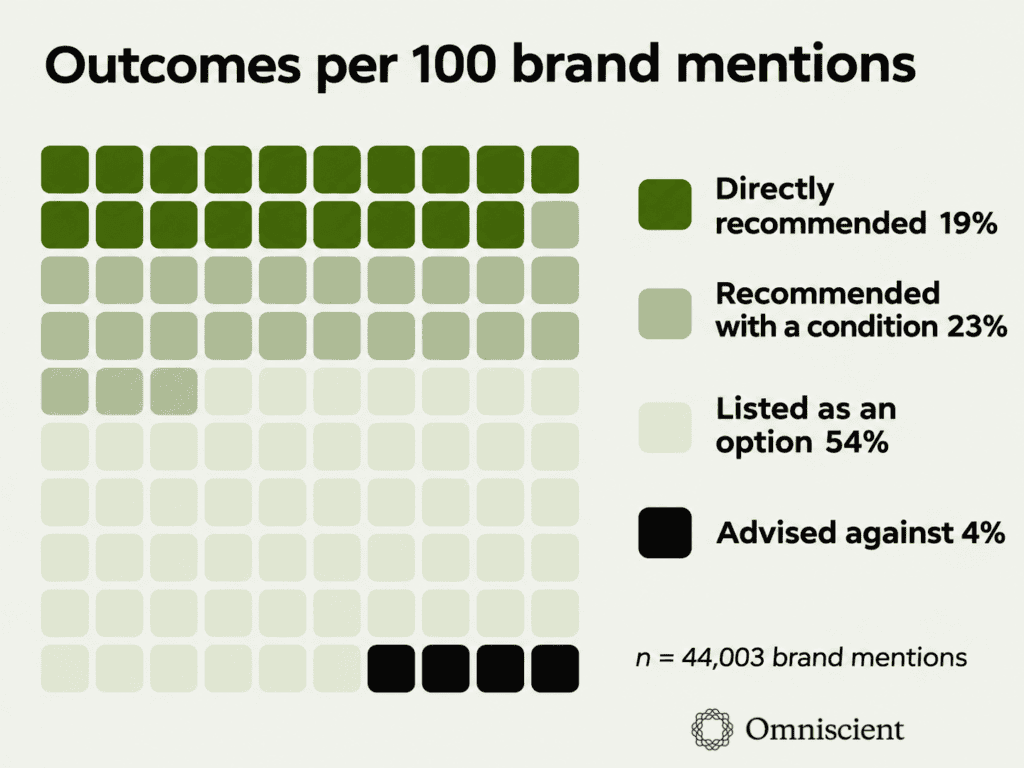
Figure 1: Models directly recommended brands in about one in five mentions.
When examining how often an entire response included a direct recommendation, we found that 97.0% of responses named at least one brand, but only 47.6% directly recommended one. A response could name several brands without telling the buyer to pursue any of them.
Visibility is therefore a useful first question: did we make the consideration set?
Recommendation is the next one: what did the model do with us once we were there?
Equally visible brands received direct recommendations at rates more than 2x apart
Our analysis found that similar visibility did not mean similar recommendation rates.
Models could mention two brands equally often while directing buyers toward one far more frequently.
Asana and monday.com both appeared in 87% of responses to project-management prompts. But among each brand’s appearances, models directly recommended Asana 38% of the time, compared with 18% for monday.com.
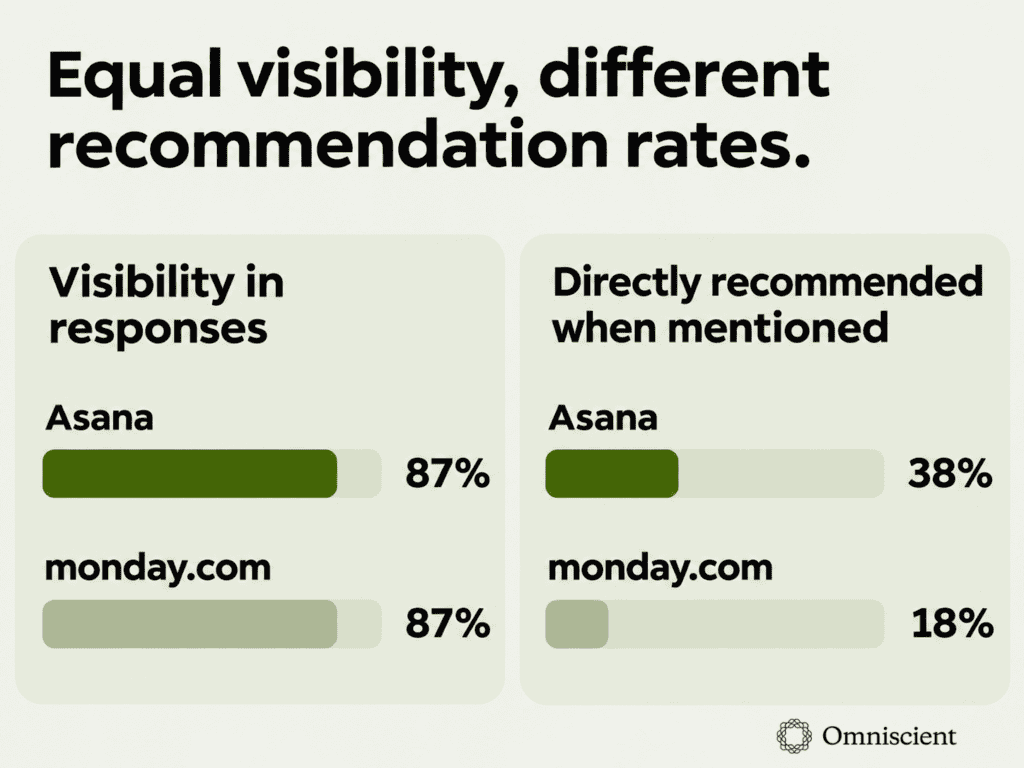
Figure 2: Equal visibility, different recommendation rates. Both brands appeared in 87% of project management responses. Models directly recommended Asana in 38% of its appearances and monday.com in 18% of its appearances.
This gap also appeared when comparing the same brand across models. HubSpot appeared in 92%-95% of responses to CRM prompts on each model. Yet ChatGPT directly recommended HubSpot in 42% of its appearances, compared with 9% on AI Mode.
For marketers, visibility alone cannot show whether models favor your brand over a competitor or which models most often recommend it. Tracking how often each model directly recommends your brand when it appears helps distinguish being part of the conversation from being a suggested choice.
Positive sentiment does not mean the model recommends your brand
Sentiment and recommendation overlap, but they are not the same signal.
When analyzing the relationship between sentiment and earning a recommendation, we found that models described brands positively in 55.7% of mentions. Yet 72.9% of those positive mentions did not include a direct recommendation. Instead, the model recommended the brand with a condition or, more often, listed it as an option.
Positive sentiment paired with a brand being listed as an option was the most common outcome, which accounted for 24.9% of all brand mentions. In these cases, models praised the brand without recommending that the buyer pursue it.
Alternatively, when we analyzed the sentiment of brands that did earn a direct recommendation, 80.4% included a positive sentiment.
Our study found that praise commonly accompanied a direct recommendation, but a positive description alone did not tell marketers whether the model recommended their brand.
Models attached an additional condition to recommendations in 23.3% of brand mentions
Our analysis found that 23.3% of brand mentions included a conditional recommendation.
Models recommended the brand only if the buyer met a requirement or preference not established in the prompt. For example, “Choose this product if you already use Microsoft” makes the recommendation depend on the buyer’s existing tools.
- Direct and conditional recommendations represented 42.1% of all brand mentions.
Our study measured these separately, given that a direct recommendation told the buyer to pursue the brand based on their stated needs, while a conditional recommendation depended on an additional requirement or preference the buyer had not provided.
For marketers, these conditions reveal which buyers models recommend your brand for.
Compare those conditions with your target audience.
For example, if you are targeting enterprise buyers, and models either leave you out of questions related to enterprise needs, or qualify your solution with something like, “it is not necessarily a replacement for a sophisticated enterprise CMS,” that is a positioning gap and worth focusing on, beyond mere visibility in answers.
If models consistently tie your brand to a narrower or different set of needs, that signals a gap between your intended positioning and how models present your brand.
ChatGPT directly recommended brands nearly 3x as often as AI Mode
When we compared each model’s answers to the same prompts, they differed sharply in how often they directly recommended a brand.
ChatGPT directly recommended 29.9% of the brands it mentioned. Claude followed at 18.0% and AI Overviews at 14.5%, and AI Mode at 10.7%.
Although AI Mode had the lowest rate of brands being directly recommended, it did have the highest share of positive sentiment at 59.9%. In other words, AI Mode spoke positively about brands more often than the other models but directly recommended them least often.
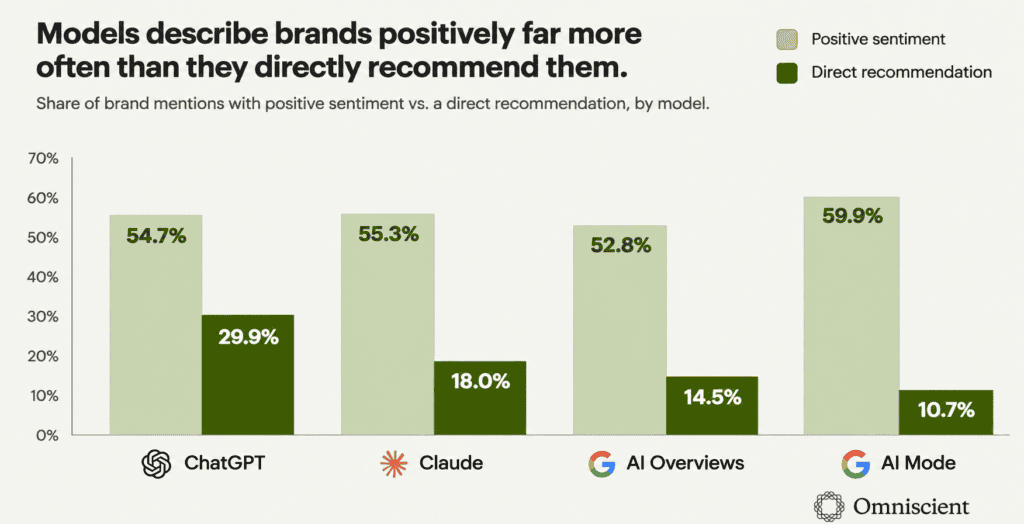
Figure 3: Positive sentiment versus direct recommendation by model.
Models also differed in how they positioned the same brand.
When all four mentioned a brand in response to the same prompt on the same day, they were consistent in whether and how they recommended it in only 17.9% of cases. Across these shared-brand cases, 42.9% included at least one model directly recommending the brand while another simply listed it as an option.
Models directly recommended brands in 33.6% of mentions when buyers asked for a choice, compared with 11.6% when they asked for a comparison
When we compared prompts across buying stages, models directly recommended brands more often when the prompt asked which option to choose.
Direct recommendations appeared in 33.6% of brand mentions from recommendation-stage prompts, compared with 11.6% from evaluation-stage prompts, where buyers asked how their options compared.
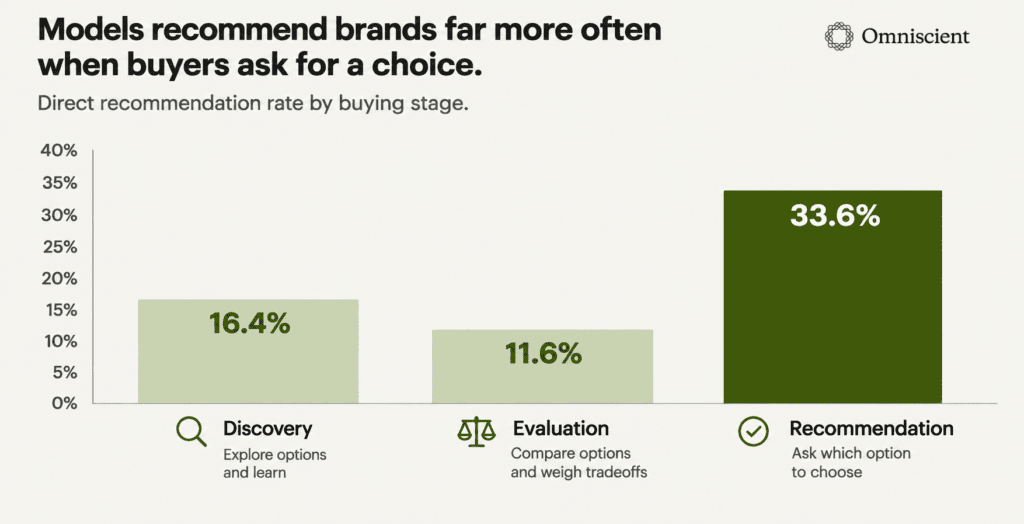
Figure 4: Direct recommendation rate by buying stage: discovery 16.4%, evaluation 11.6%, recommendation 33.6%.
Our analysis also found that the model most likely to recommend a brand shifted with the buying stage.
Although ChatGPT had the highest direct recommendation rate overall, that changed for consumer-product prompts asking for a recommendation: AI Overviews directly recommended brands in 53.7% of its mentions and AI Mode in 49.8%, compared with 35.6% for ChatGPT.
For marketing teams, this means comparing model performance within each buying stage. An overall recommendation rate can hide differences between buyers exploring their options and buyers asking for help choosing one.
Buyer needs changed which brands earned a recommendation
We tested whether adding buyer information, such as budget or team size, changed how models recommended brands.
- Among brands mentioned in answers from both the original prompt and the version with additional context related to the users needs, 38% to 65% of brands received a different recommendation once the detail was added, such as moving from a direct recommendation to only being listed as an option, or the reverse.
For example: a brand recommended directly when no detail was given might be listed only as an option once the buyer named a budget.
Here’s what this looks like in practice when comparing the difference in buyer needs:
Prompt A: “We’re a US company looking for a project management tool to keep client projects, tasks, and deadlines organized. We’d need 5 people to use it. Which project management tool would you pick?”
Prompt B: “We’re a US company looking for a project management tool to keep client projects, tasks, and deadlines organized. We’d need 200 people to use it. Which project management tool would you pick?”
Across all model responses, monday.com was mentioned about 80 times for each team size. However, models directly recommended it only twice for Prompt A, where the buyer needed a tool for five users, versus 19 times in Prompt B, when the team size increased to 200.
Wrike moved even further, from 15 mentions and no direct recommendations at five users to 63 mentions and 18 direct recommendations at 200.
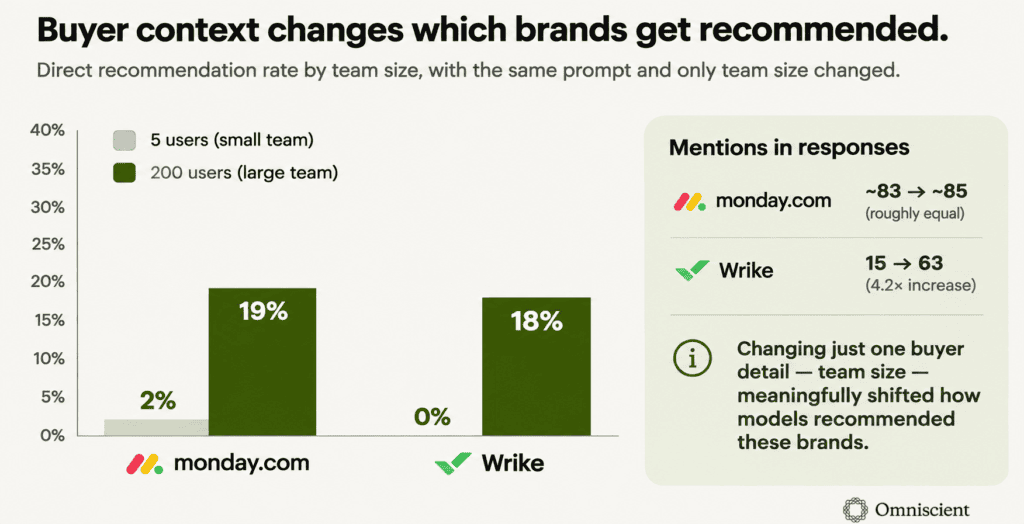
Figure 5: Changing only team size shifted direct recommendations substantially. monday.com increased from 2 direct recommendations at 5 users to 19 at 200 users, while Wrike increased from 0 to 18.
For marketing teams, this means tracking prompts that reflect your customers’ budgets, team sizes, and requirements to understand when models recommend your brand.
Use those findings to guide a review of your own content and third-party coverage. Look for gaps or outdated claims, and check whether both accurately represent what your product offers and the customer needs it serves.
What this means for marketers
The core takeaway here is that AI visibility, alone, only tells part of the story. Visibility breaks down when you consider the positioning, messaging, and contextualization given by AI models.
Here are a few ways we think this research impacts how marketers work on AEO:
1. Move beyond merely asking, “Are we visible?”
Visibility tells you whether you entered the consideration set, which of course matters.
But once you’re consistently showing up, more interesting questions are: What is the model saying about us? Who does it think we’re for? When does it recommend us? When does it choose someone else?
Asana and monday.com both appeared in 87% of project management responses, yet Asana was directly recommended more than twice as often.
Visibility told us they were both in the conversation. Recommendation told us they occupied very different positions inside it.
2. Build your prompt set around real buying situations and market-led research
The prompts you track determine what you learn and what you optimize for.
Recommendation-stage prompts produced far more direct recommendations than evaluation prompts. And changing only team size dramatically changed how models treated monday.com and Wrike.
Generic prompts like “best CRM” or “top project management tools” will only get you so far.
Use sales calls, win/loss data, customer research, and product marketing to identify the real constraints buyers bring into decisions: company size, budget, integrations, geography, security requirements, implementation complexity, and jobs to be done.
We segment our visibility data by meaningful business dimensions like product line, firmographic traits (company stage, vertical), persona (title, role), compatibility (integrations, tech stack), and constraints (pricing, team size).
3. Treat conditional recommendations as positioning research
A conditional recommendation isn’t necessarily bad.
If a model repeatedly says “choose Brand X for enterprise security” or “Brand Y is best for small teams,” it is revealing the mental model it has built around that brand.
Compare those conditions with your actual positioning and ICP.
If they align, good. If not, investigate why. Maybe your site underplays an important capability. Maybe your proof is weak. Maybe third party sources still reflect old positioning.
That makes recommendation data useful not just for AEO, but for product marketing.
4. Fix the information environment, not the individual answer
When you find a recommendation gap, don’t ask, “How do we make ChatGPT say something different?”
Ask, “Why would a model reasonably reach this conclusion?”
Look across your product pages, case studies, documentation, reviews, comparison pages, Reddit discussions, editorial coverage, and other third party sources.
If the evidence for your desired position is thin, create it. If it exists only on your website, build broader consensus around it. And if the model is reflecting a real product weakness, fix the underlying problem.
AEO is partly the work of shaping the information environment models use to form opinions.
5. Measure the chain, not one metric
I don’t think direct recommendation should become the new north star, but it is important to consider multiple angles of AEO.
We’ve begun thinking about metric constellations instead of a single north star. Within AEO prompt tracking, there are several angles to diagnose performance and opportunities:
visibility → sentiment and treatment → citations and narrative → buyer behavior → pipeline and revenue.
The upstream metrics are fast diagnostic signals. The downstream business outcomes matter more, but they’re slower and harder to observe.
The objective isn’t to maximize how often an AI model recommends your brand to everyone.
It’s to earn consideration from the right buyers, be represented accurately, and be recommended for the reasons you actually want to win.
Detailed Methodology
This appendix describes how we constructed the prompt set, collected responses, labeled brand mentions, validated those labels, and calculated the reported results.
Prompt set and collection
The study included 300 non-branded prompts, distributed evenly across four industries, with 75 prompts per industry:
- B2B software: CRM and project management
- Consumer products: Laptops and robot vacuums
- Financial services: Checking accounts and credit cards
- Professional services: Bookkeeping and IT support
Prompts were also distributed evenly across three stages of the buying journey:
- Discovery: Identifying available options
- Evaluation: Comparing options
- Recommendation: Deciding which option to choose
Of the 300 prompts, 144 formed matched comparisons. Each comparison consisted of the same question asked three ways: once without additional buyer context and twice with a single buyer detail varied between contrasting values, such as a monthly budget of $50 versus $300.
We tested 16 buyer details, four per industry, across all three buying stages, ensuring equal representation across industries. The remaining 156 prompts represented distinct buying scenarios.
Responses were collected through Peec AI using English-language prompts and US settings. Each prompt was submitted to ChatGPT, Claude, Google AI Mode, and Google AI Overviews once daily for seven days, from September 30 through October 6, 2026.
This produced 8,400 responses. Eight were excluded because the labeler failed to return a complete set of labels after four attempts. The final analysis includes 8,392 responses containing 44,003 brand mentions.
How we labeled brand mentions
Each brand mentioned in a response received two independent labels: one for sentiment, describing how the brand was portrayed, and another for recommendation, describing what the response advised the buyer to do.
These dimensions were evaluated separately. A response could describe a brand positively without explicitly recommending it.
Sentiment captures how the response portrays the brand:
- Positive: a favorable description without a substantive drawback.
- Mixed: both substantive praise and a substantive drawback.
- Neutral: factual information, such as pricing or features, without an evaluative judgment.
- Negative: an unfavorable description without substantive praise.
Recommendation captures the action the response encourages the buyer to take:
- Recommended directly: explicitly directs the buyer toward a brand through a named pick, a shortlist, a trial or quote list, or a recommendation heading such as “Top recommendations.” Multiple brands can receive this label within the same response. A recommendation heading qualifies unless the brand’s own description introduces a condition the prompt had not already established.
- Recommended with a condition: recommends a brand only if the buyer meets an additional condition not established in the prompt.
- Listed as an option: mentions a brand without explicitly recommending or discouraging it, even when the description is positive or uses language such as “worth considering.”
- Advised against: discourages the buyer from choosing a brand, or says the brand fails a requirement the buyer stated.
Brands appearing only as a cited link, and not in the response text, were excluded.
Label validation
A human annotator developed the labeling framework from one set of responses, then labeled a separate set and locked those labels before the model was compared with them. That second set contains 81 brand mentions. It was not used to write the rules, which is what makes it the held-out check.
We used a separate model, Claude Opus 5.5, to apply the framework. It is not one of the four models that generated the responses in the study. We compared it with the human labels on the held-out set before it labeled the full dataset.
On that set, the labeler agreed with the human annotator on 78 of 81 sentiment labels (96.3%). All three disagreements were descriptions the human labeled mixed and the model labeled positive.
On recommendations, the model and the human annotator agreed on the direction and differed on the strength. Where they disagreed, the brand usually moved one step: a direct recommendation became a conditional one, or a conditional recommendation became a brand listed as an option. The model assigned 16 direct recommendations where the human annotator assigned 25. It never advised against a brand the human annotator had recommended.
When the model assigned a direct recommendation, the human annotator agreed in nearly every case. The gap was about how firm the recommendation was, which is partly subjective, and the model took the stricter side of that line.
The labeler identified every brand the human annotator identified. A second labeling pass filled in labels the first pass had left blank, without changing any label already assigned. Seven mentions were still missing one label after that pass. They remain in the dataset and are left out only of the calculation for the label they are missing.
Counting methodology
A brand mention is one named brand or product within a single response. The 44,003 brand mentions are the basis for the industry-level and model-level results.
Brand-specific results, such as how often a brand appears or is recommended, count each brand at most once per response. When a response mentions more than one product from the same brand, those mentions are combined and the stronger recommendation is kept.
Brand examples in the report are limited to brands with at least 50 mentions across at least two models. The findings themselves use the full dataset. The examples show what those findings look like for a single brand.
Statistical validation
Because responses to the same prompt may be correlated, we estimated uncertainty by resampling entire prompts, including all associated responses, rather than treating individual brand mentions as independent observations. We repeated this resampling 4,000 times. The resulting 95% interval for the share of brand mentions classified as direct recommendations was 17.4% to 20.1%.
A response that names many brands could pull that share down, so we also gave each response equal weight instead of each mention. The two resulting shares were 18.8% when each mention is weighted equally and 21.5% when each response is weighted equally.
To assess whether recommendation rates differed across models, we conducted a permutation test. Model identities were shuffled among the four responses collected for each prompt on each day, preserving the prompt, industry, buying stage, and collection date. We repeated this procedure 5,000 times. Across all industries, none of the permutations produced differences as large as those observed in the original data (p < 0.001).
We recalculated the headline figures on the prompts that were set aside while the labeling rules were written and tested. Every headline figure stayed within 3 percentage points of the result in this report, including the order of the models and the gap between a positive description and a direct recommendation.
Study scope
This study measures how four AI models responded to 300 non-branded buying prompts over seven days, from September 30 through October 6, 2026, using US locale settings.
The sentiment and recommendation labels describe how each response portrays a brand and whether it encourages or discourages the buyer. The study does not check whether the claims in those responses are factually current. Pricing, product capabilities, and limits can be checked separately against the brand’s own information.