The demand for AI search skills is rising rapidly.
We’ve personally seen growth in AI engine usage and a corresponding increase in pipeline value generated from LLMs, creating the emerging answer engine optimization (AEO) industry. As such, you would expect to see a rise in job descriptions explicitly mentioning AI search skills as requirements.
Last year, as the industry was nascent, we ran a study on 643 unique SEO job postings and found that 34.21% of them include AI search skills as requirements. 1
Things move fast, so we wanted to run another analysis this year and see how things have changed. And they have certainly changed.
Analyzing 690 unique SEO job postings from August 21, 2026, we found that 62.2% include AI search requirements – representing nearly a doubling of AI search skill requirements in SEO job postings.
Before diving into the results, let’s quickly review our methodology.
Methodology
For context, we will call last year’s analysis “wave 1,” and this analysis “wave 2.” This was the methodology for analysis last year.
Similar to Wave 1, for this analysis, we scraped 54,257 jobs on LinkedIn that were posted on or before August 21st, 2026 in North America.2 Postings ranged from newly posted listings to approximately three years old, though only two postings were listed as three years old and 18 as two years old. We used SEO filters and titles, but not all jobs were SEO-specific postings. After removing duplicates and filtering out unrelated listings, we isolated a final count of 690 unique SEO job postings for further analysis.
Wave 2’s initial deduplication used Company + Title as the uniqueness key, consistent with Wave 1. Diagnostic testing revealed this over-merged real, distinct postings: extracting the LinkedIn job ID from each posting’s URL showed 19,245 unique job IDs and 14,522 unique Company + Title combinations feeding into a final set of only 567 rows. The corrected pipeline deduplicates on job ID (with a Company + Title + Location fallback for the small number of postings with non-parseable URLs), recovering 123 legitimate postings and bringing the final sample to 690.
The scrape pulled roles across the following (n=690):
- Executive (Director level and above)- 77
- Manager- 251
- Individual Contributor (IC)- 362
And across:
- Traditional SEO Roles- 489
- AI- Focused SEO roles- 201
Results: AI Search Skills Required in 62.2% of SEO Job Descriptions
We wanted to know the proportion of SEO job postings mentioning AI search skills and if that proportion has increased, decreased, or remained relatively stable since last year’s analysis.
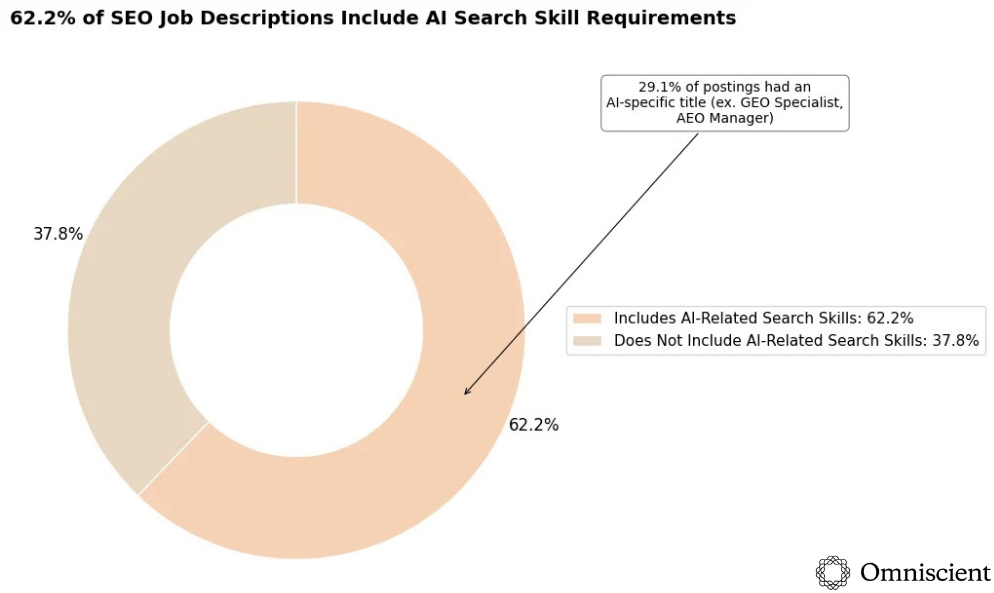
As shown above, more job posters are seeking employees with AI search skills. Within the 62.2% of the jobs that include AI search skills, almost half (29.1%) had AI specific titles.
This indicates a strong shift from last year, where only 34.21% of all job postings mentioned AI search. Within 10 months, this percentage has nearly doubled even after adjusting for the seniority composition shift, indicating an increase rather than a sampling artifact.
The following table highlights the differences between traditional and AI specific job titles:
| Job title type | Number (n=690) | % mentioning AI search in the job description |
| AI -titled (ex. “GEO Specialist”) | 200 | 97.5% |
| Traditional-titled (ex. “SEO Manager”) | 490 | 47.8% (up ~18% from last year) |
The increase within traditionally- titled roles (30% → 48%) is the strongest evidence that AI search literacy is spreading into mainstream SEO hiring, not remaining to confined, AI specific specialist titles.
So, even among postings with a completely ordinary, non-AI title, nearly half now (47.8%) describe AI search skills somewhere in the body of the posting, up from almost 30% in last year’s analysis.
GEO and AEO are tied as the most commonly used terms for AI search skills
We wanted to know if employers are creating SEO roles with more AI specific terminology in the job title.
Employers are nearly 3x more likely to put AI terms directly in SEO job titles than they were less than a year ago, jumping from 1 in 9 postings to nearly 1 in 3.
11.2% of SEO job titles included AI specific language (like “GEO Specialist” or “AEO Manager”) in the 2025 study, and that number has climbed to 29.13% in the 2026 wave 2 data.3
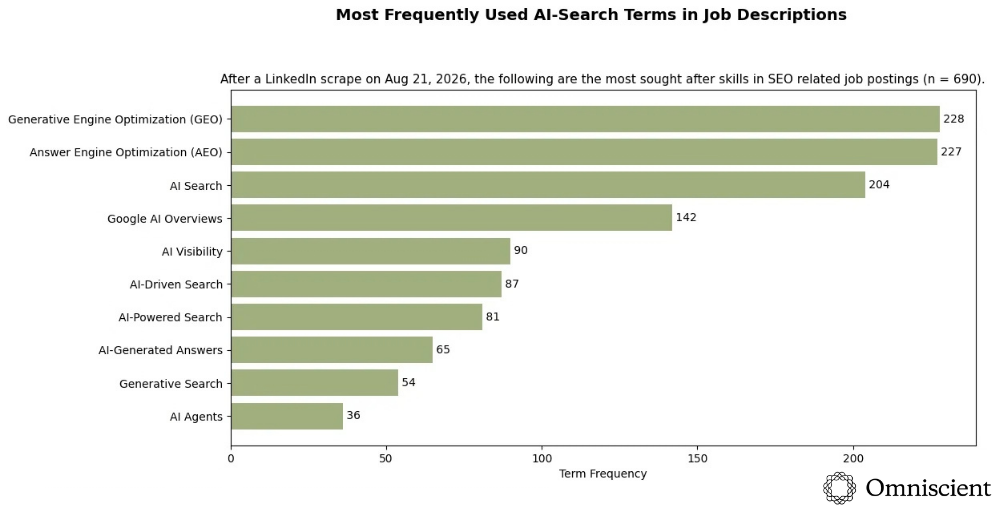
GEO and AEO skills are the most sought after AI search skills used in SEO related job descriptions, with Google AI overviews becoming increasingly more popular since its launch in 2024.
AI Search Requirements Are Represented Across Seniority Levels
We wanted to know if the AI search mention rate increases with seniority (Executive > Manager > IC).
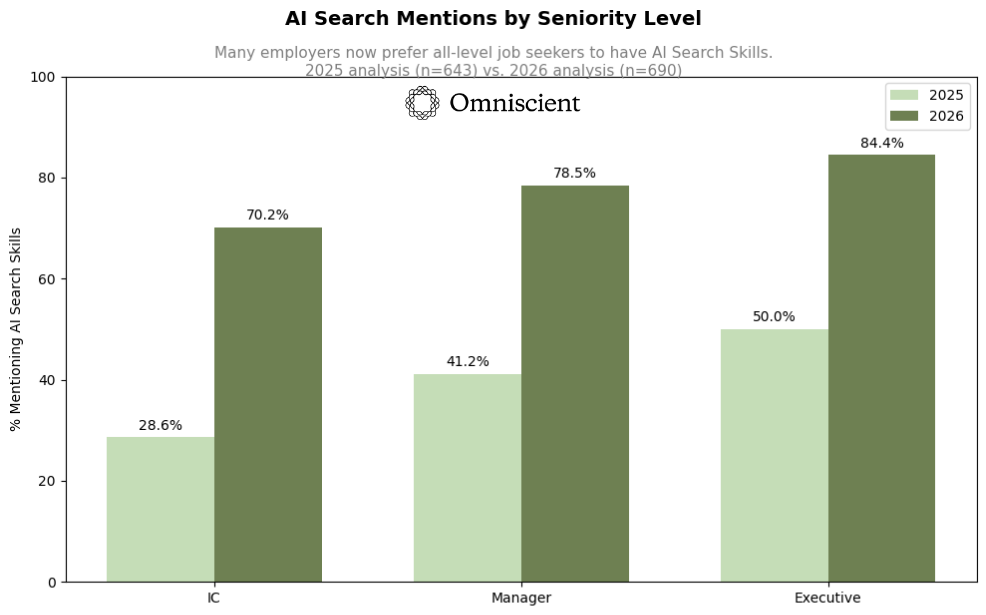
Last year, we saw a higher proportion of senior and executive jobs requiring AI search skills, with a lower amount of IC roles requiring them. This year, every tier roughly doubled, but the clean 2025 staircase (Executive > Manager > IC) has flattened at the top. Manager and Executive are now relatively indistinguishable (71–72%), and IC roles requiring AI search skills jumped from 28.6% to 53.3%.
The finding has shifted from “AI search is an executive-level concern” to “AI search is baseline for any role above individual contributor.”
Takeaways
If you’re working in marketing, you can already feel it: AI search is increasing drastically, in importance and salience.
As such, we are seeing an increase in job descriptions and hiring plans for people with AEO/GEO/AI search skills.
As a standalone study, it is interesting that roughly ⅔ of SEO jobs mention AI search. It’s even more interesting when compared to data just a year ago, where the rate of AI search skills in job descriptions roughly doubled.
While this study was limited to scraped SEO job descriptions, further questions remain:
- What other departments or roles are now being tasked with AI search expertise? Because it is cross-functional in nature, we would also expect to see PR, comms, community management, and even product marketing roles tasked with AI search.
- Are different industries, companies, or verticals growing faster than others?
- What specific AI search skills are used to filter candidates in the hiring process? The job descriptions go into varying levels of detail on this. Where is the true divergence in SEO skills and AEO skills for hiring teams?
Overall, the evidence supports AI search literacy becoming a standard, broad-based expectation in SEO hiring rather than a niche specialization.
Limitations
- Sample size: both waves fall short of the original 1,200–1,500 posting target (Wave 1: 643; Wave 2: 690), though the two are now comparably sized. ↩︎
- Snapshot scope: Wave 1 and Wave 2 span across different quarters in a business year. Wave 1 is conducted in Q4 and Wave 2 is conducted in Q3. Findings should be read as point-in-time comparisons rather than trend lines across a continuous period. ↩︎
- To make sure this comparison was fair, we re-ran the exact same title-checking method on both waves’ data. The original number reported for the earlier study (6.07%) turned out to be a slight undercount, since it relied on manually reviewing titles rather than a consistent, repeatable rule. Once we applied that same rule to both time periods, the real starting point was 11.20%, still a big jump from where things stand now. ↩︎