Your buyers are asking ChatGPT for shortlists and using Perplexity to research vendors before they ever open a search tab. The agency you hire for GEO determines how often you show up in those answers or whether you’re in the conversation at all. This guide covers eight thoroughly researched GEO agencies that pass the sniff test, so you can build a shortlist worth your time.
Table of contents
- At a glance: The 8 best GEO agencies for B2B SaaS
- 8 top picks: Which is the best GEO agency?
- Omniscient Digital: Best for B2B SaaS GEO tied to pipeline
- Growth Plays: Best for content-to-pipeline attribution for technical B2B products
- Skale: Best for SaaS brands scaling in AI search
- Breaking B2B: Best for B2B companies focused on bottom-funnel AI search visibility
- Flying Cat Marketing: Best for B2B startups
- NoGood: Best for startups wanting multi-channel GEO
- Flow Agency: Best for integrated paid and organic SaaS search marketing
- Petra Labs: Best for enterprises who want an end-to-end partner to manage their full GEO strategy, execution, and attribution
- How to evaluate generative engine optimization companies
- How to start GEO with confidence in the next 30 days
- Frequently asked questions about generative optimization companies
Disclosure: This guide is published by Omniscient Digital. We’ve included ourselves because we offer GEO services. Every agency on this list was vetted against the same five criteria, including ours.
At a glance: The 8 best GEO agencies for B2B SaaS
| Agency | Best For | Starting Price | Key Differentiator |
| Omniscient Digital | B2B SaaS GEO tied to pipeline | $10,000/mo | Focus on organic pipeline, achieved 140% AI citation growth in 60 days |
| Growth Plays | Content-to-pipeline attribution for technical B2B | Contact for pricing | Content-to-revenue attribution for technical B2B |
| Skale | SaaS brands scaling in AI search | $4,000/mo | Reverse-engineered AI query targeting |
| Breaking B2B | B2B bottom-funnel AI search visibility | $4,000/mo | Buyer journey mapping at decision stage |
| Flying Cat Marketing | B2B startups | $2,000-$8,500 | Boutique GEO planning |
| NoGood | Startups with multi-channel GEO needs | Contact for pricing | Goodie AI proprietary monitoring platform |
| Flow Agency | Integrated paid and organic SaaS search marketing | $3,500/mo | Integrated paid media and GEO for SaaS |
| Petra Labs | Full stack execution with attribution platform | Custom – typically $250-600k+ annually | Native AEO tracking and attribution platform |
How we evaluated these generative engine optimization companies
Every agency on this list passed five criteria:
- A dedicated GEO service on the agency’s website. Not “we adapt our SEO for AI”—a distinct, documented service.
- B2B or SaaS specialization. This list is built for B2B SaaS buyers. Generalist agencies were excluded.
- Verifiable GEO-specific results tied to pipeline or revenue. Outcomes achieved had to go beyond general traffic or organic rankings.
- Documented technical GEO methodology: prompt testing, entity optimization, citation building, or equivalent. Agencies that couldn’t describe a process were excluded.
- Full-service delivery capacity. The agency needs to be able to execute, not just advise.
The fourth criterion—documented methodology—matters more than it might seem. Research from Princeton and Georgia Tech, published at KDD 2024, demonstrated that systematic generative engine optimization techniques can boost content visibility in AI-generated responses by up to 40%. The researchers also found that results vary significantly by domain, which is exactly why methodology matters when choosing a partner. For further insights, explore how LLMs source brand information to enhance your understanding of AI visibility strategies.
Download: B2B Buyer Behavior in 2025—How B2B buyers navigate through channels, build trust, and make decisions in the LLM era.
8 top picks: Which is the best GEO agency?
Each entry includes a structured breakdown, including best for, overview, pros, cons, pricing, and results. This will help you evaluate fit quickly and be one step closer to finding your new partner.
Omniscient Digital: Best for B2B SaaS GEO tied to pipeline
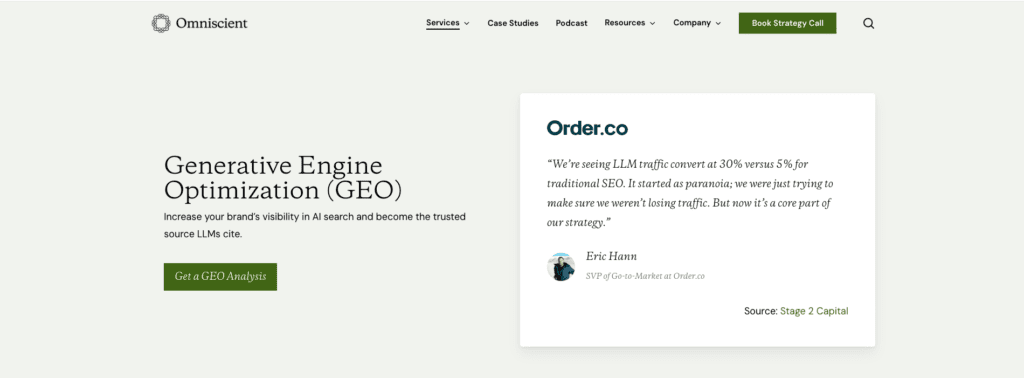
Best for: B2B SaaS companies that need GEO connected to pipeline, not just AI citation counts.
Omniscient Digital treats GEO as a pipeline problem. In other words, when buyers use ChatGPT to shortlist vendors in your category, are you in that answer, and is it driving pipeline? Work begins with a baseline AI visibility audit to benchmark where you appear versus competitors and what’s driving the gap. Reporting covers both AI citation metrics and downstream pipeline signals—connecting visibility in AI answers to deal activity, not just impression counts.
Pros
- Omniscient runs a named GEO service with a documented methodology, not an SEO adaptation dressed up as GEO.
- B2B SaaS specialization runs deep with clients ranging from Asana and Loom to Jasper, SAP, and Hotjar.
- Content engineering infrastructure supports companies running complex, high-volume content programs alongside GEO.
Pricing: Organic growth engagements start at $10,000 per month.
Results: We helped Convert grow LLM visibility by 81% and achieve 140% AI citation growth in just 60 days, with more than 23,000 AI citations analyzed.
Growth Plays: Best for content-to-pipeline attribution for technical B2B products

Best for: B2B technology companies that need content and SEO strategies tied directly to pipeline attribution and go-to-market priorities.
Growth Plays sits at the intersection of content strategy, SEO, and go-to-market execution. Founded by JH Scherck, the agency has spent nearly a decade building practical, ROI-focused content roadmaps for B2B technology brands. Growth Plays’ positioning centers on pipeline impact over vanity metrics. The team works primarily with mid-market and enterprise companies selling developer tools and complex SaaS, where long sales cycles demand precise alignment between what gets published and how it maps to product positioning and revenue operations.
Pros:
- The agency’s content engine optimizes for traditional search, AI Overviews, and LLM visibility simultaneously, with predictive cost-per-conversion modeling built into the workflow.
- Growth Plays tracks content investment through to closed revenue using integrations with HubSpot, Bizible, or Roadway AI, connecting pipeline attribution directly to content strategy decisions.
- Clients include Lattice, Calendly, LangChain, and LaunchDarkly, reflecting nearly a decade of focused work in developer tools and enterprise SaaS.
Pricing: Contact Growth Plays for a quote.
Results: Growth Plays helped Gremlin generate an ROI 10x higher than expected—their content strategy generates demo-ready leads monthly according to the former Cirector of Marketing.
Skale: Best for SaaS brands scaling in AI search
Best for: SaaS brands building AI search visibility through reverse-engineered query targeting.
Skale builds AI search visibility by working backwards from the answer. Instead of creating content and hoping it gets cited, they reverse-engineer which third-party sources AI engines already rely on in a given category, then earn placements in those sources. This off-page approach is a strong fit for SaaS brands that already have decent content infrastructure and need to solve the citation problem specifically. Notable clients include HubSpot, Freshworks, and MoonPay.
Pros
- Skale’s reverse-engineered targeting methodology identifies the specific sources AI engines cite before deploying outreach, making placements more precise than content-first GEO approaches.
- AI Brand Mentions is offered as a standalone service, but can also be combined with Skale’s SEO and content services.
- A six-year outreach network gives Skale an edge in placing brands into the citation-heavy content AI systems already use.
Pricing: Full-scope engagements start at $4,000.
Results: Jitter, a motion design SaaS, grew AI brand coverage by 150% (from 22% to 55%) and achieved 90x growth in brand mentions and domain citations in four months.
Breaking B2B: Best for B2B companies focused on bottom-funnel AI search visibility
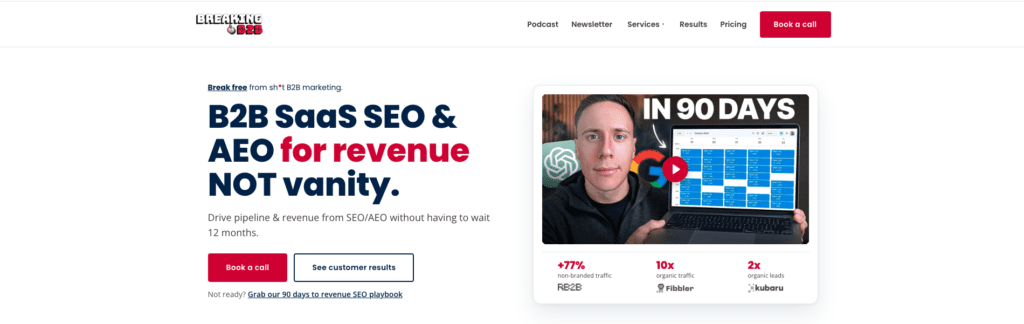
Best for: B2B companies that need to appear in AI answers at the comparison and decision stage, not just for awareness queries.
Breaking B2B was built around a specific focus: comparison and decision-stage queries such as “Best [category] tools,” “Alternatives to [competitor],” “[Product A] vs [Product B].” These are the prompts buyers use when they’re actively evaluating vendors. Breaking B2B’s position is that this is where GEO investment delivers the most measurable pipeline impact for B2B brands.
Pros
- Breaking B2B’s exclusive B2B/SaaS focus means their methodology is calibrated specifically for longer sales cycles and buying committee dynamics.
- Sam Dunning is directly involved in client strategy, which gives the work founder-level accountability that larger agencies typically can’t offer.
- Pipeline-tied results are on record across named clients, including documented AI traffic gains and competitor comparison page clicks.
Pricing: Plans start at $4,000 per month for 90-day sprints.
Results: Proposify saw a 91% increase in AI search traffic and a 68% increase in clicks to competitor comparison pages. MarqVision earned AI citations in ChatGPT and Gemini within 6 weeks of starting work.
Flying Cat Marketing: Best for B2B startups
Best for: B2B startups looking for boutique and custom engagements
Flying Cat Marketing is a Barcelona-based agency with a strong foothold in the tech and SaaS ecosystem. Their editorial process pulls product marketers, SEOs, and subject matter experts into one workflow, so content starts from what makes the product different and gets built to rank and get cited. The agency runs both tracks at once — traditional keyword-driven SEO and the agentic/AI-search optimization generative engines reward — with SME interviews, data journalism, and thought leadership as their core formats. Their case study archive spans SaaS names like Bizzabo, Livestorm, Softr, Stonly, and ActiveCampaign.
Pros:
- Flying Cat’s editorial process integrates product marketers, SEOs, and SMEs directly, rather than handing content between silos.
- The agency’s deep persona-driven approach with international SEO chops (French, German, Italian, Spanish, Portuguese), useful for SaaS companies expanding across Europe.
- Flying Cat has a strong, consistently published SaaS case study record—10 reviews on Clutch average 4.9/5.
Results: A B2B SaaS client (Stonly) saw a 986% increase in qualified traffic under a full-funnel strategy. ActiveCampaign gained 83,000 additional clicks and 4.1M additional impressions in 8 months. Softr grew SEO-sourced MRR 227% in 6 months.
NoGood: Best for startups wanting multi-channel GEO
Best for: Growth-stage startups that want GEO integrated with paid, content, and SEO rather than run as a standalone channel.
NoGood is a full-funnel growth agency that treats GEO as part of a broader marketing system rather than a standalone channel. Their model integrates AI visibility work with paid media, SEO, and CRO. As a result, GEO insights inform ad creative, landing page strategy, and content rather than sitting in a separate workstream. This integration is useful for growth-stage startups running multi-channel programs. Their client roster spans B2B SaaS and enterprise consumer brands, including Nike, Chime, and TikTok.
Pros
- Their full-funnel model integrates GEO with paid media, SEO, and CRO—useful for teams that don’t want GEO siloed from the rest of their growth motion.
- Goodie AI, their proprietary monitoring platform, helps track brand visibility across AI platforms and can be used alongside traffic and conversion measurement.
- NoGood publishes original research on AI visibility signals through their AI Lab, which informs how they build and update AEO programs.
Pricing: Contact for pricing.
Results: SteelSeries (consumer gaming) saw a 23x increase in YoY AI search traffic, a 27x increase in YoY conversions from AI platforms, and a 75% improvement in Perplexity Visibility Score.
Flow Agency: Best for integrated paid and organic SaaS search marketing
Best for: B2B SaaS brands that need paid media, SEO, and GEO managed under one team so traditional and AI search strategies reinforce each other.
Flow Agency (formerly Flow SEO) is a boutique B2B agency that focuses on SaaS companies, combining paid media, SEO, and generative engine optimization under a single team. Founded by Viola Eva, the agency was an early adopter of AI—both from a process and tooling perspective and in optimizing for visibility in AI-driven answer engines. Flow’s core positioning centers on treating paid and organic search as one integrated system, with shared data and reinforced targeting across traditional search and AI-powered discovery surfaces.
Pros:
- Flow runs a documented five-step GEO methodology that includes AI search opportunity analysis, listicle and reference source audits, and performance reporting through a proprietary LLM traffic dashboard.
- The agency staffs engagements with senior consultants only, with no junior account managers handling day-to-day execution.
- Flow integrates paid media campaigns — including LLM advertising on platforms like ChatGPT and Perplexity — with organic search, so both channels share targeting insights.
Pricing: Flow Agency’s minimum monthly retainer starts at $3,500.
Results: ELM Learning saw a 200% increase in organic conversions and an 11% rise in organic sessions over one year with Flow Agency.
Petra Labs: Best for enterprises who want an end-to-end partner to manage their full GEO strategy, execution, and attribution

Best for: Enterprise brands and growth-stage companies that want to turn AI search into a growth channel without having to manage a GEO strategy or operate a SaaS platform in-house.
Petra Labs is an end-to-end AI visibility partner that bundles highly customizable AEO software with a managed service. Petra Labs staffs dedicated operators on each account who manage the full lifecycle of GEO on your behalf, from strategy and execution all the way to revenue attribution.
Pros
- Petra Labs builds custom last-mile attribution models for each customer, connecting AI-driven visibility directly to your actual business outcomes by integrating with cost, revenue, and site data.
- Petra Labs collaborates with every team across your marketing organization that is relevant to AI search, from your content writers to your social media team, and more.
- Petra Labs’ in-house team of dedicated operators can execute on any range of AI Search initiatives, including, but not limited to: high-quality hand-written blog content, PR management, influencer management, social media, and programmatic page optimization.
Pricing: Pricing is highly custom per their website. Engagements can start at $15K / month but typically range from $250-600k+ annually. Contact Petra Labs for a quote.
Results: Petra Labs helped growth-stage startup Novig skyrocket in LLM visibility with 27x AI-referred site traffic in 6 months and serves as an end-to-end GEO partner for enterprises like Zapier and Rippling.
How to evaluate generative engine optimization companies
The agencies above are worth contacting. But before you get on a first call with any agency, it’s useful to understand what separates a real GEO practice from an SEO agency that added “GEO” to their homepage last quarter.
Start by knowing which engagement model fits your situation. This will make every conversation more targeted. Most B2B SaaS teams have a few options:
- A full-service retainer (end-to-end execution)
- A strategic advisory engagement (guidance with in-house execution)
- Or a one-off audit
Deciding which model fits your team before you get on calls saves time. You’ll ask better questions and spot mismatches faster.
Questions to ask before hiring a GEO agency
The first conversation with a potential generative engine optimization agency should give you signal on how they think, not just what they sell. Here are questions worth asking, and what you should listen for in the answers.
- “How do you define GEO, and how is it different from SEO in your work?” You want a clear, nuanced answer, not hand-wavy claims about “AI magic.” Look for GEO positioned as an extension of organic strategy into AI surfaces, not a wholesale replacement.
- “What’s your methodology for improving AI visibility?” Ask them to walk through the process from audit to implementation to measurement. Look for specific steps: prompt libraries, entity audits, citation analysis. If the answer is “we’ll optimize your content for AI,” keep pressing.
- “Which tools and data sources do you use to track AI exposure?” There’s no perfect GEO tool stack yet, but they should have a defined approach. For example, some combination of third-party tools, internal scripts, and manual testing. If they can’t explain how they’ll measure brand visibility in LLMs, that’s a concern.
- “Can you share examples where your work influenced AI answers or citations?” Perfect attribution isn’t the goal here. Real experiments, screenshots, before-and-after examples, and a thoughtful narrative of what they tried and what they learned—that’s the signal you want.
- “How do you connect GEO work to pipeline and revenue?” Listen for how they use landing page data, CRM data, and sales feedback to connect AI exposure to actual deals, rather than just traffic or citation volume.
- “What’s one thing you tried that didn’t work, and what did you change after?” Honest failure stories are a signal. If they claim everything works or dodge the question, they’re either early in the practice or not being transparent.
By the end of that first call, you should have a sense of whether you’re dealing with practitioners testing and learning in public or vendors repackaging old SEO decks with “AI” sprinkled in.
Red flags to watch for
How an agency talks about uncertainty tells you a lot. Credible GEO partners will admit what they don’t know, document what they’re testing, and avoid guarantees. In an evolving, opaque ecosystem, that kind of honesty is a green flag.
Watch for these:
- Rank or citation guarantees. Anyone promising fixed placement in AI Overviews or specific AI brand mention counts is overpromising. Guarantees in an evolving ecosystem usually mean shortcuts or misaligned incentives.
- Vague deliverables. If the scope says “AI-optimized content” and “improved visibility” without specific activities, artifacts, and timelines, you’ll have no way to manage expectations or evaluate performance.
- No prompt library or testing plan. GEO without a defined prompt set and testing cadence is just SEO with a rebrand. Forrester’s 2026 buyer research found that AI search tools “often deliver incomplete or unreliable information, creating mistrust”. Buyers already encounter this. An agency that can’t describe a testing methodology is building on that same unreliable layer.
- Traffic-obsessed reporting. If all you see are keyword rankings and organic sessions with no mention of AI surfaces, entity coverage, or pipeline impact, they’re not really doing GEO.
- No cross-channel perspective. AI engines don’t respect your org chart. If the agency ignores PR, brand, product marketing, and sales enablement as GEO levers, they’re missing key inputs that influence how models learn about you.
- Overconfidence and silver bullets. Be wary of “proprietary GEO secrets” or one-time audits that “fix” AI visibility. A thoughtful “it depends” backed by evidence is healthier than false certainty.
- No defined prompt testing cadence. If an agency can’t describe which prompts they’re targeting and how they test and update that library over time, they’re optimizing for something, but probably not for the queries your buyers are actually using.
In an emerging field, humility plus a strong experimentation engine is far more valuable than absolute claims. Look for agencies that are upfront about limits, transparent about process, and specific about where they’ve seen GEO work and where they haven’t.
Download: The AEO Field Guide—The mental models, directives, and gotchas you need to win at AI Engine Optimization.
How to start GEO with confidence in the next 30 days
Once you’ve vetted the agencies on this list and have a sense of what to watch for, the question becomes: where do you start? This framework is for teams deciding whether to build GEO capability internally, through an agency, or both before committing to either. Getting clarity here means you evaluate agencies from a position of knowledge, not urgency.
- Week 1: Map your AI exposure and risks. List your top 10–20 high-intent queries and scenarios. Keywords such as “alternatives to [competitor],” “best tools for [your use case],” “[product A] vs [product B].” Run them through ChatGPT, Perplexity, and at least one other AI tool. Screenshot the results, highlight mentions of you and competitors, and note any inaccuracies.
- Week 2: Align on goals and definitions. Define what GEO means for your team, where it fits in your broader organic strategy, and which KPIs you’ll track. Get buy-in from sales and leadership so everyone understands that “AI visibility” is about pipeline, not impressions.
- Week 3: Ship a few high-impact fixes. Update obvious gaps in your core pages—category pages, comparison pages, product overviews—so they clearly explain who you are, what you do, and who you’re for. Fix any inaccurate or outdated third-party listings that may be influencing AI engines.
- Week 4: Decide your operating model. Based on what you’ve learned, decide whether you’ll build GEO in-house, through an agency, or as a hybrid. Outline a 90-day plan with specific experiments, content initiatives, and measurement checkpoints.
By the end of those 30 days, you’ll have a clearer picture of where you stand and enough context to evaluate agencies from a position of strength instead of urgency.
That’s the same starting point we used with Convert. In 60 days of structured GEO work, they saw 81% LLM visibility growth and 140% AI citation growth. Getting to that kind of clarity doesn’t require a massive program upfront. It requires starting with the right questions.
Search Engine Land’s analysis of 13 months of LLM referral data found that visitors arriving from AI search convert at around 18%. That’s significantly above typical organic search conversion rates—and the volume is still growing, which makes being in the answer layer now worth the investment.
Ready to build your brand’s presence in AI search? Book a free strategy call with Omniscient Digital to see what a GEO program tied to pipeline looks like.
Frequently asked questions about generative optimization companies
What does a GEO agency do?
A GEO agency optimizes your brand’s presence in AI-generated answers across platforms like ChatGPT, Perplexity, Google AI Overviews, and Gemini.
Work typically starts with a baseline audit of which queries return AI answers in your category, then moves to content and technical changes designed to increase citation frequency. Most serious GEO programs also include prompt testing, entity optimization, and ongoing measurement tied to share of voice and pipeline, not just citation counts.
For B2B SaaS brands, the focus is on appearing in the queries buyers use when shortlisting vendors, not just broad awareness queries.
How much does a GEO agency cost?
Most generative engine optimization companies don’t publish pricing or only list starting prices. Based on what’s publicly available from third-party sources, GEO retainers typically run alongside or on top of existing SEO programs.
For full-service B2B GEO from specialist agencies, expect retainers in the $10,000–$40,000/month range depending on scope and whether content production is included. The clearest path to accurate pricing is to describe your content infrastructure and AI search goals before your first call.
How is a GEO agency different from an SEO agency?
An SEO agency optimizes for search engine rankings: click-through, organic traffic, and SERP position.
A GEO agency optimizes for AI-generated answers. In other words, the responses that appear before search results, in chat interfaces like ChatGPT, and in AI summaries across tools your buyers already use. The optimization levers differ: GEO involves prompt testing, entity authority, structured content for LLM legibility, and citation monitoring.
Some SEO agencies have added GEO as a service line. The difference is whether GEO is a named program with its own methodology or an SEO adaptation that they’re only calling something new.