If you sell fraud prevention, risk, or trust-and-safety software, you already know your category is one of the harder ones to win with content. The buyer is sophisticated, the topic is technical, the stakes are high, and the SERP is crowded with vendors all saying roughly the same thing about machine learning and real-time detection.
Generic content doesn’t just underperform here, it actively erodes credibility with the exact audience you’re trying to convince.
I’ve watched a lot of security and risk SaaS teams pour budget into blog content that reads like a glossary. Define the threat, list the types, restate the consequences, end with a CTA. It ranks for a while, then gets flattened the moment a competitor with more authority publishes the same outline.
The problem isn’t effort. It’s that the strategy treats content as a coverage exercise instead of a positioning one.
The fix requires rethinking the entire approach, not just what you write, but who you write for, what assets you already have, and what channels your buyers actually use. Here’s what actually moves the needle for this category.
Stop writing the encyclopedia, start writing the argument
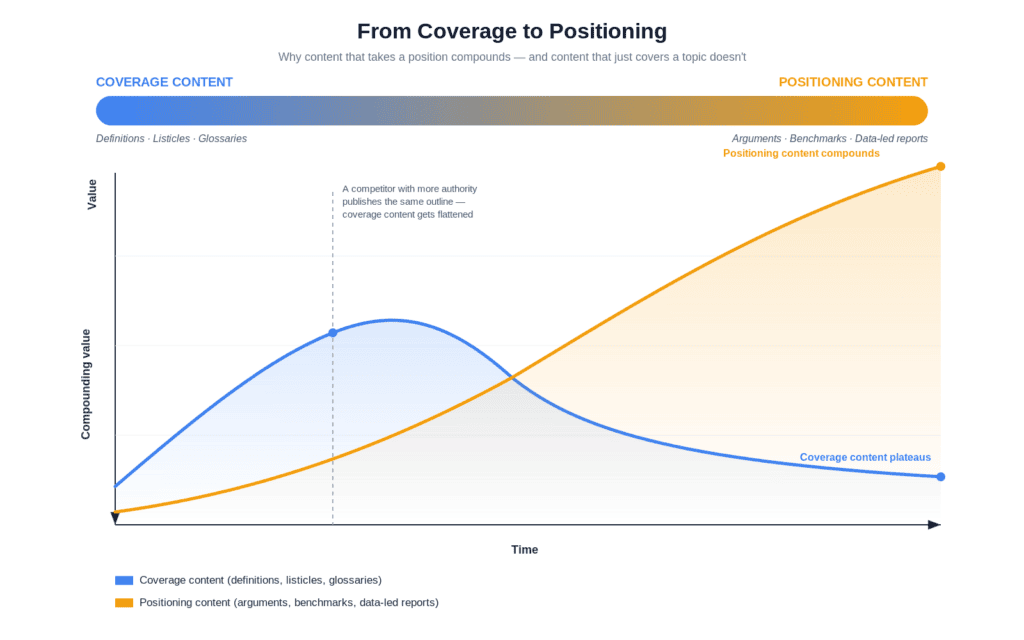
The default move in trust-and-safety content is comprehensiveness. You see it everywhere: a definitive guide that catalogs every flavor of attack, every regulation, every mitigation. There’s a place for that: foundational reference pages do earn links and rankings, but comprehensiveness alone is a commodity. Anyone can list the seven types of chargeback abuse.
What separates content that compounds is a point of view. The strongest pieces in this space don’t just explain a problem; they take a position on how to solve it and why the common approach is wrong. A well-built guide to payment fraud prevention, for example, does more than enumerate fraud types—it argues for a specific operating model: holistic platforms over point solutions, dynamic friction over blanket friction, machine learning over manual review. That argument is the asset. The definitions are just the on-ramp.
A thesis does things a glossary never can. It’s harder to copy—a competitor can replicate your outline but not your conviction. It earns more links, because people cite arguments, not definitions. And it’s more useful to a buyer trying to make a decision, who needs to know what to do, not just what the thing is.
The practical test: before you publish anything, ask whether a smart reader could reasonably disagree with it. If the answer is no, if the piece is just facts arranged in an outline, it probably isn’t taking a position worth reading. That’s the standard topical authority is built on: not volume of coverage, but depth of conviction on the topics that matter most to your buyers.
This framing also changes how you brief writers. Instead of “write a guide to account takeover,” the brief becomes: “argue that behavioral signals are more reliable than device fingerprinting for detecting account takeover, and explain why most off-the-shelf tools get this backward.”
That specificity produces a better piece every time. It gives your content team something to actually research and defend, rather than summarize from existing sources. It produces a draft that feels like it came from a practitioner, not a content mill.
The strongest trust-and-safety pieces often read less like blog posts and more like op-eds with receipts. They make a claim, show the evidence, anticipate the counterargument, and conclude with a recommendation. That structure is harder to write and harder to copy which is exactly why it works.
Map content to the actual buying committee
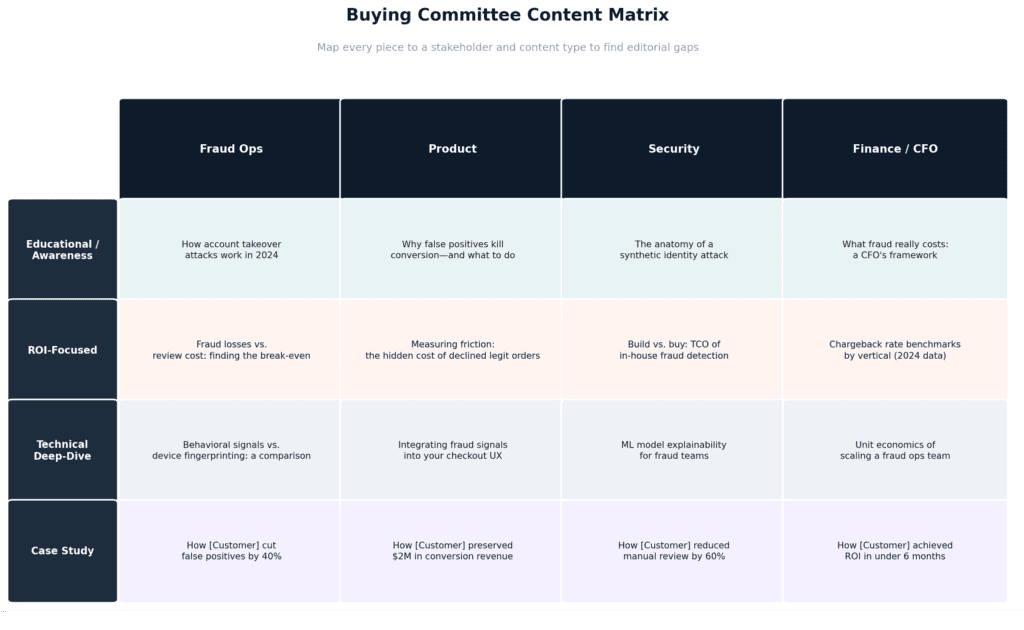
Fraud and risk purchases are rarely one person’s call. You’re usually selling to a fraud ops lead, a head of product, a security stakeholder, and a CFO who all evaluate the same tool against completely different anxieties. The fraud team cares about false positive rates. Product cares about checkout friction killing conversion. The CFO cares about chargeback losses and the cost of manual review headcount.
Most content programs in this category write almost exclusively for the practitioner, the fraud analyst Googling specific attack vectors at 11pm. That person matters, but they’re often not the one who controls budget. If every piece you publish speaks to detection mechanics and nothing speaks to the revenue impact of false positives or the operational cost of scaling a fraud team, you’ve built a library that ranks but doesn’t convert.
Spreading your content across the committee is how you fix it. For every deep technical piece on, say, account takeover signals, you want a corresponding piece that frames the same problem in the language of growth, churn, or unit economics.
This is where the “revenue, not traffic” framing earns its keep. Trust-and-safety is one of the few categories where you can credibly tie content to a dollar figure—fraud losses prevented, conversion preserved, review costs avoided. Use that. It’s your unfair advantage over horizontal SaaS competitors who can only gesture vaguely at ROI.
A useful exercise: map your last 20 published pieces to a buying committee grid. Across the top, list each stakeholder type. Down the side, list your major topic areas. Most teams discover that 80% or more of their content lands in one or two cells. The gaps become your editorial calendar for the next quarter.
This is B2B content strategy at its most practical, matching what you publish to what every decision-maker needs to see before they’ll say yes.
Consider the CFO lens specifically. Finance leaders signing off on fraud prevention tools want to see one thing: the cost of not having your product. Write that piece explicitly. Calculate the average cost of a chargeback in their vertical. Model the headcount implications of manual review at scale. Show what a 0.1% reduction in false positive rates means for conversion revenue at a company processing 10 million transactions a month.
This doesn’t require a data science team—it requires thinking about content ROI from the buyer’s perspective rather than your own. That reframe alone will surface content ideas your competitors haven’t thought to write.
Use your data — it’s the moat competitors can’t cross
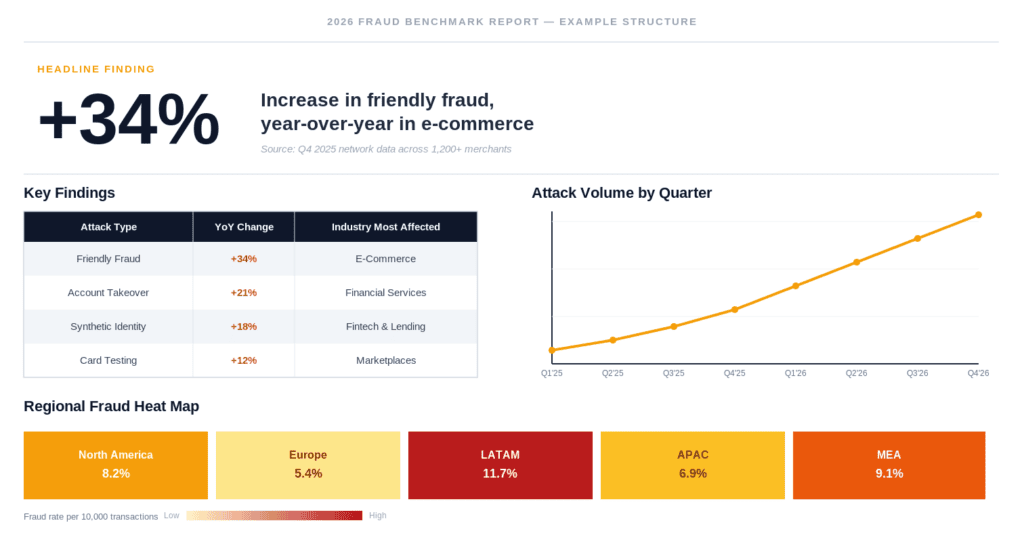
Fraud prevention companies sit on something most business-to-business (B2B) SaaS brands would kill for: proprietary data about a problem everyone in the market is anxious about. Volume of attacks blocked, emerging fraud patterns, regional differences in chargeback rates, shifts in attack vectors quarter over quarter. This is original research waiting to happen.
Data-led content is the single most reliable way to earn authority and links in a technical category, and it’s the format LLMs increasingly pull from when generating answers about fraud trends. A benchmark report or an index built on your own network data does several jobs at once: it ranks, it earns citations from journalists and analysts, it gives your sales team ammunition, and it positions you as the source of truth for how your category is defined. That last point is the real prize. The brand that defines the category’s vocabulary and benchmarks tends to become the default consideration.
None of this content can be replicated. A competitor can out-write you on a definitional guide. They cannot publish your network data. Lean into the asset only you have.
The format matters less than the consistency. A quarterly fraud index, an annual benchmark report, or even a regularly updated dataset page can all serve this function. What matters is that you publish on a cadence buyers can predict and cite. One-off data pieces earn a link spike. A recurring publication builds a reference asset that compounds. This is the difference between content that drives traffic and content that drives category authority—the compounding effect that content-led growth depends on.
When structuring data content, lead with the finding, not the methodology. “Friendly fraud increased 34% year-over-year in e-commerce” is the lead. The methodology goes in an appendix. Busy buyers—and the AI systems increasingly summarizing content for them—will extract the claim and attribute the source. That attribution, repeated across enough queries and citations, is how you build brand recognition that makes cold outreach feel warm.
Build for AI search, not just blue links
The discovery layer for technical buyers is shifting fast. A fraud ops lead evaluating vendors is increasingly likely to ask an AI assistant “what’s the best approach to preventing payment fraud at scale” before they ever type a query into Google. If your content isn’t structured to be cited by those systems, clear claims, supporting data, well-organized answers to specific questions, you’re invisible in the channel where early-stage research now happens.
This doesn’t require abandoning search engine optimization (SEO) fundamentals. It rewards them. Content with a clear thesis, original data, and clean structure is exactly what gets surfaced and cited in AI answers. The same investments that make your content defensible against competitor copycats make it legible to language models. Trust-and-safety brands that move early here will own the AI-generated consensus about their category before their competitors realize the consensus is being formed.
In practice, put the answer first. AI systems—and impatient buyers—extract claims and move on. If your conclusion is buried in paragraph six, it won’t get cited. Lead with the finding, follow with the evidence. That’s also how SEO content strategy has evolved: search engines and AI alike increasingly reward directness over the old “reveal the answer slowly” blog format.
Topic clusters matter here just as much. A well-linked set of pieces on a specific topic—account takeover, synthetic identity fraud, friendly fraud—signals topical depth in ways that isolated high-ranking pages don’t. AI systems use co-citation and link patterns to assess authority. A cluster of tightly related pieces, each linking to the others with natural anchor text, is worth more than the same number of standalone articles with no editorial relationship to each other.
Internal linking is easy to neglect in a category where the technical content feels like the hard work. Don’t let it be an afterthought. Every time you publish a new piece, spend 20 minutes updating existing articles to link to it. This is one of the highest-leverage editing tasks in content operations—it costs almost nothing and quietly raises the authority of every page it touches. The returns compound slowly and then all at once.
The throughline
The trap in this category is treating content as table stakes—something you produce because everyone else does. The opportunity is treating it as a positioning weapon. You have a sophisticated buyer who respects substance, a quantifiable problem you can attach to revenue, and proprietary data nobody else can touch.
Most of your competitors are wasting those advantages on glossary content. The question isn’t whether content can work for a trust-and-safety brand. It’s whether you’re willing to make it argumentative, committee-aware, data-driven, and structured for AI—before the competitor who gets there first owns the conversation instead of you.
Fraud losses prevented, conversion preserved, review costs avoided, if you want to put real numbers behind your content program the way this article argues you should, our Organic Traffic Growth Model will help you map the traffic and pipeline impact before you brief a single piece.