Key takeaways on GEO strategy
- A GEO strategy is an operating system, not a stack of hacks. It earns a place in the buyer’s consideration set by aligning content, technical infrastructure, and brand signals around real buyer demand.
- GEO doesn’t replace SEO. It changes what SEO has to account for. The levers that matter most (crawlability, synthesis across sources, and information gain) sit on top of traditional ranking factors.
- Being cited and being recommended are two different outcomes. A page can show up in an AI answer without ever being the brand that answer actually endorses, which is why brand and source signals matter as much as the content itself.
- AI-influenced discovery can happen without a trackable click. Self-reported data, combined with your existing analytics data, helps uncover that influence.
Table of contents
- Key takeaways on GEO strategy
- What is a GEO strategy, and why does it matter now?
- GEO vs. SEO: how generative engines change the playbook
- The 4 core components of a GEO content strategy
- Measuring the impact of a GEO marketing strategy
- Where to start with generative engine optimization
- Frequently asked questions about GEO strategy
Many, if not most, SEO managers have been handed a new mandate: own AI search visibility in addition to the rankings reports they’ve always owned. The ability to tackle this now even shows up as a contingency in the hiring process. (62.2% of SEO job postings name AI search skills explicitly, which is nearly double the prior year’s rate.)
However, a lot of advice available treats a GEO strategy as a checklist of formatting hacks. Schema markup here, FAQ blocks there, an “AI-friendly” rewrite of the homepage.
While these tasks can be helpful, they won’t set you up for max or long-term success. A GEO strategy works best when it’s grounded in buyer research and tied to measurable outcomes like pipeline. B2B buyers are already deciding who belongs on their shortlist before a single click reaches your site, which means the strategy has to start earlier than most GEO roadmaps currently do.
What is a GEO strategy, and why does it matter now?
A GEO strategy is an organizational system for earning a place in the buyer’s consideration set. It’s built from content, technical, and brand work that gets you onto an AI system’s shortlist by default, the way strong SEO used to land you on Google’s first page by default. It isn’t a one-off attempt to hack a single AI citation.
After all, the volume of B2B research happening inside AI tools has skyrocketed over the past couple of years. And there are no signs of it slowing down, either. It’s no shocker that, in addition to AI search requirements in job postings, nearly 30% of SEO titles now carry AI-specific language outright.
Developing a GEO strategy is no longer a future-proofing exercise. If you don’t have a strategy that’s already starting to show promising results, you need one yesterday.
Understanding how B2B buyers actually behave in the LLM era is the foundation everything else here builds on. Download B2B Buyer Behavior in 2025 to see how buyers use channels, build trust, and make decisions once AI tools enter the research process.
GEO vs. SEO: how generative engines change the playbook
A lot of the GEO-versus-SEO debate gets framed as a replacement question, as if one discipline is sunsetting the other. It isn’t.
Ranking in generative engines shifts which levers matter most—for example, crawlability, synthesis across multiple sources, and information gain. But the shift only happens relative to the ranking factors a traditional SEO program optimizes for. The underlying system is the same: be found, be understood, be trusted.
Search engine optimization and generative engine optimization work are best managed together, under one strategy, answering to one set of buyer questions.
The mechanics back this up. For example, Omniscient co-founder and CRO Alex Birkett has pointed to research on how AI pre-search shortlists actually form. ChatGPT writes brand names into its own search queries—a kind of query fanout—before it ever fetches a page. In one case study, brands showed up in the first query 21 of 27 times, even when the user never named them.
Large language models recall who belongs in a category “from training data, from the model’s existing understanding of who matters,” as Alex puts it. Being on that shortlist carried a 68.9% chance of appearing in the final answer, whereas being findable but off the shortlist dropped to 2.1%.
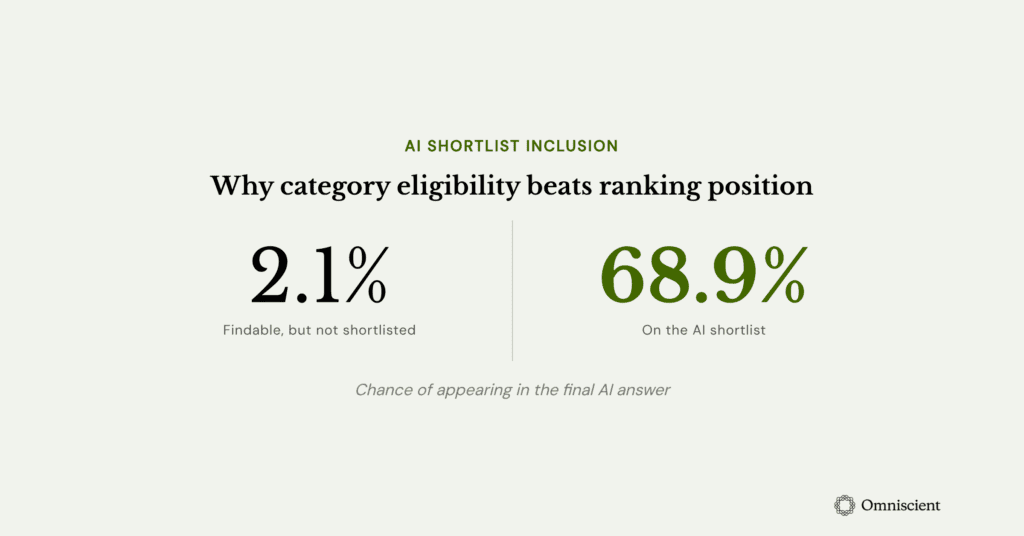
In other words, category eligibility, well ahead of ranking position within a results page that may not even exist for a given query. Benji Hyam and Devesh Khanal echoed this theme while comparing notes with Alex on which popular AEO claims hold up under scrutiny and which don’t.
The 4 core components of a GEO content strategy
Operationalizing a GEO content strategy means working across four pillars at once:
- Modeling real buyer demand
- Building content that earns a spot in the consideration set
- Shoring up the technical infrastructure AI systems actually depend on
- And shaping the wider source ecosystem that feeds AI answers
Skip any one of them and the other three compound slower.
Content that’s based on thorough, up-to-date buyer research earns more durable AI citations than generic “AI-friendly” formatting ever will. Durability comes from saying something a model’s training data hasn’t already flattened into a cliché.
1. Modeling real buyer demand
This work starts before any content gets written, before you open Ahrefs to do keyword research, and before you start tracking any AI prompts. It combines various elements into a single model of how buyers actually evaluate vendors in a category:
- Voice-of-customer research
- Sales conversations
- Competitive intelligence
- Search behavior
These tell you the comparisons your buyers run, the problems they’re trying to solve, and the criteria that separate a shortlist candidate from the pack.
But remember: Not every topic a buyer could ask about deserves equal investment—prioritization matters as much as the research itself. The questions worth answering first directly influence commercial consideration. Think category searches, product comparisons, alternatives pages, and use-case queries
Skip this step and the other three pillars inherit the gap. Technically flawless, well-distributed content built around the wrong demand model still won’t earn a place in the consideration set.
2. Content built to win the consideration set
The next component is content. The stuff that wins depends entirely on where the reader sits in their buying journey, and the gap between stages is larger than most teams assume. Our research across 5,323 LLM outputs breaks down citations by buying stage.
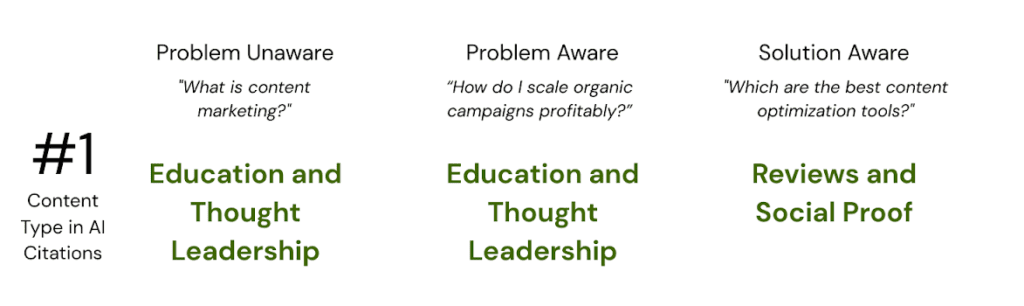
Education and thought leadership dominate problem-unaware queries by far (86%), while social proof barely registers at that stage.
Move one stage down the funnel, and the picture shifts slightly. Educational content still holds 74% of citations at problem-aware, but social proof more than doubles to 22%, with listicles doing most of that work.
By the solution-aware stage, the pattern flips outright. Social proof accounts for 51% of citations, with listicles alone driving 47.3%. But even then, educational content hangs on to 42%.
The TL;DR: As purchase intent grows, AI citation share moves from educational content to social proof. Write for that shift explicitly. A problem-unaware piece and a solution-aware comparison page shouldn’t read like variations on the same template. They’re answering different questions for a reader with different levels of conviction.
Some of the sharpest execution of this comes from teams working in constrained categories, where niche B2B SEO forces this kind of precision. Even if that’s not your circumstance, there’s value in borrowing that approach.
3. Technical foundations AI crawlers and agents need
Traditional technical SEO has always demanded a strong technical layer, and shoring yours up is still useful in this era dominated by AI search. A page an AI system can’t crawl or parse has a much lower chance of being cited. So you need to cover all the main bases:
- Agentic readiness
- Crawlability
- Structured data
- Internal linking
Here’s the part worth being honest about, though. Schema didn’t move the needle for pages that were already being cited.
Ahrefs tested this directly, tracking JSON-LD schema added to 1,885 pages and comparing them against roughly 4,000 matched control pages. The result: no statistically significant citation lift on ChatGPT or Google AI Mode, and a small, statistically significant decline on Google AI Overviews that the researchers couldn’t confidently attribute to schema. To sum it up, structured data is still worth doing; it just isn’t the lever that decides whether you show up in AI answers.
Crawlability and clean information architecture are table stakes. Schema belongs in the hygiene-factor column, and the budget you were planning to spend perfecting markup probably belongs somewhere else on this list.
4. Brand and entity signals that earn AI recommendations
Alex calls this brand gravity: the rest of the web echoing and corroborating who you are. It has three components.
- Consistency: Third-party information—whether from forums, reviews, or media coverage—matches how you describe your brand on-site.
- Category association: You get discussed in the context of your specific category instead of being mentioned in loosely related contexts.
- Third-party corroboration: Other sources back up your claims since LLMs “[don’t] trust your homepage alone.”
To double-tap on why this matters, an LLM will reference content that’s accurate and relevant. However, recommending a brand takes stronger evidence than that. Reviews, industry coverage, and community discussion that tell a consistent story about who’s actually good at the thing you do. Off-page work like digital PR and third-party validation isn’t a nice-to-have anymore; it’s load-bearing.
Once you’ve got the pillars down, the harder part is applying them without defaulting back to formatting checklists. Grab the AEO Field Guide for the mental models and pitfalls worth knowing before you operationalize any of this.
Measuring the impact of a GEO marketing strategy
None of the above matters if you can’t connect it to pipeline. A GEO marketing strategy that optimizes for AI-mention counts alone is just as bad as an SEO program that equates success with traffic increases.
That said, proving connection to pipeline does have its challenges. Omniscient’s own pipeline data found that first-touch attribution captured only 15% of self-reported AI-sourced leads, with the rest scattered across Organic Search, Direct Traffic, and Referral/Other. That’s a structural issue. 87% of Omniscient’s citations live on third-party pages that first-party and server-side tracking can’t see.
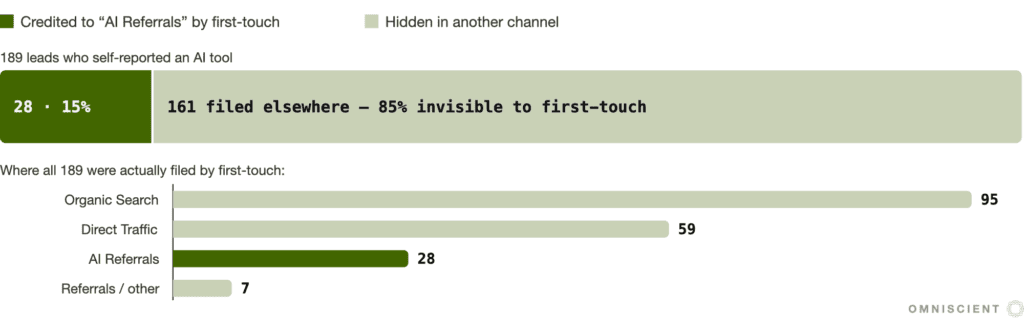
So don’t wait for better pixels. Build self-reported attribution into your intake forms now, and treat it as a lower bound rather than a precise number. Additionally, apply a simple test to the measurement method itself: would more precision actually change what you’d do next? If not, don’t invest in getting it. That’s the core of what Alex calls marginal analysis — choosing the method that most changes your decision, not the one that looks most rigorous in a board deck.
Avoiding vanity “AI visibility” metrics is exactly the model Omniscient’s practitioner-led GEO work is built around. Our programs prioritize buyer and anchor to revenue. Plus, we have healthy skepticism when it comes to any number that can’t be traced back to a decision it should change.
Measuring this correctly is its own discipline, separate from running the strategy itself. Read Measuring Organic Growth in 2025 for the metrics and attribution models worth building your reporting around before you present this to leadership.
Where to start with generative engine optimization
Many teams pick a GEO tactic (schema, FAQ blocks, a citation tracker) and then go looking for a strategy to retrofit around it. Flip it. Model actual buyer demand first, then let the tactics follow from what you learn.
There’s also a timing argument that doesn’t get made often enough. Alex argues that AI search compounds the old narrative about a category faster than SEO ever did. That’s “absolutely amazing if the compounding is in your favor, but a runaway train if not.”
Challengers get a real opening here. They can offer more specificity than the incumbent and a sharper read on what the buyer actually struggles with. But that window closes as soon as the market settles on who belongs in the category. Early movers get the benefit of the doubt; late ones have to argue against an already-settled narrative.
Practically, that means treating this the way a good experimentation program treats any new channel: pilot it, measure it against decisions rather than vanity numbers, and expand what works. The same discipline that improves testing cadence in content teams applies here—a tight pilot beats a sprawling six-month rollout nobody can evaluate.
For example, look into how SEO and GEO strategies have already driven measurable pipeline results for B2B companies. Read the OnBoard case study and book a free strategy call to map what the same approach could do for yours.
Frequently asked questions about GEO strategy
How do I get my content to show up in AI search answers?
Start by making sure AI crawlers can actually access and parse your pages. That’s table stakes.
From there, the real gains come from:
- Category-specific, research-backed content
- And third-party corroboration (reviews, press, community discussion)
Schema alone isn’t a proven citation-growth lever, and there’s no special markup required for Google’s AI features. Keep content accessible and well structured, then build category-specific content and credible third-party corroboration.
Why isn’t my brand being cited in AI-generated search results?
Weak category association can be one reason your brand isn’t appearing, but it’s not the only one. Check technical eligibility and content relevance alongside how consistently credible sources connect your brand to the category.
If those sources don’t consistently associate your brand with the category, strengthen that corroboration. Also check whether your own product pages, case studies, and articles clearly demonstrate the capabilities buyers are asking about.
Does updating old content help generative engine optimization?
Sometimes. And extensive updates may not always be necessary.
For instance, Otterly.ai ran an experiment updating only the visible “last updated” date on 10 existing articles, with no content changes. It saw citations rise 31.5% over the following 30 days across ChatGPT, Claude, Perplexity, and four other platforms.
The authors call the result directional rather than conclusive: citations were already trending before the date change, so the experiment suggests a possible role for freshness signals without isolating their impact. That’s reason enough to treat your content refresh calendar as part of your GEO strategy, not a separate housekeeping task.