
Marketing a database product built for a narrow, technical buyer forced us to rethink most of what passes for conventional wisdom on SEO for niche B2B software. When your total addressable audience searches in the hundreds rather than the thousands, volume-chasing tactics stop working and a different set of rules takes over.
The same is true for categories like specialized project tracking tools built for a single engineering discipline.
This piece breaks down what actually moved the needle, and what any marketer selling a specialized product to a small, high-intent audience can borrow.
Why Niche B2B Software Breaks the Standard SEO Playbook
Most SEO advice is built on an assumption that doesn’t hold for niche software: that there’s real, measurable search volume behind your category, and a broad enough buyer pool to justify publishing at scale. Standard SaaS SEO playbooks tell you to map keyword clusters by volume, build content hubs around the highest-traffic terms, and let programmatic or templated pages do the heavy lifting.
A purpose-built custom database software product, the kind a handful of engineering and data leaders evaluate per quarter, not thousands of self-serve buyers per month, doesn’t work that way. Head terms return a rounding error’s worth of monthly searches, if they show up in keyword tools at all. The buyer pool is small and specific, and it often doesn’t search the way keyword tools expect.
Buyers ask colleagues, read vendor comparisons buried in Slack threads, or search for the problem rather than the category name. A niche project tracking platform built for, say, hardware manufacturing teams faces the exact same gap: the category term barely registers, but the pain-point searches around it are highly qualified.
In that environment, “more content, more keywords” wastes effort rather than driving it. Publishing volume for the sake of coverage produces pages that rank for nothing, convince no one, and dilute the few pages that could actually do work. The five lessons below outline what we did instead.
Lesson 1: Keyword Research Has to Start With the Buying Committee, Not the Volume
When head-term volume is near zero, a volume-first keyword research process breaks immediately. There’s nothing to rank-order. So we flipped the starting point: instead of asking “what has the most search volume,” we asked “who is in the room when this purchase gets decided, and what does each of them need to know before they’ll sign off?”
For a custom database software product, that buying committee typically includes a handful of distinct roles: the engineer who will actually operate the system, the architect weighing it against a build-vs-buy decision, and a budget owner who needs the business case translated into risk and cost terms. Each of those roles searches differently, even when they’re evaluating the same product. The engineer searches for specific technical constraints and failure modes. The architect searches for comparisons and migration paths.
The budget owner, if they search at all, searches for total cost of ownership and case studies. A vendor selling niche project tracking software would map this identically: the practitioner who logs into the tool daily, the ops lead comparing it to a build-vs-buy or spreadsheet alternative, and the finance stakeholder weighing per-seat cost against consolidation.
Mapping keywords to these roles rather than to a volume curve surfaced a set of long-tail, low-volume, high-intent terms that a standard tool would have deprioritized or missed entirely. Low volume didn’t mean low value. It meant the term was precise enough that almost nobody else was searching it, and almost everyone who did was a real buyer.
For a structured way to run this kind of committee-first research, our keyword research framework is a useful starting point, even though it needs to be adapted for near-zero-volume categories.
Lesson 2: Content Has to Sell as Much as It Ranks
In a high-volume category, a single ranking page can afford to be purely informational. The traffic is large enough that even a low conversion rate produces a real pipeline. That math doesn’t work in a niche category. If a page only gets a few dozen relevant visits a month, it has to convert a meaningful share of them, which means every ranking page also has to do sales-enablement work.
That reshaped how we approached content briefs and on-page calls to action. A standard SaaS content plan optimizes primarily for search intent and secondarily for conversion. Ours had to treat those as equally weighted from the start because a technical buyer landing on the page is often mid-evaluation, skeptical by default, and actively looking for reasons to rule the product out. Content that doesn’t address that skepticism directly loses the reader before it has a chance to convert them.
What Changed in the Content Brief Itself
A few specific additions became standard in every brief:
- Objection-handling sections written into the outline, not bolted on. Instead of a generic FAQ at the end, we built objection-handling directly into the body of the page, addressing the build-vs-buy question, migration risk, and total cost of ownership at the point in the page where a skeptical reader would naturally raise them.
- Technical proof points, not marketing claims. Benchmarks, architecture diagrams, and specific performance numbers replaced generic claims like “fast” or “scalable” because a technical buyer discounts unsupported claims immediately.
- Comparison tables against the realistic alternative. For most of our buyers, the real alternative wasn’t a competitor product, it was building the capability in-house. Every relevant page needed a direct, honest comparison against that option, not just against other vendors.
For more on adapting standard content marketing playbooks to this kind of buyer, see our niche B2B content marketing guide.
Lesson 3: Topical Authority Beats Chasing More Keywords in a Thin SERP
The natural instinct in a thin search category is to publish more: if no single page can capture much volume, publish enough pages to add up to something. We tried a version of that early on, and it didn’t work. Thin content spread across many pages didn’t build authority. It diluted authority, and none of the individual pages had enough depth to actually rank or convert.
What worked instead was the opposite move: shrinking the content plan down to a small number of deep, thoroughly interlinked pages built around the handful of terms and questions that actually mattered to the buying committee.
Each of those pages went deeper than anything else in the category, because “anything else in the category” often didn’t exist. In a thin SERP, depth is a much lower bar to clear than it is in a crowded one, and it’s a durable advantage once you clear it—a competitor would need to out-invest a well-built page rather than simply match it. Plus, when a category has almost no search volume, AI search visibility starts to matter more than ranking, because a buyer researching an unfamiliar category is more likely to ask an assistant than to work through page one.
Lesson 4: Digital PR Fills the Gap When Nobody’s Covering Your Category
Traditional link building assumes there’s an ecosystem of publications, blogs, and communities actively writing about your space. That’s what guest posts, roundups, and typical outreach plays are built on. In an under-the-radar product category, that ecosystem is thin or nonexistent.
Nobody is writing “best Custom Database software for X” roundups because there aren’t enough products, or searchers, to justify the post. The same holds for a specialized project tracking category serving a single vertical, the roundup posts simply don’t exist yet.
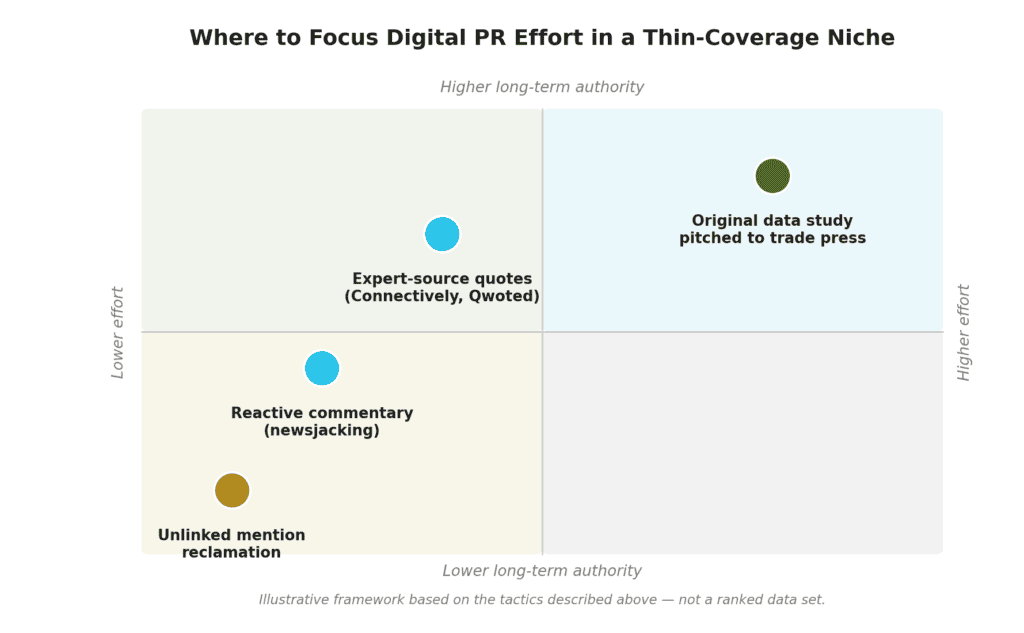
That forced a shift from outreach-style link building to digital PR: earning coverage through journalists and analysts instead of asking site owners for a placement. In practice that meant answering expert-source requests on platforms like Connectively and Qwoted with tight, credentialed quotes a technical reporter could use verbatim, and pitching a single original data study to five or six trade publications rather than mass-emailing fifty.
It also meant reactive commentary: when a relevant story broke in the category, whoever on the team could turn around a sharp, specific quote within hours got the placement, and a quick pass to reclaim existing brand mentions that never carried a link. None of this scales the way guest-post outreach does, but in a category with few natural coverage opportunities, a handful of earned placements from a credible practitioner did more for authority than a large volume of low-quality links would have.
Increasingly, that also meant tracking whether the earned coverage showed up as a citation in AI Overviews and chatbot answers, not just whether it produced a backlink, the two don’t always move together, and in a thin-coverage category, AI citations can be the more valuable of the two.
Lesson 5: Product and Usage Data Are an SEO Asset Most Teams Waste
One advantage a product company has that a pure content or agency team doesn’t: real usage data. Anonymized customer benchmarks, query patterns, performance data, and adoption trends are all raw material for original research, and original research is exactly the kind of content that earns links and citations in a category where secondary sources are scarce.
Most product teams sit on this data without ever turning it into content. That’s a missed opportunity specifically in niche categories, where “the only source that has this data” is a genuinely defensible position, competitors and commentators alike have to cite you if they want to reference the benchmark at all.
Turning that data into a real asset usually comes down to whether someone on the team is pushing to prioritize it, since this kind of work rarely happens organically without a champion advocating for it against more immediate product priorities.
What SEO for Niche B2B Software Actually Looks Like in Practice
Pulled together, the five lessons collapse into a short, practical checklist:
- Start keyword research from the buying committee, not from a volume report: map terms to roles and pain points, not rank order.
- Write every page to sell as much as it ranks: build objection-handling, technical proof, and honest comparisons into the brief itself.
- Go deep on a small number of pages instead of wide across many: it’s a lower bar to clear in a thin SERP, and a more durable advantage once you clear it.
- Replace volume-based link building with a lean digital PR program: expert-source quotes, one well-pitched data study, and fast reactive commentary.
- Turn product and usage data into original research: it’s one of the few link-worthy assets a niche product company has that competitors can’t easily replicate.
For teams that want the fuller strategic framework this checklist sits inside, our B2B SEO strategy framework is a useful next read.
Proof: What a Focused, Niche SEO Strategy Can Deliver
Shipyard, a cloud-based data orchestration platform serving a similarly technical, niche B2B buyer, is a useful proof point for what this approach can do over a longer runway.
Over a roughly 13-month engagement, Omniscient Digital ran a four-phase strategy: aligning on goals, auditing existing content, building a full-funnel content plan, and executing against it with a small, consistent output, about four search-optimized blog posts and four high-authority backlinks a month, all built around topical authority in data orchestration, the modern data stack, and DataOps.
The results tracked the same pattern covered in the five lessons above: fewer, deeper pages outperforming a scattershot content plan. Monthly organic blog pageviews grew 735%. Page-one keyword rankings grew 309%, from 58 to 289 total ranking keywords, with more than 130 landing on page one. Domain rating was on pace to double, and trial account creation, the metric that actually mattered to the business, grew 771%.
None of that came from chasing volume. It came from the same discipline covered in the five lessons above: a small number of deep pages, built around real buyer questions, sustained consistently over time.
If you’re marketing a specialized product to a small, high-intent audience, whether custom database software or a purpose-built project tracking tool, and want help building a strategy around it, our SEO and content strategy team can help you figure out what it should look like for your category.
Frequently Asked Questions About SEO for Niche B2B Software
Is SEO worth it for a niche B2B product with low search volume?
Yes, when the goal is qualified pipeline rather than traffic volume. Low search volume doesn’t mean low value in a niche category. The small number of people searching are often deep into an active buying process, so a handful of well-targeted, high-intent pages can outperform a much larger volume-driven content library on pipeline contribution, even with modest traffic numbers.
How is SEO different for a niche or custom software product than for a mainstream SaaS product?
The core difference is that keyword research, content, and link building all have to be built around a small buying committee instead of a broad market. That means fewer pages, more depth per page, more sales-enablement built into content, and link building that relies on original data and partnerships rather than volume-based outreach, since natural coverage of the category is thin to begin with.
How long does it take to see SEO results for a niche B2B software category?
It varies, but niche categories can sometimes show meaningful results faster than crowded ones because there’s less competition to outrank. A well-built page targeting a precise, low-volume, high-intent term can rank within a few months in a thin SERP, though building the broader authority and link profile needed to convert that visibility into consistent pipeline typically takes longer, often six months to a year, depending on how established the category and the vendor already are.