A performance marketer running paid social will ship 30 to 50 creative variants in a week. A B2B content team will ship four blog posts in a month and will have decided what those four posts were about roughly 60 days earlier.
That difference is the creative velocity gap, and budget or headcount doesn’t explain it. Both teams are trying to answer the same question: which message actually moves this audience. One team gets an answer in 72 hours. The other waits a quarter and often never gets a clean read at all.
The gap exists because the two disciplines designed their cycles around different assumptions. Performance marketing assumed from the start that most ideas fail and built a system for finding the ones that do not. Content marketing inherited its planning rhythms from traditional marketing, where the calendar came first and learning came later, if at all.
There is a lot worth stealing here. There is also a limit to the analogy, which most writing on agile content marketing skips over, and which matters more than the borrowed vocabulary.
The velocity gap in numbers
Agile ways of working are not new to marketing, and the adoption data is more interesting than the evangelism suggests.
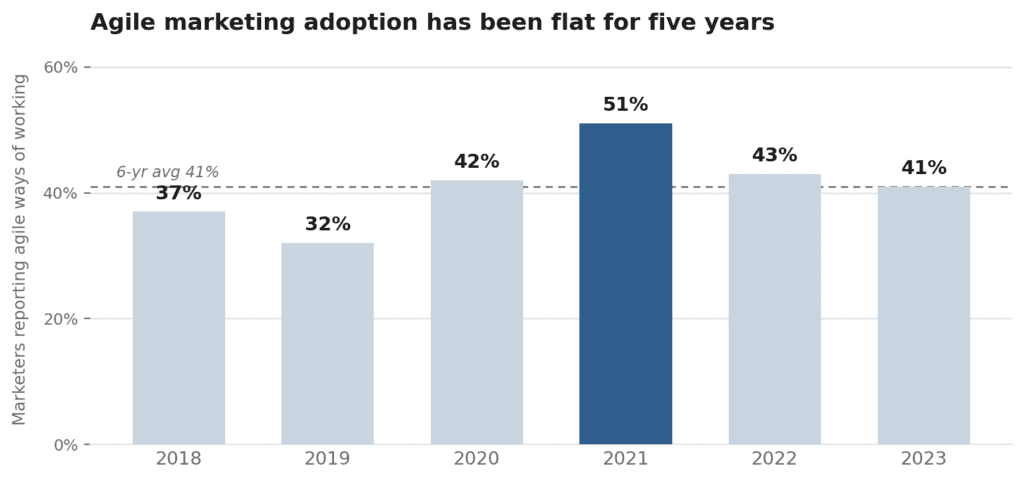
Adoption has been broadly flat for half a decade. It peaked at 51% in 2021 and has hovered in the low forties since. That is not the curve of a practice that is quietly winning. It is the curve of a practice that a lot of teams try, partially implement, and stall on.
The 2026 report puts a sharper point on why. Nearly half of teams who describe themselves as agile say they are only “somewhat agile,” having picked up sprints or a kanban board without building the underlying operating model. The vocabulary spread faster than the practice did.
That matters for this discussion because it tells you where the real work sits. Adopting the ceremony of an agile methodology is easy and largely cosmetic. Adopting the feedback loop underneath it is the part that closes the velocity gap, and it is the part most teams skip.
Why content cycles are slow by design
Look at where the time actually goes in a typical content strategy.
You run keyword research. You build content plans for the quarter. You brief, draft, edit, design, publish, and then wait for indexing, wait for rankings to settle, and wait for enough sessions to say anything about performance.
Six weeks is optimistic. Three months is normal.
During that entire window the team is operating on untested assumptions: that the query maps to a real problem, that the angle chosen was the right one, that the reader cares about the benefit you led with. Every brief encodes a stack of guesses, and the program only finds out whether the guesses were right after the money is spent.
Keyword volume does not rescue you, because volume tells you how many people search a phrase. It says nothing about whether your framing of that phrase is compelling. Two articles can target the same query and perform very differently on angle alone. Omniscient’s own B2B organic growth playbook makes a related point about strategy translating cleanly to execution, and the translation layer is exactly where framing decisions get made or fudged.
Performance marketers face the same uncertainty. They simply refuse to wait a quarter to resolve it.
What performance marketers actually do differently
Three habits account for most of the difference, and none of them require a paid budget to adopt.
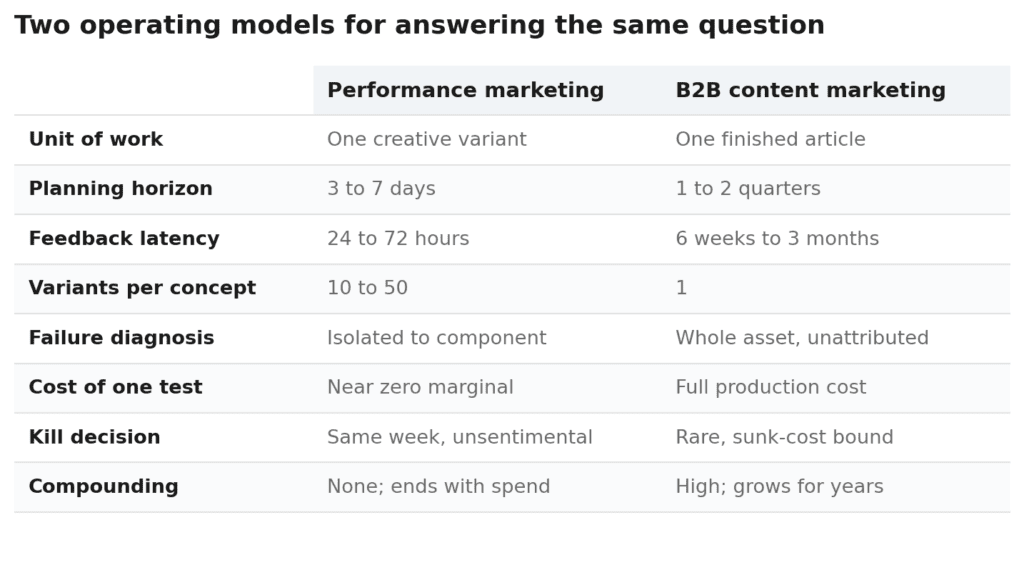
Image source: Original framework developed by the author , Visual generated using ImagineArt
They test variants, not finished pieces. A paid team does not produce one ad and hope. It produces one concept expressed 12 ways, holds everything constant except the hook, and lets the platform sort them. The unit of work is the variant, not the asset.
They read signals at the component level. When an ad underperforms, the team knows whether the hook failed or the offer failed, because the team isolated each one. Content teams usually learn only that a post underperformed, which is not actionable and leads to the wrong post-mortem conversation.
They kill things quickly and without ceremony. Sunk cost has less grip when an asset took 20 minutes to produce. Teams almost never kill a 4,000-word pillar page that took three weeks, even when the data says they should.
The enabling condition for all three is cheap production. Testing 12 variants only works if variant 12 costs roughly what variant one did. This is why performance teams gravitate toward whatever they judge the best AI Ad Studio for batch output to be. ImagineArt’s, for example, treats hook, presenter, background, and script as independently swappable, which is the specific property that makes a readable test possible rather than merely a faster one.
Content teams have historically had no equivalent, which is why the variant habit never crossed over. That is changing, and it is why this comparison is worth making now rather than five years ago.
Five practices worth stealing
Run content in sprints, not quarters
The single most effective change is shortening the planning horizon. Two-week cycles force a team to commit to a small batch, ship it, and look at the result before committing again.
You do not need full scrum to get the benefit, and importing an entire project management methodology usually creates more overhead than it removes. Take the parts that carry weight.
Short stand-up meetings keep blockers visible. A kanban board makes work in progress obvious, and work in progress is where content teams quietly drown: 11 half-finished drafts and nothing shipped. A retrospective at the end of each cycle captures the learning instead of leaving the team to rediscover it next quarter.
Skip the parts that do not transfer. Most content teams do not need a dedicated scrum master, and story point estimation on creative work tends to manufacture false precision. A 1,500-word explainer and a 1,500-word original research piece are not the same size in any useful sense. The agile approach is worth adopting. The ceremony around it usually is not.
One practical constraint: the cycle only works if something ships at the end of it. If your review chain takes 11 days, your two-week sprint is a two-week queue with a meeting attached.
Write briefs as user stories
Performance creative starts from a person and a moment, not a keyword. Borrowing user stories from agile methodology forces the same discipline. Rather than briefing “2,000 words on inventory forecasting,” brief “a supply chain lead who just missed a quarter needs to explain to their CFO why the forecast was wrong.”
The second version tells the writer what the reader is feeling, what they need to walk away with, and which objection to handle first. The first tells them a word count.
This is also where your personas stop being decorative. Omniscient’s content outline process builds jobs-to-be-done directly into the outline stage for this reason, and their content brief template treats the brief as the communication tool between strategy and execution. A brief written that way survives a handoff. A brief written as a spec does not.
Build a variant layer above the asset layer
Do not test whole articles. Test the framings that go into them.
Take one planned piece and extract the four or five arguments competing inside it: a cost angle, a risk angle, a speed angle, a status angle. Express each cheaply, as a social post, an email subject line, a short video, or a simple infographic. Ship them, watch which earns attention, and write the article around the winner.
This works particularly well at the cluster level, where a pillar and cluster structure already forces you to decide what the parent argument is. Test the parent argument before you commit six child pieces to supporting it.
The same logic applies across formats. A podcast episode, a set of infographics, and a long-form post are three expressions of one argument that cost wildly different amounts to produce. Test in the cheap format, publish in the expensive one.
Instrument leading indicators
Content teams measure lagging indicators almost exclusively. Page views, rankings, and pipeline all arrive too late to steer with.
Add leading metrics that resolve inside a single cycle: three-second view rate on the variant, hold rate on video, reply rate on the email version, scroll depth on the published piece. These are cruder than your quarterly KPIs and they arrive roughly 40 times faster, which is the entire point. Keep the lagging metrics for reporting and use the leading ones for decisions. Confusing the two is how teams end up reporting page views to an executive team that wanted pipeline.
Shorten the publish path
Velocity dies in handoffs. Every step between a finished draft and a live page is latency, and most B2B teams have five or six of them.
Some of this is infrastructure. A headless CMS removes the developer dependency that turns a two-hour change into a two-week ticket, and teams that migrate to a headless CMS usually name publishing frequency as the first thing that improves. Some of it is workflow consolidation. An Agentic AI Workspace can carry a brief through research, drafting, visuals, and a publishable page without the exports and re-uploads between six tools, which is where cross-functional teams lose most of their calendar.
Audit your own path once. Count the handoffs between “draft approved” and “live.” Most teams are surprised.
Where the analogy breaks
Anyone selling agile content marketing as a methodology will skip this section, so here it is.
SEO compounds and paid does not. A paid variant either works this week or it is dead. An SEO asset can rank in month nine after eight months of nothing.
Applying paid kill criteria to organic content will cause you to cut assets that were about to work. The right move on an underperforming post is usually a content refresh rather than deletion, which is the opposite of the paid instinct. Rapid iteration validates direction. It does not judge published assets.
Feed psychology is not search psychology. A message that stops an interrupted scroller is not automatically the message that satisfies someone who typed a question. Emotional hooks tend to overperform in feed and underperform in search, where specificity and completeness carry more weight. Treat variant results as a prior to update on, not a verdict.
Sample sizes rarely cooperate in B2B. Long cycles, buying committees, and small addressable audiences make feed testing noisy. If your total market is 4,000 accounts, a creative test is a qualitative signal wearing quantitative clothing. Read it as directional and stop there.
Cheap production invites lazy tests. When variations cost almost nothing, the temptation is to run 30 and change several variables at once. The result is unreadable. Cheap production raises the discipline required rather than lowering it.
Agile theatre is the common failure mode. This is the one the adoption data already warned us about. Teams adopt sprints, stand-up meetings, and a kanban board, then keep making the same annual planning decisions inside a two-week wrapper. If one cycle’s output never changes the next one’s plan, you have bought ceremony, not agility.
A 90-day agile content marketing roadmap
An agile content marketing roadmap is not a content calendar with shorter rows. It’s a sequence of decisions where the result of one funds the next.
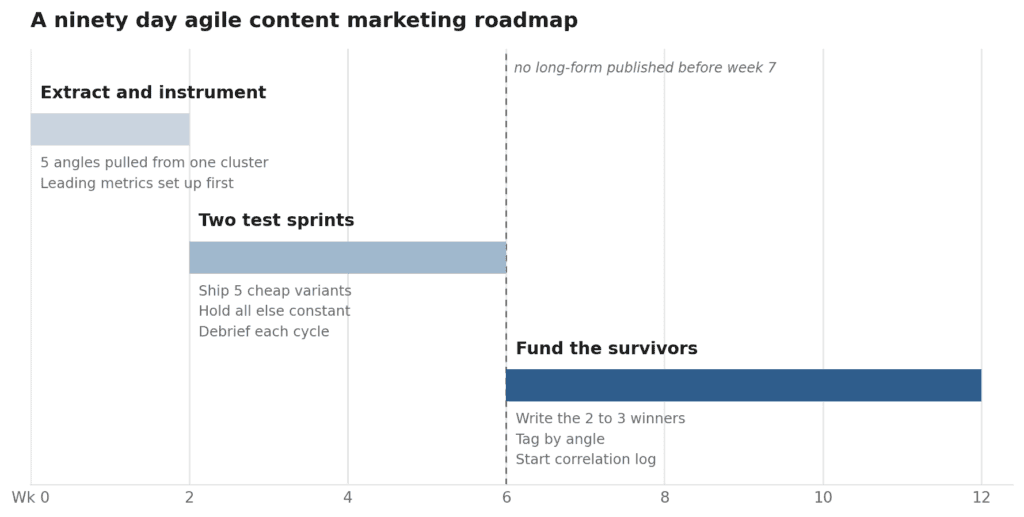
Source: Original framework by the author.
Weeks 1–2: extract and instrument. Pick a single cluster from your existing content strategy and pull five competing angles out of it. Write them as sentences a person would say out loud. Set up your leading metrics before you ship anything, because retrofitting measurement is how the first cycle produces no learning.
Weeks 3–6: two sprints, no long-form. Ship the five angles as cheap variants. Hold everything constant except the message.
Debrief at the end of each one and write down what you would do differently, not just what happened. Resist the urge to publish the article yet. That urge is the old cadence reasserting itself.
Weeks 7–12: fund the survivors. Write the two or three pieces whose framings earned attention. Tag each published piece with the angle it was built on and begin the correlation log. Once you have 30 or 40 tagged pieces, you can start comparing variant attention scores against organic outcomes, and that is the point where this stops being a tactic and becomes a model of your audience.
By day 90 you should have a small library of tested framings and an honest answer to whether the loop earns its keep in your market. If it does not, stop running it. That is a legitimate finding and a cheap one to obtain.
If you would rather not build this operating model from scratch, this is roughly the work Omniscient Digital does for B2B software companies.
The short version
The velocity gap is about shortening the distance between a decision and the evidence that the decision was wrong.
Performance marketers built that feedback loop into their cycle from the beginning. Content teams inherited planning rhythms from traditional marketing and have been paying the latency cost since. Sprints, user stories, retrospectives, and cheap variant production close most of the gap for an SEO program, provided you remember that organic content compounds on a timeline paid creative never will.
Steal the cadence. Keep patience.
Curious what a faster feedback loop actually looks like in practice? See how we’ve helped B2B SaaS teams turn content iteration into pipeline in our case studies.