Key takeaways on hiring a SaaS content marketing agency
- SaaS specialization beats generalist marketing experience. An agency that runs a dedicated SaaS practice understands product-led growth motions, buying committees, and churn dynamics in a way a generalist shop applying the same playbook across industries typically doesn’t.
- Pipeline and revenue attribution matter more than traffic or rankings. The agencies worth hiring can point to a specific case study tying content to signups, pipeline, or ARR—not just a chart showing sessions going up.
- A defined, repeatable methodology signals maturity. Agencies that can name and explain their own process, rather than describing generic “content strategy,” are the ones that can reproduce results across different clients and product categories.
- Fit matters as much as capability. Among the 11 agencies compared here, the right pick depends on whether you need a full-funnel partner or a narrowly-focused content shop.
Most B2B marketers aren’t starting from zero. According to the Content Marketing Institute, 76% already have a dedicated content marketing team or person on staff. The bigger the company, the more likely that’s true. But 54% of those teams are just two to five people, which is rarely enough bandwidth to run SaaS content at the pace pipeline goals demand.
That gap is exactly where a SaaS content marketing agency earns its keep, whether you’re supplementing a lean in-house team or building the function from scratch. This guide compares 11 agencies that specialize in SaaS, by methodology and by the revenue results they can actually show for it.
Table of contents
- Key takeaways on hiring a SaaS content marketing agency
- At a glance: The 11 best content marketing agencies for SaaS
- The top content marketing agencies for SaaS companies
- Omniscient Digital: Best for attributable revenue through SEO and content
- Quoleady: Best for lean SEO and LLM optimization
- Campfire Labs: Best for narrative-driven, high-production content
- Animalz: Best for scaling SaaS content with an embedded team
- Grow and Convert: Best for pain point SEO and proprietary AI visibility tooling
- Ten Speed: Best for PLG-to-enterprise SaaS teams
- Bay Leaf Digital: Best for content bundled with paid, email, and HubSpot
- Growfusely: Best for ongoing content refresh and decay management
- Growth Plays: Best for SEO paired with GTM strategy
- Directive: Best for content bundled with paid media and RevOps
- Single Grain: Best for content plus broader growth marketing
- How to spot a good content marketing partner for SaaS
- How much does SaaS content marketing cost?
- Find your ideal SaaS content marketing partner
- Frequently asked questions about hiring a content marketing agency for SaaS
Disclosure: This guide is published by Omniscient Digital. We’ve included ourselves because we handle content marketing for dozens of B2B SaaS clients and have the case studies to back it up. However, every agency on this list was evaluated against the same criteria.
At a glance: The 11 best content marketing agencies for SaaS
| Agency | Best For | Starting Price | Key Differentiator |
| Omniscient Digital | Attributable revenue through SEO and content | $10,000/month | GEO and CRO built into every engagement |
| Quoleady | Lean SEO and LLM optimization for lead-stage SaaS teams | Contact for pricing | Full LLMO + SEO scope without a full-service retainer |
| Campfire Labs | Narrative-driven, high-production content | Contact for pricing | Design-led microsites and thought leadership |
| Animalz | Scaling SaaS content with an embedded team | Contact for pricing | Product-fluent writers embedded in one account long-term |
| Grow and Convert | Pain point SEO with proprietary AI visibility tooling | $10,000/month | Traqer AI visibility platform included free |
| Ten Speed | PLG-to-enterprise SaaS teams | Contact for pricing | Strategists are former in-house marketers |
| Bay Leaf Digital | Content bundled with paid, email, and HubSpot management | Contact for pricing | One vendor covers content plus three other channels |
| Growfusely | Ongoing content refresh and decay management | $3,000/month | TRACE framework for AI-era authority building |
| Growth Plays | Fast-growing B2B brands needing SEO and GTM support | Contact for pricing | CMS and domain migration support included |
| Directive | Cross-vertical tech brands wanting content bundled with paid media | Contact for pricing | Revenue ops and lifecycle marketing included |
| Single Grain | Cross-vertical brands wanting content paired with growth marketing | Contact for pricing | Serves SaaS alongside ecommerce and other verticals |
How we evaluated these providers
Every agency here had to clear three bars to earn a spot:
- SaaS or B2B software experience. SaaS is its own beast, so any agencies that had little to no proven experience working with B2B software companies were disqualified.
- A defined content methodology. Does the agency describe a repeatable process it applies across clients, rather than generic language about content marketing strategy?
- Case study evidence tied to outcomes. We looked at whether each agency has case studies with specific details about the ROI achieved.
Most B2B marketers say their content strategies are only moderately effective at best. You need a partner with both know-how and a track record of getting bottom-line results for companies like yours.
Check out the Foundations of Content Strategy email course: This self-serve primer will get you ready to be able to vet and brief any agency you’re considering.
The top content marketing agencies for SaaS companies
Each agency met the criteria above, but they aren’t interchangeable. The right fit depends on whether you need a full-funnel partner, a narrow blog engine, or someone to manage a migration alongside your content program.
Omniscient Digital: Best for attributable revenue through SEO and content
Best for: B2B SaaS teams that want every content investment tied to pipeline and revenue, not just traffic or rankings.
Omniscient Digital is an organic growth agency that helps B2B and B2B software businesses turn content into a reliable growth channel. Our team runs SEO strategy, content production and optimization, technical SEO, and generative engine optimization (GEO) as a connected system. Plus, we pair it with a hands-on approach to conversion rate optimization so traffic gains don’t stall out before they reach a form fill.
Pros:
- We unify analytics data into a single source to answer the business questions that actually matter. I.e., what your marketing spend is producing and which pages drive conversions, so you know what steps to take next.
- Technical SEO monitoring and advising are part of the core engagement, which catches indexing and crawl issues before they quietly erode a content program’s returns.
- We’ve worked with SaaS companies at multiple stages, from Adobe and SAP to earlier-stage names like Loom and Retool, giving it range across company size and buying complexity.
Pricing: Full-service engagements start at $10,000 a month, with scope customized to the right content volume and channel mix for you.
Results: Omniscient Digital’s content program for Jasper grew organic blog sessions by 810% and product signups attributed to the blog by 400x. This run has driven over $4 million in annual recurring revenue to date.
Curious how AI Engine Optimization fits into a revenue-focused content strategy? Grab The AEO Field Guide for a closer look at what it takes to show up in AI search results.
Quoleady: Best for lean SEO and LLM optimization
Best for: Lead-stage SaaS teams that want SEO and LLM optimization handled together without committing to a full-service retainer.
Quoleady runs combined SEO and LLM optimization programs for SaaS companies, covering content strategy, writing, link building, and technical SEO alongside newer work like structuring pages for AI answer engines. Its scope stops at SEO and LLMO rather than extending into paid media or broader growth marketing, which makes it a fit for lead-stage teams that want those two channels covered without committing to a full-service retainer.
Pros:
- Every engagement starts with a content gap analysis against competitors, which surfaces topics a SaaS brand can win before any writing begins.
- The agency maintains a dedicated internal-linking strategy as part of its content sheet, rather than treating internal links as an afterthought during publishing.
- Clients get monthly reporting on rankings, clicks, and conversions, so progress is visible before a full quarter has passed.
- The agency has worked with recognizable SaaS names like Monday.com and PandaDoc, suggesting it can operate at more than one company stage.
Pricing: Quoleady requires a consultation call to scope a content package.
Results: Quoleady’s independent content strategy for RingBlaze generated 650 sign-ups from 20 articles within a few months of launch.
Campfire Labs: Best for narrative-driven, high-production content
Best for: SaaS brands that want flagship content assets—microsites, thought leadership, research reports—rather than a steady blog cadence.
Campfire Labs builds content for software companies with an emphasis on original reporting and narrative structure over volume. The agency’s output leans toward pillar assets like interactive microsites, reports, newsletters, and thought leadership. It also offers design, so this agency is a bit closer to a creative studio than a blog production factory.
Pros:
- The agency explicitly positions its SEO content as written for humans first, which may appeal to teams wary of formulaic AI-assisted output.
- The agency’s design team is involved from the start of a project rather than added after the writing is done.
- Campfire Labs has produced work for recognizable SaaS brands including Stripe, Notion and Asana, giving it a track record with companies of meaningful scale.
Pricing: Contact Campfire Labs for pricing.
Results: Within two quarters of launch, Campfire Labs’ interactive microsite drove Clearbit’s readership into the tens of thousands and added $30,000 to its monthly recurring revenue.
Animalz: Best for scaling SaaS content with an embedded team
Best for: SaaS companies that want a content team that can learn the product and go-to-market motion well enough to write without heavy internal review cycles.
Animalz works with B2B SaaS brands on content programs that combine SEO, answer engine optimization (AEO), and thought leadership under a single strategy rather than treating each as a separate workstream. This agency’s writers spend time learning a client’s product and market before producing content, rather than hoping generalist writers can pull quality content together quickly.
Pros:
- Writers are matched to accounts based on domain familiarity and stay embedded long enough to internalize a client’s product and positioning.
- Survey-driven whitepapers are a distinct offering, giving clients a way to generate proprietary data rather than relying only on secondary research.
- The agency runs SEO and AEO together, so content is built to perform in both traditional search and AI-driven answer engines rather than optimizing for one and hoping the other follows.
Pricing: Animalz does not publish pricing on its site and requires a consultation to scope an engagement.
Results: Animalz’s content refresh program for SimpleLegal increased traffic to existing articles by an average of 515%. Individual articles grew from as few as 43 monthly pageviews to over 3,000.
Grow and Convert: Best for pain point SEO and proprietary AI visibility tooling
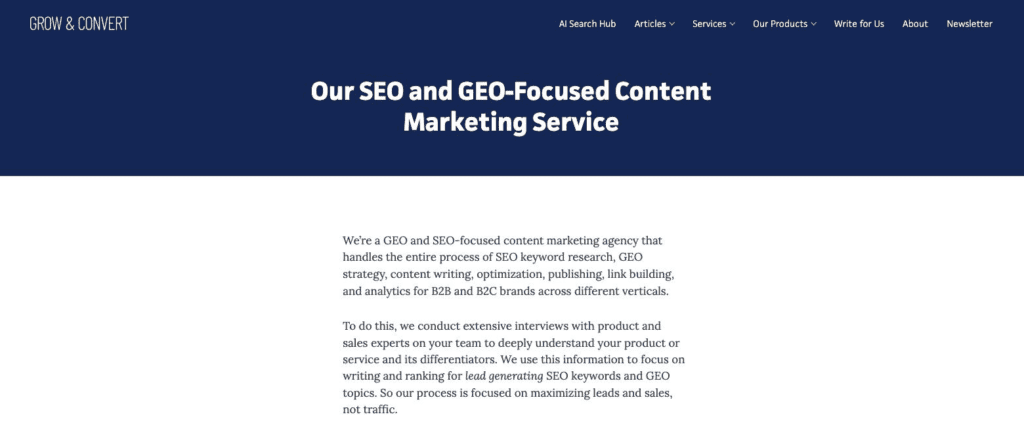
Best for: Teams prioritizing bottom-of-funnel signups and sales-qualified leads over top-of-funnel traffic volume.
Grow and Convert built its practice around what it calls Pain Point SEO, a method the agency says it coined in 2018. Content gets planned around lead volume rather than pageviews. That same lead-first logic carries into its generative engine optimization work, which the agency tracks through Traqer, its proprietary AI visibility platform.
Pros:
- Content is written in-house by the agency’s own team rather than outsourced to freelancers, according to the agency.
- The agency attributes leads and sales to specific articles using first- and last-touch models, giving clients a clearer view of which pieces are actually converting.
- Clients get free access to Traqer, meaning they can reallocate the budget they’d otherwise have to spend on a separate GEO tool.
Pricing: Engagements start around $10,000 a month and scale with the number of keywords or articles targeted.
Results: After adopting Grow and Convert’s pain point SEO approach, Leadfeeder’s blog began driving upward of 225 trial signups a month—about one in eight of all signups the company saw at the time.
Ten Speed: Best for PLG-to-enterprise SaaS teams
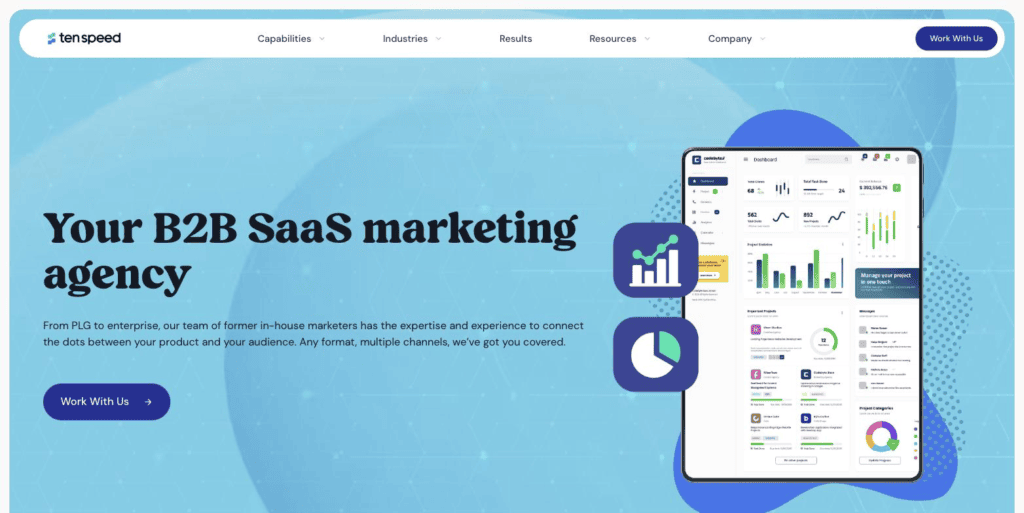
Best for: Companies spanning product-led growth and enterprise sales motions that want strategists who’ve actually run in-house marketing teams.
Ten Speed staffs its accounts with former in-house marketers rather than career agency hires, a distinction the agency leans on as its core positioning. The team covers strategy, content creation, and answer engine optimization as connected pieces of an organic growth program, and works with SaaS companies across the range from early product-led growth to enterprise sales cycles.
Pros:
- Accounts are staffed by former in-house marketers who understand what it’s like to defend budget under scrutiny from leadership.
- The agency measures success through its own CLEAR framework—conversion, loyalty, engagement, awareness, and reputation. It ties strategy to outcomes like qualified leads, pipeline growth, and MRR rather than vanity metrics.
- Ten Speed has worked with SaaS companies spanning early PLG products like Bitly to enterprise-motion names like Teamwork, suggesting range across company stages.
Pricing: Ten Speed doesn’t publish rates and requires a consultation to scope a program.
Results: Ten Speed’s content strategy for Concept3D drove a 48% increase in closed-won deals year over year, along with a 50% reduction in the average deal cycle.
Bay Leaf Digital: Best for content bundled with paid, email, and HubSpot
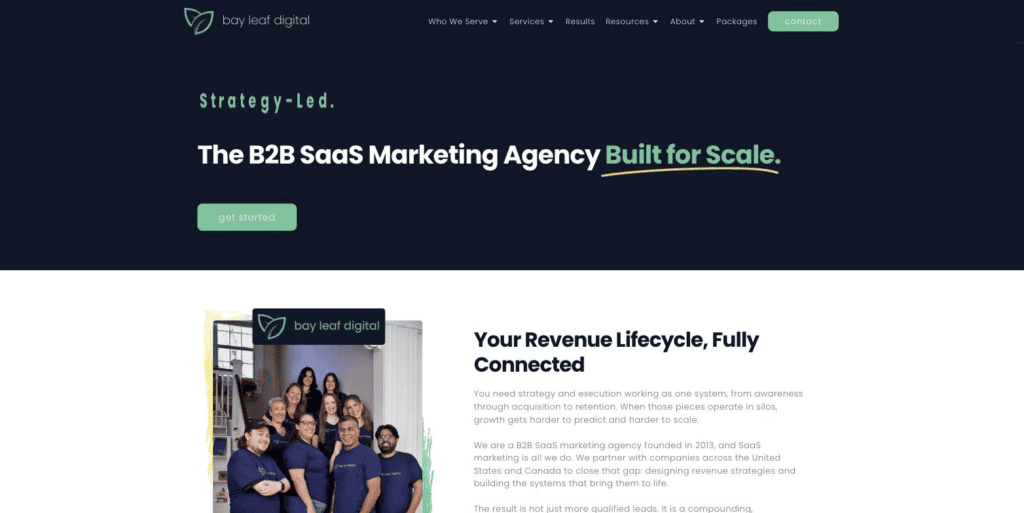
Best for: Teams that want one contract covering content, paid search, email, and HubSpot management instead of separate vendors for each.
Bay Leaf Digital bundles content production—blogs, ebooks, white papers, case studies, and video scripting—directly alongside paid advertising, LinkedIn ads, email, and HubSpot management. Where several other agencies on this list also offer services beyond content, Bay Leaf Digital’s specific combination of content plus paid, email, and marketing automation under one contract is what sets it apart for teams that want a single vendor managing that particular mix of channels.
Pros:
- Every content package is paired with content amplification across paid advertising, industry publications, and other channels.
- The agency produces a wide range of formats, including video storyboards and landing pages, which reduces the need to brief a second vendor for adjacent creative work.
- Though Bay Leaf Digital uses AI tools like ChatGPT, professional writers then edit and polish content to get it ready for publication.
Pricing: Bay Leaf Digital’s pricing isn’t public. Contact the team for details.
Results: Bay Leaf Digital’s multi-channel marketing strategy for VHT/Mindful increased organic traffic by 66% over a six-month engagement, and also boosted corporate leads by 54%.
Growfusely: Best for ongoing content refresh and decay management
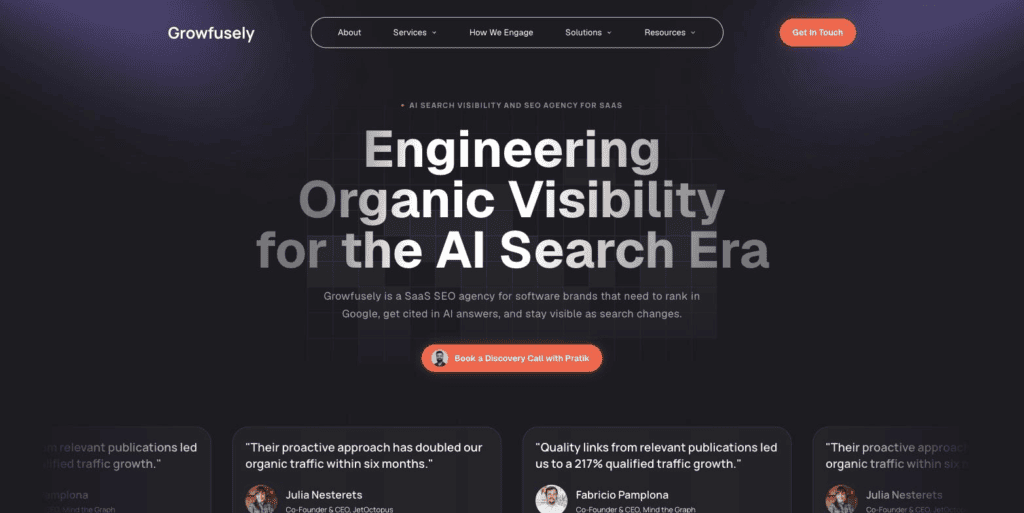
Best for: Teams sitting on an existing content library who need someone actively watching for ranking or citation decay, not just producing new posts.
Growfusely runs engagements through its own TRACE framework—topical authority, reference-grade content, authoritative mentions, corroboration, and entity clarity—aimed at keeping a brand’s visibility intact across Google and the AI engines buyers now use for research. Content decay is treated as an ongoing maintenance problem rather than a one-time cleanup. Decay analysis, refreshes, and internal linking optimization are all built in as a standing part of the service.
Pros:
- The agency runs a citation footprint audit across ChatGPT, Perplexity, Gemini, and AI Overviews, giving clients visibility into how their content performs beyond traditional search.
- Content distribution includes guest contributions and review platform presence management, extending reach beyond the client’s own domain.
- Thought leadership work centers on founder and executive voices specifically, on the premise that individual perspectives carry more weight with buyers and AI engines than brand-authored pages.
Pricing: Growfusely’s pricing starts at $3,000 per month for ongoing execution retainers. The agency also publishes starting prices for audits and strategy, 90-day sprints, and advisory and enablement.
Results: Growfusely created a content and SEO strategy that enabled JetOctopus to double its organic traffic within only 6 months.
Growth Plays: Best for SEO paired with GTM strategy
Best for: Fast-growing B2B teams that need SEO paired with broader go-to-market strategy support, including help through CMS or domain migrations.
Growth Plays builds content strategies designed to map to complex, multi-touch buyer journeys rather than a single conversion path. Plus, it combines that work with technical SEO monitoring and go-to-market strategy support. The agency also offers CMS and domain migration assistance, which is helpful for growth-stage companies trying to rebuild their site infrastructure without losing existing rankings.
Pros:
- The agency combines AI-assisted content creation with human refinement, aiming to speed up production without giving up quality control.
- Revenue attribution is built into the engagement, so clients can understand what topics and page types lead to pipeline and closed-won revenue.
- Growth Plays does technical SEO monitoring to catch issues before they affect rankings. This can be especially helpful for companies mid-migration or scaling site architecture quickly.
Pricing: You’ll need to schedule a 1:1 consultation to scope your engagement.
Results: One co-founder and CTO said: “We’re getting a lot of inbound demos from our content, and we’re able to close a lot of deals from that. The ROI has been pretty clear.” A former director of marketing also stated that its “content strategy paid off 10x better than they estimated and drives demo-ready leads month after month.”
Directive: Best for content bundled with paid media and RevOps
Best for: Companies that want content, paid media, and revenue operations managed under one roof, including teams outside pure SaaS.
Directive Consulting works across a wider set of industries than most agencies on this list. It serves healthcare, finance, manufacturing, and telecommunications clients alongside SaaS. When working with this team, content sits inside a broader performance marketing stack that includes paid media, conversion rate optimization, and revenue operations. For example, Directive runs revenue operations work to align marketing, sales, and data systems. This extends its scope beyond content production into the systems that determine whether content converts.
Pros:
- Directive offers lifecycle marketing, including churn prevention and upsell campaigns. That means it can reach into the post-signup part of the customer journey, which most content-only agencies don’t touch.
- Conversion rate optimization is offered alongside content and SEO, with a specific focus on demo bookings, trial activations, and pricing page performance.
- The agency’s cross-industry client base, including Adobe, Amazon, and Uber Freight, suggests it can operate at enterprise scale even beyond SaaS specifically.
Pricing: Directive doesn’t have published pricing. Contact the team for a consultation and quote.
Results: Directive’s content strategy for Sumo Logic generated over 2 million impressions within four months, with keyword rankings in the top 3 search positions up 175% year-over-year.
Single Grain: Best for content plus broader growth marketing
Best for: Companies that want content produced as one piece of a wider growth marketing engagement rather than as a standalone service.
Single Grain serves SaaS alongside ecommerce, education, and crypto clients, positioning content as part of an integrated growth stack rather than a dedicated practice area. The agency pairs strategic content development with competitive analysis and repurposing across formats and channels, aiming to extend the life of each piece rather than treating publication as the end of the work.
Pros:
- The agency conducts a formal competitive content analysis before producing new material. As a result, it’s able to identify gaps competitors haven’t covered.
- Single Grain does content curation and repurposing across formats and platforms, so that content doesn’t just perform temporarily and then get archived.
- The team produces interactive formats like infographics and calculators alongside standard blog content. This broadens the options for how clients can reach their target audience.
Pricing: Single Grain doesn’t publish rates. You’ll need to fill out their contact form to request details.
Results: In separate case studies, Single Grain reports that its work for LS Building Products increased site conversions by 229% over 12 months and generated more than 400 additional AI citations through a comprehensive content strategy.
How to spot a good content marketing partner for SaaS
While the agencies above are all solid options, a shortlist still has to get narrowed against your own situation. These four factors are the ones that most often separate a good pitch from a good fit.
Comprehensive content marketing services
Strategy, production, and on-page SEO are table stakes at this point—every content marketing agency you consider should offer all three without you having to ask. What separates a mature partner is what sits on top of that baseline. Namely:
- Generative engine optimization for AI search surfaces
- Conversion-focused editing that treats a published article as a funnel step rather than a finished deliverable
- And pipeline or revenue attribution that ties specific pages to specific outcomes
That last point doubles as a useful gut check: Ask a prospective agency how they’d measure success six months into the engagement. If the answer stops at traffic or rankings, that’s a signal the rest of their process is probably built around the same ceiling.
Content-market fit for SaaS buying cycles
Next, any good agency will understand that B2B SaaS buying committees read differently than general B2B audiences.
A single deal often involves a champion doing early research alone, a technical evaluator stress-testing claims, and a budget holder who shows up only at the final stage. And each of them needs a different kind of content at a different point in that sequence.
An agency that’s only ever written for a single-buyer sales motion will default to persuasive, benefits-led copy even when the moment calls for something closer to technical documentation. So request to see examples written for a multi-stakeholder SaaS deal specifically, not just SaaS content in general.
Contract flexibility and reasonable ramp time
Finally, gather as much detail as you can upfront on what your engagement will look like. This is critical because minimum engagement lengths vary more than most buyers expect going in. Some agencies will run a single quarter to prove out fit, while others require a year-long commitment before they’ll staff a dedicated team.
Neither is outright wrong, but a mismatch between your internal approval cycle and the agency’s minimum commitment is a common reason engagements stall before they produce anything.
Ramp time also matters, but faster isn’t automatically better. Some agencies front-load strategy work—research, positioning, creating an editorial calendar—before the first piece ships. That groundwork can be time well spent rather than dead air.
The question worth asking isn’t how quickly an agency can turn around a first draft; it’s what you’ll get during and after the ramp that’s more important. Is the output setting the engagement up to work?
How much does SaaS content marketing cost?
Pricing across this market runs in three rough bands:
- At the low end, a single-channel engagement focused on blog content alone typically starts around $3,000 to $5,000 a month.
- The middle of the market runs $8,000 to $15,000 a month once strategy, production, and SEO are bundled together. This is where most full-service SaaS content programs land.
- At the high end, agencies that fold in paid media, revenue operations, or dedicated GEO tooling can run $20,000 a month or more.
Of course, in any of the three bands, final cost depends on scope. For example, GEO and AEO tracking, dedicated technical SEO monitoring, and multi-channel distribution may sit outside of a standard content package.
Before signing anything, find out what’s included in the base quote versus billed on top. Then, factor in the indirect costs of content marketing beyond the retainer itself, like internal review time and asset production.
Find your ideal SaaS content marketing partner
Ultimately, the right agency depends less on reputation and more on whether its methodology, specialization, and results match what your team actually needs solved. A blog-only shop and a full-funnel partner running paid media and revenue operations can both be “the best,” depending on which problem you’re actually trying to fix.
We built Omniscient Digital around the belief that content should be judged on pipeline and revenue, not traffic. We’ve run that playbook long enough to have the receipts, from Jasper’s $4 million in blog-attributed ARR to the GEO work baked into every engagement we run today.
If that’s the outcome you’re optimizing for, book a free strategy call. We’ll walk through what a content program built around your specific pipeline goals could look like.
Frequently asked questions about hiring a content marketing agency for SaaS
How do I choose the right SaaS content marketing agency?
Start with the three criteria in the “how we evaluated” section above: SaaS specialization, a defined methodology, and case studies with pipeline or revenue outcomes, not just traffic.
Beyond that, weigh how each agency stacks up against the specific bottleneck slowing your pipeline down. Take note of thin case study evidence, a methodology that’s more of a marketing spiel than a repeatable process, or lack of SaaS experience. The agency that solves your particular bottleneck is more likely to be the right one.
Should I hire a content marketing agency or build an in-house SaaS content team?
An in-house team gives you tighter control over voice and faster context retention, but it takes months to hire, ramp, and prove out.
An agency gets a specialized team and an established process running in weeks, which is usually the better trade when you need results on a shorter timeline or don’t yet have the volume to justify full-time headcount.
Many SaaS teams end up running both—a small in-house lead paired with an agency for production and specialized skills like GEO.
How long does it take to see results from a SaaS content marketing agency?
Most SaaS content programs need three to six months before rankings and traffic move meaningfully. New content has to get indexed, gain authority, and climb through SERP positions.
Pipeline and revenue impact typically lag traffic by another month or two, as visitors move through a sales cycle.
Agencies that promise faster timelines are usually citing traffic gains on already-strong pages, not results from newly published content.