The phrase “best SEO agency” does a lot of work for a three-word search. For a VP of Marketing at a growing B2B SaaS company, it means a team that can build a pipeline-generating organic program, not just one that moves rankings. For a multi-location retailer, it means local search expertise and Google Business Profile management. For a small business owner, it usually means something affordable that still actually works.
These aren’t edge cases. They’re different markets with different agency types built to serve them. According to a Google and National Research Group survey, nearly three-quarters of U.S. business buyers now complete their purchasing journey in 12 weeks or less and 58% switched vendors in the same period they made a purchase. That compression means your organic search presence either earns a spot on someone’s shortlist early, or it doesn’t earn one at all.
Each agency on this list was selected to represent a distinct buyer type. The right fit depends on your business model, growth stage, and what you actually need SEO to accomplish, not good reviews alone.
Table of contents
- At a glance: The 12 best SEO agencies
- The 12 best SEO agencies for different business types
- 1. Omniscient Digital: Best for established B2B SaaS companies
- 2. Seer Interactive: Best for enterprise companies with analytics-first SEO needs
- 3. iPullRank: Best for enterprise SEO and generative AI challenges
- 4. Directive Consulting: Best for mid-market to enterprise B2B SaaS companies
- 5. Grow and Convert: Best for B2B SaaS startups focused on demos and trials
- 6. First Page Sage: Best for B2B SaaS companies building long-term thought leadership
- 7. Local SEO Guide: Best local SEO agency for multi-location businesses
- 8. WebFX: Best SEO agency for small businesses
- 9. Animalz: Best for scaling content-led organic growth in B2B SaaS
- 10. Growth Plays: Best for B2B tech companies tying content to pipeline
- 11. Organic Growth Marketing: Best for embedded SEO partnerships at high-growth SaaS companies
- 12. Flow Agency: Best for B2B startups unifying SEO, GEO, and paid search
- What should you look for in an SEO agency?
- How to find the best SEO agency for your business
- Frequently asked questions about SEO agencies
Disclosure: This article is published by Omniscient Digital. We’ve included ourselves because we’re a B2B SEO agency and wanted to give honest, first-hand context on how our approach compares to others in the market. Every agency on this list was evaluated against the same criteria.
At a glance: The 12 best SEO agencies
One question should anchor your evaluation before any other: Does this agency’s specialty map to your specific business type? An agency built for B2B SaaS pipeline won’t necessarily be the best SEO agency for a regional service business, and vice versa.
| Agency | Best For | Starting Price | Key Differentiator |
| Omniscient Digital | Best for established B2B SaaS companies | $10K/month | Pipeline and revenue attribution, GEO/AI search |
| Seer Interactive | Best enterprise SEO agency for analytics-heavy programs | $10K/month | 250+ specialists, SeerSignals technology platform |
| iPullRank | Best enterprise SEO agency for AI search and technical depth | Contact for pricing | Relevance Engineering, enterprise-grade methodology |
| Directive Consulting | Best for mid-market to enterprise B2B SaaS | Contact for pricing | Customer Generation, integrated SEO + paid media |
| Grow and Convert | Best for B2B SaaS startups focused on demo and trial conversion | $10K/month | Pain Point SEO, conversion-focused content |
| First Page Sage | Best for B2B thought leadership and GEO | Contact for pricing | Expert-ghostwritten through leadership content |
| Local SEO Guide | Best local SEO agency for multi-location brands | $500-$150K/month | 20+ years, enterprise local at Walmart/AutoNation scale |
| WebFX | Best SEO agency for small business | $3,000/month | Transparent tiered pricing, RevenueCloudFX attribution |
| Animalz | Best for scaling content-led organic growth in B2B SaaS | Contact for pricing | AEO integration, AI-assisted content at scale |
| Growth Plays | Best for B2B tech companies tying content to pipeline | Contact for pricing | Content revenue attribution, LLM-ready strategies |
| Organic Growth Marketing | Best for embedded SEO partnerships at high-growth SaaS | Contact for pricing | Deep team integration, ICP-driven SEO programs |
| Flow Agency | Best for B2B startupos unfiying SEO, GEO, and paid search | $3,500/month | Unified SEO, GEO, and paid search strategy |
How we evaluated these SEO agencies
Three criteria shaped who made this list.
First, specialization. Agencies without a defined focus tend to be average across the board. The ones here have a defined buyer type they serve and a methodology built around it.
Second, business outcome attribution. Case studies with vague traffic graphs and percentages don’t tell you much. Case studies with pipeline numbers, trial signups, or revenue attribution do. Every agency on this list has published results tied to business outcomes, not vanity metrics.
Third, full-service execution capability. An agency that handles technical SEO, content, and off-page signals in a single engagement creates a coherent strategy. Those that offer only one leg of the stool leave too much to chance.
Want a framework for measuring organic growth when AI is reshaping search results? The Measuring Organic Growth in 2025 report covers how marketers are rethinking attribution, metrics, and what counts as success in an era where AI overviews and LLM citations sit above the organic results.
The 12 best SEO agencies for different business types
Below are 12 agencies worth considering when looking for an SEO partner. Whether you’re looking for the best enterprise SEO agency, the best local SEO agency, or the best SEO agency for small business, one of these is likely the right fit.
1. Omniscient Digital: Best for established B2B SaaS companies

Best for: Series B+ B2B SaaS companies with a content-driven go-to-market and a VP of Marketing who needs to attribute organic activity to pipeline.
Omniscient Digital builds comprehensive B2B SEO programs that connect organic search and AI search to pipeline. The full-service model spans technical SEO, content strategy, digital PR, and link building. Generative Engine Optimization is also part of every engagement, with revenue and pipeline attribution built into how they report results.
Pros:
- Strong business outcome track record with pipeline attribution built into reporting
- Full-service organic model—technical SEO, content, digital PR, and link building—means no handoffs between strategy and execution
- GEO and AI search capability alongside traditional organic, not yet common at this pricing tier
Pricing: Engagements start at $10,000/month.
Results: We helped Smartling generate $3.7M in qualified pipeline, and also generated $4M in blog-attributed ARR for Jasper.
2. Seer Interactive: Best for enterprise companies with analytics-first SEO needs

Best for: Enterprise marketing teams running analytics-heavy programs that need SEO grounded in data science.
Seer Interactive is a 200+ person SEO and analytics agency with a proprietary data platform called SeerSignals. Their approach treats SEO as a measurement problem first: every recommendation is backed by large-scale data analysis rather than best practices inherited from the previous decade.
Pros:
- 200+ member team with deep analytics specialization and capabilities that go beyond what most agencies offer
- Strong fit for marketing teams that expect to interrogate the numbers closely, not just receive reports
- 92% client retention rate across an enterprise client base
Pricing: Minimum project size is $10K+ according to Clutch, but you’ll need to contact the agency for monthly pricing specifics.
Results: After Seer Interactive addressed SEO issues following an ecommerce client’s website redesign, the client sae a 64% increase in organic revenue.
3. iPullRank: Best for enterprise SEO and generative AI challenges

Best for: Enterprise brands with complex site architecture, aggressive AI search requirements, or both.
iPullRank is a content marketing and enterprise SEO agency specializing in what they call Relevance Engineering. The framework integrates AI, information retrieval, content strategy, technical SEO, and user behavior to engineer visibility across both traditional search and AI-driven results. Clients include American Express, Nordstrom, Etsy, and SAP.
Pros:
- Among the most technically sophisticated options available for enterprise sites with complex architecture or aggressive AI search requirements
- Publishes rigorous original research on AI search, information retrieval, and content engineering, which is a signal of genuine depth in methodology
- Claims to have generated $5B+ in results across its portfolio
Pricing: Contact the team for pricing details.
Results: A global ecommerce brand attributed $290M+ in revenue to iPullRank’s content engineering strategy.
4. Directive Consulting: Best for mid-market to enterprise B2B SaaS companies

Best for: Mid-market to enterprise B2B SaaS companies that want SEO and paid search managed under a single pipeline attribution framework.
Directive Consulting runs integrated B2B SEO and paid media under a single pipeline attribution model called Customer Generation—a methodology that connects content, paid media, and revenue operations around one shared outcome: qualified pipeline. For B2B companies that want SEO and paid search aligned under the same measurement framework, it removes the complexity of managing two separate agency relationships.
Pros:
- Claims to have generated $1B+ in attributed client revenue generated through the Customer Generation methodology
- Has a team of over 100 strategists to ensure enough bandwidth for larger SEO projects
- Stratos, their AI-powered intelligence platform delivers real-time analytics, predictive signals, and campaign insights
Pricing: Contact the Directive Consulting team for pricing information.
Results: With Directive’s help, Inscribe achieved 237% increase in keyword rankings. Seagate also saw an 50.6% increase in keyword visibility through long-tail coverage and structured data.
5. Grow and Convert: Best for B2B SaaS startups focused on demos and trials

Best for: B2B SaaS companies with a defined demo or trial conversion model and a strong focus on bottom-of-funnel organic growth.
Grow and Convert built their Pain Point SEO methodology around a single outcome: converting organic traffic into demos and signups. Its Pain Point SEO methodology starts with high-intent, bottom-of-funnel content designed to generate conversions, then can expand into mid- and top-of-funnel topics as a program scales.
Pros:
- Conversion accountability is baked into how they measure success, not added on as an afterthought
- Focused model means no budget is diluted across channels or content types that don’t convert
- Has its own AI visibility tool called Traqer, so customers can enjoy the benefits of SEO and AEO
Pricing: Contact the team for pricing details.
Results: Geekbot grew to 1,700+ organic signups through Pain Point SEO content, while Circuit saw a 313% increase in trial signups within a six-month period.
6. First Page Sage: Best for B2B SaaS companies building long-term thought leadership

Best for: B2B SaaS companies playing a long game in a competitive category, prioritizing thought leadership content designed to rank in traditional search and AI-generated answers over 12–18+ months.
First Page Sage takes a thought leadership-first approach to SaaS SEO, producing authoritative content designed to rank in both traditional search and AI-generated answers. They were among the first to begin using the term Generative Engine Optimization and remain a commonly cited name on GEO methodology.
Pros:
- Ghostwrites expert-level thought leadership using subject matter experts in the client’s industry—not generalist SEO writers
- Clients include Verizon, Salesforce, Logitech, and U.S. Bank, which is a strong enterprise track record across complex, competitive markets
- Lead generation-focused by design: every piece of content is optimized to fit into the client’s conversion funnel, turning organic visitors into leads
Pricing: Contact the team for pricing details.
Results: First Page Sage says it has generated 702% average ROI over three years for B2B SaaS clients. It also helped Cadence Design Systems achieve a 934% increase in total keyword rankings over the course of a year.
7. Local SEO Guide: Best local SEO agency for multi-location businesses

Best for: Multi-location businesses, enterprise retailers, and franchise brands that need local search at a significant scale.
Local SEO Guide is a strategy and consulting firm with 20+ years of experience in enterprise local search. If you need a partner who has handled local SEO for the likes of Walmart, AutoNation, Rotten Tomatoes, and Adobe scale, this is the firm. They cover local pack optimization, Google Business Profile management, and multi-location site architecture.
Pros:
- Business intelligence is a core part of their engagement model, helping clients identify and quantify untapped local revenue opportunities
- Boutique-scale team with enterprise-scale client experience—more direct access to senior expertise than at a 200+ person agency
- Offers a service to produce AI location pages at scale and cost-effectively
Pricing: Pricing ranges from $500–$150,000/month, depending on scope.
Results: LSG identified a $2.3B untapped local revenue opportunity for Walmart. The agency also helped AutoNation achieve +164% organic clicks to dealer sites over two years.
8. WebFX: Best SEO agency for small businesses

Best for: Small to mid-size businesses that want technical SEO, content, and attribution tracking in one engagement without enterprise price tags.
WebFX is one of the few agencies at scale with transparent, tiered pricing published directly on their website. For small to mid-size businesses that want technical SEO, content, and attribution tracking in one engagement without enterprise price tags, it’s a clean option. Their proprietary RevenueCloudFX platform provides attribution reporting that’s usually only available at higher spend levels.
Pros:
- The broad service menu (SEO, content, web design, development, etc.) means SMBs can consolidate multiple vendors into one engagement
- Claims to have generated $10B+ in total revenue driven for clients across their portfolio
- 450+ Clutch reviews at 4.9 stars
Pricing: Plans start at $3,000/month.
Results: KOA saw 260% increase in organic revenue through SEO-led content strategy after wokring with WebFX. The agency helped Resource Furniture increase SEO form completions by 217%.
9. Animalz: Best for scaling content-led organic growth in B2B SaaS
Best for: B2B SaaS and technology companies that need a content marketing partner to build, scale, and optimize a full-funnel content engine spanning strategy, production, SEO, and answer engine optimization.
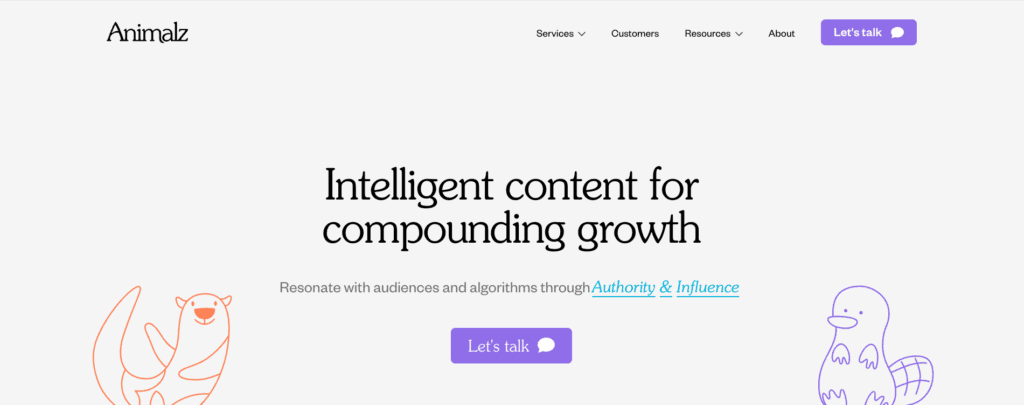
Animalz is a content marketing agency that builds and scales content programs for B2B SaaS and technology companies. Their service model covers strategy, production, SEO, answer engine optimization, and content operations — structured as an integrated engagement rather than a set of isolated projects. The agency positions itself around content as a compounding growth system, combining proprietary research, AI-assisted workflows, and editorial rigor into programs designed to generate both audience reach and brand authority over time.
Pros:
- Animalz has built content programs for brands including Google, Amazon, Airtable, Amplitude, and Segment, bringing cross-company pattern recognition from seed-stage startups through enterprise.
- Their answer engine optimization (AEO) practice addresses visibility in AI-generated answers and traditional search results simultaneously, treating both as surfaces a content program should earn.
- The team follows a structured four-phase process — building context, formulating strategy, crafting content, and analyzing performance — that scales production without relying on generic templates or one-size-fits-all playbooks.
Pricing: Pricing is not publicly available. Contact Animalz for a quote.
Results: SupportLogic grew qualified organic traffic by 500% within 12 months through a content diversification strategy built with Animalz, an effort the company says led to new business opportunities and signed deals.
10. Growth Plays: Best for B2B tech companies tying content to pipeline
Best for: B2B technology and developer tools companies that need content strategy mapped to complex buyer journeys with content revenue attribution built into the engagement from day one.
Growth Plays is a B2B SEO and content strategy agency that builds content programs for technology companies, developer tools brands, and venture-backed startups. The agency positions content as a pipeline channel rather than a traffic play, mapping owned media strategies to complex, omnichannel buyer journeys and measuring performance through a dedicated attribution and analytics practice designed to give marketing leaders a clear line from content investment to qualified leads, opportunities, and closed-won revenue.
Pros:
- Growth Plays offers content revenue attribution as a core service, connecting specific topics and pages to qualified leads, opportunities, and closed-won revenue rather than treating content performance as a traffic metric.
- Their content strategies are built for visibility in both traditional search and AI-generated results, with workflows designed to earn LLM citations alongside organic rankings.
- The agency has worked with B2B technology brands including Calendly, Lattice, LangChain, and AlphaSense, with particular depth in developer tools, infrastructure software, and VC-backed companies.
Pricing: Pricing is not publicly available — contact Growth Plays for a quote.
Results: Gremlin’s former director of marketing said Growth Plays’ content strategy paid off 10x better than estimated and drove demo-ready leads month after month.
11. Organic Growth Marketing: Best for embedded SEO partnerships at high-growth SaaS companies
Best for: High-growth B2B SaaS companies that need a deeply integrated SEO partner to co-own organic growth strategy, execution, and revenue attribution alongside their internal marketing team.
Organic Growth Marketing is an SEO agency that builds organic growth programs for B2B SaaS companies at the high-growth stage. Their operating model centers on deep team integration — embedding into client marketing functions to co-own strategy, execution, and outcomes rather than delivering work at arm’s length. OGM brings together SEO, content strategy, and UX into a unified organic program designed to drive qualified traffic and attributable revenue, treating organic growth as a business outcome channel rather than a visibility exercise.
Pros:
- OGM embeds directly into client marketing teams rather than operating as an external vendor, co-owning strategy decisions and organic growth outcomes alongside in-house stakeholders.
- The agency specializes in ICP-driven SEO programs, building keyword strategies and content roadmaps around buyer personas and purchase triggers rather than search volume alone.
- Their monthly reporting provides granular insight into organic marketing performance, connecting SEO activity to revenue metrics rather than delivering traffic-only dashboards.
Pricing: Contact Organic Growth Marketing for a quote.
Results: According to ProfitWell, OGM 10x’d the company’s organic traffic. Another company, Hotjar, saw 1400% growth over the course of two years.
12. Flow Agency: Best for B2B startups unifying SEO, GEO, and paid search
Best for: B2B SaaS startups and professional services firms that want SEO, generative engine optimization, and paid search managed as a single integrated strategy by one team.
Flow Agency is a B2B marketing agency that combines SEO, generative engine optimization, and paid search for SaaS startups and professional services firms. Formerly known as Flow SEO, the agency expanded its service model to include LLM optimization, B2B Video SEO, digital PR, and paid media management. Their positioning centers on running organic and paid search as a unified strategy rather than separate channels, built around the premise that fragmented search marketing wastes budget and produces inconsistent results.
Pros:
- Flow Agency offers GEO and LLM optimization as a dedicated service line, building client visibility in AI search engines including ChatGPT Search, Perplexity, and Gemini alongside traditional rankings.
- The agency manages organic SEO and paid search under a single strategy, reducing the channel disconnect that often results when separate teams or vendors handle each.
- Founder Viola Eva is a recognized industry voice on search and AI, contributing to publications including Ahrefs and Semrush and speaking at conferences on generative search — lending the team credibility in a fast-evolving space.
Pricing: Flow Agency’s minimum monthly retainer starts at $3,500.
Results: One Flow Agency client achieved a 48% improvement in organic conversions and a 12% increase in organic sessions over six months, while another saw organic conversions increase by over 200%. Specific company attributions for these metrics are not publicly disclosed on the agency’s website.
What should you look for in an SEO agency?
The right SEO agency for your business depends on more than reputation. Five factors consistently separate agencies worth working with from those that only look good on paper.
1. Industry and buyer-type fit
The first thing to evaluate: Does this agency have verifiable experience in your specific business type? B2B SEO for a SaaS company is structurally different from local SEO for a franchise. The two have different buyer intents, different content formats, and different conversion paths.
For example, a B2B SaaS company measures SEO in demos booked and pipeline influenced, whereas a franchise measures it in local pack rankings and store traffic. And a small business might care most about showing up for near-me searches.
An agency that can’t show you specific case studies in your situation is learning on your budget.
2. Outcome-based case studies and references
Traffic graphs are not evidence of business impact. Look for case studies that name the client, describe what the agency did specifically, and show results tied to pipeline, revenue, trials, or signups. Then find companies that have worked with them on your own, not just the references the agency provides. Reaching out directly to former or current clients gives you more honest feedback than a reference who’s been prepared by the agency.
Gartner found that 61% of B2B buyers prefer a rep-free experience, completing most of their research independently before buying. That applies to how you’re evaluating agencies too. Your shortlist is probably built before you’ve spoken to a single sales rep.
3. An experienced day-to-day team
Ask who’s actually on your account. What’s their experience in your industry? What’s the client-to-strategist ratio at your tier? What happens if you want to change team members mid-engagement?
Agencies that can’t answer these questions concretely are usually the ones where the pitch team hands the account to someone junior the week after you sign.
Wondering how B2B buyers actually navigate the research phase before engaging a vendor? The B2B Buyer Behavior in 2025 report covers how buyers move between channels, what proof they rely on, and what tips the final purchase decision in the LLM era.
4. A fair pricing model
Hourly billing rewards slow work. And some performance-based arrangements can create misaligned incentives, optimizing for the metric that triggers a bonus rather than the one that matters.
Monthly retainers are standard for a reason: they align agency effort with long-term organic growth, which compounds over time.
5. Transparency about fit and scope
The agencies worth working with tell you who they’re not right for. For example, we’ve got a “not a good fit” list on our website. That kind of honesty is a signal. It means an agency has gotten selective enough to know what they’re genuinely good at.
Take it as a positive if an agency you’re talking to speaks up when a service you need is not in their wheelhouse. Bonus points if they have reputable partners they can refer you to, though. This can take pressure off you to find another agency to fill in the gaps and, ideally, the two agencies can work together to execute a comprehensive strategy.
How to find the best SEO agency for your business
The agency you need depends on what you’re actually trying to build:
- Established B2B SaaS company trying to drive qualified pipeline from organic → Omniscient Digital
- Multi-location business that needs to win in local search → Local SEO Guide
- Small business needing full-service SEO at a predictable price → WebFX
- Enterprise brand with complex technical SEO or AI search challenges → iPullRank or Seer Interactive
- B2B SaaS startup where every organic visit needs to convert to a demo → Grow and Convert
- B2B company building long-term thought leadership in a competitive category → First Page Sage
If none of these fit cleanly, start with the outcome you actually care about. Then ask each agency on your shortlist how many clients they’ve taken from your starting point to that specific outcome. The ones with a clear answer are worth your time.
If you’re an established B2B SaaS company looking to turn organic search and AI visibility into a reliable pipeline channel, book a free strategy call with the Omniscient Digital team.
Frequently asked questions about SEO agencies
How much does an SEO agency cost per month?
Depends almost entirely on scope and business type.
Local SEO for a single-location small business can run $500–$3K/month. Full-service SEO for a B2B SaaS company typically starts at $8K–$10K/month. Enterprise engagements with integrated strategy, content, and link building can run $20K–$100K/month or more.
Agencies that don’t publish pricing aren’t necessarily hiding something—their scope genuinely varies too much to list—but you should still get a specific number before signing anything.
What’s the difference between an SEO agency and a full-service digital marketing agency?
A dedicated SEO agency operates entirely inside organic search: technical SEO, content strategy, link building, and increasingly AI search optimization.
A full-service digital agency handles paid media, social, email, and other channels alongside SEO. The tradeoff is depth versus breadth.
If SEO is a primary growth channel for your business, a dedicated agency typically outperforms the SEO team embedded inside a larger generalist shop.
How long does it take to see results from an SEO agency?
Three to six months before you see meaningful movement; six to twelve before compounding effects show up in pipeline. Organic growth is a long-cycle bet.
The agencies worth working with will set realistic milestones and show you early leading indicators—rankings, impressions, crawl health—while the revenue signal builds. They won’t promise faster results just to win the pitch.
Any agency guaranteeing fast results from organic search is either optimizing for a metric that doesn’t matter or planning something that will eventually hurt your site.