The typical B2B buying decision now involves 13 internal stakeholders and nine external influencers, according to research by Forrester. That’s far from a single buyer with a budget — it’s a consensus-building exercise running six to eighteen months across an entire organization. The marketing program that reaches all those people looks nothing like it did five years ago.
This list covers eight B2B marketing agencies that excel at different things: organic and content-led growth, demand generation, performance marketing, ABM, and integrated PR. Not every agency is right for every company. The right choice depends largely on which problem you’re trying to solve.
Table of contents
- At a glance: The 8 best B2B marketing agencies
- The top B2B marketing agencies: pros, cons, and results
- Omniscient Digital: Best for B2B SaaS compounding organic growth systems
- Animalz: Best for enterprise B2B SaaS content at scale
- Grow and Convert: Best for targeting B2B high-intent keywords
- Siege Media: Best for tech brands that need SEO and visual design
- Directive Consulting: Best for performance marketing across paid, SEO, CRO, and RevOps
- Ironpaper: Best for B2B companies with complex buying committees
- Growth Plays: Best for technical B2B content-to-pipeline programs
- Walker Sands: Best for combined PR and digital demand gen programs
- How to spot expert B2B marketing agencies
- Which B2B marketing agency is best for you?
- Frequently asked questions
Disclosure: This guide is published by Omniscient Digital. We’ve included ourselves because we specialize in B2B organic growth — the same work this list evaluates — and we believe a fair comparison helps companies make the right call, even if that’s not us. However, every agency on this list was evaluated against the same criteria.
At a glance: The 8 best B2B marketing agencies
| Agency | Best For | Starting Price | Key Differentiator |
| Omniscient Digital | B2B SaaS organic growth (SEO + GEO + digital PR) | $10,000/month | Revenue-centric organic growth programs — SEO, GEO, and digital PR integrated and held accountable to pipeline |
| Animalz | Enterprise B2B SaaS editorial content at scale | Contact for pricing | Editorial content and full content operations including AEO |
| Grow and Convert | High-intent BOFU SEO for B2B SaaS | $10,000/month | Pain Point SEO with month-to-month flexibility and revenue attribution built in |
| Siege Media | B2B/B2C tech content with integrated design | Contact for pricing | In-house design team integrated with SEO and AI-enhanced strategy tools |
| Directive | Full-funnel B2B performance marketing | $6,500/month | DiscoverabilityOS: paid, SEO, CRO, and RevOps unified under pipeline accountability |
| Ironpaper | Mid-market/enterprise ABM and demand gen | Contact for pricing | B2B-exclusive since 2003; multi-stakeholder ABM built for complex buying committees |
| Growth Plays | Content-to-pipeline programs for technical B2B and dev tools | Contact for pricing | Buyer-journey content engines with pipeline attribution for technical B2B |
| Walker Sands | B2B tech PR and digital demand gen | Contact for pricing | Outcome-based Marketing: PR and digital working together from revenue targets down |
How we evaluated these B2B marketing agencies
We assessed each agency on five criteria: B2B focus and client track record, strategic transparency, revenue and pipeline accountability, demonstrated marketing quality, and channel depth. Agencies were evaluated against publicly verifiable case studies, stated methodologies, client outcomes, and their own marketing as a live quality sample.
Looking for data on how B2B buyers actually make decisions in 2026? B2B Buyer Behavior in 2025 covers how buyers navigate channels, build trust, and move from research to purchase in the LLM era.
The top B2B marketing agencies: pros, cons, and results
Below are some of the most reputable marketing partners around for B2B companies, with context on their strengths, track records, and who they’re best suited to serve.
Omniscient Digital: Best for B2B SaaS compounding organic growth systems
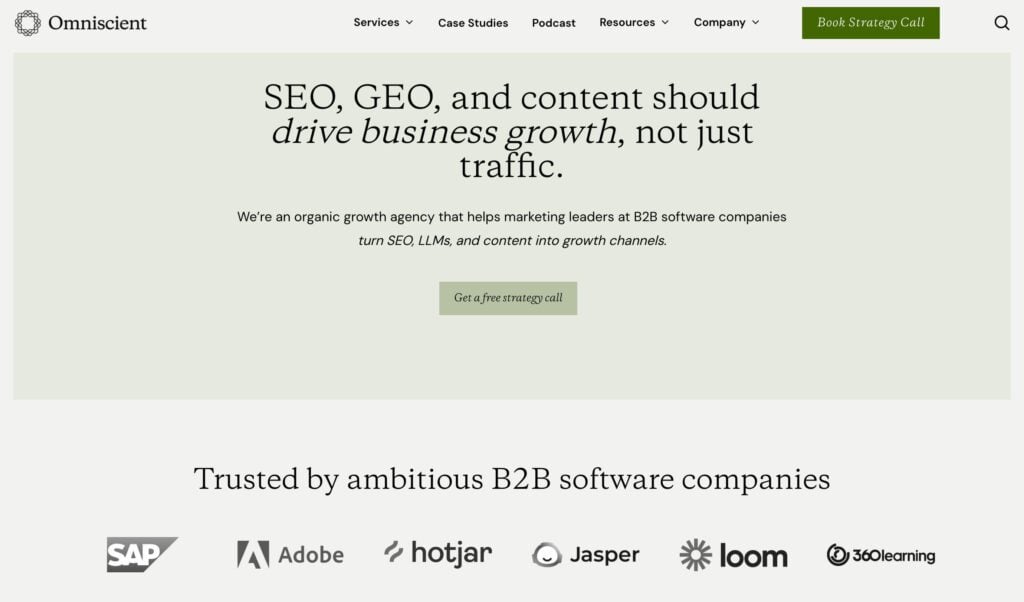
Best for: B2B SaaS companies with product-market fit that want organic SEO, generative engine optimization (GEO), and digital PR working as one integrated program — held accountable to pipeline, not traffic.
Omniscient Digital is a B2B organic growth agency offering SEO, GEO, and digital PR for B2B software companies. One core belief: organic growth is no longer just a content volume problem — it’s an authority problem. The brands that win both in search and AI-generated answers earn trust through specificity, expertise, and a distinct point of view.
Pros
- Omniscient takes a strategy-first approach: ICP definition and pipeline attribution are set up before content production begins.
- As an early mover on GEO, Omniscient helps clients appear cited in AI-generated answers across ChatGPT, Perplexity, and Google AI Overviews.
- Programs are accountable to qualified leads, pipeline, and revenue — not vanity metrics like traffic and rankings.
Results: Omniscient generated $3.7M in qualified pipeline for Smartling. For Convert, our program produced an 81% increase in LLM visibility and a 140% increase in AI citations.
Starting price: Engagements start at $10,000/month.
Want to see how B2B companies are attributing organic programs to revenue? Measuring Organic Growth in 2025 covers the metrics and attribution frameworks marketing teams are using to connect organic to pipeline.
Animalz: Best for enterprise B2B SaaS content at scale
Best for: Enterprise B2B SaaS companies in technical or competitive categories that need deep editorial content at scale.
Animalz is a content marketing agency for B2B software companies, covering content strategy, editorial production, and content operations from a single team. They focus on smart, differentiated editorial programs for high-growth software businesses rather than high-volume generic output.
Pros
- Animalz pairs clients with content experts and can either work with your subject-matter experts or lead the research themselves.
- The scope includes content strategy and creation, SEO/AEO strategy, content refreshes, campaign content, and content operations/analytics support.
- The client roster spans prominent B2B SaaS companies across highly competitive categories, including Amazon, Airtable, Google, Atlassian, and Ramp.
Results: Unit21 generated millions in pipeline from a printed book campaign Animalz produced. SupportLogic grew organic traffic 5x in 12 months through their content program.
Starting price: Pricing is not publicly listed; contact for a quote.
Grow and Convert: Best for targeting B2B high-intent keywords
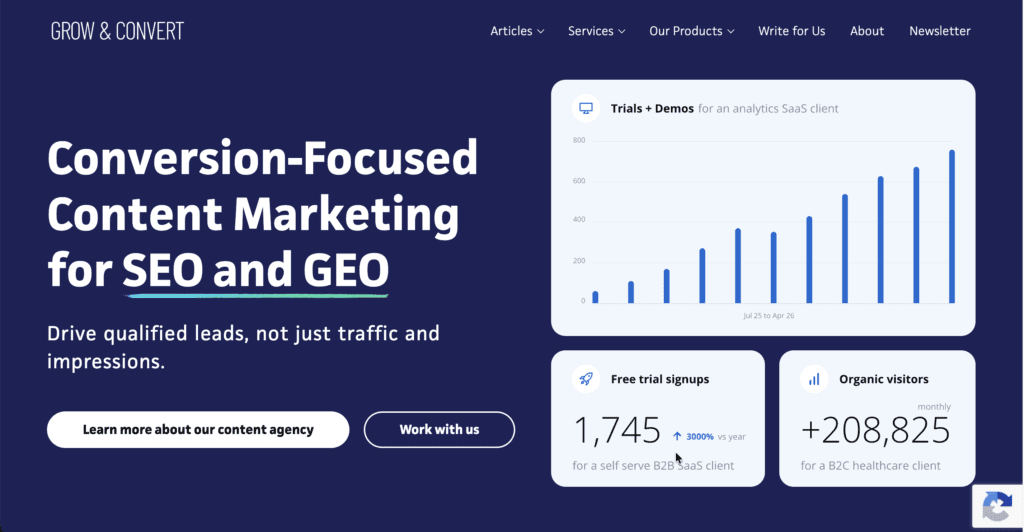
Best for: B2B SaaS companies that want content tied directly to conversion with verifiable lead and signup attribution.
Grow and Convert is a content-focused SEO and GEO agency built around a single organizing principle: conversion, not traffic. Their methodology, Pain Point SEO, asks a different question than most content programs — not “what does our audience find interesting?” but “what would a buyer search right before they’re ready to make a decision?”
Pros
- Grow and Convert sets up revenue attribution in GA4 and your CRM, connecting content directly to qualified leads and pipeline.
- The agency has expanded into GEO and built Traqer.ai, their own AI visibility tracking tool, which is included at no cost for every client.
- Grow and Convert offers PPC and technical SEO services in addition to content strategy and GEO.
Results: Leadfeeder generated 215+ monthly signups attributed to content and reached 21,000 monthly organic visitors from content created by Grow and Convert.
Starting price: Pricing starts at $10,000 per month.
Siege Media: Best for tech brands that need SEO and visual design
Best for: Tech companies that want SEO and branded visual content — infographics, data tools, interactive assets — produced by one team.
Siege Media is a content marketing, SEO, and GEO agency serving clients across SaaS, fintech, e-commerce, travel, health, and education. What distinguishes Siege Media from most content agencies is its robust design capabilities: infographics, data visualizations, and interactive assets are produced as part of the core program rather than sourced from a separate vendor.
Pros
- Siege Media maintains an in-house design team integrated with its SEO practice, allowing for close working relationships and consistent quality.
- Two proprietary tools power the process: DataFlywheel for data-backed content updates at speed, and BlueprintIQ for AI-enhanced content strategy.
- The agency estimates that it generates approximately $148.6M per year in client traffic value.
Results: Mentimeter generated 3,400 conversions in one month from Siege’s GEO-optimized content. Hippo saw a 450% increase in brand visibility over two years.
Starting price: Pricing isn’t publicly available. Contact for a quote.
Directive Consulting: Best for performance marketing across paid, SEO, CRO, and RevOps
Best for: B2B tech companies that need paid media, SEO, CRO, and revenue operations working together under a single pipeline framework
Directive Consulting is a B2B performance marketing agency organized around Customer Generation. That’s their term for marketing that is accountable to actual customers and revenue rather than to leads or traffic metrics alone.
The agency operates through three internal divisions (Performance, Commerce, and Communications. These are unified under a single pipeline accountability framework called DiscoverabilityOS, designed to compound across channels rather than optimize each in isolation.
Pros
- DiscoverabilityOS is Directive’s proprietary methodology: paid media, SEO, CRO, and RevOps unified under a single pipeline accountability framework.
- The agency invests $2.2M per year in internal R&D, validating tactics before recommending them to clients rather than running experiments at client expense.
- A startup-accessible entry point is available at $6,500/month with no annual commitment required.
Results: AxisCare saw 70% organic traffic growth and 200% demo growth through Directive’s program. In another B2B SaaS engagement, Directive drove $2.87M in non-branded revenue.
Starting price: The startup package starts at $6,500/month.
Ironpaper: Best for B2B companies with complex buying committees
Best for: Mid-market and enterprise B2B companies with long sales cycles and committee-driven buying processes — where deals require consensus across multiple stakeholders, not just a single economic buyer.
Ironpaper is a B2B digital growth agency headquartered in New York City, offering digital marketing, ABM, lead generation, content, website development, and sales enablement for B2B organizations. This agency has accumulated years of institutional knowledge of complex B2B sales cycles with long timelines, multiple stakeholders, and distinct decision stages.
Pros
- Ironpaper was founded in 2003 and focuses on helping B2B companies improve lead generation, conversion, and sales performance—particularly for long or complex sales processes.
- The agency offers ABM, demand generation, content marketing, sales enablement, and HubSpot implementation. These can be connected through its Growth Engine approach for complex B2B sales cycles.
- Their campaign architecture is designed to reach all buying committee personas simultaneously, with differentiated messaging for each stakeholder role.
Results: A B2B IoT/telecom solution provider saw a 3,000% increase in lead generation. Additionally, a B2B SaaS IT company recorded over 600 B2B SQLs within four months after working with Ironpaper.
Starting price: Pricing is not publicly listed; contact for a quote.
Growth Plays: Best for technical B2B content-to-pipeline programs

Best for: B2B tech and developer tool companies that need content programs tied to complex buyer journeys — with revenue attribution connecting content directly to pipeline and closed-won deals.
Growth Plays is a B2B SEO agency that builds content engines designed to earn visibility across traditional search, AI Overviews, and LLMs. The agency works primarily with technical products—dev tools, B2B SaaS, and VC-backed companies—where complex sales cycles and technical audiences make generic content programs ineffective. Their core positioning: content should drive qualified leads, pipeline, and closed-won revenue, with product- and customer-relevant topics mapped to the buyer journey.
Pros:
- Growth Plays builds content revenue attribution into every engagement, connecting content to pipeline, opportunities, and closed-won revenue through HubSpot, Bizible, or Roadway AI.
- The agency has deep experience with website migrations, handling domain moves, CMS transitions, and M&A rebrands while preserving rankings and user experience.
- Content production combines AI workflows with human oversight, scaling output while maintaining editorial quality across the program.
Pricing: Contact Growth Plays for a quote.
Results: Gremlin’s former Director of Marketing reported that Growth Plays’ content strategy delivered results 10x beyond initial projections, generating demo-ready leads on a recurring monthly basis.
Walker Sands: Best for combined PR and digital demand gen programs
Best for: B2B tech companies building brand authority alongside demand gen — where original research, earned media coverage, and paid amplification should reinforce each other rather than run as separate programs.
Walker Sands is a B2B integrated marketing and PR agency founded in 2001. Its capabilities span strategy, public relations, content, creative, digital marketing, and social media. This agency’s positioning is anchored in Outcome-based Marketing (OBM) — a methodology that works backward from the client’s business objectives to determine campaign design, channel mix, and messaging, rather than scoping deliverables first and hoping they produce results.
Pros
- The agency’s model integrates PR and digital demand generation: original research and earned media coverage are designed to feed and amplify paid performance, rather than operate as separate programs.
- Walker Sands has deep expertise in B2B tech verticals, including AI, cybersecurity, fintech, HR tech, and enterprise SaaS.
- The agency’s acquisition of RevPartners adds RevOps and GTM engineering capability.
Results: Sophos’ Annual 2022 State of Ransomware Report campaign, developed with Walker Sands, won Gold in PR Club. Additionally, the agency helped Sendbird generate $2.5 M in pipeline through an optimized paid and SEO strategy.
Starting price: Pricing is not publicly listed; contact for a quote.
How to spot expert B2B marketing agencies
Choosing the right agency is less about evaluating their credentials and more about asking the right questions in the process.
B2B focus and client track record
Distinguish between agencies that serve B2B and B2C versus those focused exclusively on B2B. Enterprise software requires a content and demand gen strategy fundamentally different from consumer products.
B2B buyers are six to eighteen months into an evaluation involving legal, finance, and a buying committee before they sign anything — consumer buyers typically decide in a single session. An agency built for e-commerce impulse purchases won’t have a ready answer for how to reach a VP of Finance six months into a committee evaluation.
Logos are not strong evidence. Ask for named case studies with measurable outcomes at a company stage and deal complexity similar to yours. Red flag: an agency presenting e-commerce, consumer, or SMB wins in response to a B2B-related request.
Ask: “Can you walk me through how you approached a client in our space with a similar deal size and sales cycle?”
Strategic transparency
A great agency can articulate a hypothesis about your buyer, your category gaps, and your competitive position before any contract is signed. Agencies that lead with deliverable counts before they understand your business signal something about how they’ll work with you.
Ask: “How would you think about building a program for our market?” An answer that references your specific buyer and category — not a generic framework — is what you’re looking for.
Revenue and pipeline accountability
The reporting framework an agency proposes reflects their incentives. Agencies that set up attribution in GA4 and your CRM, track qualified leads, and report on pipeline influenced are structurally different from those that only report on sessions and rankings.
Ask: “What metrics do you report on, and how do you connect them to pipeline?”
If your team runs HubSpot, having it correctly configured before an agency engagement starts is critical, deal stages, contact properties, and pipeline definitions directly affect how accurately any agency can attribute marketing programs to revenue. A proper HubSpot implementation removes this as a variable before the first campaign launches.
Demonstrated marketing quality
Read the agency’s blog before you get on a call. Does their content have original thinking, specific data, a clear POV — or is it generic? Their website is a live sample. An agency that produces mediocre content for itself is unlikely to produce exceptional content for clients. This is especially true for content and PR agencies where creative quality is the primary deliverable.
Channel depth
Before evaluating agencies, know whether you need a specialist or a generalist. Organic-first companies should evaluate organic specialists. Performance-first companies should evaluate performance specialists. An agency that does everything at surface depth is generally worse than one that goes deep in the one or two channels that actually drive your growth. If you’re still deciding between a freelancer, in-house hire, or agency, the channel question will help narrow the decision first.
How are marketing leaders structuring their programs heading into 2026? New Research: 2025 Marketing Leaders Report covers how B2B marketing leaders are prioritizing channels, measuring programs, and thinking about agency relationships.
Which B2B marketing agency is best for you?
The right B2B marketing agency depends on what you actually need to build. Organic growth, demand gen, earned media, ABM — these require genuinely different capabilities, and the agencies on this list are strong in different ways. They are not interchangeable.
Omniscient is built specifically for B2B SaaS companies whose primary growth levers are organic search, GEO, and content — and for whom pipeline accountability is non-negotiable. To explore whether Omniscient is the right fit, book a free strategy call.
Frequently asked questions
What does a B2B marketing agency do?
A B2B marketing agency helps companies that sell to other businesses attract, engage, and convert their target buyers. Depending on the agency’s specialization, that means SEO and content, paid advertising, account-based marketing, PR, demand generation, or some combination.
The agencies on this list vary significantly in scope — from organic-only specialists like Omniscient Digital to full-funnel performance shops like Directive.
See also: best SEO agencies and GEO agencies for more specific comparisons.
How much does a B2B marketing agency cost?
Most agencies start somewhere between $6,500 and $10,000 per month.
Content and organic agencies tend to run $8,000–$15,000/month for core engagements. Multi-channel performance agencies and enterprise PR firms typically require direct contact for pricing. Full-program engagements spanning paid, organic, and ABM will run higher. Budget accordingly.
When should a B2B company hire a marketing agency?
The clearest signal: you have a defined ICP and product-market fit. But marketing isn’t generating pipeline at the rate the sales team needs — and internal capacity to fix it doesn’t exist yet.
Agencies add the most value when there’s a clear growth lever to invest in (organic, paid, earned media) and the problem is execution depth rather than strategic clarity. Pre-PMF companies often get less value from agencies because foundational positioning isn’t settled yet.
What’s the difference between a B2B marketing agency and a B2C marketing agency?
B2B buying is a group decision made across a long sales cycle — often 6–18 months with multiple stakeholders involved. B2C buying is typically faster, individual, and more emotionally driven.
The programs that work in B2B (thought leadership, ABM, GEO visibility for category-level queries) are structurally different from what drives B2C conversion. A B2B-specialized agency understands this deeply at a practitioner level. A B2C agency or one that services both company types may not.
How do B2B marketing agencies approach AI search and GEO?
B2B marketing agencies leverage all of the follow for GEO: topical authority depth, structured data, original proprietary research, and consistent brand positioning that AI models can reliably reference and cite.
Several agencies on this list have built GEO into their core programs. This is critical since, enerative AI is fundamentally reshaping how business buyers discover, evaluate, and purchase products and services. GenAI searches are now the starting point for B2B buyers.
For a deeper look at how B2B buyers now research and evaluate vendors in AI search.