Key takeaways on choosing a growth marketing agency
- The gap you’re filling determines the model you should buy. Depth in one channel calls for a specialist, coordination across several calls for a full-funnel shop, and the wrong choice costs two quarters.
- Retainers here run from roughly $3,000 to north of $20,000 a month, but most agencies require contact for a quote. Scope breadth and minimum commitment move a quote more than headcount does.
- Measurement is the weak link in most agency relationships, well ahead of execution. Forrester’s measurement research found 64% of B2B marketing leaders don’t trust their own measurement, which makes “show me the pipeline you sourced” a shakier test than it sounds.
Companies looking to hire a growth marketing agency often find themselves in a tricky spot. Gartner found that marketing spend is basically flat at 7.8% of company revenue in 2026. Yet, B2B product and service companies outsource 28% and 25% of their digital marketing activities, respectively, according to The CMO Survey. And both figures are expected to increase within the next two years.
With such tight budgets, every dollar spent must count. This covers 16 growth marketing agencies that have proven their worth.
Table of contents
- Key takeaways on choosing a growth marketing agency
- At a glance: Comparing 16 expert teams
- The 16 best growth marketing agencies
- What to consider when choosing a digital marketing growth agency
- How much do growth marketing agencies cost?
- The right agency gets compounding results
- Frequently asked questions
Disclosure: This guide is published by Omniscient Digital. We’ve included ourselves because we run organic growth programs for B2B companies. However, every agency on this list was evaluated against the same criteria.
At a glance: Comparing 16 expert teams
| Agency | Best For | Starting Price | Key Differentiator |
| Omniscient Digital | Organic and AI search pipeline | From $10,000/mo | Revenue-attributed organic growth for SaaS |
| GrowthRocks | Product-led growth experimentation | From $3,000/mo | Tiered growth hacking, published rates |
| Ignite Visibility | Multi-location and franchise brands | Contact for pricing | Full-channel coverage at scale |
| Single Grain | AI-native full-channel execution | Contact for pricing | Channel execution replacing headcount |
| Grow and Convert | Bottom-funnel content and SEO | Contact for pricing | Pain Point SEO methodology |
| Demand Curve | Startups building growth in-house | Contact for pricing | Senior-operator staffing, month-to-month |
| Disruptive Advertising | Mid-market paid media and CRO | Contact for pricing | Most-reviewed full-funnel agency |
| NoGood | Embedded multi-discipline squads | Avg retainer above $20,000/mo | Answer Engine Optimization practice |
| Skale | B2B SaaS organic signups and MRR | Contact for pricing | Ex-in-house operators, pipeline SEO |
| Directive Consulting | Mid-market and enterprise B2B | Contact for pricing | Customer Generation methodology |
| Stellar | PE-backed portfolio performance | Fixed retainer, roughly $30,000/mo | Parent-built AI ad tech |
| Graphite Growth | Compounding SEO and AEO engines | Contact for pricing | PhD-led research organization |
| NP Digital | Global omnichannel performance | Contact for pricing | Owned SEO tooling and search data |
| Gold Front | Creating and launching a new category | Contact for pricing | End-to-end category creation |
| Growth Marketing Pro | Founder-led paid and organic | Contact for pricing | Founder delivery, two-week ramp |
| Olivine Marketing | Product marketing and GTM support | Contact for pricing | Ex-in-house PMMs, three engagement models |
How we evaluated each agency
We scored every agency on three things a buyer can verify before a sales call, using the agency’s own site and third-party profiles.
- Verified scope of delivery. What the agency actually names as a service, since “growth” on a homepage often resolves to a single channel underneath.
- Segment and stage fit. Whether the agency states the company type and stage it serves, so you can rule yourself in or out without a discovery call.
- Engagement model and contract flexibility. Retainer, sprint, embedded pod, fractional or project, and what minimum commitment comes attached.
The 16 best growth marketing agencies
Each overview below covers what the agency delivers and proof that it gets results, some of its top advantages and, if available, information on starting prices. This will help you to assess which one fits the gaps your company needs to fill.
1. Omniscient Digital: Best for organic and AI search pipeline
Best for: B2B software companies whose organic traffic keeps climbing while pipeline stays flat, and who need to defend content spend to a skeptical board.
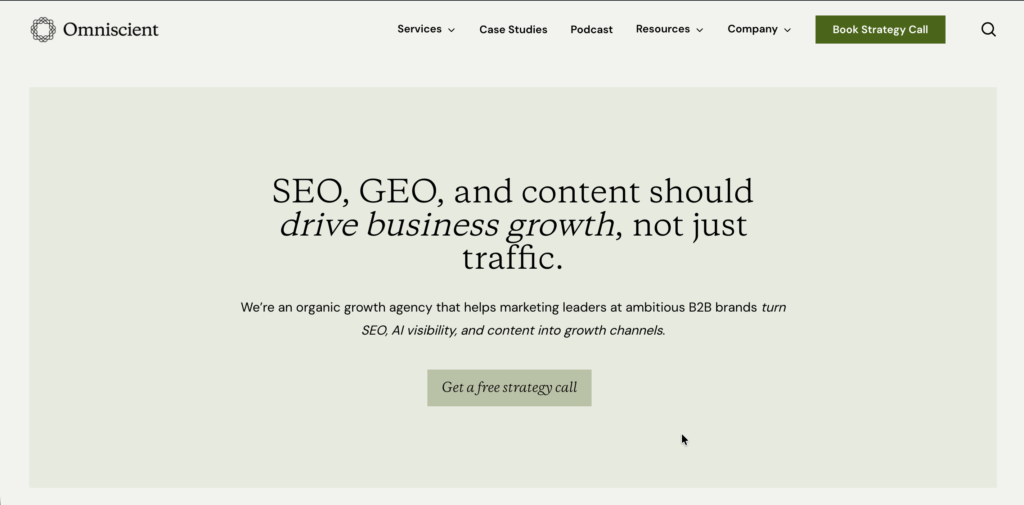
Omniscient Digital is an organic growth agency for B2B companies. We run search, AI visibility, and content as one revenue channel instead of covering every marketing discipline, which puts us at the specialist end of this lineup.
The thesis is that organic compounds when it amplifies positioning that already works, and stalls when asked to compensate for weak fundamentals. That belief shapes what we take on and what we turn down.
Pros:
- Our SEO and content strategy combines buyer, product, and channel research with voice-of-customer work, product alignment, search-intent analysis, and proprietary organic-growth frameworks.
- In addition to offering generative engine optimization services, we also publish original research on what LLMs are citing and how the AI search landscape is changing. Our findings inform client strategy first and foremost.
- We offer Digital PR and link building services, and have a network of writers, editors, and publishers at sites with a minimum Domain Rating of 50.
Pricing: Full-service engagements start at $10,000 a month, and standalone strategy development starts at $15,000.
Results: Our team helped Teambridge generate $400,000 in qualified pipeline and increase monthly organic conversions by 385% in early 2025 and Q3 2025.
2. GrowthRocks: Best for product-led growth experimentation
Best for: Teams that want structured growth experiments run against a defined budget before they commit to a fully outsourced marketing function.
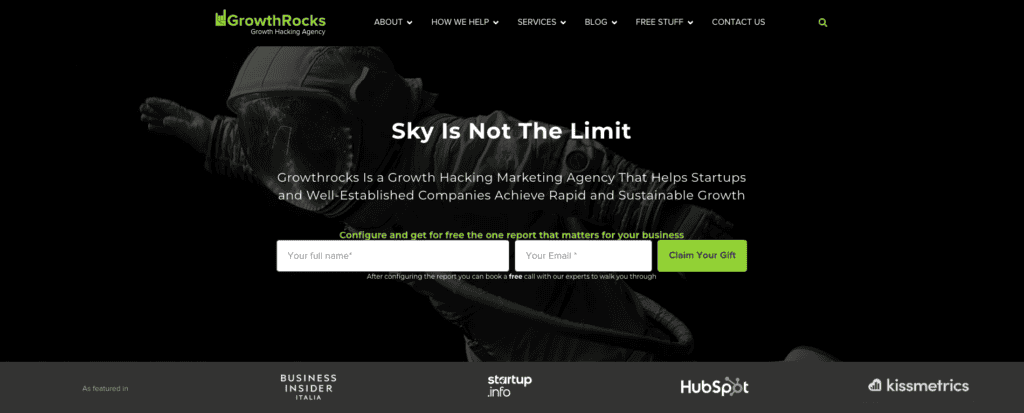
Growth hacking is the organizing discipline at GrowthRocks, which the agency states plainly by describing paid ads as an enabler and not the main strategy. That framing shapes the whole offering toward organic and product-led mechanisms.
The agency works out of London and Athens across three modes: consulting, execution, and training. Its market position rests on transparency about what each mode costs, which is fairly uncommon in a category where almost every competitor routes buyers to a quote.
Pros:
- GrowthRocks offers 5 different service packages—GrowthBites, Growth Consulting, Growth Execution, Full Implementation, and CMO Office. These allow buyers to choose from senior advisory support or more hands-on growth execution.
- The agency serves B2B and B2C businesses, along with marketplaces, so it’s a flexible option.
- A separate training arm runs in-class, remote, in-house, and hackathon formats, including a program that produces a six-month growth plan.
Pricing: Besides consulting for $400 per hour, GrowthRocks’s monthly pricing starts at $3,000 per month and ranges up to $15,000 for higher-tier plans.
Results: Via a project that covered on-site and off-site SEO, email marketing, and lead nurturing, Volta Wireless achieved a 600% increase in SEO visibility within nine months.
3. Ignite Visibility: Best for multi-location and franchise brands
Best for: Brands running national campaigns that have to resolve down to local execution across dozens or hundreds of individual physical locations.
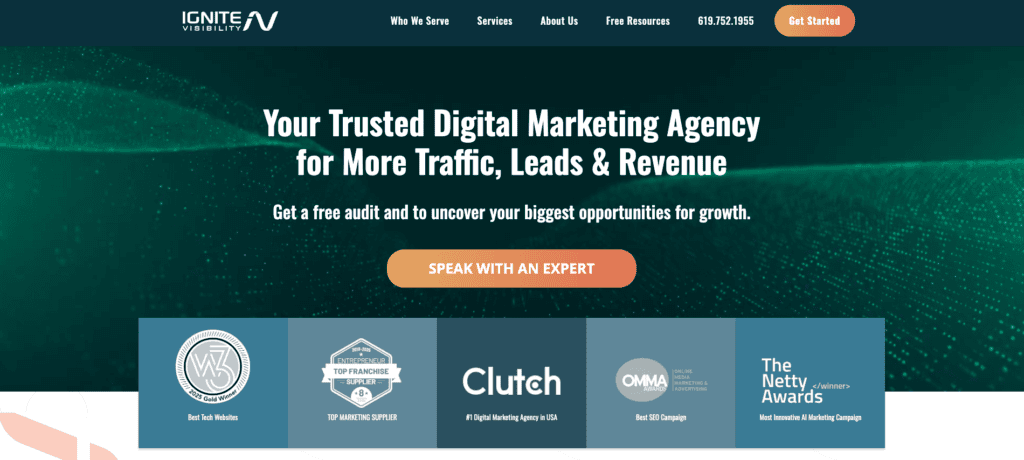
Since partnering with Mountaingate Capital in 2023, Ignite Visibility has completed four acquisitions, including Outliant and EverConnect, to expand its capabilities for enterprise, franchise, and multi-location brands. The San Diego firm covers SEO, digital PR, programmatic, web development, and lifecycle marketing under one contract.
Pros:
- The agency states it does not use long-term contracts or hidden fees, and clients own the work Ignite produces on their behalf.
- It operates a low client-to-account-manager ratio with a dedicated help desk and standing calls.
- Across 100+ reviews on Google and Clutch, Ignite maintains a nearly 5-star rating. The agency also has numerous case studies that potential clients can sort by industry to find the cases most similar to their own.
Pricing: Pricing is not publicly available—contact Ignite Visibility for a quote.
Results: During a five-week benchmark period, AI-generated traffic accounted for approximately 10.15% of Ignite Visibility’s total leads while representing 5.46% of total website sessions.
4. Single Grain: Best for AI-native full-channel execution
Best for: Marketing teams that need to add channel capacity within a quarter and can’t get headcount requisitions approved to do it.
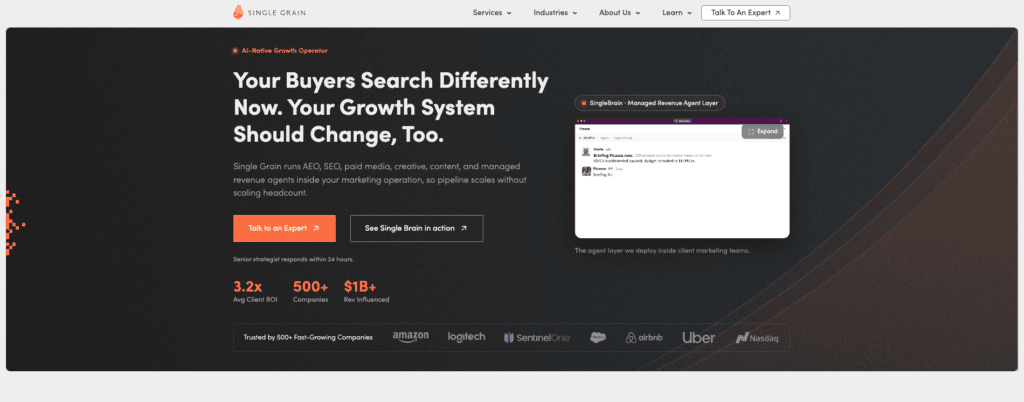
Leveling up marketing without increasing headcount is the recurring promise at Single Grain, and capacity substitution is how the Los Angeles agency positions itself against specialist shops. It combines agency services—SEO, paid media, content, and conversion optimization—with proprietary products including Single Brain, ClickFlow, and Karrot.ai.
Pros:
- The agency builds lead-generation campaigns across paid search, social, email, content, and retargeting, allowing multichannel acquisition work to be managed together.
- A Search Everywhere Optimization service spans search engines, social platforms, LLMs including ChatGPT and Perplexity, and forums such as Reddit and Quora.
- Single Grain offers a pay-per-lead option that lets clients define qualification criteria such as company size, budget, buyer role, timeline, and need. Clients only pay for leads that have been pre-qualified.
Pricing: Pricing is not publicly available—contact Single Grain for a quote.
Results: LS Building Products increased site conversions 229% and organic traffic 206% over a 12-month engagement, starting from roughly seven quote requests and 725 organic visits a month.
5. Grow and Convert: Best for bottom-funnel content and SEO
Best for: Teams whose content program produces traffic and no signups, and who need every article aimed at a problem the product solves.
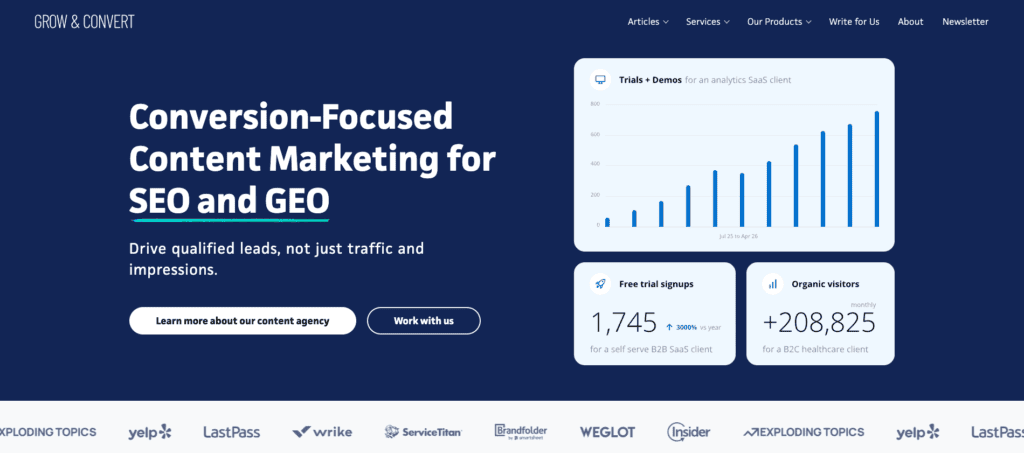
Pain Point SEO is the methodology that gives Grow and Convert its position in the market. The agency plans, writes, and publishes editorial content, orienting every piece around bottom-of-funnel commercial keywords instead of broad traffic terms.
That choice sets it apart from the volume model most content agencies run on. The agency has since extended the same approach into AI search under a framework it calls Prioritized GEO, which covers traditional search engines and LLM surfaces together.
Pros:
- Strategy engagements run four to six weeks and produce a prioritized editorial calendar mapping each topic to a keyword, funnel stage, and product use case.
- Grow and Convert’s approach is rooted in subject matter expert interviews, so writers extract domain-specific insight from your team instead of working as generalist freelancers.
- Clients get their AI visibility tool, Traqer.ai, free alongside the content engagement.
Pricing: Pricing is not publicly available—contact Grow and Convert for a quote.
Results: Over the course of two years, Grow and Convert’s content brought in over 200,000 organic visits for GeekBot and also generated 1,745 trial signups.
6. Demand Curve: Best for startups building growth in-house
Best for: Series A through C teams that need paid acquisition running this month while they build the internal capability to take it over later.
Demand Curve built its reputation around startup-growth education, including courses, playbooks, webinars, and its Growth Program. That origin still shapes what it sells. The paid acquisition, ad creative, landing page, and AI search work sits alongside a training product aimed at the same buyer.
Not only does the team specialize in working with startups, but all services are rendered by senior operators. No junior staff and no account-manager layer is sitting between the client and the people actually doing the work.
Pros:
- Engagements run month to month with no long-term contract.
- Besides standard AI search optimization across ChatGPT, Perplexity, and Gemini, Demand Curve also creates ChatGPT Ads.
- Their proprietary AI, Signal, is trained on data from more than 7,000 startups instead of off-the-shelf public models.
Pricing: Pricing is not publicly available—contact Demand Curve for a quote.
Results: Demand Curve helped Astra grow monthly active users by 500%, and 2x’d conversions for 3Leaf.
7. Disruptive Advertising: Best for mid-market paid media and CRO
Best for: Mid-market advertisers spending mid-five figures a month across paid channels who want managed execution backed by a performance guarantee and no long-term contract.
With 350+ Clutch reviews and 100+ on G2, Disruptive Advertising has accumulated more verified third-party feedback than many alternative agencies. Review volume, more than a proprietary methodology, is what the firm leads with.
Disruptive Advertising combines paid media with SEO, conversion optimization, Amazon advertising, lifecycle marketing, creative, and analytics services. The agency states its own fit profile plainly: businesses doing millions in annual revenue that spend tens of thousands a month on marketing, which places it squarely in the mid-market rather than at the enterprise end of this list.
Pros:
- The service surface covers paid search, paid social, SEO, Amazon, lifecycle, CRO, creative, and analytics in one engagement.
- The agency operates a deliberate capacity cap, publicly stating it onboards only 10 new clients a month. This presumably prevents the team from being spread too thin in terms of bandwidth.
- Disruptive has many certifications and partnerships, including partnerships with Google, Amazon, HubSpot, Microsoft, Meta, and Klaviyo.
Pricing: Pricing is not publicly available—contact Disruptive Advertising for a quote.
Results: Disruptive helped a home warranty company generate a 10-20% increase in leads, brand awareness, and sales.
8. NoGood: Best for embedded multi-discipline growth squads
Best for: Series A and later companies whose priorities shift quarterly and who need a team that changes shape without a new statement of work.
NoGood is a growth marketing agency serving startups, scaleups, and enterprise brands across SaaS, fintech, healthtech, and consumer markets. Its services include SEO, AEO, paid search, social advertising, content marketing, performance branding, and lifecycle marketing. The team consists of specialists across growth, creative, design, engineering, and data science
Pros:
- Thirteen named service lines run from AEO and paid search through lifecycle marketing, CRO, and marketing analytics. It’s a good fit for brands in need of full-funnel service.
- Fractional CMO and consulting engagements sit alongside execution, so buyers can start with strategy before committing to a full retainer.
- NoGood can support an AI-search program with Goodie’s real-time monitoring, optimized content creation, traffic and conversion tracking, and actionable LLM-visibility insights.
Pricing: NoGood states that its average retainer is above $20,000 a month.
Results: SteelSeries grew AI search traffic 6.7-fold to over 1,500 daily visitors and saw a 27-fold year-over-year increase in conversions from AI platforms.
9. Skale: Best for B2B SaaS organic signups and MRR
Best for: SaaS companies past the content experiment stage that need organic search reported against signups and monthly recurring revenue.
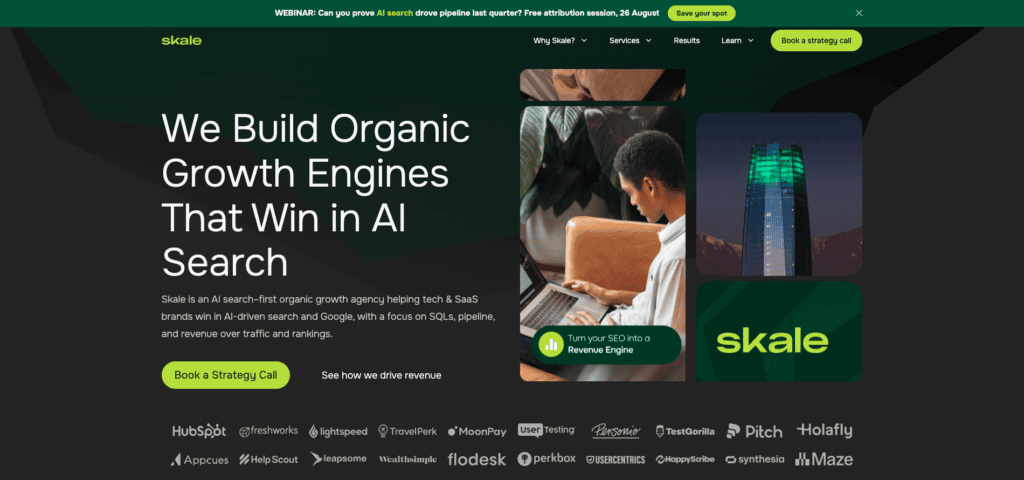
Skale sells organic search as a revenue channel, running SEO and generative engine optimization out of a distributed team of 20+. While they have broader multichannel demand-generation experience, the agency specializes in working with B2B SaaS brands. Its offerings are tied to SaaS acquisition metrics.
Skale combines SaaS in-house experience with specialist SEO, content, technical SEO, and off-page expertise.
Pros:
- GEO engagements cover AI search audits, content restructuring, schema markup, brand mention outreach, and rank tracking across ChatGPT, Perplexity, Bing AI, and Google AI surfaces.
- Engagements follow a five-step process. It starts with agreeing on business outcomes and North Star metrics, followed by building and executing against a three-month prioritized roadmap.
- Each account is staffed with a combination of SEO experts, content producers, and outreach specialists instead of generalist team members.
Pricing: Pricing is not publicly available—contact Skale for a quote.
Results: Maze grew monthly organic signups 283% in under six months, alongside a doubling of signup conversion rate and fourfold growth in non-branded organic visits.
10. Directive Consulting: Best for mid-market and enterprise B2B
Best for: Marketing teams answering to a board on pipeline and unit economics, where lead volume has stopped being a credible reporting metric.
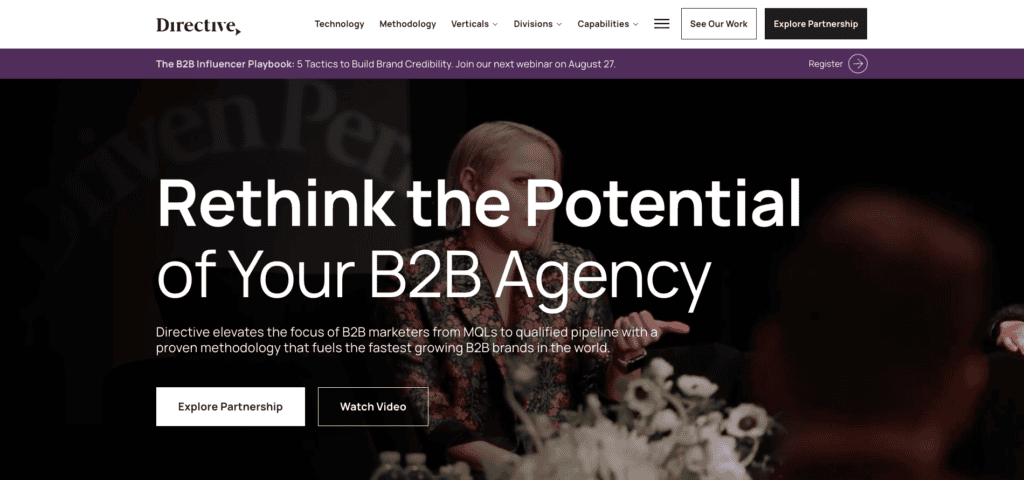
Directive Consulting’s Customer Generation methodology underpins its approach to B2B marketing, which emphasizes revenue growth, pipeline impact, and customer value over lead volume alone.
The firm is structured into three divisions spanning performance, commerce, and communications. A standing annual research and development budget of $2.2M feeds all three—few agencies operating at this scale disclose that kind of investment publicly.
Pros:
- Directive brings content, paid media, performance creative, programmatic, RevOps, and startup-growth programs together within its Performance division.
- The agency offers ABM programs that use personalised, multichannel campaigns to reach and convert high-value target accounts.
- Directive has a transparent operating cadence. Clients receive proactive communication through Slack, regular calls, and data reporting at every meeting.
Pricing: Pricing is not publicly available—contact Directive Consulting for a quote.
Results: AxisCare recorded a 200% year-over-year increase in scheduled demos and 70% growth in relevant organic traffic within nine months across Q1 to Q3 2024.
11. Stellar: Best for PE-backed portfolio performance marketing
Best for: Private equity portfolios and high-spend advertisers where agency fees scaling in line with media budget has itself become the problem.
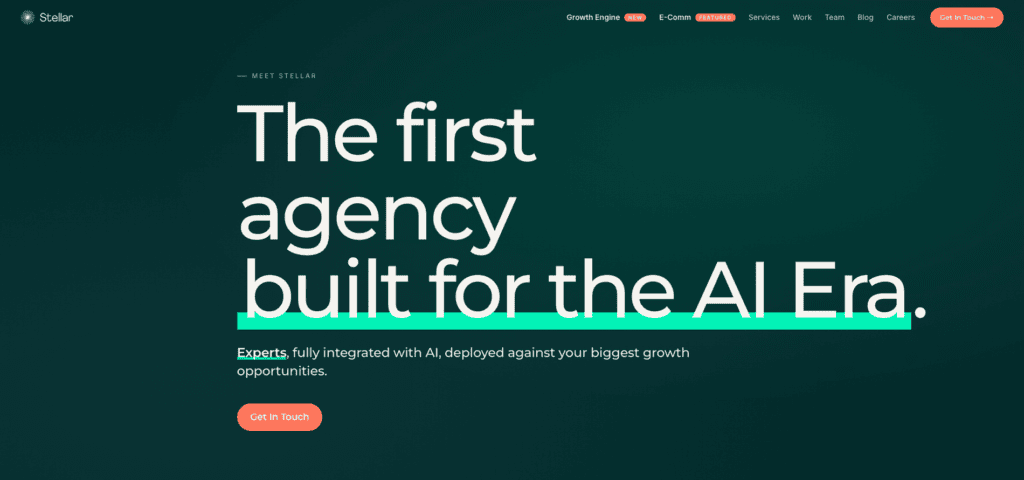
Stellar operates as a collective of specialist agencies under Pixis, an AI marketing technology company. That parentage is the structural difference: the software its teams run on is built in-house by the parent company. Coverage spans paid search and social, SEO and GEO, creative, Amazon and marketplace advertising, and measurement infrastructure.
The agency positions this combination as agency infrastructure rebuilt for AI-era media buying, aimed squarely at advertisers whose budgets have outgrown percentage-of-spend fee models.
Pros:
- Stellar charges a fixed retainer that stays flat as media spend rises, avoiding the conventional percentage-of-spend model.
- Roughly 300 people are organized into seven specialized agencies instead of one generalist bench.
- Clients get access to parent-company tooling including Prism for cross-channel performance monitoring, AdRoom for AI creative, and Visibility for unified SEO and GEO.
Pricing: Stellar has a fixed-retainer model, citing $30,000 a month regardless of media spend.
Results: Sonos recorded 3.2x return on ad spend year over year, as well as a 20x increase in revenue.
12. Graphite Growth: Best for compounding SEO and AEO engines
Best for: Companies treating search as a multi-year channel, willing to trade early momentum for durability against algorithm updates and AI-driven discovery shifts.
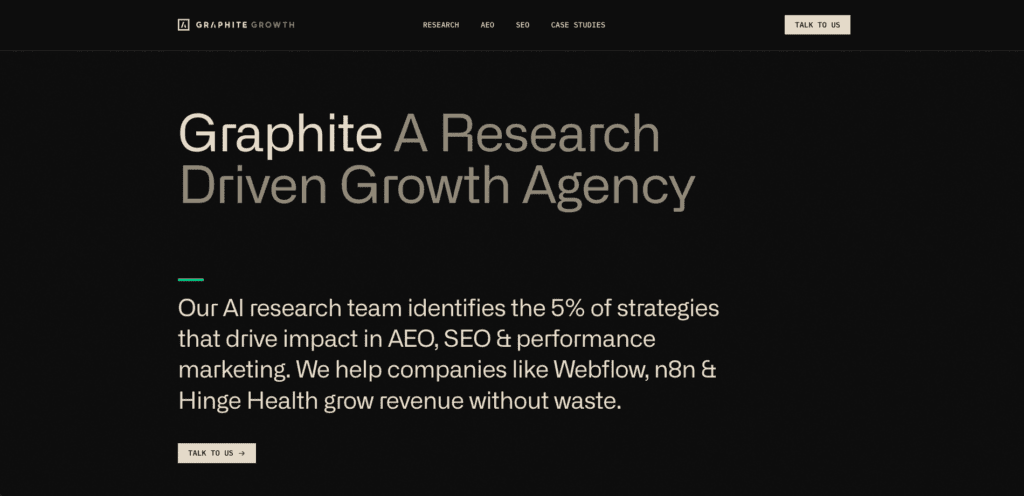
Graphite Growth runs as a research organization first and an SEO and answer engine optimization agency second.
An in-house team of credentialed AI and data scientists publishes original studies, and the agency sells only the strategies that survive that testing. The commercial consequence is a narrower offering than most competitors carry. Graphite’s work is limited to research, AEO, and SEO.
Pros:
- Graphite doesn’t overpromise in terms of the timeline for results—it states that results mature at nine to 12 months. The agency requires a minimum 12-month engagement to match, allowing enough time for clients to judge the impact properly.
- Its research team is led by two PhDs, including a Chief AI Officer with prior research roles at Yahoo, Google, and Microsoft.
- AEO performance is benchmarked against a fixed prompt set of typically 200 or more high-intent queries per quarter.
Pricing: Pricing is not publicly available—contact Graphite for a quote.
Results: Webflow doubled its share of signups originating from LLMs, moving from 4% to 8%, and grew LLM share of voice from 33% to 64% during the course of an engagement with Graphite.
13. NP Digital: Best for global omnichannel performance marketing
Best for: Brands running campaigns across multiple countries that need genuine local execution without appointing and managing a separate agency in each market.
Owned software is what separates NP Digital from many other agencies here. Strategy runs on first-party search data from the team’s own tools, including Ubersuggest and AnswerThePublic, instead of licensed third-party platforms.
Founded in 2017 by Neil Patel and now with over 1,000 employees, the agency delivers search, paid media, creative, and analytics at scale. Its footprint is built for buyers whose primary problem is geographic coverage rather than depth in any single channel.
Pros:
- NP Digital’s AI Search Optimization service uses technology that monitors brand mentions, citations, and sentiment across LLMs including ChatGPT, Perplexity, Gemini, and Copilot.
- Its proprietary data assets span more than 50 trillion rows of backlink data and over 30 billion keywords across 100-plus countries.
- With 500+ clients and 70+ awards and mentions under its belt, NP Digital is a top growth marketing agency both in terms of experience and reputation.
Pricing: Pricing is not publicly available—contact NP Digital for a quote.
Results: Universal Technical Institute achieved a 411% year-over-year increase in organic search sessions and 18% growth in total organic inquiries with NP Digital’s help.
14. Gold Front: Best for creating and launching a new category

Best for: Executive teams whose growth problem is that buyers have no existing category to file them under, so channel spend has nowhere to land.
Category design is the whole offering at Gold Front—this San Francisco brand studio covers category strategy, naming, visual identity, and launch campaigns. It describes itself as the only agency serving category creators end-to-end. That combination of strategy consultancy and brand studio craft sits at the foundation layer of growth.
Most of this list operates on channels; Gold Front works on the narrative those channels would carry, which may suit companies whose positioning is the blocker.
Pros:
- A defined Category Design Program follows a fixed sequence starting with stakeholder interviews and leadership workshops, and ending with finalized website design and copy based on unique category POV.
- 45% of new clients arrive by referral from venture capital and private equity investors, proving that the agency has built up a great deal of trust.
- Having designed and named 76 categories, Gold Front has a repeatable approach to its work.
Pricing: Pricing is not publicly available—contact Gold Front for a quote.
Results: Qualtrics raised $180 million at a $2.5 billion valuation shortly after the 2017 category strategy engagement, and IPO’d at $21 billion in 2021.
15. Growth Marketing Pro: Best for founder-led paid and organic
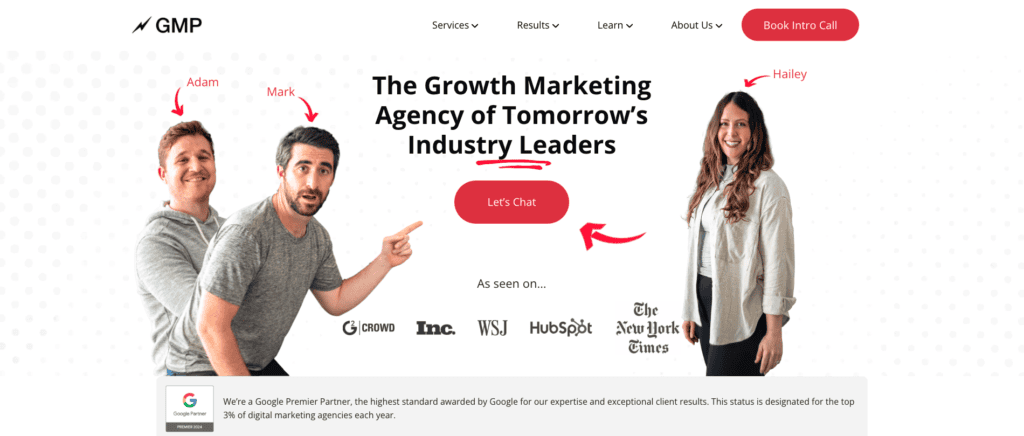
Best for: Venture-backed teams that need paid and organic running under one roof and cannot absorb a long agency ramp before results appear.
Principal-level delivery defines Growth Marketing Pro. Clients work directly with the three founders and an extended team of experienced marketers, rather than having their accounts handed over to junior managers.
This agency’s offerings span paid media, CRO, and marketing operations for fast-growing B2B and consumer tech companies. Also, instead of traditional search engine optimization, Growth Marketing Pro does Search Everywhere Optimization, which provides broader coverage including Reddit, YouTube, and Wikipedia.
Pros:
- The agency commits to a two-week ramp, which is faster than many agencies that use the first several weeks for strategy only.
- It holds Google Premier Partner status, which it states is designated for the top 3% of digital marketing agencies each year.
- Growth Marketing Pro also does RevOps to improve revenue visibility. These engagements start with audits of CRM, data, routing, reporting, and integrations, followed by prioritized fixes.
Pricing: Pricing is not publicly available—contact Growth Marketing Pro for a quote.
Results: Point One Navigation grew organic traffic 672%, cut cost per acquisition 44%, and doubled Google Ads lead volume over a nine-month engagement.
16. Olivine Marketing: Best for product marketing and GTM support
Best for: Teams whose growth problem sits upstream of channels, in unclear positioning, weak sales enablement, or a launch with no story behind it.
Olivine Marketing’s team includes former in-house product marketing leaders from LinkedIn, Meta, Intercom, and Salesforce. This allows the agency to act as an embedded extension of a client’s product marketing function.
Its work covers positioning, messaging, go-to-market strategy, competitive intelligence, and sales enablement for B2B software companies. That places it upstream of the channel execution most of this list sells, closer to the strategic groundwork that campaigns downstream depend on.
Pros:
- Olivine offers full-service agency support, fractional product marketing consultants, and self-guided Playbooks, giving buyers options across different levels of hands-on support.
- Fractional consultants are available at five to 40 hours a week, so teams can staff a part-time product marketing function without hiring.
- Each engagement opens with a positioning and messaging strategy workshop to facilitate discovery and alignment before any asset work begins.
Pricing: Pricing for agency and fractional services isn’t published, though the self-serve Playbooks program is priced at $99 and Playbooks plus coaching at $499.
Results: For SketchUp, Olivine embedded inside the in-house product marketing team across a seven-month engagement, delivering four competitor battlecards and four product teardowns validated through a stakeholder workshop. The agency publishes these kinds of outcomes in place of performance metrics.
What to consider when choosing a digital marketing growth agency
The lineup above tells you what reputable agencies are out there. But choosing between them (or any alternative agencies) comes down to a handful of important considerations.
Specialization vs. full-service
The common mistake is buying breadth as insurance. A team that hires a full-service shop because it might need paid media later may end up with shallow execution everywhere and depth nowhere.
Look instead at where your growth is actually stuck. One underperforming lever calls for a specialist with a narrow practice. Three channels running without a shared thesis means the coordination itself is what you’re buying.
Embedded teams vs. consulting
Beyond scope, the structural question is whether an agency works inside your operation or beside it. For instance, embedded pods may sit in your Slack channels and sprint cycles, while consulting partners just hand over a strategy and step back.
Siloed channel teams—paid over here, creative over there—is the older model, and it breaks at the handoff. Embedded models implement faster but demand real integration effort from your side.
Ask how the agency handles a mid-quarter pivot. The answer tells you which you’re buying.
Track record in your vertical
That said, vertical experience matters less than most buyers assume, and for a different reason than they expect. It rarely changes an agency’s channel skill—a good paid search team is good across categories.
What it changes is buying-cycle knowledge: sales cycle length, who signs, what objections surface at month four. B2B SaaS growth looks nothing like DTC ecommerce or fintech there, which is why a SaaS growth marketing agency usually reads your funnel faster.
Where your category is genuinely new, a horizontal agency with strong research habits beats a vertical specialist working from stale assumptions.
AI search and GEO capability
Discovery has changed since most agency retainers were designed, and the field has responded at very different depths. Some agencies now sell AI visibility as a standalone service with its own deliverables—audits, entity work, citation tracking, prompt benchmarking. Others tack it onto an existing SEO line item without truly adjusting their approach for this new reality.
Ask which one you’re being sold, and what gets reported monthly. Our guide to LLM optimization tactics covers what GEO work involves if you want to pressure-test a claim.
Before you shortlist, get the framework we use to scope AI search work. Read the AEO Field Guide. It lays out the three modes of influence in AI search and how to measure each one.
Onboarding speed and time to results
Two clocks run in every engagement, and buyers routinely conflate them. Ramp time is how long until work ships. Results time is how long until the work moves a number.
Some agencies ship within weeks. Others require a twelve-month commitment and say plainly that outcomes mature at nine to twelve months. Neither is inherently wrong—they’re selling different levers.
The warning sign is an agency promising fast outcomes on a slow-compounding channel. Organic search producing pipeline in 60 days should prompt a question before a signature.
How much do growth marketing agencies cost?
Only four of the sixteen agencies listed here publish a rate on their own site. GrowthRocks starts at $3,000 a month for consulting, Omniscient Digital at $10,000 for full-service work, NoGood reports an average retainer above $20,000, and Stellar charges a fixed retainer of roughly $30,000, whatever the media spend.
For everyone else, third-party sites like Clutch are the only benchmark. The minimums cluster tightly, typically running from $5,000 per month, with $10,000 and up being the most common.
A realistic band for an ongoing growth marketing retainer, then, is $5,000 to $30,000 a month, with most mid-market engagements landing between $10,000 and $20,000. Run the content marketing ROI math against that range before your first call.
The right agency gets compounding results
These agencies on this list are not interchangeable. A category design studio and a paid media shop both sell growth. Only one helps if your problem is that buyers can’t tell what you are.
Match the agency you’re considering to a specific gap. Organic traffic climbing while pipeline sits flat is a strategy and measurement problem, and a bigger channel team will not fix it. Three channels running without a shared thesis means coordination is what you’re short of.
We built Omniscient Digital around the first of those. Organic search, AI visibility, and content, run as one revenue channel for B2B software companies, with attribution attached. If that’s the shape of your gap, book a free strategy call, and we’ll tell you which problem you have before you spend anything.
Frequently asked questions
What’s the difference between growth and performance marketing?
Performance marketing focuses on measurable paid acquisition and direct response. Growth marketing covers the whole funnel—acquisition, activation, retention, referral, and revenue—across paid and organic channels with systematic experimentation.
The practical difference is the optimization target. Performance marketers optimize for immediate conversions; growth marketers optimize for lifetime value and compounding loops.
Should you hire a growth marketing agency or build in-house?
Pre-product-market-fit startups should stay founder-led and run small experiments before hiring anyone. Once product-market fit is established, companies scaling toward Series A and B gain the most, since agencies supply specialist expertise and velocity that would take a year to build internally.
Even then, the in-house route may be viable longer in B2B than the cross-sector averages imply. This is because B2B product companies outsource just 28% of their digital marketing activity and services firms 25%. Our breakdown of freelancer, agency, or in-house covers where each model starts to strain.
How do you measure growth marketing ROI beyond vanity metrics?
Focus on attributed revenue, pipeline generated, CAC payback period, LTV:CAC ratio, and retention cohorts. Be wary of any agency reporting traffic, impressions, or rankings without connecting them to revenue.
Get the organic measurement report: It covers how attribution changes once AI surfaces sit between your content and your buyer.
Set the measurement model before the engagement starts. Forrester found that 64% of B2B marketing leaders don’t trust their own marketing measurement, so the baseline you’ll judge an agency against may need fixing first. Our guide to calculating SEO ROI covers how to build one that holds up.
Get the Field Notes
Weekly learnings from working on B2B content & SEO for dozens of companies.