Key takeaways for choosing the best analytics agency
- Specialist vs. full-service is the first fork in the road. Some agencies focus solely on data, while others fold analytics into a broader digital marketing retainer. The right choice depends on whether your gap is technical or strategic.
- Revenue-tied measurement is pulling ahead of dashboard reporting as the thing agencies actually get hired for. B2B marketers using full-funnel attribution are 45% likely to exceed primary marketing goals, compared with 24% for those who don’t.
- Almost nobody publishes a price. Most agencies require you to contact them for pricing, which makes sense given how variable analytics-related scopes can be.
“Half the money I spend on advertising is wasted; the trouble is I don’t know which half.”
This old line from John Wanamaker originally described a data problem, but analytics dashboards come a dime a dozen now. Most teams today have more data than they know what to do with, so the problem has shifted from collection to interpretation. This is where an agency can be helpful if you choose wisely based on your company’s needs.
This list compares several agencies, plus what to think about when zeroing in on the best data analytics agency for your team.
Table of contents
- Key takeaways for choosing the best analytics agency
- At a glance: The 7 best analytics agencies
- 7 reputable agencies that offer analytics services
- 1. Omniscient Digital: Best for B2B SaaS revenue-focused analytics
- 2. Vision Labs: Best for dedicated data consulting
- 3. Seer Interactive: Best for unifying paid and organic data
- 4. Concord: Best for consulting-led analytics and data governance
- 5. Growth Savvy: Best for performance marketing analytics
- 6. OneMagnify: Best for full-service digital and analytics
- 7. Artefact: Best for Amazon Marketing Cloud and retail media analytics
- What to look for in an analytics agency
- How much do analytics agencies cost?
- You can make sense of your analytics
- Frequently asked questions
Disclosure: Omniscient Digital appears on this list since digital marketing analytics services are a core part of our work. However, we’ve evaluated every agency here by the same criteria, and we’ll tell you plainly where a competitor might be the better fit.
At a glance: The 7 best analytics agencies
| Agency | Best For | Starting Price | Key Differentiator |
| Omniscient Digital | B2B SaaS revenue-focused analytics | $10,000/mo for full-service engagements | Ties analytics directly to organic-driven pipeline, not just traffic |
| Vision Labs | Dedicated, specialized data consulting | ~$6K–$15K/mo (flat fee) | Pure data/analytics specialist, not a marketing agency with analytics attached |
| Seer Interactive | Unifying paid and organic data in one system | Contact for pricing | Proprietary SeerSignals platform combines paid and organic marketing data |
| Concord | Consulting-led analytics & data governance | Contact for pricing | Consulting pedigree with named enterprise clients across retail and finance |
| Growth Savvy | Performance marketing analytics | Contact for pricing | Analytics tightly wired into paid and performance channel execution |
| OneMagnify | Full-service digital + analytics | Contact for pricing | Analytics as one piece of a broader integrated marketing engagement |
| Artefact | Amazon Marketing Cloud & retail media analytics | Contact for pricing | Specialized Amazon Marketing Cloud service provider with proprietary ML modeling |
How we evaluated the agencies
We scored each agency on three things:
- Technical implementation rigor—how deep their hands-on expertise goes in tracking, tagging, and data infrastructure, since misconfigured tracking undermines everything built on top of it.
- Strategic reporting and business alignment—whether they turn data into audience-specific, actionable recommendations instead of handing over a dashboard and a shrug.
- Client-fit clarity—how plainly the agency states who it’s actually built for, so you can self-select in or out quickly instead of finding out three months into a retainer.
Those criteria assume a fairly stable idea of what “measurement” means, but that ground is shifting too. Self-reported attribution increasingly clashes with what click-based tools show, and we break down this tension in our guide to first-touch versus self-reported attribution.
Attribution models themselves are shifting as AI reshapes organic channels: Our Measuring Organic Growth report breaks down how other marketing leaders are adapting.
7 reputable agencies that offer analytics services
Here’s how each agency approaches analytics, who it’s built for, and past outcomes that back up its claims regarding its analytics capabilities.
1. Omniscient Digital: Best for B2B SaaS revenue-focused analytics
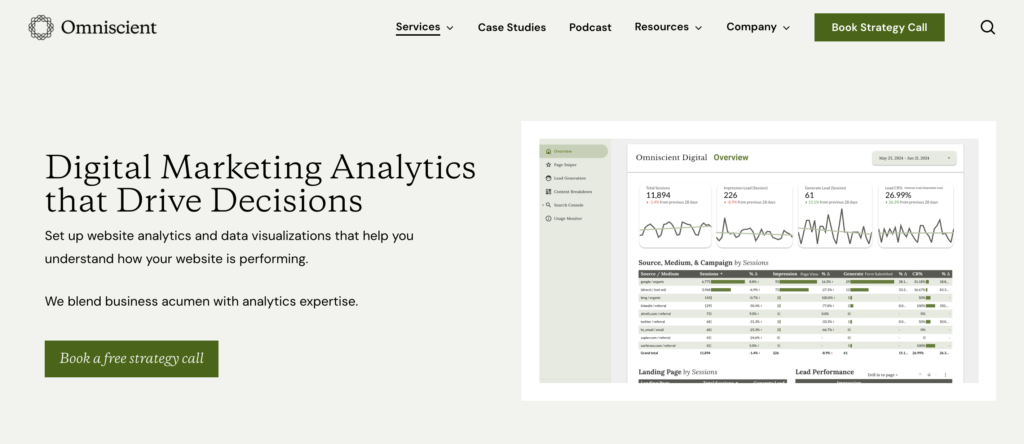
Best for: B2B SaaS companies that need analytics tied directly to pipeline and revenue outcomes, not just organic traffic growth.
Omniscient Digital is an organic growth agency built around a simple premise: organic growth only matters if you can trace it to revenue. Our reporting is built around attribution models that connect content and search performance to pipeline. It’s a narrower positioning than most full-service shops on this list, and that’s deliberate. Our team routinely works with B2B SaaS marketing leaders who know that sessions and traffic aren’t the metrics that matter.
Pros:
- Our digital marketing analytics service pairs analytics with an SEO strategy service, so measurement and the organic growth work it’s measuring come from the same team.
- We go beyond a standard tag-management setup, implementing server-side tracking and data warehousing to unify multiple data sources and ensure accuracy.
- In addition to working with common tools like GA4, Google Search Console, and Google Tag Manager, we can do custom implementations as needed.
Pricing: Full-service engagements start at $10,000 and are customized to your needs.
Results: Our work with Smartling, a translation and localization platform, generated $3.7 million in pipeline value through organic search. The company also saw a 31,250% jump in blog conversions between August 2022 and January 2024.
2. Vision Labs: Best for dedicated data consulting
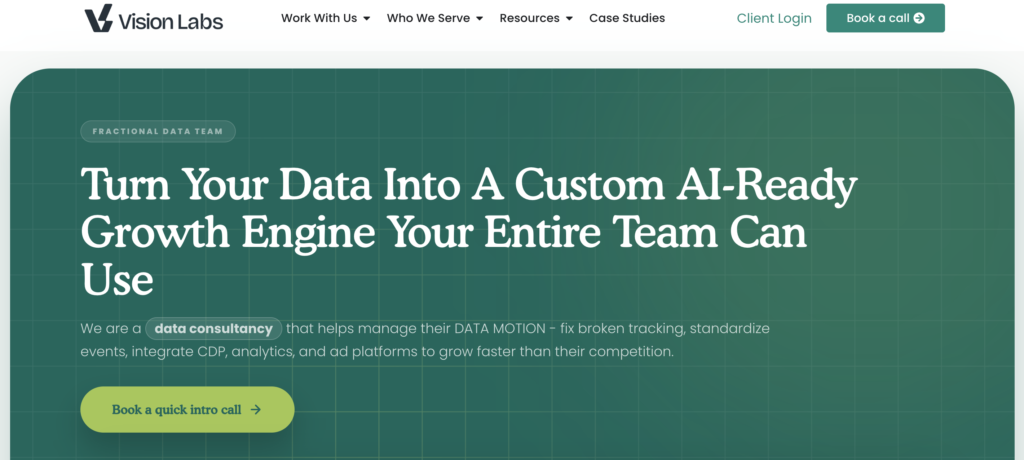
Best for: Teams that want a dedicated data and analytics specialist, not a bundled marketing retainer.
We’re big fans of Vision Labs—so much so that we’ve solicited their guidance in the past to better our own content analytics and optimization programs at Omniscient Digital.
Beyond dashboards and rankings, some teams need a partner that treats attribution modeling itself as the product, not the report. Particularly as self-reported attribution increasingly complicates what a clean dashboard can actually tell you. Vision Labs specializes in that technical side of analytics: GA4 migrations, BigQuery pipelines, and tracking implementations for sites where data volume alone can break a poorly built setup.
Pros:
- Vision Labs supports GA4, Google Tag Manager, PostHog, Looker Studio, and Google Analytics 360 implementations for complex measurement needs.
- The agency offers product analytics capabilities including PostHog setup, migration, event tracking, funnels, retention analysis, session replay, and feature experimentation.
- This data consultancy can own the entire technical and data-systems side of marketing, for organizations ranging from roughly $1M to $1B in revenue.
Pricing: Vision Labs typically charges a flat monthly fee in the range of $6,000 to $15,000.
Results: Vision Labs has various case studies across web analytics, product analytics, e-commerce analytics, attribution, and more. One client said: “Vision Labs transformed how we approach measurement and attribution. Their insights have been invaluable in understanding our true impact and making data-driven decisions.”
3. Seer Interactive: Best for unifying paid and organic data
Best for: Brands that need paid and organic performance data unified into one system, rather than reported on channel by channel.
Seer Interactive is a data-driven digital marketing agency offering analytics, SEO, paid media, creative, and conversion optimization services. Its analytics work combines structured and unstructured marketing data with business-intelligence platforms to identify opportunities across channels. The agency also develops proprietary tools, including SeerSignals, and researches how AI search affects visibility and click-through behavior. This makes it relevant for large brands adapting measurement beyond traditional search.
Pros:
- Seer can combine paid and organic search data through its proprietary SeerSignals platform to support cross-channel budget, content, and customer-acquisition decisions.
- Its analytics practice uses diagnostic and predictive analysis with tools such as BigQuery and Power BI to turn marketing data into dashboards and actionable insights.
- Seer’s analytics AI assistant connects to Google Analytics data in BigQuery and supports conversational analysis with baselines, hypothesis testing, and visual explanations.
Pricing: Seer Interactive does not publish a starting price for its analytics services. Prospective clients must contact the agency for pricing.
Results: Seer reported that its SeerSignals platform and customer research helped Adaptive Insights achieve a 122% increase in organic sessions and a 34% year-over-year increase in organic conversions.
4. Concord: Best for consulting-led analytics and data governance
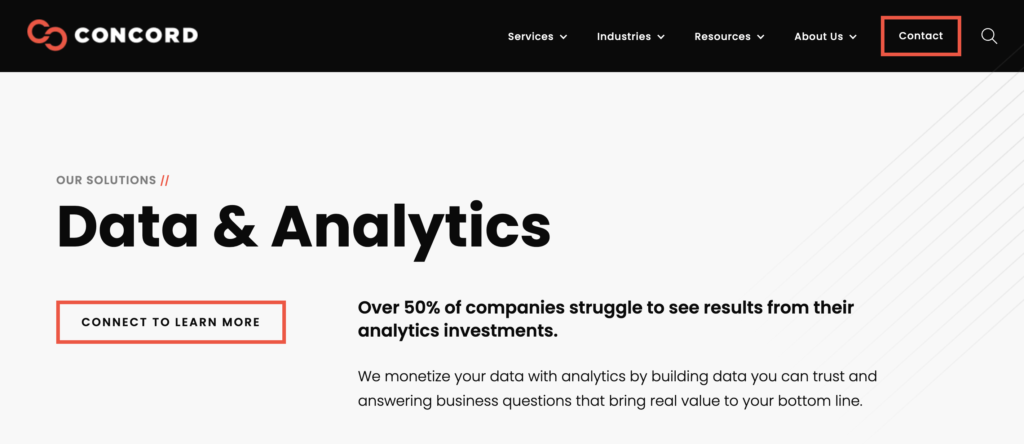
Best for: Enterprise teams that need analytics paired with data governance and consulting-grade strategic oversight.
Concord acquired the analytics company Evolytics in 2022. It approaches analytics from a consulting background rather than a pure marketing-agency one, with data governance and infrastructure sitting alongside reporting. Its client roster, including Intuit, USBank, and other big names, shows that it’s comfortable operating inside large, process-heavy organizations.
Pros:
- The agency’s capabilities include data science and analysis, BI and data visualization, data engineering and architecture, data management, and more. This makes it a good fit for enterprises, which have large tech stacks, a high volume of siloed data, and other complexities.
- The agency structures engagements around a named seven-stage framework spanning data foundation, governance, and AI-driven forecasting. This gives clients a defined maturity path rather than an open-ended retainer.
- Concord serves a wide industry spread, including healthcare, retail, financial services, and manufacturing. This suggests that its infrastructure is built to adapt across different data-governance requirements.
Pricing: Concord doesn’t list pricing on its website. Contact the team for a quote.
Results: Concord has helped customers achieve revenue increases of $2.5 million, double digital cross-sells, and even save close to $1 million in a single quarter.
5. Growth Savvy: Best for performance marketing analytics
Best for: Teams running active paid and performance marketing programs that need analytics wired directly into channel execution.
Growth Savvy builds its analytics work around performance marketing specifically, running paid campaigns and measuring them as one motion rather than reporting on them from the outside. That combination tends to suit teams whose biggest measurement gaps sit inside paid channels rather than organic or content-driven ones.
Pros:
- Growth Savvy connects analytics with paid advertising and conversion-rate optimization, allowing teams to act on insights within the same growth program.
- The team also provides training that helps internal teams interpret data, identify revenue opportunities, and make more informed campaign decisions.
- The agency offers both audits of existing setups and analytics infrastructure from the ground up, so it can work for a variety of companies. It also makes reporting accessible to technical and non-technical stakeholders.
Pricing: You’ll need to contact Growth Savvy for pricing info.
Results: One of the agency’s clients said: “Growth Savvy completely rebuilt our Google Analytics tracking, as the former data setups were not correct and were not fulfilling our needs. It was the first time we could properly track our campaigns on a custom dashboard. And those insights had a huge impact on the success of our Black Friday sales and on future advertising campaigns.“
6. OneMagnify: Best for full-service digital and analytics
Best for: Teams that want analytics folded into a broader integrated marketing engagement rather than run as a standalone workstream.
OneMagnify’s data and analytics service is one component of a wider full-service marketing offering, which suits organizations looking to consolidate multiple vendor relationships into one team. It’s less of a standalone audit product, and more so an infrastructure meant to inform other programs happening under the same roof. Beyond analytics, OneMagnify’s services span digital experience, customer loyalty and incentives, performance marketing, and more.
Pros:
- OneMagnify combines data, analytics, AI, and design work under one team, reducing the number of vendors needed to turn insight into a finished customer experience.
- The agency frames data and analytics work as infrastructure that directly informs paid, creative, and strategy decisions across the account, rather than a report handed off after the fact.
- It uses a three-phase process encompassing data integration and assessment, modeling and intelligence development, and activation and optimization. It also uses machine learning to forecast outcomes and recommend strategies before implementation.
Pricing: OneMagnify uses custom, contact-based pricing.
Results: On a project that encompassed strategic analytics, data visualization, AI automation, and other services, OneMagnify helped ESPN increase customer satisfaction by 9%. The company also boosted streaming subscribers by 176%.
7. Artefact: Best for Amazon Marketing Cloud and retail media analytics
Best for: Brands running Amazon Marketing Cloud that need AMC-specific consulting and data-science-grade modeling layered on top of standard marketing analytics.
Artefact operates further up the technical stack than most agencies on this list, offering marketing measurement tools that use machine-learning technologies such as CausalNex, alongside its Amazon Marketing Cloud services. That positioning suggests a firm built less for teams that need a GA4 audit and more for organizations already generating enough data complexity to justify a data-science layer on top of standard reporting.
Pros:
- Artefact operates as a service provider for Amazon Marketing Cloud, a specialization most generalist analytics agencies don’t offer.
- The agency provides end-to-end AMC consulting, from initial setup through custom dashboard development and ongoing strategic insights.
- It offers algorithmic customer segmentation and lifetime-value scoring on top of standard measurement, useful for teams that want predictive modeling rather than descriptive reporting alone.
Pricing: Artefact uses custom, contact-based pricing.
Results: Artefact used IBM watsonx.ai to develop a generative-AI solution for a leading French bank that analyzed customer data and created targeted customer clusters or samples. The solution was developed in approximately one month and was designed to support more personalized, data-driven marketing.
What to look for in an analytics agency
Beyond the specific agencies above, a few underlying factors tend to separate a good fit from a bad one regardless of which agency you’re evaluating.
1. Reporting cadence and stakeholder alignment
The best web analytics agencies don’t just report more often—they report differently to different audiences.
A weekly dashboard update means nothing to a CFO who needs a monthly revenue-impact summary, and a quarterly business review means nothing to a marketing manager who needs to catch a tracking break within days.
You need to know how an agency structures reporting across stakeholder levels before you sign, not after the first review meeting goes sideways.
This matters most when leadership is already skeptical of marketing’s numbers. An agency that can translate GA4 events into a narrative a CFO will actually grasp builds more internal credibility than one that just hands over a clean dashboard.
2. Tracking and tagging implementation depth
Beyond reporting cadence, everything downstream of your analytics setup depends on the tracking and tagging layer being right. A misconfigured GA4 event or a broken GTM trigger quietly poisons every report built on top of it. Often unnoticed until someone questions a number that looks too good or too bad to be true.
Depth here is a baseline quality signal, not a nice-to-have. Ask any agency you’re evaluating to walk through how they audit an existing tracking setup, not just how they’d build one from scratch.
3. Integration with existing MarTech stack
Tracking accuracy only matters if the data actually reaches the rest of your stack. An analytics agency that can’t integrate cleanly with your CRM, CDP, or ad platforms is asking you to rebuild parts of your stack around their process instead of the other way around.
Don’t underestimate this switching cost. Before you onboard, find out about an agency’s integration experience with the platforms you already run. And, to be clear, they need more than general familiarity with “CRM integrations” as a category.
4. Contract flexibility and engagement model
Beyond the technical fit, engagement models are also worth thinking about upfront because different types solve different problems. For example, a retainer suits ongoing reporting and iterative optimization, while a project-based model is better for a defined deliverable like a GA4 migration or a one-time audit.
Ramp time matters too, since some agencies can start delivering within a week while others need a month of discovery first. Neither is inherently better or worse, but you could find your investment wasted if you don’t pick wisely. For example, if your team isn’t ready to act on findings—good intentions aside—an open-ended retainer won’t be worth it.
5. Analyst access and support quality
Finally, inquire about who you’ll be in contact with day-to-day. Some digital analytics agencies put you in contact with the analyst doing the work. Others route every question through an account manager who relays it to someone else and then comes back to you with an answer.
AMs can be extremely valuable. For example, ours are excellent at explaining reporting to various stakeholders with differing priorities and levels of analytics knowledge. But not having any direct access to the actual analyst is a problem—it adds latency when you need answers fast.
That said, look for a setup where you can interact directly with the analysts working on your project, even if an account manager handles other aspects of the work.
With all criteria above considered, choosing an analytics partner is still only half the equation. When the gap is organic growth rather than measurement itself, you may also need a B2B SEO agency (or a partner with both analytics and SEO capabilities).
How much do analytics agencies cost?
Nearly every agency in this list uses custom, contact-based pricing rather than published rates. That’s partly because analytics engagements vary enormously in scope.
Two broad models show up repeatedly, though:
- Flat monthly retainers, which suit ongoing reporting and optimization work. These typically fall in the $6,000–$15,000/mo range for a technical implementation specialist.
- Project-based pricing, which is best for a defined deliverable like a migration or a one-time audit. These engagements are priced against the scope of a specific project rather than an ongoing relationship.
What influences the number within either model? Scope, platform complexity, and the seniority of the team assigned to your account all factor in. For instance, what costs more for a data analytics agency to build and maintain? A BigQuery pipeline for an enterprise site or a standard GA4 setup? The answer is obvious.
In any case, there’s a good argument for treating an analytics engagement as an investment in decision quality. It’s not just a line item to minimize. Digital channels now account for 61.1% of total marketing spend, according to Gartner’s 2025 CMO Spend Survey. As more budget moves digital, the cost of getting measurement wrong moves with it. This underscores why it’s worth doing your due diligence before signing on with any agency.
You can make sense of your analytics
The best digital analytics agency for your team may not be the most well-known, or the one that shows up at the top of Google search results. The right fit depends more on where your actual gap sits.
Let’s say that your gap is technical—broken tracking, an unmigrated GA4 setup, an unwieldy BigQuery pipeline. In that case, an implementation specialist like Vision Labs solves a narrower problem faster than a full-service shop will.
But what if the problem is strategic? For example, data exists but nobody’s turning it into decisions tied to revenue. Or no one on your team can accurately determine a program’s impact (take SEO ROI, for instance). This is where an agency like Omniscient Digital can step in.
Curious where your current measurement setup is leaving revenue on the table? Book a free strategy call and find out.
Frequently asked questions
What’s the difference between a web analytics agency and a full-service marketing agency?
A web analytics agency focuses specifically on tracking, reporting, and data infrastructure—GA4 implementation, tagging, dashboards, attribution modeling. In contrast, a full-service marketing agency folds analytics in as one workstream alongside paid media, content, creative, and strategy.
Teams with a narrow, technical measurement gap tend to be better served by specialists who know that specific problem inside and out. On the other hand, teams looking to consolidate multiple vendors tend to prefer a full-service shop.
How long does it take to see results from an analytics agency engagement?
It depends heavily on what “results” means for the engagement. A technical fix, like a GA4 migration or a broken tracking audit, can show measurable improvement in data accuracy within weeks—this is usually the fastest kind of win a digital analytics agency delivers.
Strategic outcomes, like attribution-driven changes to budget allocation or pipeline growth tied to reporting insights, typically take a full quarter or more to show up clearly, since they depend on enough data accumulating to act on.
Can a mid-size company benefit from an analytics agency, or is it mainly for enterprise brands?
Mid-size companies can benefit, though the right agency type differs from what an enterprise brand needs. Enterprise-focused agencies are often built around data volume and governance complexity that a mid-size team doesn’t have yet.
An agency built for a specific vertical or company stage, like B2B SaaS, often serves a mid-size company better. It already calibrates its reporting frameworks to that scale, rather than scaling down an enterprise build.
Get the Field Notes
Weekly learnings from working on B2B content & SEO for dozens of companies.