Key takeaways on choosing a B2B PPC agency
- Paid search takes a larger share of digital budgets every year while returns get harder to prove. Paid online channels now account for 69% of total digital spend, so more of your budget rides on a channel your CFO wants defended in revenue terms.
- The agencies worth shortlisting connect ad platforms to your CRM before optimizing anything. Platform conversions tell you an ad worked; only sales data tells you the lead was worth buying.
- Channel breadth and deliberate narrowness are both defensible, but not interchangeable. An agency running six channels and one running two solve different problems, and the wrong fit becomes work you staff yourself.
Paid search budgets keep climbing. It is now the leading digital channel, growing its share of total digital spend from 13.6% to 13.9% year over year, according to the Gartner 2025 CMO Spend Survey.
Unfortunately, pressure to justify that spend is also increasing.
Most leaders evaluating a B2B PPC agency aren’t short on firms willing to report clicks and lead volume. But they are short on agencies that tie spend to pipeline.
This guide compares eight agencies on what can be verified about their measurement, channel scope, and market fit.
Table of contents
- Key takeaways on choosing a B2B PPC agency
- At a glance: The 8 best B2B PPC agencies
- The 8 best B2B PPC agencies
- Single Grain: Best for growth-stage SaaS on many channels
- KlientBoost: Best for CRO-led paid programs
- Directive Consulting: Best for enterprise B2B pipeline accountability
- Semetrical: Best for international B2B paid search
- Clarity Performance: Best for established B2B tech
- Riverbed Marketing: Best for small to mid-market B2B
- Flow Agency: Best for paid media plus AI search visibility
- ProperExpression: Best for regulated B2B and fintech
- What should you look for in a B2B PPC agency?
- How much do B2B PPC agencies cost?
- How to hire the right B2B PPC agency for your pipeline
- Frequently asked questions about B2B PPC agencies
Disclosure: This guide is published by Omniscient Digital and, at the time of writing, we do not offer paid media services. We’ve evaluated every agency below objectively and against the same criteria.
At a glance: The 8 best B2B PPC agencies
| Agency | Best For | Starting Price | Key Differentiator |
| Single Grain | Growth-stage SaaS on many channels | Contact for pricing | Full-service operator, not paid specialist |
| KlientBoost | CRO-led paid programs | Contact for pricing | Goal-pacing accountability with in-house CRO |
| Directive Consulting | Enterprise B2B pipeline accountability | Contact for pricing | LTV:CAC-modeled paid media, not MQL volume |
| Semetrical | International B2B paid search | Contact for pricing | Sales-data-fed paid search across markets |
| Clarity Performance | Established B2B tech and scale-ups | From £5,000/mo media per channel | Budgets reverse-engineered from deal value |
| Riverbed Marketing | Small to mid-market B2B | From $3,000/mo month | Published rates and 30-day cancellation |
| Flow Agency | Paid media plus AI search visibility | Contact for pricing | Paid integrated with SEO and LLM optimization |
| ProperExpression | Regulated B2B and fintech | Contact for pricing | RevOps-integrated PPC for financial services |
How we evaluated these B2B PPC agencies
We assessed each agency on what could be verified from its own public pages and published client work rather than on reputation:
- Paid channel coverage. Whether an agency runs paid search alone or extends into paid social, ABM, and programmatic determines what you still staff internally.
- Revenue-side measurement setup. We looked for evidence the agency connects ad platforms to CRM and sales data and reports in pipeline terms.
- B2B segment and sales-cycle fit. A firm built for self-serve SMB buyers and one built for enterprise ABM both call themselves B2B PPC agencies, and neither volunteers the difference.
- Integration with organic, content, and CRO. Paid programs stall on weak landing pages, so whether that work sits in-house changes cost and speed.
One caveat: capabilities and pricing were verifiable on nearly every agency’s site, but outcome metrics often were not. Some publish nothing quantified, and where they do, timeframes are missing. We have noted what each firm documents, including where evidence is thinner than the pitch. The same gap shows up in wider organic and paid benchmark data.
The 8 best B2B PPC agencies
Single Grain: Best for growth-stage SaaS on many channels

Best for: Teams needing one partner across Google, Microsoft, Amazon, and AI answer surfaces without adding headcount per channel.
Single Grain runs paid media alongside other services, including SEO, content marketing, conversion rate optimization, and even NFT marketing. What separates it from the paid-search specialists here is the operating model, not the channel mix. It positions itself as embedded execution capacity working inside a client’s existing tools and data rather than an advisory relationship.
Pros:
- Single Grain connects ad platforms to the client’s CRM using offline conversion tracking, then reports ROAS, CAC, and SQL rate at campaign level.
- Account architecture spans Google Ads, Microsoft Advertising, and Amazon, using negative lists and exact-match protectors to hold lead quality as spend scales.
- Landing pages, form speed, and lead routing sit inside the paid engagement rather than being scoped separately.
Pricing: Single Grain uses a monthly retainer model based on a percentage of advertising spend or a small management fee.
Results: Single Grain helped Learning A-Z surpass projected revenue by 65% and lift ROAS from 3.69 to 4.79.
KlientBoost: Best for CRO-led paid programs
Best for: Demand gen teams whose paid spend converts poorly and who need landing page and creative testing inside the same engagement as media buying.
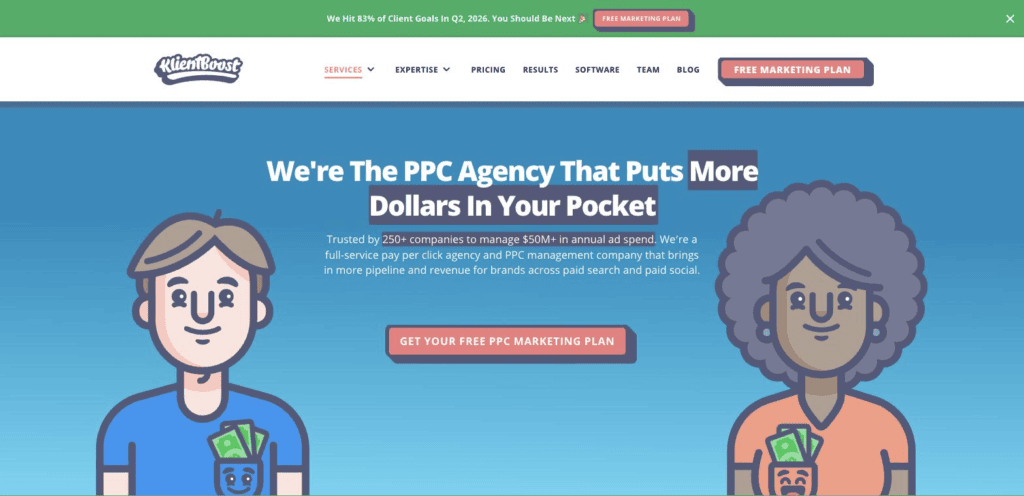
KlientBoost bundles paid search, paid social, conversion rate optimization, and revenue attribution into one engagement, managing over $50M in annual ad spend across 250-plus companies. Its distinguishing position is accountability made contractual rather than aspirational, with a published quarterly goal-hit rate and consequences for missing targets built into the engagement. Where most agencies here treat conversion work as adjacent to media buying, KlientBoost runs the two as one discipline. Its market position follows from that choice more than from any channel specialism.
Pros:
- In-house CRO and creative teams design and test landing pages alongside the ad campaigns from day one rather than as a later add-on.
- KlientBoost offers a revenue share arrangement as an alternative to a standard retainer, reducing upfront cost.
- The agency commits to adding resources at no cost when pacing behind goal, and to removing a service that fails to hit its target.
Pricing: KlientBoost charges a monthly retainer quoted after a scoping conversation. Contact the team for a quote.
Results: KlientBoost increased conversions 23% and cut cost per click 72% for Delphix in three months. For Excedr, it delivered a 20% conversion rate improvement and a 12% drop in cost per acquisition over the same window.
Directive Consulting: Best for enterprise B2B pipeline accountability
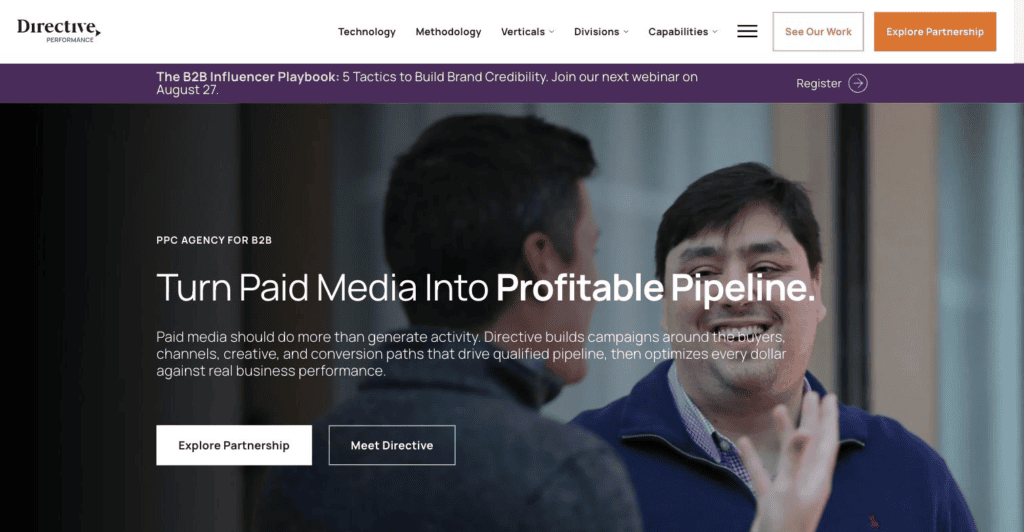
Best for: Marketing leaders who must defend paid budget in financial terms, especially those running account-based programs against a defined target list.
Directive Consulting has worked with B2B brands since 2013, organizing its service around shifting measurement from MQLs toward qualified pipeline. The agency is proudly independent rather than part of a media conglomerate, and states it reinvests $2.2M a year into research and development. Of the agencies here it sits furthest toward the enterprise end of the market, and its language throughout is financial rather than promotional.
Pros:
- Paid media targeting is built on buyer intent, firmographic data, and LTV:CAC modeling, with campaigns optimized toward qualified pipeline rather than lead volume.
- Directive’s budget recommendations are based on financial modeling tied to the client’s north star metrics. This gives a demand gen lead something defensible to anchor on during a budget review.
- The agency’s account-based campaigns run as a paid channel inside the same engagement, targeting decision-makers on high-value accounts.
Pricing: Directive Consulting does not publish rates, but primarily uses a flat retainer model rather than charging a percentage of ad spend.
Results: Directive generated a 59% pipeline increase and a 109% closed-won revenue increase quarter over quarter for Arctic Wolf. Cost per meeting fell 36% between Q1 and year-end.
Semetrical: Best for international B2B paid search
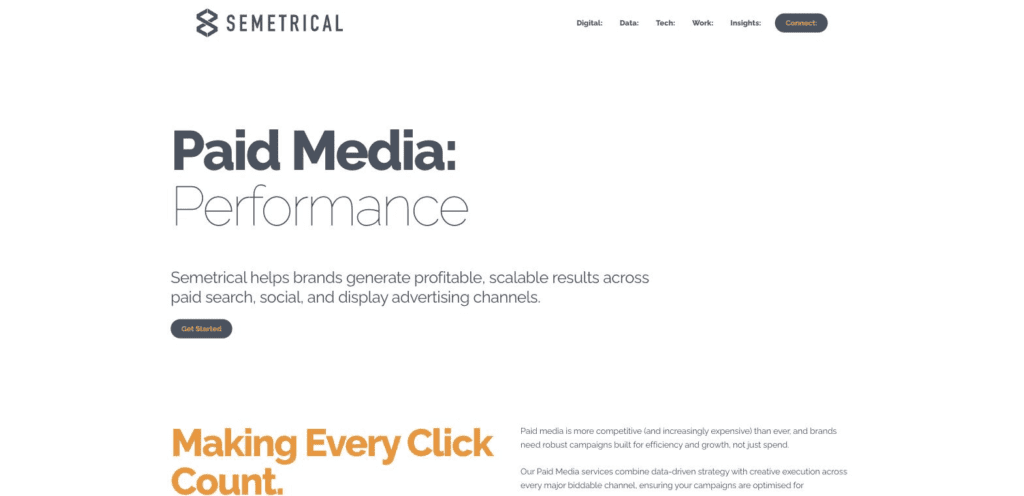
Best for: Companies running paid search across many countries, where lead quality varies by market and sales feedback needs to reach campaign level.
Semetrical is a London agency running paid search, social, and display as one biddable-channel service. It puts an emphasis on data-driven campaign management. It’s the only agency here whose core competence began as a data problem rather than a marketing one, and the multi-market work is where that shows.
Pros:
- Semetrical builds a working data channel between its paid media specialists and the client’s sales team, so campaign optimization draws on sales-side lead information.
- Weekly lead data exports let the team identify where leads became invalid and adjust targeting against publisher data accordingly.
- An in-house analytics team implements server-side tagging and consent-mode tracking, which matters for multi-market campaigns under differing privacy regimes.
Pricing: Semetrical does not publish rates or minimums, so you must contact the team for pricing.
Results: Semetrical delivered a 239% increase in paid search conversions for Cloudflare, from 2,000 to 7,600 quarter over quarter. Cost per inquiry fell 63% over the same period, from $150 to $56.
Clarity Performance: Best for established B2B tech
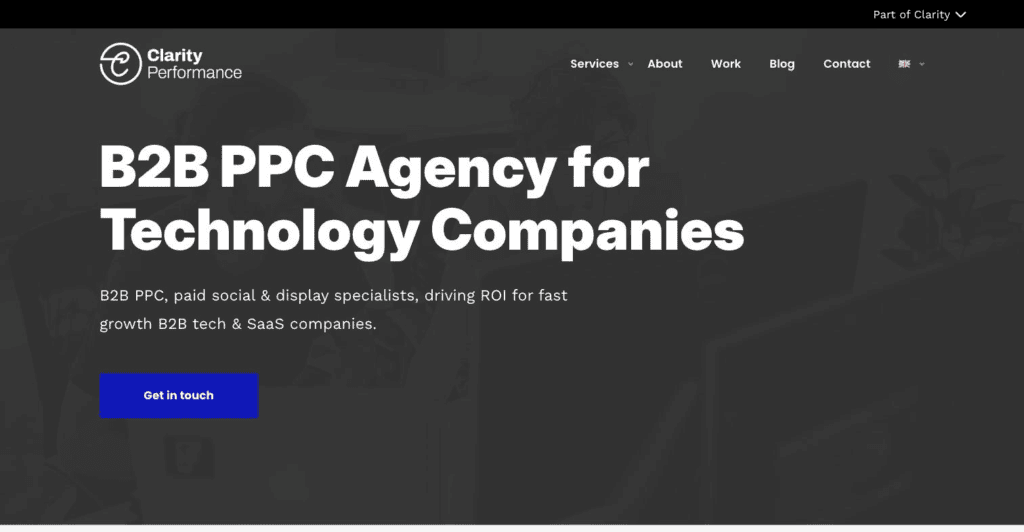
Best for: Scale-ups and established software businesses with high deal values that can commit at least £5,000 per channel per month in media.
Clarity Performance works exclusively with B2B technology, software, and SaaS businesses, with roughly 35 specialists in London. It rebranded from 93x in December 2024 and sits inside the wider Clarity group. Its positioning rejects traffic-and-rankings reporting in favor of leads, pipeline, and revenue, putting it near Directive in philosophy at a different scale.
Pros:
- Clarity Performance sizes paid budgets by working backwards from a client’s average deal value or lifetime value to estimate a defensible acquisition cost.
- An in-house design and development team builds the landing pages behind the ads, so post-click work does not wait on client engineering time.
- The agency states that it doesn’t usually work with pre-revenue or pre-product-market-fit startups. This makes segment fit easy to establish before a call.
Pricing: Clarity Performance requires a minimum media budget of roughly £5,000 per month per channel and charges management as a fixed channel fee plus a percentage of media budget.
Results: Clarity Performance delivered over £500,000 of pipeline in the first four months for a B2B software business using an intent-based bid framework. For a global data and research business, PPC combined with organic work contributed to over £1.5m in pipeline in a quarter, up from £180,000.
Riverbed Marketing: Best for small to mid-market B2B
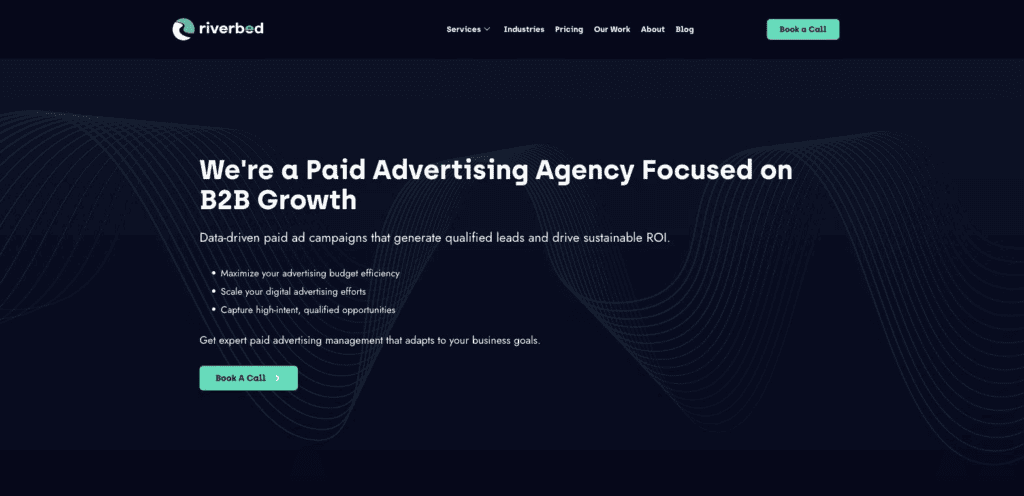
Best for: Smaller teams wanting published rates and a 30-day exit rather than a long contract, with paid media running inside a wider program.
Riverbed Marketing is a Vancouver agency built around demand generation for growth-stage B2B technology companies, having worked with over 100 of them. Paid advertising is an available service line with its own page, but delivery is organized around a five-stage demand generation model rather than channels. It is the most transparent firm here on commercial terms. Its market position rests on accessibility rather than specialism, which is unusual in a category that mostly competes on depth, and it shapes what the engagement can and cannot cover.
Pros:
- Paid media can be bought as a standalone engagement or as one channel within a broader demand generation program.
- Paid channel scope is deliberately narrow, with Google Ads and LinkedIn Ads named as the strategy and Microsoft Ads appearing alongside them on the rate card.
- Engagement terms include a 30-day cancellation policy with no long-term contracts, and onboarding only takes two to four weeks.
Pricing: Riverbed offers three retainers, with the lowest tier starting at $3,000 per month. Per-service pricing is also available upon request
Results: Riverbed’s published outcomes are program-level rather than paid-specific. For Aubea, paid media drove the first movement in traffic and leads within two months, and the blended program generated 416% more traffic and 2x qualified leads over six months.
Flow Agency: Best for paid media plus AI search visibility
Best for: Teams that want one agency running paid search and AI-search visibility together rather than splitting them across two vendors.
Flow Agency is a boutique B2B agency serving SaaS and professional services companies, founded by Viola Eva. Its distinguishing position is the deliberate fusion of paid media with organic and LLM search work under one team rather than running PPC separately. That integration is the reason to shortlist them. Of the agencies here, it’s the one built most explicitly around the shift in how buyers discover vendors, rather than around the channels that shift is moving through.
Pros:
- Channel coverage extends into live LLM ad inventory, with the agency noting that paid advertising is either available or being tested on Google, ChatGPT, and Perplexity.
- Flow’s monthly reporting combines ad platform data with CRM data and GA4 rather than reporting platform metrics in isolation.
- Conversion tracking is scoped to lead quality and pipeline rather than lead volume alone, audited alongside the client’s marketing operations team.
Pricing: Contact Flow Agency for PPC pricing details.
Results: Flow Agency publishes no quantified paid media metrics, so its evidence is testimonial. Michael Romero, Sr. Manager of Demand Generation at Betterworks, cites roughly six months of Google Ads work producing “more efficient results.” The same review also describes over a year of LinkedIn Advertising with “a steady improvement of performance month over month.”
ProperExpression: Best for regulated B2B and fintech
Best for: Wealth management, FinTech, and RIA marketers needing PPC wired into RevOps so cost per opportunity is visible, not just cost per lead.
ProperExpression is a full-stack growth marketing agency organized around revenue, profitability, and acquisition cost rather than activity metrics. It differentiates its PPC offering by combining full-stack growth marketing and RevOps capabilities with stated experience in wealth management, fintech, WealthTech, and financial services.
The agency markets itself to registered investment advisors as the only agency pairing full-funnel marketing with revenue operations. ProperExpression is the clearest example here of an agency competing on domain knowledge rather than channel breadth.
Pros:
- The agency’s paid search planning evaluates whether a client’s buyers use Google, Bing, or Apple Search before budget is split across platforms.
- RevOps specialists map and redesign the client’s sales and marketing funnels as part of the PPC engagement rather than as separate work.
- ProperExpression determines KPIs before any ad goes live, and clients can track progress via real-time performance dashboards.
Pricing: ProperExpression does not publish PPC rates or minimums. Contact the team for pricing.
Results: ProperExpression drove 466% growth in inbound-generated revenue for Intraprise Health within 12 months of engagement. Additionally, the agency helped an award-winning RIA platform generate more than $2 billion in AUM pipeline in one year.
What should you look for in a B2B PPC agency?
The lineup above shows how differently agencies interpret the same brief. Choosing between them comes down to operational questions that rarely surface in a pitch deck, each mapping to work you otherwise absorb internally.
1. Channel coverage across search, paid social, and ABM
US search ad revenue reached $114.2 billion in 2025, but growth slowed to 11% year over year from 15.9%, according to the internet advertising revenue report from IAB and PwC. Search is still the largest pool of paid demand but no longer the fastest-growing.
Some of that deceleration may come from the changing results page itself, which keeps more clicks on Google rather than sending them out.
Either way, ask where the next increment of budget goes if search volume for your category flattens. A B2B PPC marketing agency with paid social and ABM in scope has an answer, whether that means B2B marketing on LinkedIn or running ads on Facebook alongside search.
A search specialist, by contrast, tells you to bid wider. That’s simply the more expensive route to the same target.
2. Conversion tracking and CRM attribution setup
The most common mistake in agency selection is accepting platform conversions as the reporting standard.
A form fill counted in Google Ads is not a qualified opportunity. Our research into how B2B buyers research found they move across AI tools, peers, and review sites well before clicking any ad, which widens that gap further.
The better signal is who owns the plumbing.
Some agencies connect ad platforms to B2B CRM systems with offline conversion imports and report SQL rate by campaign. Others hand you a dashboard and leave reconciliation to your ops team. That determines whether you can hold a B2B PPC management agency to pipeline at all. It’s why self-reported attribution methods have become necessary.
3. Landing page and ad creative production
Picture month three. Campaigns are live, cost per click is reasonable, but conversion rate is flat because the landing page was built for a different audience and nobody can rebuild it.
This is where most paid programs stall, and it is predictable from the scope of work. Agencies with in-house design build the page. Agencies without it file a ticket with your team and wait, or lean on dedicated team services to cover the gap. So price that difference honestly.
A lower retainer looks cheaper right up until you notice it assumes your designers are free, and they are booked through the quarter. The post-click experience is where paid budgets are won or lost, and smooth customer experiences take design time somebody has to supply.
4. Reporting cadence and dashboard access
Live dashboard access beats a monthly deck. The deck is a narrative assembled after the fact, while a dashboard is the data itself. Any agency confident in its numbers gives you both, potentially even built on the same SaaS reporting tools your team already runs.
The complication is that access without an agreed metric set produces arguments rather than clarity. Two people reading one report disagree if one tracks cost per lead and the other cost per opportunity. Settle those definitions in onboarding.
Of course, this applies to PPC engagements and others like digital marketing analytics services too. Pick the marketing KPIs that matter upfront, and it’ll be much easier to judge performance later on.
5. Contract length, spend minimums, and exit terms
Lastly, get three numbers in writing before signing with any B2B PPC marketing agency:
- The management fee. Many agencies don’t have published pricing on their websites, so this makes the pre-qualification stage a little harder. But find out an agency’s fee as early as possible in your discovery calls.
- The minimum media spend per channel. This sits outside the management fee, and it is where a modest test budget quietly becomes an unaffordable commitment. Ask for the figure per channel rather than in total.
- The notice period. It tells you how fast you can course-correct if the program underperforms. An agency that hesitates on this one is telling you something useful.
Notice how none of these five considerations focus on media buying. Many agencies can bid competently enough. What separates the good agencies from the bad is how much of the surrounding work you’re left to manage on your own.
How much do B2B PPC agencies cost?
As you’ve seen, many B2B PPC agencies don’t publish rates. Only Riverbed Marketing and Clarity Performance state numbers on their own sites, and they sit at opposite ends of the market. Riverbed starts Google and Microsoft Ads management at $2,000 per month. Clarity Performance requires roughly £5,000 per month per channel in media before its fees apply.
The number itself matters less than how it is structured. Three fee models dominate:
- Flat monthly retainer. This is the most common and the easiest to budget against.
- Percentage of ad spend. This model aligns the agency with scale rather than efficiency.
- Fixed channel fee plus a percentage of media. This hybrid model means your cost moves as your spend does.
Within any of those models, what drives a quote up is rarely the media buying. Channel count, creative and landing page production, market count, and CRM integration depth all add scope, as does bundling in extra marketing services. Each is where a cheap retainer quietly becomes an internal cost instead.
Those are the costs you can see coming. The ones that surprise buyers are structural: minimum media spend per channel, contract length, and whether a B2B PPC management agency requires discovery before campaigns run. A $2,000 fee with a 30-day exit and a $20,000 fee with a twelve-month commitment are not the same purchase, however similar the monthly numbers look.
How to hire the right B2B PPC agency for your pipeline
With some agencies and general criteria in mind, it’s time to build your shortlist. As you do, keep your focus on evidence rather than positioning.
Have each agency walk through one account where paid spend was reallocated on sales data, and listen for the specifics:
- Which signal in the sales data triggered the move
- What they moved budget away from
- What happened to cost per opportunity afterward
Ask which metric they would hold themselves to in month three, and whether their reporting produces it without your team building anything.
Then verify what matters. Case study metrics here are often reported against forecast rather than time, and several capable agencies publish nothing quantified. That is not disqualifying, but it means rigor gets tested on the call, not the website.
Paid online channels now account for 69% of total digital spend according to the Gartner 2025 CMO Spend Survey—a lot of budget to commit on a deck. So make the pitch do the work the case study cannot.
Choosing well is only half the decision, though. One structural point should change how you size the paid budget at all. That same Gartner research found allocations to owned and earned channels decreased 9% year over year.
Many teams are buying more paid demand while the compounding channels that reduce their dependence on it get less. Paid and organic solve the same pipeline problem from two directions, and treating them as competing line items usually means overpaying for the paid half.
That second half is our work. Omniscient Digital builds SEO and content strategy and AI-search visibility programs for established B2B companies. The results our clients report show up as pipeline that keeps producing after a campaign ends. If you want the organic side working alongside your paid program rather than in a separate silo, book a free strategy call.
Frequently asked questions about B2B PPC agencies
What does a B2B PPC agency actually do day-to-day?
Day-to-day work splits between account management and analysis. Account management covers keyword and audience adjustments, negative keyword lists, bid strategy changes, creative testing, and budget pacing.
The analysis half separates a B2B SaaS PPC agency from a general paid search shop. B2B marketing is different precisely here: the conversion that matters happens weeks after the click. The work means reconciling ad platform data against CRM records to find which campaigns produced opportunities rather than form fills.
How long does B2B PPC take to produce qualified leads?
Ads generate clicks immediately, but qualified leads take longer because the account needs enough conversion data to optimize against. Most agencies point to a three-month window before performance stabilizes.
Any B2B SaaS PPC agency should also tell you to add your sales cycle. If deals take four months to close, a program launched in January shows no revenue impact until mid-year, and judging it earlier means judging it on lead volume. Work to shorten your sales cycle pulls that date forward.
Should you hire a B2B PPC agency or build in-house?
The honest test is channel count. One channel with steady spend is often cheaper in-house once you account for agency fees. Three or more with creative and landing page needs usually is not, because you are hiring several distinct skill sets.
The other consideration is pattern recognition. An agency running dozens of accounts sees what works across a category faster than one in-house team can, which is the main thing you buy beyond execution capacity.