If you’re evaluating SaaS marketing agencies for 2027, the pressure is real.
Marketing budgets have flatlined at 7.7% of overall company revenue, and 39% of CMOs plan to cut agency spending, according to the Gartner 2025 CMO Spend Survey. It’s no exaggeration that every agency dollar has to connect to pipeline, not impressions.
This list narrows the field to 10 B2B SaaS marketing agencies that have proven their ability to deliver impressive ROI.
Table of contents
- At a glance: 10 SaaS marketing agencies
- 10 top marketing agencies and how they help SaaS brands
- Omniscient Digital: Best for B2B SaaS organic growth and AI search
- KlientBoost: Best for paid acquisition and performance marketing
- Omnius: Best for SaaS and fintech SEO and AEO (with tooling)
- Flow Agency: Best for integrated organic and paid search for SaaS startups
- Flying Cat Marketing: Best for international SEO for B2B SaaS
- SmartBug Media: Best for B2B SaaS teams running on HubSpot
- NoGood: Best for multi-channel growth marketing
- Kalungi: Best for early-stage B2B SaaS without a marketing team
- Bay Leaf Digital: Best for mid-market B2B SaaS growth
- Refine Labs: Best for demand gen transformation at $50M+ ARR
- What to look for in a SaaS marketing agency
- Ready to choose a SaaS digital marketing agency?
- Frequently asked questions about SaaS marketing agencies
Disclosure: This guide is published by Omniscient Digital. We’ve included ourselves because we specialize in B2B SaaS organic growth and AI search, and these are directly relevant to what today’s marketing leaders need. However, every agency on this list was evaluated against the same criteria.
At a glance: 10 SaaS marketing agencies
| Agency | Best For | Starting Price | Key Differentiator |
| Omniscient Digital | B2B SaaS organic growth and AI search | $10,000/month | Integrated SEO + GEO with barbell content strategy |
| KlientBoost | Paid acquisition and performance marketing | Contact for pricing | Proprietary paid media frameworks with built-in CRO |
| Omnius | SEO and AI search optimization for B2B SaaS and fintech | Contact for pricing | 8-client yearly cap with in-house AI visibility tool |
| Flow Agency | Integrated organic and paid search | $3,500/month | Integrated SEO and paid media for B2B SaaS |
| Flying Cat Marketing | International SEO for B2B SaaS | Contact for pricing | Native-language content and SEO across US, UK, and European and Latin American markets |
| SmartBug Media | B2B SaaS teams running on HubSpot | Contact for pricing | HubSpot Diamond Partner covering the full platform stack |
| NoGood | Multi-channel growth marketing | Contact for pricing | AEO + multi-channel squads with dedicated SaaS practice |
| Kalungi | Early-stage B2B SaaS without a marketing team | ~$25,000/month | T2D3 framework with fractional CMO on every engagement |
| Bay Leaf Digital | Mid-market B2B SaaS growth | $3,999/month | B2B SaaS-exclusive since 2013 with Dual-Leader Model |
| Refine Labs | Demand gen transformation at $50M+ ARR | $5,000/month | Demand gen overhaul with measurement methodology for enterprise SaaS |
How we evaluated the agencies
To qualify for this list, each agency had to meet five criteria:
- B2B SaaS expertise
- Pipeline and revenue accountability
- Meaningful channel depth beyond a single tactic
- Descriptive case studies with measurable outcomes
- A published operating methodology
Every agency here met our qualifying thresholds in all five areas.
10 top marketing agencies and how they help SaaS brands
Agency fit is a stage and motion decision, not a ranking. The right choice for a Series A company with no marketing function is different from the right choice for a $30M ARR company overhauling demand gen. What follows is structured to reflect that—each entry leads with its specific use case, because that’s the question that actually narrows the shortlist.
Omniscient Digital: Best for B2B SaaS organic growth and AI search
Best for: B2B SaaS companies wanting durable organic authority and AI search visibility
Omniscient Digital is an organic growth agency focused exclusively on established B2B software companies. Our core methodology—the barbell content strategy—pairs high-authority content designed to build brand credibility with precise bottom-funnel pages mapped to buyer intent. Services span SEO strategy, generative engine optimization, technical SEO, link building, digital PR, content production, and CRO. The team brings deep B2B SaaS domain expertise, with founders and leaders who have worked at powerhouse companies like HubSpot, Workato, and Shopify.
Pros:
- We regularly discuss our marketing approach, whether as it relates to “surround sound SEO” or barbell content strategy. Such transparent methodology can help with the evaluation process.
- By default, every engagement is measured against revenue-oriented KPIs like pipeline influence, attributed revenue, and conversion rates.
- Omniscient not only offers generative engine optimization services, but is also a leader in terms of researching how AI is changing search and what works for brands trying to change with it.
Pricing: Full-service engagements start at $10,000/month; SEO and content strategy development packages start at $15,000.
Results: We helped Jasper generate $4M in blog-attributed ARR, increasing product signups by 400%. Similarly, with our help, Order.co achieved 2,117% blog growth and a 39x improvement in conversions.
KlientBoost: Best for paid acquisition and performance marketing
Best for: B2B SaaS companies wanting paid acquisition with integrated CRO
KlientBoost is a performance marketing agency built around paid advertising, landing page design, and CRO. The firm has developed a set of proprietary, publicly documented paid media frameworks that distinguish its approach. It serves clients across multiple industries, including B2B SaaS, with an emphasis on measurable acquisition outcomes.
Pros:
- KlientBoost publicly documents paid media approaches such as SKAGs (Single Keyword Ad Groups) and its Keyword Tapering methodology. This gives prospective clients visibility into its approach before an engagement.
- With 200+ published case studies naming specific clients and outcomes, KlientBoost has one of the more transparent track records of any performance agency.
- A 4.9/5 average rating across 400+ Clutch reviews reflects consistent client satisfaction at scale.
Pricing: KlientBoost offers a pricing calculator on its website to provide quotes based on the services you’re interested in and your goals.
Results: KlientBoost reports 83% of client goals met in Q2 2026. It has helped SaaS brands like Shipware achieve over 100% increases in conversions.
Omnius: Best for SaaS and fintech SEO and AEO (with tooling)
Best for: B2B SaaS and fintech companies who want a boutique agency that pairs SEO, AI search optimization, and a proprietary visibility-tracking platform.
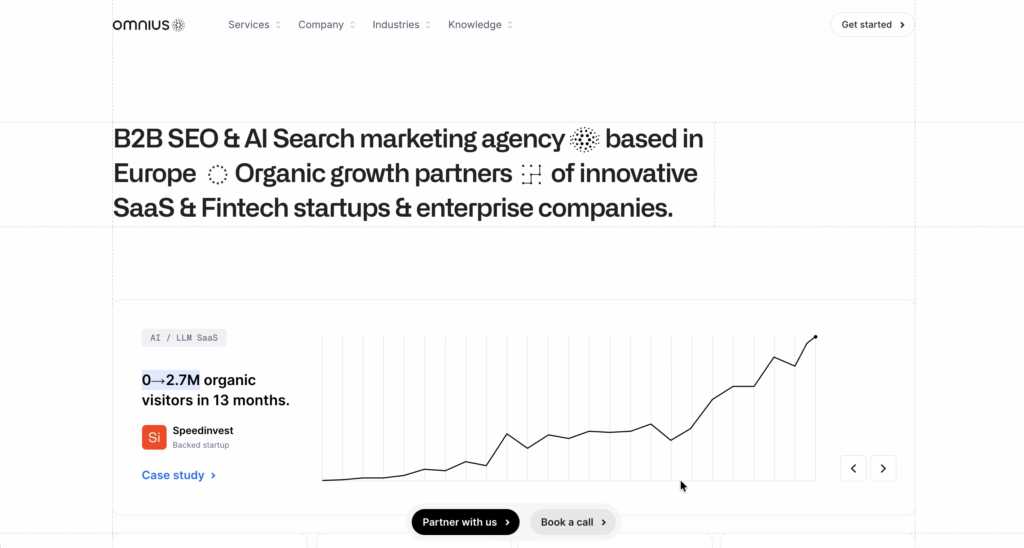
Omnius is a London-headquartered agency specializing in working with SaaS brands and fintech startups. It optimizes for both traditional search engines and AI-driven answer engines such as ChatGPT, Claude, and Perplexity, but rightly treats AI search as its own acquisition channel. The agency also combines technical SEO, content, and programmatic SEO with generative engine optimization under one team.
Pros:
- Omnius caps itself at eight new clients a year. The agency states this is the maximum it onboards annually to allow close work between the team and each client.
- The agency built Atomic AGI, which tracks brand AI search visibility across both traditional and AI search engines. This gives them real visibility into how content performs across the full search landscape.
- The team can run hundreds of prompt-discovery sessions across ChatGPT, Claude, and Perplexity to inform prioritization and improve AI visibility.
Pricing: Contact Omnius for a quote.
Results: Myos, a fintech lender, increased signups by 227.9% within six months of an SEO and content overhaul. AuthoredUp saw conversions rise 64% within weeks of a website relaunch Omnius also built and optimized.
Flow Agency: Best for integrated organic and paid search for SaaS startups
Best for: B2B SaaS startups and professional services firms that need organic search and paid media coordinated under a single specialist team.
Flow Agency—formerly Flow SEO—is a boutique B2B search marketing firm that specializes in SaaS startups and professional services companies. The remote team of 16+, led by founder Viola Eva, has served 100+ B2B companies since the agency’s founding, including Betterworks, Beekeeper, and FloQast. Flow’s positioning centers on business growth rather than vanity metrics — the agency measures success through qualified leads, pipeline, and revenue-focused outcomes. The rebrand from Flow SEO marked an expansion from pure SEO into integrated search marketing.
Pros:
- Flow combines B2B SEO with paid media management across Google Ads, Microsoft Ads, and LinkedIn Ads, eliminating the need for separate specialist vendors for each channel.
- The agency provides direct access to senior consultants with no account executives or intermediaries, which may accelerate decision-making for lean startup teams.
- Flow follows a documented six-part framework that starts with quarterly goal-setting tied to business objectives and ends with blended reporting across GA4, Search Console, and Ahrefs.
Pricing: Flow Agency’s SEO retainers start at $3,500 per month.
Results: ELM Learning saw 200% growth in conversions, and Detrack achieved a 300% increase in organic traffic after partnering with Flow Agency.
Flying Cat Marketing: Best for international SEO for B2B SaaS
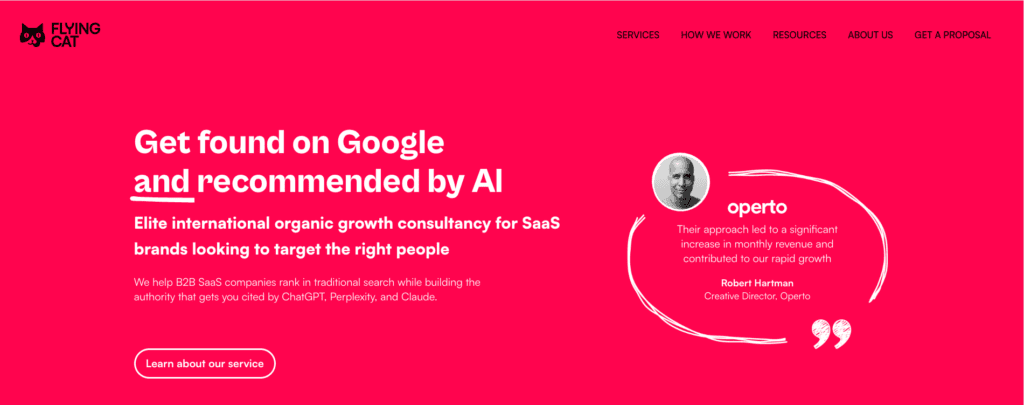
Best for: B2B SaaS companies that need to scale organic growth across multiple languages and international markets from a single agency partner.
Flying Cat Marketing is an SEO-focused content marketing agency specializing in B2B SaaS. Its services include SEO and GEO strategy, content creation, link building, technical SEO, and international SEO. For companies expanding into new markets, Flying Cat can coordinate local organic growth strategists and native-language content teams across the US, UK, and European and Latin American markets through a single point of contact.
Pros:
- Flying Cat pairs traditional SEO with generative engine optimization, addressing visibility across both Google and AI-powered discovery tools like ChatGPT and Perplexity.
- The agency holds a 4.9/5 rating on Clutch across 10 verified reviews, with a perfect 5.0/5 score for schedule adherence.
- Flying Cat offers programmatic SEO alongside conventional organic strategy, enabling SaaS companies to scale targeted landing pages for long-tail search demand.
Pricing: Pricing is not publicly available. Contact Flying Cat Marketing for a quote.
Results: Softr saw 227% growth in MRR within six months of working with Flying Cat, and Mixmax reported a 500% increase in blog-assisted demo requests over a ten-month engagement.
SmartBug Media: Best for B2B SaaS teams running on HubSpot
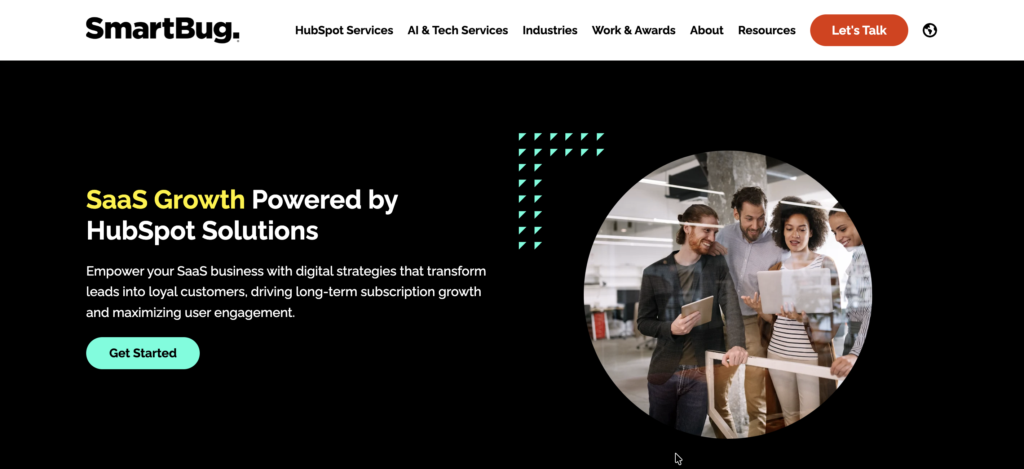
Best for: B2B SaaS companies with HubSpot at the center of their marketing and revenue stack
SmartBug Media is a HubSpot Elite Solutions Partner and inbound marketing agency with a dedicated practice for B2B SaaS and software companies. The firm covers the full HubSpot platform—from initial onboarding and RevOps configuration through advanced demand generation, sales enablement, and AI-powered workflows. Its depth within the HubSpot ecosystem is the defining characteristic of its engagement model, distinguishing it from generalist inbound agencies that support multiple CRM platforms.
Pros:
- SmartBug is HubSpot’s 2025 North American Partner of the Year—a recognition that reflects technical depth and outcome consistency within the HubSpot ecosystem.
- SmartBug team of 250+ offers tailored SaaS growth solutions that inform how it structures campaigns and measures success.
- The firm has built AI agents and automation capabilities that extend HubSpot’s native functionality, adding intelligent workflow options beyond out-of-the-box platform features.
Pricing: Pricing is not publicly available. Contact SmartBug Media for a quote.
Results: SmartBug helped Spotlight achieve an MQL-to-SQL conversion rate of 39%, along with a YOY revenue increase of 159%.
NoGood: Best for multi-channel growth marketing
Best for: Growth-stage B2B SaaS needing paid, organic, AEO, and CRO coordinated in one program
NoGood is a growth marketing agency with a dedicated SaaS practice. Its multi-channel capabilities span SEO, paid search, paid social, answer engine optimization, CRO, and lifecycle marketing. The firm operates a squads model with cross-functional teams built around each client account. It positions itself as AI-native, offering answer engine optimization as a distinct service alongside an AI Marketing Lab focused on generative-AI applications for marketing and media.
Pros:
- NoGood‘s roster of clients includes MongoDB, Anthropic, and Intuit, reflecting experience at both high-growth and enterprise scale.
- The firm offers answer engine optimization and AI search visibility. The fact that it has a dedicated AI Lab increases the chances that it can evolve at the speed of AEO itself to generate results for its clients.
- The company reports an 84% average client retention rate, which is a meaningful signal in an industry where client-agency relationships often turn over quickly.
Pricing: Contact NoGood for pricing information.
Results: NoGood drove a 500% increase in active users (from trial signups) for Intuit Accelerate. It also drove a 230% boost in new user signups for SaaS brand, Rivet.
Kalungi: Best for early-stage B2B SaaS without a marketing team
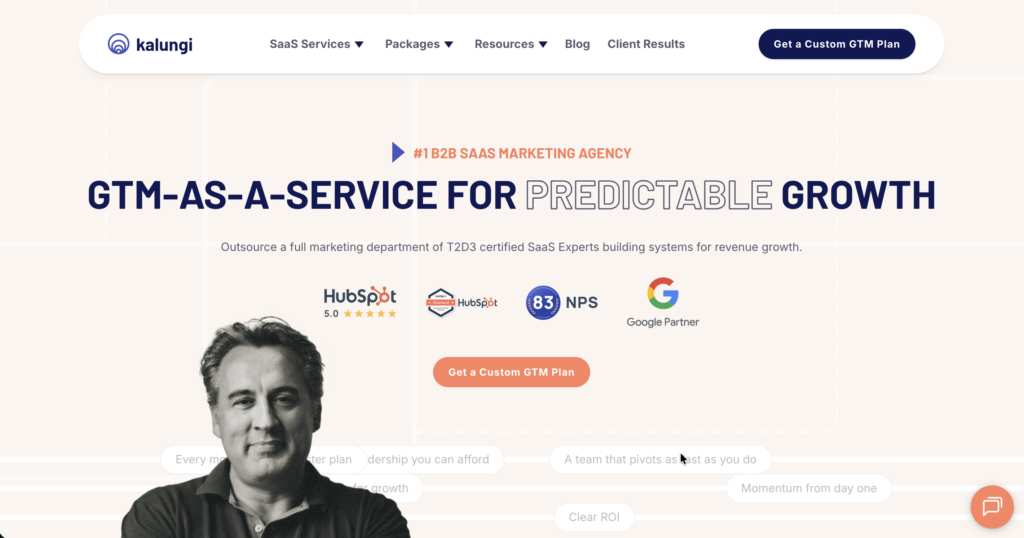
Best for: B2B SaaS companies at $1M–$10M ARR building their GTM function from scratch
Kalungi is a B2B SaaS marketing agency that delivers GTM-as-a-service across three engagement models matched to ARR stage. Its signature offering is the T2D3 framework—a structured playbook targeting triple-triple-double-double-double growth. The firm focuses exclusively on B2B Saa, with over 150 clients under its belt. Not to mention experience across pre-PMF startups through established mid-market companies.
Pros:
- Every full-service Kalungi engagement includes an Associate CMO, giving early-stage companies fractional marketing leadership without the cost or risk of a full-time executive hire.
- The T2D3 framework covers the full GTM stack—positioning, messaging, demand generation, SEO, content, paid, ABM, and RevOps.
- Kalungi’s three engagement models let companies match scope to their current stage and ARR. Each model allows for different levels of agency involvement.
Pricing: Clutch suggests that the minimum project size is $25,000, but you’ll need to contact the Kalungi team for details.
Results: With Kalungi’s help, DataGuard grew MQLs by 330% and generated $4M in pipeline within 6 months. Patch, on the other hand, increased MQLs by 1,500% in 6 months.
Bay Leaf Digital: Best for mid-market B2B SaaS growth
Best for: Mid-market B2B SaaS companies at $2M+ ARR wanting a senior-led full-funnel partner
Bay Leaf Digital is a B2B SaaS marketing agency founded in 2013, serving the United States and Canada. The firm’s Marketing-Led Growth framework spans the full funnel from demand creation through customer retention. Unlike the many agencies that serve SaaS alongside other verticals, Bay Leaf Digital has primarily focused on B2B SaaS since its founding.
Pros:
- Bay Leaf Digital offers a broad full-funnel service mix, including SEO/GEO, paid media, content, automation, and retention. This can reduce the need to stitch together multiple vendors.
- Every engagement is staffed through the Dual-Leader Model: a dedicated Growth Marketing Manager paired with a Senior Strategist, with no junior hand-offs on either role.
- Bay Leaf Digital is platform-agnostic, supporting clients on HubSpot, Salesforce, and other stacks without requiring a platform migration to get started.
Pricing: Bay Leaf’s packages start at $3,999 per month.
Results: TrueFort achieved 171% organic traffic growth and a 60% increase in leads with Bay Leaf Digital. Sapience Analytics grew leads by 564% quarter over quarter.
Refine Labs: Best for demand gen transformation at $50M+ ARR
Best for: Mid-market and enterprise B2B SaaS companies overhauling how they generate and measure pipeline
Refine Labs is a B2B demand generation agency that helps mid-market and enterprise SaaS companies transition from traditional lead gen to modern demand gen. The firm’s philosophy draws a clear distinction between demand creation (educating buyers and building brand presence) and demand capture (converting existing demand through high-intent paid media). Its work centers on paid media strategy, pipeline measurement, creative, and demand generation programs.
Pros:
- Measurement and attribution methodology is a core service, not a reporting feature. This agency builds the infrastructure for understanding which channels actually drive pipeline and revenue.
- Having worked with 300+ B2B SaaS clients, Refine Labs has a large enough pattern base to draw real conclusions about what works at mid-market and enterprise scale.
- Refine Labs maintains high content transparency: a published pricing page structure, The Vault content library, and a widely followed demand gen podcast all make it easier to assess fit before a sales conversation.
Pricing: Refine Labs’ monthly engagements start at $5,000.
Results: The agency helped Clari reduce CAC by 67%, cut the cost of qualified pipeline by 36%, and improve win rate by 64% over 9 months. It also helped Zappi grow average deal size by 3x.
Now that you’ve gotten a good overview of some of the top agencies and their track records, it’s time to move on to a harder question. Which criteria matter most for your specific situation?
What to look for in a SaaS marketing agency
The highest-rated agency is not automatically the best fit for your needs. Neither is the one you hear mentioned the most often on LinkedIn. The criteria that matter most depend on your stage, your existing team, and what problem you’re actually trying to solve.
Below are the five considerations that separate useful agencies from expensive ones.
1. Deep SaaS expertise
An agency that only works with SaaS companies carries a kind of pattern recognition that generalists don’t have. The same is true for one that focuses on B2B specifically.
Just to name a handful, a true B2B SaaS marketing agency understands:
- CAC payback windows
- NRR as a health signal
- The difference between an MQL and a pipeline-qualified lead
- The content formats that move technical buyers through a long evaluation cycle
Ask what percentage of the agency’s current clients are B2B SaaS companies, and whether they have case studies from companies at your specific ARR stage. The depth of their SaaS-specific experience should show up in how they structure engagements and how they talk about metrics, not just in how they describe their vertical expertise.
If SaaS content strategy is part of what you’re building, that domain depth matters even more. Understanding what effective content marketing for SaaS looks like—as distinct from content for B2C or enterprise software—is a baseline you want your agency to bring to the table.
2. Stage and ARR fit
Stage mismatch is one of the most common mistakes buyers make in agency selection.
A fractional CMO engagement designed for a $2M ARR company with no marketing function will produce the wrong outputs at a $20M ARR company with an established team. A demand gen transformation practice designed for $50M+ ARR will be over-engineered for a Series A.
That said, it’s helpful to know where the majority of the agency’s clients sit by ARR stage, and whether they’ve worked with companies in your specific range. Outcomes at one stage don’t reliably predict outcomes at another, and the best agencies will be direct about where their model fits and where it doesn’t.
3. Engagement model and what you need to bring
Next, it’s crucial to make sure that an agency’s model matches what you can bring to the engagement.
A full-service agency replacing 10+ marketing hires needs executive access, a real budget, and organizational patience for a program that compounds over time. On the other hand, a strategy-plus-advisory model requires your team to execute recommendations consistently. And a specialized channel partner assumes you already understand where that channel fits in your broader growth motion.
Before starting agency conversations, know which of those models fits your current situation. Ask every agency what their most successful clients look like on day one, including what team, alignment, and budget are already in place.
And think about how AI is reshaping buyer discovery. That context shapes which channel investments are worth prioritizing right now, particularly as AI tools take over more of the early stages of vendor evaluation.
4. Revenue and pipeline accountability
Another big test for any agency is whether they measure what you’re accountable for. Traffic, rankings, and impressions are relatively easy metrics to move. Pipeline influence, SQL contribution, and CAC payback are harder but much more meaningful to leadership.
According to the Benchmarkit 2025 SaaS GTM Benchmarks, median CAC payback improved from 18 months in CY-24 to 16 months in CY-25. That’s an 11% improvement year-over-year, and it’s a real shift. But it’s also the kind of metric most agencies don’t discuss unless you push for it.
You need to find out the specific KPIs an agency defaults to in reporting, and whether they have a documented framework for connecting their work to B2B lead generation outcomes that matter to your CEO. At Omniscient, revenue attribution is built into the engagement model from day one, not retrofitted after a few months of traffic reporting.
5. Descriptive case studies
Lastly, keep in mind that traffic is a result—but it’s only a second-tier one. The real result is what that traffic converts into: pipeline, revenue, qualified leads.
A case study that shows “organic traffic grew 150%” without linking that traffic to revenue or conversions says more about SEO mechanics than marketing performance. So, look for case studies that:
- Name the client
- State a starting baseline
- Identify the specific metric moved
- And include the timeframe
That structure is what separates a substantiated outcome from a marketing claim.
With these five criteria as a framework, the decision becomes less about which SaaS digital marketing agency has the best reviews and more about which model fits what you’re trying to build.
Ready to choose a SaaS digital marketing agency?
All in all, matching the right agency to your stage and GTM motion is a more tractable problem than finding the “best” agency in the abstract. The agencies on this list differ from each other in meaningful ways—not just in size or reputation, but in what problem they were built to solve and which kind of company they solve it for.
Early-stage companies without a marketing function need a different kind of partner than post-Series B companies with established teams and a demand gen infrastructure that needs modernizing. A $3M ARR company that needs fractional CMO leadership and a full GTM build isn’t a fit for a demand gen transformation practice designed for $50M+ ARR companies. And the opposite is also true.
Getting the stage match right is often more important than which agency has the strongest brand or the longest client list.
If organic search, content, and AI search visibility are central to your SaaS marketing plan, Omniscient’s SEO strategy service is built for exactly that. Book a free strategy call with us to talk through channel strategy, what your current program is missing, and whether an organic-first approach makes sense for your stage.
The questions below cover what we hear most often from marketing leaders evaluating a marketing agency for SaaS for the first time.
Frequently asked questions about SaaS marketing agencies
What does a SaaS marketing agency do?
A SaaS marketing agency builds and executes marketing programs for software companies. Services vary by agency—SEO, paid acquisition, content strategy, demand generation, ABM, RevOps, CRO, and AI search optimization are all common.
The best B2B SaaS marketing agencies connect every channel to pipeline and revenue, not just to traffic or MQL volume.
How much does a SaaS marketing agency cost?
Pricing varies widely by scope and model. For example:
- Performance agencies focused on paid acquisition may start at $4,000–$6,000/month.
- Full-service SaaS digital marketing agency engagements typically start at $20,000/month or higher.
- GTM-as-a-service models with fractional CMO leadership can run $25,000/month and up.
Most agencies don’t publish detailed pricing publicly. A strategy call is usually the first step to getting a real number based on your specific scope and stage.
What’s the difference between a SaaS and a generalist agency?
A generalist agency applies marketing fundamentals across any industry. On the other hand, a SaaS-specialist brings domain-specific pattern recognition—they understand what works at your ARR stage, with your sales motion, and in your buyer segment. That specialization shows up in how engagements are structured, which metrics get tracked, and how the team communicates with leadership about outcomes.
A marketing agency for SaaS is also more likely to have built playbooks around SaaS-specific challenges: long sales cycles, technical buyers, high CAC, and the need to connect every channel to revenue. For B2B SaaS companies where those dynamics are front and center, that depth is usually worth more than the breadth a generalist brings.