According to the 10Fold 2026 Marketing Budget Blueprint, 69% of marketing executives expected budget increases in 2026. More budget can, of course, mean more growth. But for companies that need external vendors, extra money only makes a positive difference if it goes toward a marketing agency that can meet the specific goals and challenges your team is actually facing.
The hard part is matching the right channel specialty to the right growth gap: organic pipeline, paid acquisition, or multi-channel scale. After all, most agencies pitch the same full-service promise, which makes the differences harder to see from the outside.
This guide evaluates six agencies across the same criteria, so you can compare based on what your team needs rather than what each agency chooses to highlight.
Table of contents
- At a glance: The 6 best marketing agencies
- 6 options compared: Which is the best marketing agency?
- Omniscient Digital: Best for B2B organic growth through SEO, GEO, and content
- NoGood: Best for growth marketing for high-growth and venture-backed companies
- Disruptive Advertising: Best for performance marketing and paid media optimization
- WebFX: Best for full-service digital marketing with data-driven technology
- Ignite Visibility: Best for multi-channel marketing across earned, paid, and owned media
- Straight North: Best for B2B lead generation through SEO and paid advertising
- What should you look for in a marketing agency?
- How to choose the right marketing agency for your business
- Frequently asked questions about marketing agencies
Disclosure: This guide is published by Omniscient Digital. We’ve included ourselves because our organic growth methodology is directly relevant to mid-market and enterprise B2B companies evaluating marketing agencies. However, every agency on this list was evaluated against the same criteria.
At a glance: The 6 best marketing agencies
The right marketing agency depends on which growth gap your company needs to fill—not on a generic ranking. The table below maps each agency to the channel it owns so you can self-select based on what your team actually needs.
| Agency | Best For | Starting Price | Key Differentiator |
| Omniscient Digital | B2B organic growth through SEO, GEO, and content | $10,000/month | Revenue-tied organic growth for B2B companies |
| NoGood | Growth marketing for high-growth and venture-backed companies | Contact for starting price. Average: $20,000+/month | AI-native squad model with senior talent |
| Disruptive Advertising | Performance marketing and paid media optimization | Contact for pricing | $450M+ annual ad spend managed |
| WebFX | Full-service digital marketing with data-driven technology | $2,900/month (SEO) | RevenueCloudFX proprietary platform |
| Ignite Visibility | Multi-channel marketing across earned, paid, and owned media | Contact for pricing | Top 1% Google Premier Partner |
| Straight North | B2B lead generation through SEO and paid advertising | Contact for pricing | 25+ years, 100% USA-based team |
How we evaluated these marketing agencies
We evaluated each agency across five criteria designed to match mid-market and enterprise buying needs.
- Channel depth or full-service breadth: Whether the agency goes deep on a specific discipline or delivers competently across multiple channels.
- Strategic depth: Whether the agency shapes the marketing roadmap or primarily takes execution tickets.
- Technology and reporting infrastructure: Proprietary platforms or structured reporting that give clients visibility into what’s working and why.
- Mid-market and enterprise readiness: The agency’s ability to handle larger budgets, cross-functional stakeholders, and complex reporting expectations.
- Verified business outcomes: Case studies that cite pipeline, revenue, or ROI rather than traffic or impressions alone.
6 options compared: Which is the best marketing agency?
Each agency below owns a distinct channel lane—organic growth, performance marketing, full-service execution, or multi-channel coordination. The breakdown for each covers what they do best, the kinds of outcomes they’ve gotten for clients, and more so you can compare them against the growth gap you’re trying to fill.
Omniscient Digital: Best for B2B organic growth through SEO, GEO, and content
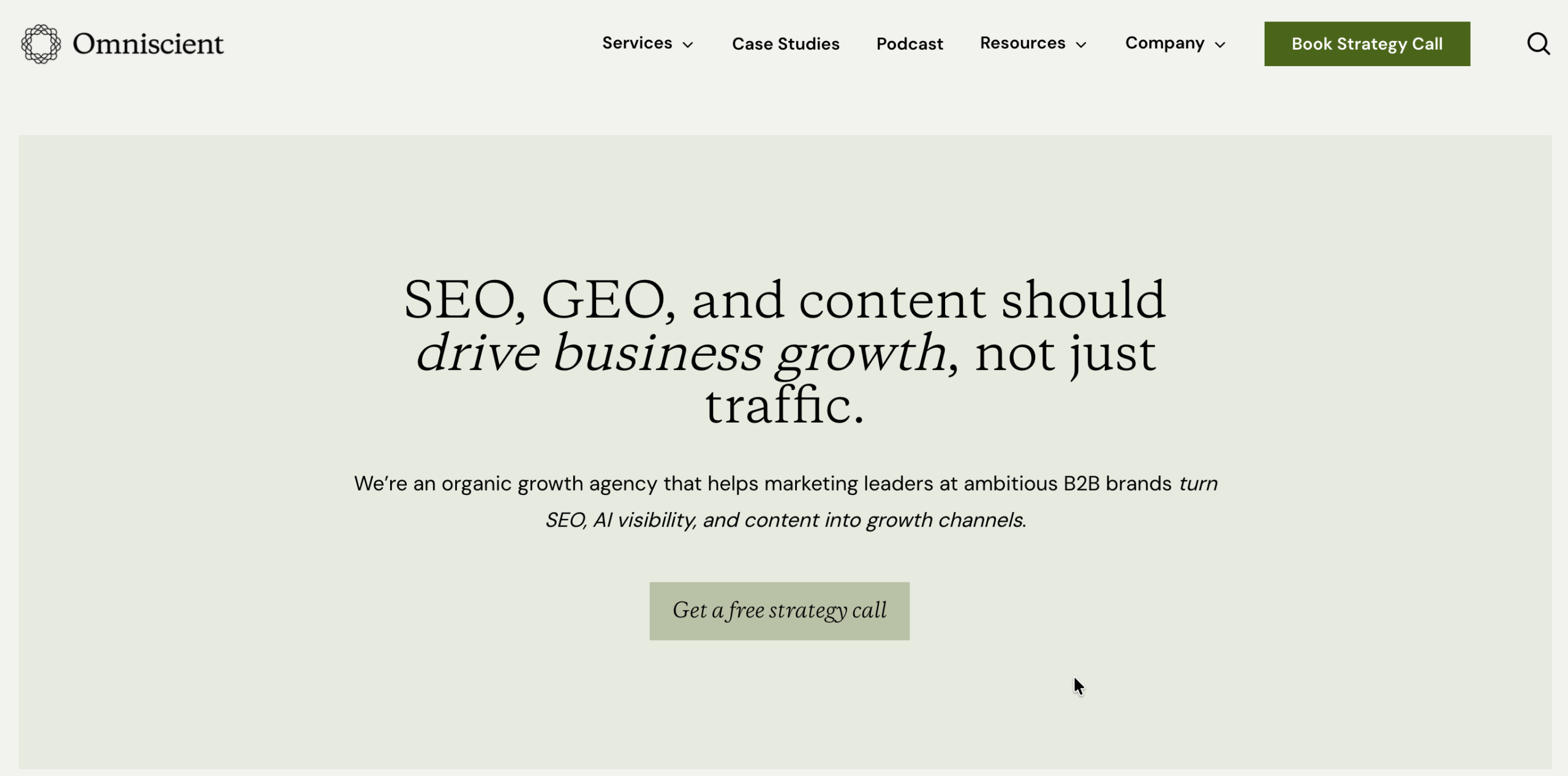
Best for: B2B organic growth through SEO, GEO, and content—specifically for mid-market and enterprise companies who value pipeline attribution
Omniscient Digital is an organic growth agency built for B2B companies. Particularly those that already have product-market fit and need SEO, GEO, and content to compound into durable pipeline. We’re known for developing the barbell content strategy, and our team is led by former growth leads from powerhouse companies like HubSpot, Shopify, and Workato. Our approach emphasizes aligning marketing activity with product positioning, sales insights, and buyer needs to create compounding organic growth systems rather than pursuing traffic as an isolated objective.
Pros:
- Omniscient’s barbell content strategy pairs high-volume keyword targeting with original research and brand authority content. This builds both search coverage and credibility simultaneously.
- Our GEO service addresses AI citation and LLM visibility as a native SEO strategy capability, not an afterthought bolted onto a traditional search program.
- Reporting ties directly to pipeline and revenue through marketing analytics that connect organic activity to sourced deals rather than ranking positions.
Pricing: Full-service engagements start at $10,000 per month.
Results: We generated $3.7M of qualified pipeline from organic search for Smartling and $2.94M of pipeline for SpotDraft. For Convert, we grew LLM visibility by 81% and AI citations by 140%.
NoGood: Best for growth marketing for high-growth and venture-backed companies
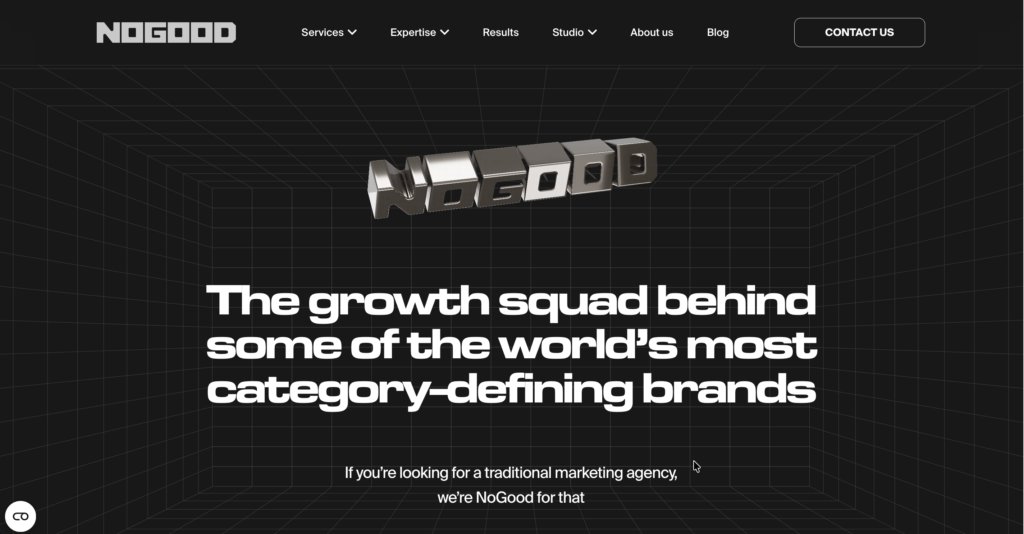
Best for: Growth marketing for high-growth and venture-backed companies—particularly SaaS, fintech, and AI startups that need a multi-channel growth engine.
NoGood is an AI-native growth marketing agency built around a squad model where each client gets a dedicated team of senior operators. The agency runs from offices in New York, Miami, and Dubai and has built proprietary AI tools for answer engine optimization. Its positioning centers on being the growth partner for companies scaling fast enough that execution speed and analytical rigor matter more than a long track record in one discipline.
Pros:
- NoGood assembles custom growth squads of strategists, growth engineers, and data scientists matched to each client’s vertical and growth stage, rather than rotating a shared account team across clients.
- The agency’s Goodie AI platform tracks brand visibility across ChatGPT, Gemini, and Perplexity, giving clients data on how they appear in AI-driven search results.
- NoGood’s client roster includes Nike, TikTok, MongoDB, and P&G, demonstrating credibility with both enterprise and high-growth brands.
Pricing: The starting price isn’t publicly listed. However, NoGood states that its average retainers start above $20,000 per month, so it’s reasonable to expect to be in that ballpark.
Results: Through a combination of services including paid media and a multi-channel strategy, NoGood increased Spring Health’s leads by 113%. The company’s conversion rate also grew by 149%.
Disruptive Advertising: Best for performance marketing and paid media optimization
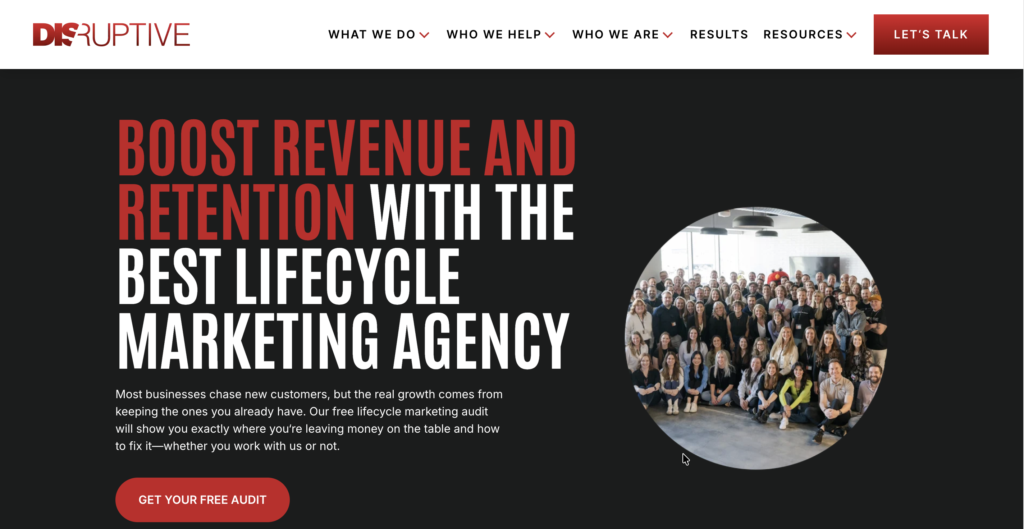
Best for: Performance marketing and paid media optimization, especially for mid-market companies spending $10,000 or more per month on ads
Disruptive Advertising is a performance marketing agency built around paid media—paid search, paid social, display, and shopping campaigns. The agency combines strategy, campaign execution, testing, and reporting for businesses seeking measurable improvements in lead generation, ecommerce performance, and customer acquisition. Its model is meant to tie ad spend directly to measurable revenue.
Pros:
- Disruptive manages over $450 million in annual ad spend across its client base, giving the team pattern recognition across industries and budget levels that a smaller PPC agency may lack.
- Whether or not you become a client, a free audit is available to identify wasted marketing spend.
- For qualifying brands, the agency offers a 90-day performance guarantee—results or you don’t pay. This puts accountability on the agency rather than locking the client into a long-term contract upfront.
Pricing: Contact Disruptive Advertising for pricing information.
Results: Disruptive’s case studies document a 120% increase in lead volume for Security National Life Insurance and a 4x return on ad spend for Arch Roamright.
WebFX: Best for full-service digital marketing with data-driven technology
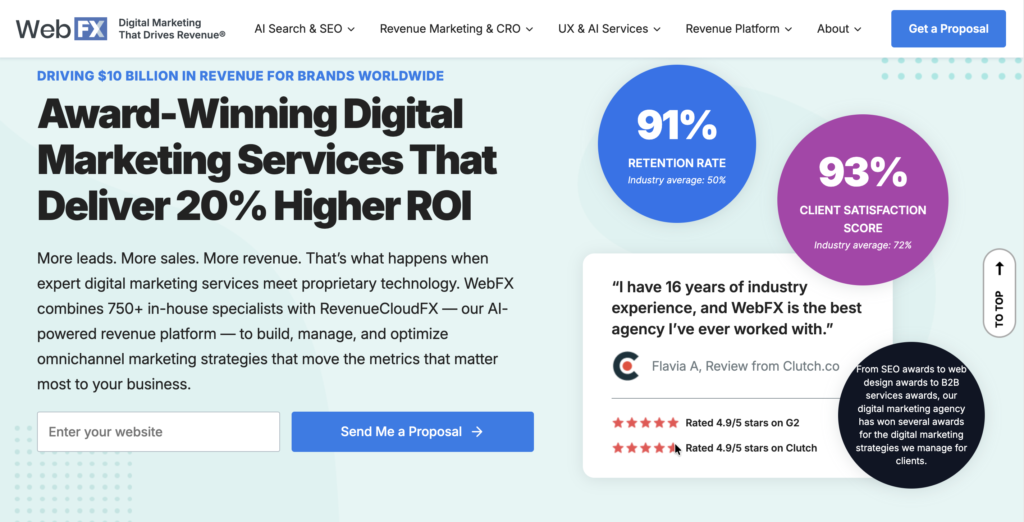
Best for: Mid-market and enterprise companies that want full-service digital marketing with proprietary tech to connect every channel to revenue
WebFX is a full-service digital marketing agency with more than 750 digital experts spanning SEO, PPC, content, web design, email, and analytics. The agency’s defining asset is RevenueCloudFX, a proprietary platform that integrates various data sources and models to connect marketing activity to revenue. With over $10 billion in self-reported client revenue in the last five years, WebFX positions itself as the data-infrastructure choice for companies that want multiple channels managed under one roof.
Pros:
- The agency consists of more than 750 specialists across SEO, PPC, content, web design, email, and analytics. This gives mid-market and enterprise clients a full-service capability without outsourcing.
- RevenueCloudFX integrates CRM data, call tracking, AI visibility tracking, and ROI forecasting into a single client-facing dashboard. This is a level of technology infrastructure rare among full-service agencies.
- WebFX has one of the highest review volumes of any agency on this list with comments from hundreds of clients, and maintains nearly 5-star ratings on both Clutch and G2.
Pricing: WebFX publishes SEO pricing starting at $2,900 per month, with higher tiers scaling to $9,200 per month. Other services require a custom quote.
Results: WebFX drove a 586% increase in AI-generated traffic for Thompson Tractor and a 260% increase in organic revenue for KOA.
Ignite Visibility: Best for multi-channel marketing across earned, paid, and owned media
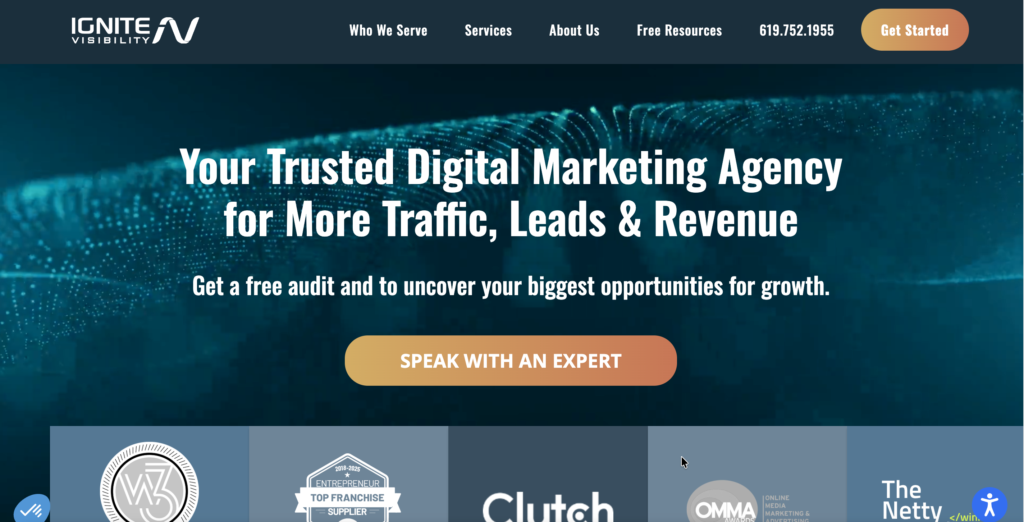
Best for: Multi-channel marketing across earned, paid, and owned media—particularly for mid-market and enterprise franchise, healthcare, and home services companies
Ignite Visibility is a multi-channel digital marketing agency with 600+ employees. The agency delivers across earned media (SEO, digital PR, influencer), paid media (PPC, paid social, programmatic), and owned media (content, email, CRO, web development). Its scale and platform partnerships with Google, Meta, and TikTok make it a fit for companies that need coordinated execution across channels, such as franchise and multi-location businesses. Its positioning centers on being the single online marketing agency for the full paid-earned-owned spectrum.
Pros:
- Ignite Visibility holds Google Premier Partner status, along with Meta Premium Partner and TikTok Premium Partner designations. These verified platform partnerships indicate ad spend volume and platform access.
- With more than 600 employees and 13+ years in operation, the agency has the operational scale to manage complex, multi-location campaigns across earned, paid, and owned channels.
- The agency has earned Clutch’s #1 Digital Marketing Agency ranking and an OMMA Award for Excellence in Online Advertising, showing recognition from both clients and industry peers.
Pricing: Contact Ignite Visibility for pricing details.
Results: Ignite Visibility’s case studies report a 458% increase in AI visibility for a home services franchise with 5,500+ locations, and a 1,009% return on ad spend for a multi-brand franchise. It also generated a 72.7% increase in leads with an 8% reduction in cost per lead for a 90+ location franchise.
Straight North: Best for B2B lead generation through SEO and paid advertising
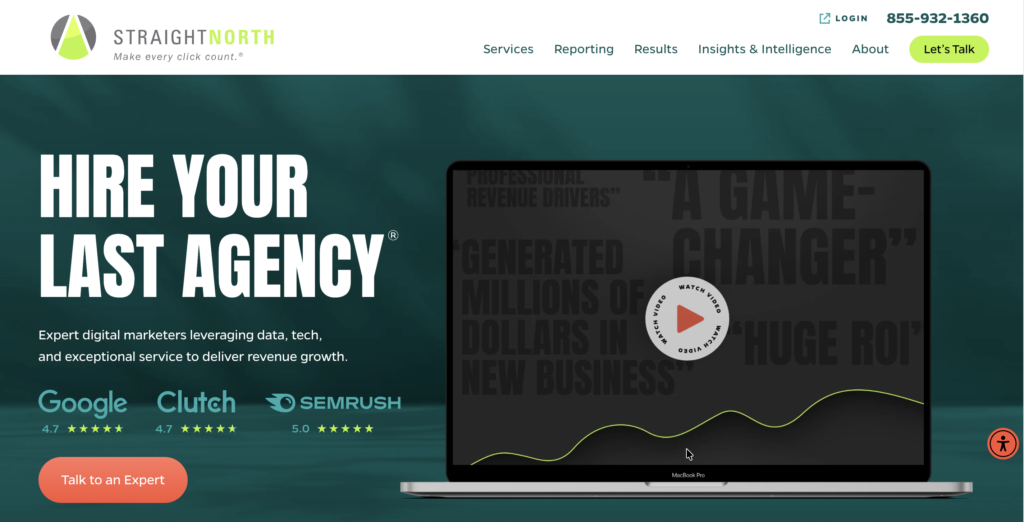
Best for: Growth-oriented B2B companies looking for B2B lead generation through focused SEO and paid advertising (rather than a broad multi-channel engagement)
Straight North is a digital marketing agency focused on lead generation through national and local SEO, paid search, paid social, and web design. The agency operates with a 100% USA-based team and has been in business for more than 25 years. Its positioning—”hire your last agency”—is a bet on consistency and long-term partnership rather than breadth. Straight North fits B2B companies that want a focused partner for search-driven lead generation without the overhead of a full-service online marketing agency.
Pros:
- Straight North operates a 100% USA-based team, which may matter to enterprise procurement teams with vendor location or data residency requirements.
- With 25+ years of digital marketing experience, the agency has one of the longest operating track records on this list—a signal of durability and institutional knowledge.
- The agency’s GoNorth! reporting platform gives clients a dedicated analytics dashboard for tracking lead flow, campaign performance, and ROI across SEO and paid channels.
Pricing: Contact Straight North for pricing information.
Results: Straight North increased revenue by 155% for Modern Bathroom across SEO and paid channels. It also drove a 620% increase in PPC leads for Steadfast Painting while reducing cost per acquisition by 80%.
What should you look for in a marketing agency?
Whether they’re on the list above or not, there are several key factors to evaluate when considering any marketing agency. Here’s a mix of things you should either research independently and/or bring to a discovery call.
1. Meaningful, measurable business impact
Never assume that an agency that can grow impressions, traffic, or rankings can also grow pipeline and revenue. Those are different problems, and case studies should reflect which one an agency actually solves. If the proof stops at vanity metrics, the agency may be great at marketing itself without having demonstrated the business impact that matters to your team.
Look for case studies that name the client, the metric that moved, and the timeframe. Even better if they describe the starting baseline and what the agency did to drive the stated outcomes. If you need to pressure-test these details or fill in any blanks, you can do so on a discovery call. However, you can gather most of this information from any agency’s website before you ever have to set aside time for a call. Frontload as much of this research as possible, so you can disqualify any bad-fit agencies fast.
2. Strategic depth versus heavy execution focus
Some agencies operate as strategic partners that shape the marketing roadmap. They identify which channels to invest in, which bets to make, and how to sequence programs against the buyer journey.
Others operate primarily as execution shops: they do good work on the tasks they’re assigned, but their clients do all the strategic thinking.
The distinction is becoming more consequential. According to Forrester’s 2026 agency predictions, agencies are facing a 15% reduction in roles as the industry shifts from retainer-based service models toward platforms and performance-based pricing. That shift rewards agencies with proprietary methodology—like Omniscient Digital’s barbell content strategy—and penalizes those selling generic execution.
How do you know which type of agency you’re dealing with? Ask what frameworks they use and how they’d change your current roadmap, not just what they’d execute against it.
3. Industry and vertical knowledge
An agency can be excellent at SEO or paid media in the abstract and still produce work that misses for your audience. The gap usually comes down to vertical knowledge—understanding how your buyers research, what objections they carry, and which proof points move them.
For instance, a SaaS company selling to CFOs needs content that speaks to procurement cycles and ROI modeling. But a healthcare platform, of course, has a very different need. I.e., messaging that navigates regulatory constraints without losing clarity.
Any prospective agency you’re in talks with should be able to walk you through a recent engagement in your industry. See if they can explain the specific decisions they made that a generalist wouldn’t have.
4. Transparent team structure
The team you meet in the pitch rarely matches the team that does the work. This isn’t always a problem—execution can happen effectively at any level—but you should know the staffing model before you sign.
For example, you’ll want to know:
- How many clients each strategist manages
- Whether the work stays in-house or gets subcontracted
- Whether the senior people in the pitch stay involved after onboarding
Agencies that assign a single junior account manager as the primary contact may deliver competent execution, but the strategic input tends to flatten. The tradeoff between agency versus in-house often comes down to this question.
5. Regular communication cadence and stakeholder access
A fast way to gauge whether an agency engagement will work is to ask who you’ll talk to, how often, and what happens when something isn’t working. A monthly report deck isn’t communication—it’s documentation.
Mid-market and enterprise engagements typically involve multiple internal stakeholders: a marketing lead, a demand gen manager, sometimes product or sales. The agency needs a communication model that maps to that reality. For instance, a few things worth investigating:
- What is the cadence? Depending on how hands-on your team wants or needs to be, you might prefer an agency that offers either bi-weekly or weekly calls.
- Who’ll be on the calls? Say, for example, that you’ll only communicate with an account manager who then has to convey all questions and decisions back to a strategist. This would add undesirable lag and potential miscommunication to the engagement.
- When results stall or performance declines, what’s the escalation path and timeline? You want to know that any agency already has a plan to quickly diagnose issues, propose solutions, and test the implemented fixes for results impact.
- Who has the authority to make decisions? Within reason, your strategist should be able to pivot without running every change up a long chain of command for approval.
Ultimately, if you do your due diligence by looking for these five key characteristics, you’ll have a higher chance of finding an agency partner that can take your marketing and business performance to new heights long-term.
Before you evaluate agencies, get clear on how organic growth should be measured. The Measuring Organic Growth research report covers how marketers are adapting their metrics and attribution as AI reshapes search.
How to choose the right marketing agency for your business
The decision comes down to three questions. First, where is the growth gap—organic pipeline, paid acquisition, or multi-channel coordination? The answer narrows the list to agencies that own that channel. Second, can the agency prove outcomes that match the metrics your leadership team cares about? Traffic alone doesn’t survive a board review. Third, does the engagement model fit how your team works?
With the marketing budget increases currently being expected, the pressure to deploy that spend toward proven outcomes is real. For mid-market and enterprise companies where the growth gap is organic, a content marketing agency with depth in SEO and GEO—like Omniscient Digital—is built for that problem. Book a free strategy call to see what that program looks like for your business.
Frequently asked questions about marketing agencies
How much does a marketing agency cost?
Agency pricing varies widely based on scope, channel, and engagement model. On this list, published starting prices range from $2,900 per month for a single-channel SEO program to $20,000 or more for a multi-channel growth engagement. Many mid-market agencies don’t publish pricing at all, requiring a custom proposal after an initial audit.
The more useful question is what you’re buying. A retainer that includes strategy, execution, and reporting costs more than one that covers execution alone—and the ROI difference between the two often justifies the gap.
What is the difference between a marketing agency and an advertising agency?
A marketing agency typically covers a broad scope, such as SEO, content, email, web development, analytics, and sometimes paid media. In contrast, an advertising agency focuses primarily on paid channels: media buying, creative production, and campaign management.
The distinction has blurred in recent years, though, as most agencies now offer some combination of both.
For practical purposes, the difference matters most in how the agency thinks about growth. An online marketing agency that leads with organic and content will build programs that compound over time. An advertising agency that leads with paid delivers faster results that stop when the spend stops.
How do I choose a marketing agency for my business?
Start with the growth gap. If organic pipeline is the priority, a content marketing agency with depth in SEO will matter more than one with a broad service menu. If paid acquisition needs to scale, a performance marketing agency with ad spend management experience is the better fit.
Then verify the claims. Ask for case studies with named clients, specific metrics, and defined timeframes. Do a discovery call and ask the agency to walk through one engagement from diagnosis to outcome. The way they describe the work—whether it’s strategic or purely executional—tells you more than their website alone will.