Enterprise SEO isn’t a traffic problem. It’s a coordination problem layered on top of a technical problem. With attribution pressure from finance and a development queue that doesn’t move on your schedule.
At the enterprise level, you’re managing hundreds of thousands of URLs. Not to mention cross-functional stakeholder reviews at every stage and a leadership team that wants pipeline rather than just rankings.
Plus, generative engine optimization—earning citations in the AI search surfaces your buyers already use—runs alongside SEO as a parallel discipline. The two are related but distinct, and the agencies that are built for this environment understand the difference.
Hire the wrong agency, and you’re not just burning budget. You’re burning a full annual cycle and the credibility it takes to get another shot. The eight agencies on this list were built to operate in that environment.
Table of contents
- At a glance: The 8 best enterprise SEO agencies
- The 8 best enterprise SEO agencies
- Omniscient Digital: Best for revenue-attributed, B2B SEO
- iPullRank: Best for technical SEO and complex enterprise sites
- Seer Interactive: Best for SEO tied to analytics infrastructure
- Growth Plays: Best for pipeline-focused SEO strategy for B2B tech companies
- Graphite: Best for enterprises needing programmatic SEO
- WebFX: Best for full-service SEO and multi-channel attribution
- Organic Growth Marketing: Best for embedded organic growth partnerships for B2B SaaS
- Conductor: Best for professional services with an enterprise SEO platform
- What to look for in an enterprise SEO agency
- How to choose the right enterprise SEO agency for your team
- Frequently asked questions
Disclosure: This guide is published by Omniscient Digital. We’ve included ourselves because we specialize in revenue-attributed SEO (and GEO) for established B2B software companies—the same buyer profile this article is written for. However, every agency on this list was evaluated against the same criteria.
At a glance: The 8 best enterprise SEO agencies
| Agency | Best For | Key Differentiator |
| Omniscient Digital | Revenue-attributed SEO and GEO for B2B companies | Pipeline and revenue attribution as primary output |
| iPullRank | Technical SEO and relevance engineering on complex architectures | Relevance Engineering framework for AI-era search |
| Seer Interactive | Data-mature enterprises needing SEO tied to analytics infrastructure | SeerSignals proprietary SERP data + full GEO practice |
| Growth Plays | Pipeline-focused content engines for B2B tech companies | Pipeline-first content engine for SEO and Gen AI |
| Graphite | Consumer tech and product-led enterprises needing programmatic content at scale | AI-native full-stack growth team with AEO capability |
| WebFX | Enterprises wanting one vendor across SEO, paid, content, and ROI reporting | RevenueCloudFX unified attribution platform |
| Organic Growth Marketing | Embedded organic growth partnerships for B2B SaaS | Embedded organic growth partner for in-house teams |
| Conductor | Enterprises needing AEO + SEO platform intelligence with integrated professional services | AgentStack for LLM and AI agent optimization |
How we evaluated these enterprise SEO agencies
Agencies on this list were assessed against these criteria that reflect what a CMO is actually accountable for:
- Enterprise results at scale: verifiable case studies showing revenue or pipeline impact.
- Revenue and pipeline attribution: connecting organic growth to business outcomes.
- Execution capacity for enterprise complexity: team and process depth for cross-functional environments.
- GEO and AI search capability: a dedicated, verifiable approach to LLM optimization in addition to SEO.
Let’s see who made the cut.
The 8 best enterprise SEO agencies
Below are eight reputable agencies you might consider as an enterprise SEO partner. Learn about their capabilities, strengths, and other details that will help you make an informed choice.
Omniscient Digital: Best for revenue-attributed, B2B SEO
Best for: Revenue-attributed SEO (and GEO) for established B2B companies
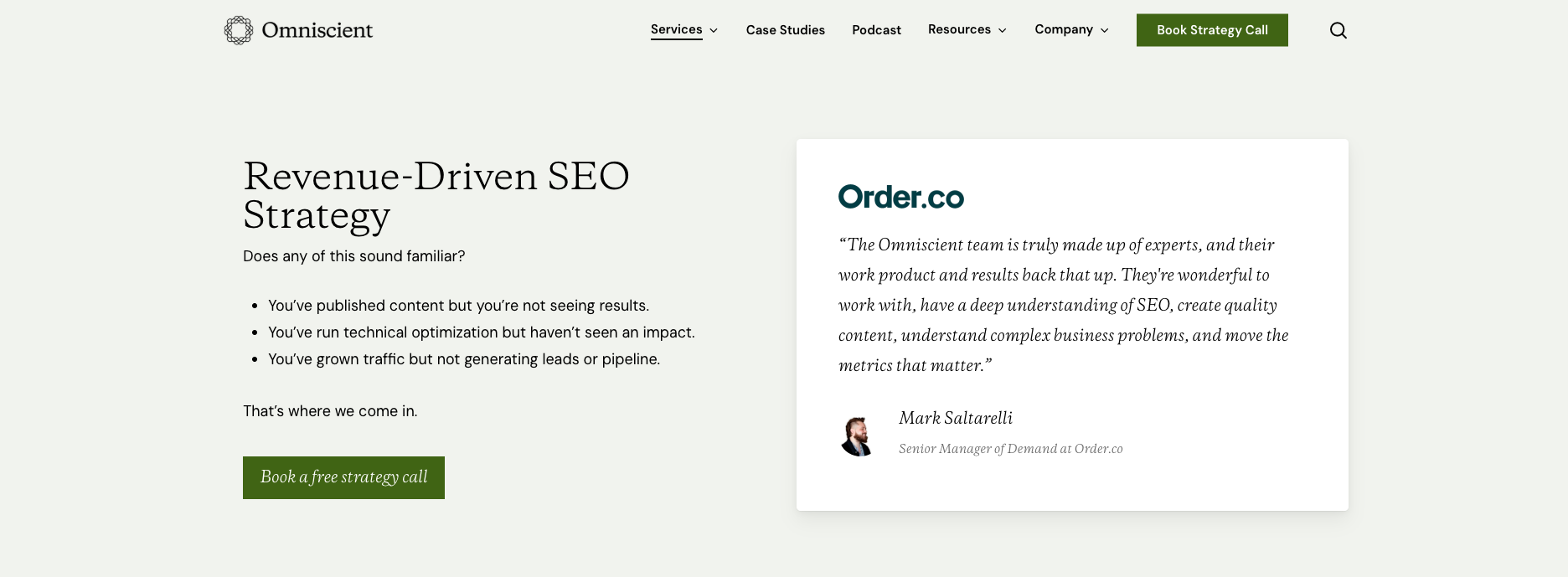
Omniscient Digital is an organic growth agency for established B2B companies, including many B2B SaaS brands. We help them turn SEO strategy, content, and generative engine optimization into measurable revenue channels. One of our top operating principles: organic should be accountable to the same pipeline and revenue metrics as paid. Our service stack—which is also inclusive of SEO technical SEO, digital PR, and CRO—is built accordingly. The team is composed of former growth and content leaders from companies like HubSpot, CXL, and Workato, so we understand organic deeply.
Pros:
- A Pareto-principle approach to prioritization avoids the 1,000-item audit trap. Our engagements are structured around the highest-leverage initiatives.
- Our case studies are structured around pipeline and revenue attribution, which reflects how our team approaches strategy from day one.
- Omniscient’s growth programs integrate SEO with GEO. This gives enterprise B2B clients a structured approach to the search surfaces their buyers are using in 2026 and beyond.
Pricing: Full-service engagements start at $10,000 per month.
Results: Smartling generated $3.7M in qualified pipeline and a 12.8X ROI through Omniscient’s product-led SEO program. Additionally, AppSumo grew organic traffic 843% and revenue from organic search 340% within one year of the engagement starting.
iPullRank: Best for technical SEO and complex enterprise sites

Best for: Technical SEO and relevance engineering on complex enterprise architectures
iPullRank is an enterprise SEO and content engineering firm led by Mike King, known for its Relevance Engineering framework. This methodology connects technical SEO, content strategy, information retrieval, AI optimization, and digital PR under one system. A system that’s designed for how search engines and LLMs actually retrieve and rank content. Its client portfolio includes major financial institutions and enterprise e-commerce brands.
Pros:
- The agency’s proprietary tools, including Orbitwise, help enterprise SEO teams analyze content relevance computationally, not just editorially.
- Technical depth covers the full stack required for complex architectures: JavaScript rendering, log file analysis, crawl noise reduction, schema markup, and content engineering at scale.
- The Relevance Engineering framework is built for AI-era search, optimizing content for retrieval systems and traditional search signals.
Pricing: Contact iPullRank for pricing.
Results: A large enterprise e-commerce client saw a 34% increase in organic traffic revenue year-over-year. They generated millions in incremental revenue after iPullRank resolved critical technical SEO issues.
Seer Interactive: Best for SEO tied to analytics infrastructure
Best for: Data-mature enterprises that need SEO tied to analytics infrastructure and attribution
Seer Interactive is a full-service digital marketing agency founded in 2002. Its services span SEO, paid media, analytics, CRO, creative, and GEO. The agency is particularly well-suited to enterprises that want organic strategy built on top of a sophisticated data infrastructure rather than standard keyword tools.
Pros:
- The agency’s proprietary tech—SeerSignal—provides SERP intelligence at scale. It informs content and keyword decisions with data sets that go beyond standard third-party SEO tools.
- Seer’s 200+ person team spans every digital channel, so enterprise clients can run multiple integrated programs without adding vendors.
- Seer’s B-Corp certification and a 71 NPS signal client satisfaction are good signals for enterprise buyers.
Pricing: Contact Seer Interactive for pricing.
Results: A major video game company generated 18.8M impressions through Seer’s strategic FAQ content and GEO program.
Growth Plays: Best for pipeline-focused SEO strategy for B2B tech companies

Best for: B2B technology companies that need a content engine connecting SEO and generative AI visibility directly to pipeline.
Growth Plays is a B2B SEO agency that builds content engines designed to generate pipeline and real business results, not just pageviews. The agency works with technology companies—from venture-backed startups to established enterprises—combining content strategy, creation, and revenue attribution into a single operational system. Growth Plays maps content strategies to complex buyer journeys, connecting each piece of content to pipeline outcomes rather than optimizing for traffic volume alone.
Pros:
- Growth Plays offers a dedicated Content Revenue Attribution service that connects content performance directly to pipeline using platforms like HubSpot. This brings attribution rigor typically reserved for paid channels to organic content.
- The agency’s content engine is designed for both traditional search rankings and LLM visibility, positioning clients for discovery across AI Overviews and generative search surfaces alongside conventional SERPs.
- Domain and CMS migration support ensures platform transitions preserve existing traffic and rankings, a critical capability for enterprises navigating infrastructure changes.
Pricing: Contact Growth Plays for a quote.
Results: Gremlin’s former Director of Marketing reported that Growth Plays’ content strategy delivered results 10x beyond initial projections, generating demo-ready leads on a consistent monthly basis.
Graphite: Best for enterprises needing programmatic SEO
Best for: Consumer tech and product-led enterprises needing programmatic content at scale
Graphite is an AI-native growth agency specializing in SEO and AEO. The agency uses AI across editorial, technical SEO, programmatic content, AEO, and performance measurement. This includes high-volume page generation and scalable content systems.
Pros:
- AI-native workflow integrates editorial, technical, programmatic, and AEO capabilities in a single team structure. Graphite doesn’t treat AI as an add-on to a traditional SEO program.
- Graphite’s platform and team specialize in programmatic content at enterprise scale, where URL footprints extend across thousands of product or category pages.
- Growth forecasting and CRO audits are included in scope, connecting content investment to conversion outcomes beyond organic traffic.
Pricing: Contact Graphite for pricing.
Results: Graphite helped Masterclass grow non-branded traffic to 571K per month over the course of a 16-month project.
WebFX: Best for full-service SEO and multi-channel attribution
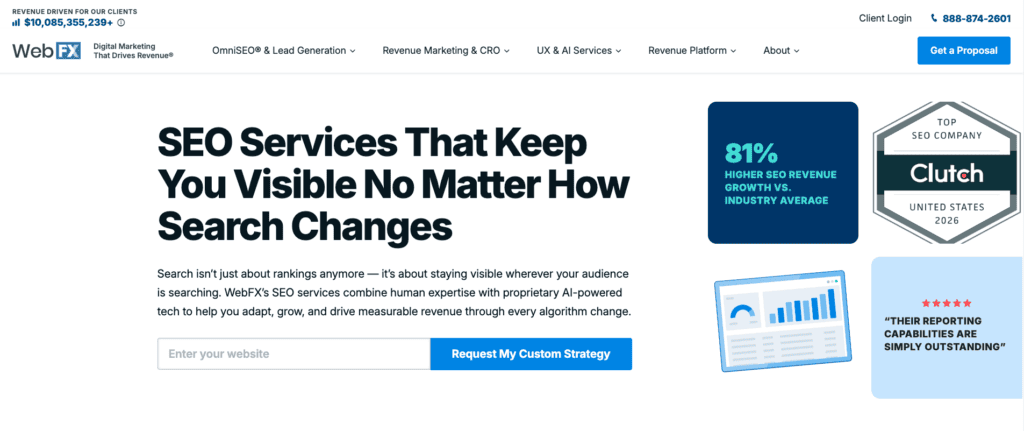
Best for: Enterprises that want one vendor across SEO, paid, content, and unified ROI reporting
WebFX is a full-service digital marketing agency that supports enterprise clients with SEO, paid media, content, analytics, web design, and AI-enabled marketing. Its enterprise offering emphasizes customized, data-driven strategies and transparent reporting through its own RevenueCloudFX. In-house execution is backed by a large team and client testimonial base.
Pros:
- RevenueCloudFX connects SEO, paid, lead management, and CRM data into unified revenue attribution.
- 750+ in-house experts across every digital channel give enterprise teams the staffing depth to run integrated programs without adding vendors.
- Enterprise GEO and AI search services are also available, including LLM visibility tracking and AI brand visibility audits.
Pricing: Contact WebFX for engagement pricing.
Results: WebFX reports generating $10B+ in client revenue over the past several years, delivering more than 24 million leads for clients globally.
Organic Growth Marketing: Best for embedded organic growth partnerships for B2B SaaS
Best for: B2B SaaS companies that want an organic growth partner embedded alongside their in-house team, combining SEO, content strategy, and UX into a unified, revenue-attributed program.
Organic Growth Marketing is a B2B SaaS-focused agency that works closely with in-house teams to build organic growth programs at scale. Founded by Nigel Stevens and based in San Francisco, the agency takes a deliberately specialized approach to organic channels. OGM has built its reputation through deep partnerships with companies like Ramp, Twilio Segment, Hotjar, and Intercom, operating as an embedded extension of each client’s marketing team rather than a traditional outside vendor.
Pros:
- OGM caps each team member at no more than two to three active clients, ensuring the sustained depth of attention that enterprise-scale organic programs require to build momentum.
- The agency’s services span programmatic and editorial SEO, technical SEO, off-page brand visibility, UX and design, and reporting and analytics.
- OGM’s partnership model emphasizes knowledge transfer to in-house teams. The agency operates as an embedded extension rather than a black-box vendor.
Pricing: Contact Organic Growth Marketing for a quote.
Results: ProfitWell worked with OGM to 10x its organic traffic, while OptimoRoute saw a 600% increase in organic traffic and a 3x boost in organic product demo signups.
Conductor: Best for professional services with an enterprise SEO platform
Best for: Enterprises that need SEO platform intelligence combined with professional services in one system
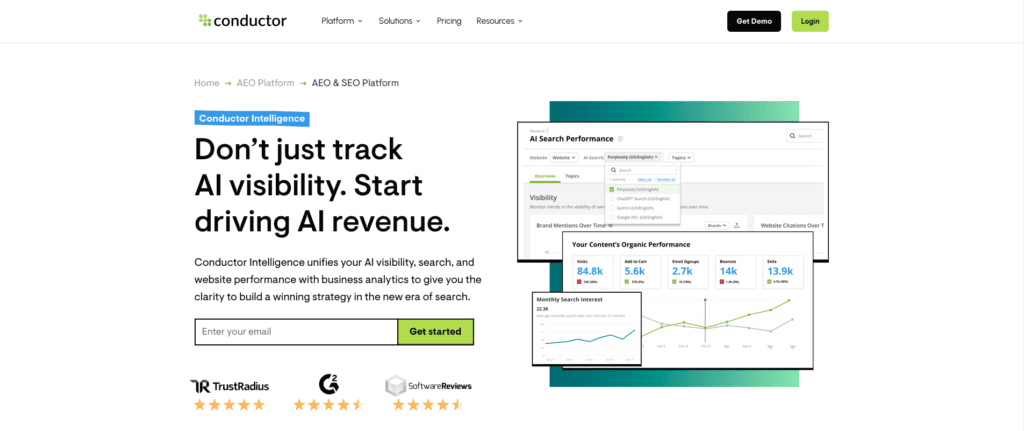
Conductor is an enterprise platform for AI and search visibility that also offers managed services through its professional services team. The platform includes solutions for content generation, SEO and AEO analysis, site health monitoring, and agentic AEO workflows. Unlike pure agencies, Conductor’s model integrates platform intelligence with strategy consulting and execution in a single vendor relationship.
Pros:
- Conductor Intelligence provides enterprise-grade keyword tracking, SERP monitoring, and competitive gap analysis across global markets.
- The agency was named a Leader in the 2025 Forrester Wave™ for SEO Platforms.
- Professional services include site migrations, site audits, strategy consulting, technical consulting, content consulting, and on-demand services. Execution support is available alongside platform access when needed.
Pricing: Contact Conductor for pricing.
Results: Taylor Corporation increased organic traffic by +125% after deploying Conductor across its enterprise web properties.
What to look for in an enterprise SEO agency
Choosing an enterprise SEO agency isn’t a software decision. There’s no trial period, no clean offboarding, and no way to recover the compounding time cost if you get it wrong.
An agency that misunderstands your business model or can’t navigate your internal environment won’t just deliver poor work. They’ll occupy your bandwidth while competitors build an organic moat you’ll spend years catching up to.
Here’s what actually separates real enterprise capability from an agency that handles mid-market accounts and uses the word “enterprise” in its sales deck.
Enterprise track record with verifiable results
Any agency can show you a traffic chart. The question is whether they can show you a pipeline impact, a revenue outcome, or a cost-per-lead calculation that ties organic to the metrics your CFO cares about.
Real enterprise case studies name the client (or at minimum describe the industry and scale), specify the measurable outcome, and give you a timeframe.
What to ask: How do you attribute pipeline to organic? Can you show me the methodology behind a result, not just the number?
The pattern that disqualifies an agency fastest is case studies that measure success in organic sessions without connecting those sessions to anything that moves downstream. At the enterprise level, organic traffic that doesn’t convert to qualified pipeline is cost, not growth.
Omniscient’s approach hinges on one benchmark. Every client engagement is designed around measurable outcomes—pipeline generated, revenue attributed, ROI calculated—not impressions or keyword rankings. That frame should be a minimum expectation, not a differentiator.
Technical SEO and crawl management at scale
Enterprise technical SEO is a different discipline than a mid-market audit.
Your site may have hundreds of thousands of URLs, a JavaScript-rendered architecture, multiple subdomains, and 18 months of accumulated legacy decisions. In such a case, the problems aren’t fixable with a single Screaming Frog crawl and a prioritized recommendation list.
According to Statista (via Ahrefs), 40% of B2B companies say they lack the internal expertise needed to manage technical SEO. That’s part of why enterprise organizations seek outside partners for this work in the first place.
What adds up to enterprise-ready technical capability?
- JavaScript rendering at volume: Understanding how Googlebot and LLM crawlers handle client-side rendering differently from server-side, and building a solution that works at scale
- Log file analysis: Reading actual Googlebot behavior against your site structure, not inferring it from GSC data
- Multi-domain and subdomain coordination: Managing crawl budget and canonical strategy across properties that weren’t originally designed to work together
- Engineering roadmap navigation: The ability to write a technical recommendation that survives a sprint prioritization meeting and gets implemented, not just filed
This last one is often where agency value is lost entirely. A technically correct recommendation that never ships is worth nothing. The best enterprise SEO agencies understand how to write specs that engineers can implement, stage the work to show early wins, and maintain momentum across a roadmap that will change. For a detailed look at enterprise SaaS SEO techniques that hold up at this scale, that’s worth reading before you evaluate any agency.
GEO and AI search capability
Forty-five percent of B2B buyers are now using AI chat tools as part of their research process before reaching a vendor’s website. That percentage will keep climbing, and the implication isn’t just reach.
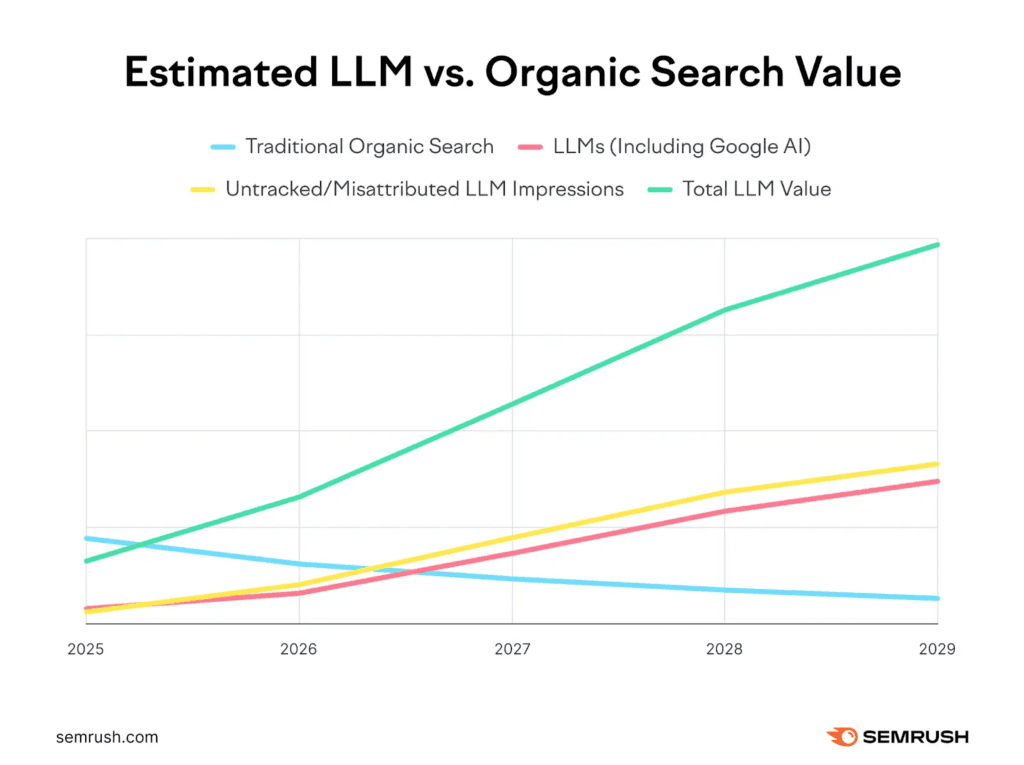
According to Semrush, AI search visitors are worth 4.4x more than traditional organic visitors. In other words, the audience forming opinions in AI search surfaces skews toward high-intent buyers. For enterprise marketers, this means a meaningful share of your most valuable audience is forming opinions about your brand in an environment where you have no direct control over what they see.
Unless you’ve built the kind of content authority that earns citations.
Separating genuine GEO capability from AI trend awareness isn’t hard once you know what to ask:
- Does the agency have a dedicated GEO service with defined deliverables, or are they “monitoring AI search” as a value-add?
- Can they show you a client’s AI citation share before and after their program and talk through their methodology?
- Do they understand the difference between optimizing for generative AI search (LLM citations) and reputation management in AI search (controlling what AI says about you)?
Optimizing for LLM citations and controlling what AI says about your brand are related but distinct disciplines. Agencies that treat them as the same thing are working from trend awareness, not operational expertise. If you want to understand what a structured generative engine optimization program actually looks like, that distinction is the right place to start.
Evaluating whether your agency has a real AI search playbook? Our AEO Field Guide breaks down the three modes of influence every GEO initiative maps to—and how to tell when a program is built to last versus built to trend.
Revenue and pipeline attribution methodology
Organic traffic is easy to grow. The harder—and more important—question is whether it converts to qualified pipeline at a rate that justifies the cost. That gap is where most enterprise SEO programs die. Either because the agency optimizes for traffic metrics, or because the client never established the attribution infrastructure needed to connect organic to revenue.
Ask every agency candidate:
- What does your attribution model look like?
- How do you segment organic traffic by funnel stage?
- How do you handle multi-touch attribution when a deal touched both paid and organic?
- What does the monthly report show the CMO—and what does it show the CFO?
The agencies that answer these questions with precision are the ones that have had hard conversations with finance teams and survived them. The ones that pivot to traffic dashboards and keyword rankings are telling you what they optimize for. Both are honest answers, but only one matches what a CMO is accountable for.
Get the Measuring Organic Growth report: Our research covers how marketing teams are thinking about attribution in the AI era—what metrics are shifting, where confidence is highest, and what’s actually working to connect organic to revenue.
Execution capacity and stakeholder navigation experience
Enterprise SEO fails at execution more often than it fails at strategy. The audit is thorough. The recommendations are correct. And then: legal needs to review every piece of content. IT has a six-week queue for site changes. The product team just announced a full CMS migration. The Q4 content freeze starts in three weeks.
This execution gap is more common than most agencies admit. Lumar research found that 60% of digital leaders cite executing improvements and monitoring large sites at scale as their biggest SEO challenge. An enterprise SEO agency’s ability to navigate this environment is a function of experience, not methodology. What to probe in the evaluation:
- Can they show you examples of technical recommendations that actually shipped, not just recommendations they made?
- Have they worked with procurement and legal processes at companies larger than yours?
- Do they have a process for communicating progress to multiple internal stakeholders—and for re-prioritizing when the roadmap shifts?
Ask for a reference from a client at an organization with 1,000+ employees. The conversation you get will tell you more about execution capacity than any case study.
How to choose the right enterprise SEO agency for your team
Every enterprise SEO agency on this list covers different ground, and the right choice isn’t the one with the biggest client logo or the largest team—it’s the one built for your specific situation.
- Omniscient Digital—If your goal is B2B pipeline tied to organic and you’re building AI search visibility alongside traditional SEO, Omniscient is built for that problem.
- iPullRank—For enterprises carrying significant technical debt on complex architectures, or sites that need to be rebuilt for AI-era retrieval, iPullRank’s Relevance Engineering model is the most technically rigorous option on this list.
- Conductor—When you need both a software platform and agency execution under one contract—especially with strong AEO and AI citation management—Conductor is the only entry here that combines both.
- Seer Interactive—Data-mature enterprises that want organic strategy built on top of an analytics infrastructure (rather than alongside it) will find the strongest fit in Seer’s SeerSignals technology and full-stack capability.
- Graphite—Product-led and consumer tech companies that need AI-native programmatic content at high velocity will find the right operational model here.
- WebFX—For enterprises that need one vendor running SEO, paid, content, and ROI reporting with a unified attribution platform, WebFX provides that at enterprise staffing depth.
The match that matters most is between the agency’s operational model and your internal environment. The best technical SEO firm in the world can’t help you if your engineering team runs an 18-month roadmap. The best content agency can’t serve you if your ICP is a regulated industry they’ve never touched.
Be honest about your constraints, including budget, headcount, implementation bandwidth, and executive tolerance for a 12-month payback period. Then, evaluate agencies against those realities, not just their case studies.
If revenue-attributed SEO is your goal and yours is a B2B software company, book a free strategy call with Omniscient Digital to see what a full organic growth strategy looks like.
Frequently asked questions
How does enterprise SEO differ from standard SEO?
Standard SEO operates at a scale where a single practitioner can handle the full picture: keyword strategy, technical issues, content, and links. Enterprise SEO adds three dimensions that change the problem entirely.
- Scale: Enterprise sites often have hundreds of thousands or millions of URLs, multiple domains, and dozens of language variants. Manual execution doesn’t work, so everything from internal linking to schema to crawl management requires programmatic solutions.
- Complexity: Changes have to survive multiple stakeholder reviews across legal, brand, IT, compliance, and product before they ship. The SEO strategy is rarely the constraint; organizational throughput is.
- The evolution of AI search: Enterprise brands appear in LLM responses whether they’ve optimized for it or not, and what those models say about your brand shapes buyer perception before a prospect ever reaches your site. Managing AI citation share, training AI on accurate brand information, and building content authority that earns LLM mentions are now just as critical for enterprises as traditional SEO.
How much do enterprise SEO agencies typically cost?
Enterprise SEO retainers typically run from $10,000 to $50,000+ per month, depending on scope, team size, and whether the engagement includes execution (content production, link building) alongside strategy.
At the lower end of that range, you’re typically getting strategic advisory like SEO strategy, technical recommendations, and project management without full-service content production or implementation. At $25,000 and above, you’re generally looking at comprehensive programs that include content at scale, technical SEO execution, and sometimes GEO or paid media coordination.
Platform-plus-agency models like Conductor carry an additional software licensing cost on top of service fees. The total cost of the engagement needs to account for both layers.
One useful reference point: enterprise organic programs that are working tend to generate a significant multiple of their cost in pipeline within 12 to 18 months. An agency that can show you that ROI math from past clients is worth the premium. One that can’t—or won’t—is telling you something important about how they think about accountability.
What KPIs should an enterprise expect from their SEO agency?
Traffic and keyword rankings still matter as leading indicators, but they’re not the outcomes a CMO can bring to the CFO.
Enterprise-ready KPIs for measuring organic growth include:
- Pipeline influenced by organic—deals in the CRM where the first or a significant touch was organic search
- Revenue attributed to organic—closed revenue where organic was in the attribution path, with a methodology both marketing and finance sign off on
- Content ROI by stage—return on content investment separated by funnel stage, so you know which content types are building awareness versus driving pipeline
- Organic-assisted conversion rate—for leads that touched organic, what percentage converted to MQL, SQL, and closed deal?
Agencies that report only on sessions, rankings, and domain authority are giving you the metrics they can control rather than the metrics that matter. Ask for a reporting framework before you sign, not after.