Building and scaling an in-house CRO program is hard. You need a clear process, the right team, and executive buy-in. Most teams are short on at least one. The average B2B SaaS company converts just 2.1% of organic visitors into leads.
True, a conversion rate optimization agency can close that gap faster than building the capability in-house. But not all are worth working with.
Every agency now claims to offer optimization. However, few build testing programs around the traffic strategy that determines whether tests can produce meaningful results at all. This guide evaluates eight agencies across B2B SaaS, ecommerce, and enterprise against a consistent set of criteria.
Table of contents
- At a glance: The 8 best conversion rate optimization agencies
- 8 options: What’s the best conversion rate optimization agency?
- Omniscient Digital: Best for B2B software companies integrating CRO with organic and AI search
- SplitBase: Best for DTC ecommerce brands scaling conversion alongside ad spend
- Speero: Best for mid-market and enterprise SaaS teams building an experimentation program
- Spiralyze: Best for predictive CRO with performance-based pricing
- Conversion Sciences: Best for fully managed CRO with a 180-day results guarantee
- Invesp: Best for dedicated CRO with proprietary analytics software
- GetUplift: Best for SaaS companies using an emotional targeting methodology
- Conversion Rate Store: Best for performance-based CRO with pay-for-results pricing
- 5 things to look for in a conversion rate optimization agency
- How to choose the right conversion rate optimization agency for your growth stage
- Frequently asked questions about conversion rate optimization agencies
Disclosure: This guide is published by Omniscient Digital. We’ve included ourselves because we integrate CRO with our organic growth programs and have deep in-house expertise on hand from my time at CXL. However, every agency on this list, including ours, was evaluated against the same criteria.
At a glance: The 8 best conversion rate optimization agencies
| Agency | Best For | Starting Price | Key Differentiator |
| Omniscient Digital | B2B software companies integrating CRO with organic and AI search | $10,000/month | CRO built into an organic growth program — not standalone |
| SplitBase | DTC ecommerce brands scaling conversion alongside ad spend | $8,500/month | 3Ps research methodology built for 8–9 figure DTC brands |
| Speero | Mid-market and enterprise SaaS teams building an experimentation program | $10,000/month | XOS experimentation operating system |
| Spiralyze | Predictive CRO with performance-based pricing | $25,000/month | Prediction engine trained on 78,000+ sites |
| Conversion Sciences | Fully managed CRO with a 180-day results guarantee | Contact for pricing | Conversion Catalyst program with 20,000+ tested hypotheses |
| Invesp | Dedicated CRO with proprietary analytics software | ~$9,000/month | No-lift, no-fee model |
| GetUplift | SaaS companies using an emotional targeting methodology | Contact for pricing | Customer-first, emotion-based testing framework |
| Conversion Rate Store | Performance-based CRO with pay-for-results pricing | Contact for pricing | 52% A/B test win rate, pay per % of conversion uplift |
How we evaluated these conversion rate optimization agencies
We evaluated each agency against five criteria:
- A CRO program built with purpose rather than a lightweight bolt-on added to a generalist retainer
- Verifiable case studies with named clients and measurable conversion improvements
- A documented testing methodology with a defined research and hypothesis process
- Engagement model transparency—enough public information to evaluate program structure and what kind of commitment the relationship requires
8 options: What’s the best conversion rate optimization agency?
Let’s get into which agencies made the cut based on our criteria.
Omniscient Digital: Best for B2B software companies integrating CRO with organic and AI search
Best for: B2B software companies that want CRO integrated with their SEO and AI search program rather than run in isolation from it.
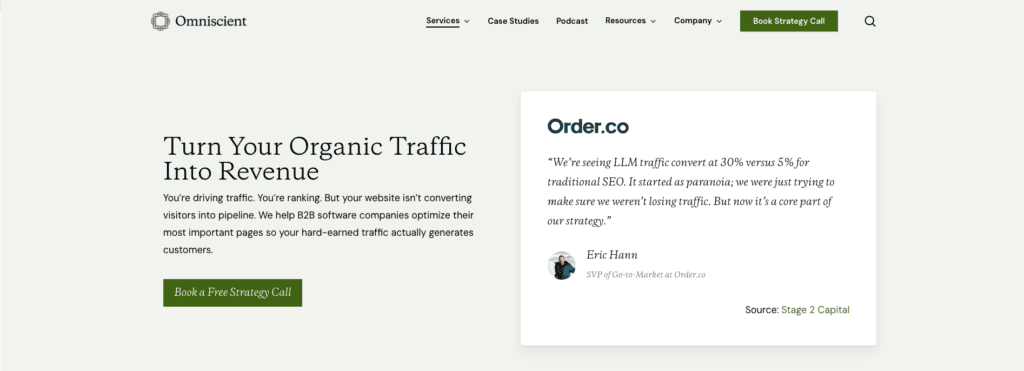
Omniscient Digital is an organic growth agency for B2B software companies. We build conversion rate optimization into our core engagement model alongside SEO and AI search. Rather than treating CRO as a standalone service, Omniscient designs conversion programs around the same traffic context it manages. That way, hypotheses are grounded in keyword intent and AI search referral behavior.
Pros:
- Omniscient’s hypotheses are informed by what traffic lands on a page, from what source, and carrying what intent. This makes experiments more targeted than those designed without context from existing keyword and AI search data.
- Our team has led growth and experimentation initiatives at CXL, HubSpot, and other companies that ran conversion programs at scale.
- Since LLM-referred visitors convert at different rates than organic search visitors, Omniscient’s digital marketing analytics practice tracks both separately. Our conversion hypotheses are built on the actual intent of each traffic segment arriving on the page.
Pricing: Full-service engagements, which include CRO as part of a broader organic growth program, start at $10,000 per month.
Results: We helped Jasper increase product signups by 400X, and helped Shipyard boost trial account creations by 771%.
SplitBase: Best for DTC ecommerce brands scaling conversion alongside ad spend
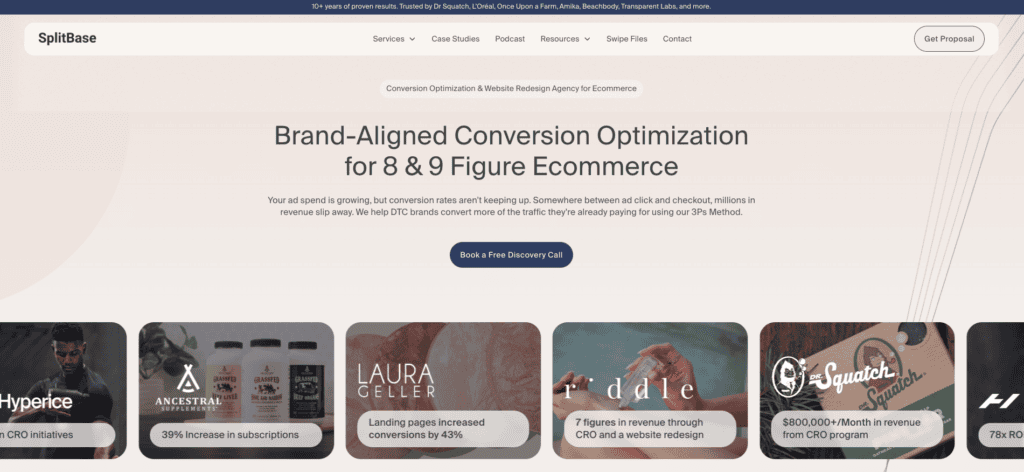
Best for: DTC ecommerce brands generating $10M+ in annual revenue that need a dedicated CRO program designed to convert paid traffic more efficiently as ad spend scales.
SplitBase is a conversion optimization and landing page agency built specifically for 8- and 9-figure DTC ecommerce brands. Where most CRO agencies serve a mix of B2B and ecommerce clients, SplitBase focuses entirely on direct-to-consumer. It works with brands like Dr. Squatch, Kiehl’s, and Hyperice to turn existing traffic into more revenue.
Pros:
- SplitBase assigns a dedicated team of seven specialists per engagement, including CRO strategists, conversion-focused designers, copywriters, developers, and data analysts.
- Their methodology, the 3Ps (Patterns, Perception, Proof), starts with quantitative and qualitative conversion research before moving into A/B testing and landing page optimization.
- SplitBase reports a 95% client retention rate after six months and an average 5x ROI by month three across their portfolio.
Pricing: Full-service conversion optimization programs start at $8,500 per month.
Results: SplitBase’s CRO and landing page optimization work helped Moon Pod generate $3.3M in additional annualized revenue through a combination of on-site optimization, upsell and cross-sell experiments, and paid social landing pages.
Speero: Best for mid-market and enterprise SaaS teams building an experimentation program
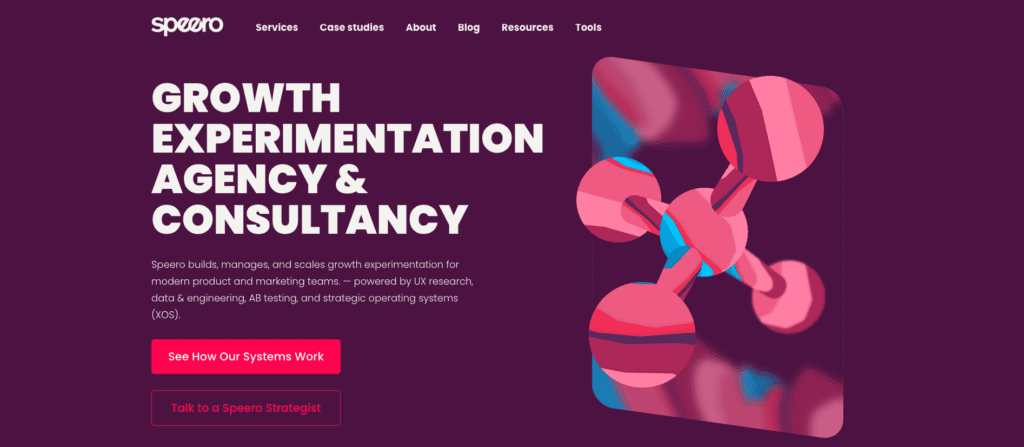
Best for: Marketing and product teams at $50M+ companies that want to build a systematic experimentation capability, not just run individual A/B tests.
Speero is a growth experimentation agency that builds and scales experimentation programs. It caters to marketing and product teams whose leadership has committed to experimentation. Speero’s core offering is XOS. This is an experimentation operating system that combines UX research, data and engineering, AI, and A/B testing to help teams scale experimentation. The agency serves enterprise and mid-market companies across B2B, SaaS, and ecommerce.
Pros:
- Speero offers three service models to allow teams to engage at the level that fits their current maturity.
- Speero has published experimentation blueprints spanning strategy, design, development, analysis, research, and operations.
- Advisory engagements include access to CXL.com training, which helps teams build and retain experimentation skills in-house.
Pricing: Speero’s 12-month programs start at $10,000 per month.
Results: MongoDB grew from zero to 100 experiments per year within six months of working with Speero. The MongoDB team attributes this to “the tooling, research, statistics, and processes needed to run experimentation at scale.” Additionally, Native was acquired for $100 million after Speero helped build out its experimentation program.
Spiralyze: Best for predictive CRO with performance-based pricing
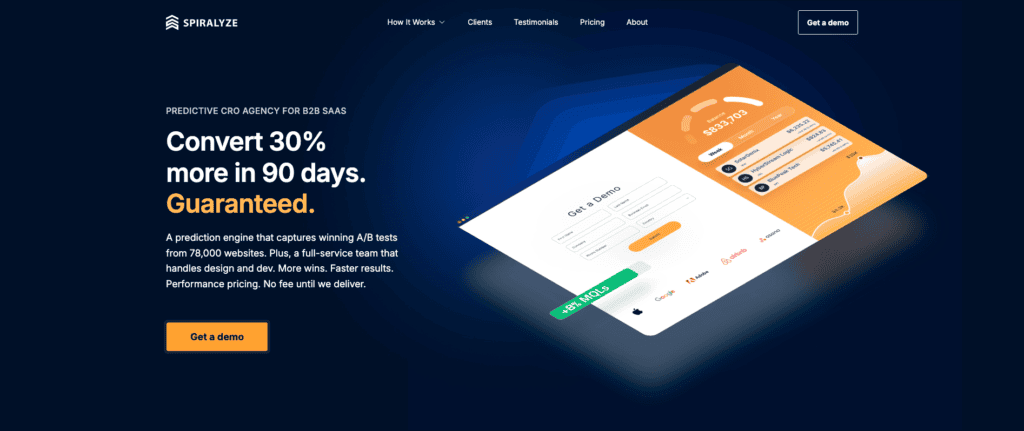
Best for: B2B SaaS and ecommerce companies that want a fully managed CRO program with a guaranteed 30% lift and the option to pay on results rather than a fixed fee.
Spiralyze is a CRO agency that uses a proprietary prediction engine to accelerate test design. Spiralyze offers a full-service team that handles design, copy, development, QA, analytics, and project management. The agency works with both B2B SaaS companies and ecommerce brands.
Pros:
- The engine scrapes A/B test data from 78,000 websites to identify proven winners and predict what will work on a client’s site.
- Spiralyze’s fees are all-inclusive, with the company even providing testing tools like VWO, Mutiny, CrazyEgg, Hotjar, and Wynter.
- The test-to-live cycle runs one to two weeks, helping reduce the lag between a validated hypothesis and data collection.
Pricing: Spiralyze’s flat-fee model is $25,000 per month with no contract commitment. Performance-based and pilot pricing are available upon contact.
Results: One client reported over a 30% conversion rate increase on landing pages. Another reported a 125% increase in conversion rate for demo requests.
Conversion Sciences: Best for fully managed CRO with a 180-day results guarantee
Best for: Companies that want a fully managed program with a defined results guarantee and an agency that will continue testing until the target is met.
Conversion Sciences is a fully managed CRO agency founded in 2007 by Brian Massey, who coined the term “conversion scientist.” The agency runs the Conversion Catalyst program, providing a complete conversion team across strategy, research, design, development, and testing.
Pros:
- It offers a 180-day results guarantee and may continue testing if the engagement does not produce satisfactory results within that period.
- Conversion Sciences draws on experience from more than 20,000 tests across engagements with over 150 clients to inform its hypothesis development process.
- This agency offers team training alongside its managed service, which suits clients who want to build in-house CRO capability over time.
Pricing: Conversion Sciences uses custom pricing. Contact for details.
Results: Wasp Barcode saw a 250% increase in demo-request conversion rate within six months of starting the Conversion Catalyst process. Galeton, on the other hand, achieved an 18% increase in revenue per session.
Invesp: Best for dedicated CRO with proprietary analytics software
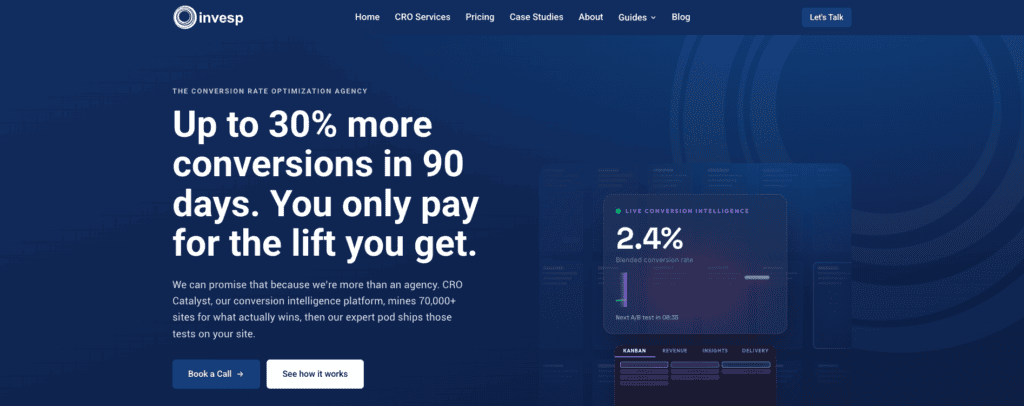
Best for: SMB to enterprise businesses that want a no-lift, no-fee CRO program with a proprietary testing and analytics platform included.
Invesp is a dedicated CRO agency that pairs a no-lift, no-fee engagement model with its proprietary SHIP methodology. It’s a structured framework for scrutinizing, hypothesizing, implementing, and propagating conversion improvements across the organization. The agency offers a pod model with a full conversion team covering strategy, research, design, development, and testing.
Pros:
- Potential clients can read about the SHIP prioritization framework to understand exactly how hypotheses are formed, tested, and institutionalized before signing.
- The no-lift, no-fee model aligns the agency’s incentives directly with the client’s conversion outcomes.
- Invesp’s teams can build test variations in your tool of choice, whether it’s VWO, Optimizely, Convert, or a similar alternative.
Pricing: Invesp’s retainer pricing starts at approximately $9,000 per month. The no-lift, no-fee model means client fees are contingent on verified conversion improvements.
Results: Show Her Off saw a 40% conversion lift within four months of working with Invesp. The agency attributes this to the emotional and social appeal of revised copy developed through customer research.
GetUplift: Best for SaaS companies using an emotional targeting methodology
Best for: SaaS companies and fast-growing brands that want a CRO program built around customer psychology and emotional driver research rather than UX heuristics alone.
GetUplift is a conversion optimization agency founded by Talia Wolf that applies an emotional targeting methodology to CRO. In other words, research starts with understanding what emotions drive and block customer decisions before a single test is designed. Services include conversion optimization audits, done-for-you CRO programs, and workshops and training for in-house teams. The agency has worked with the likes of Bitly, Teamwork, Mercedes, Thinkific, Sprout Social, and Upright.
Pros:
- GetUplift’s emotional targeting methodology starts with VoC research and qualitative interviews before any test is designed, producing hypotheses grounded in buyer psychology rather than UX heuristics alone.
- GetUplift coordinates testing across multiple internal teams and stakeholders, which suits companies with complex org structures where CRO needs to run across product, marketing, and growth simultaneously.
- In addition to managed CRO services, the agency offers in-house training and workshops, giving teams a path to build internal capability
Pricing: Pricing is not publicly available. Contact GetUplift directly for engagement terms.
Results: Bitly reported a 31% increase in conversion rates after working with GetUplift, and Teamwork saw homepage signups increase 7x after the agency optimized their conversion funnel.
Conversion Rate Store: Best for performance-based CRO with pay-for-results pricing
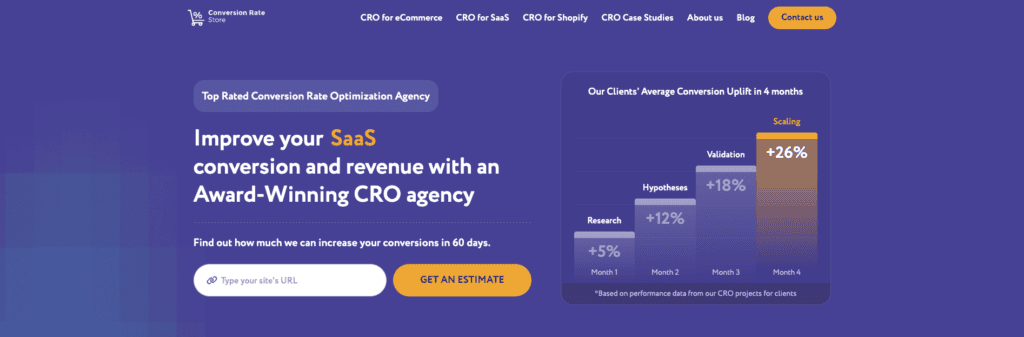
Best for: Enterprise and mid-market companies generating over $3 million in revenue that prefer to pay for conversion uplift rather than fixed retainers.
Conversion Rate Store is a CRO and UX optimization agency with a 50+ person team and a reported A/B test win rate of 52%. The agency offers three engagement models: a fixed monthly retainer for SMEs, a performance-based model, and a one-time audit. Its European remote team structure allows the agency to offer pricing it claims is 30–40% lower than comparable US and UK agencies.
Pros:
- The performance-based engagement model ties every fee directly to conversion uplift, so clients pay only for actual results.
- Conversion Rate Store’s self-reported 52% A/B test win rate is higher than the common range of 20–30%.
- The team is skilled in nine CRO and UXO competencies, so clients don’t have to fill in gaps in their conversion programs.
Pricing: A free CRO audit is available for businesses with over $200K in monthly revenue. For retainer and performance-based pricing, you must contact the Conversion Rate Store team.
Results: PapayaGlobal saw a 106.2% increase in conversion to quote requests and an 88.5% increase in demo scheduling. Additionally, Depositphotos saw an 18% uplift in conversion rate for new users alongside 8.3% growth in new user revenue.
5 things to look for in a conversion rate optimization agency
The agencies above were chosen because they meet a minimum bar on each of the five criteria below. But how you weigh those criteria for your specific situation determines which one is the right fit. Here’s what each criterion means in practice and what it costs you when an agency falls short.
1. A documented, repeatable testing methodology
The most common version of a CRO agency pitch involves the word “process” used often and defined rarely. A documented methodology means the agency can show you (in writing and before you sign) exactly how they move from initial research to hypothesis to experiment to implementation. That includes:
- How they collect data
- How they prioritize what to test
- What statistical thresholds they use to call a winner
- How they institutionalize learnings across iterations
Agencies that fall back on “best practices” rather than a documented hypothesis framework will produce inconsistent results across clients because the thinking that went into one test doesn’t reliably inform the next one.
The test for whether an agency’s methodology is genuine or a marketing description: ask them to walk you through the last three tests they ran for a client. What was the hypothesis? What data informed it? And what happened to the losing variation? Vague answers are a signal.
2. Verified case studies with named clients and specific outcomes
A percentage lift without a baseline, a timeframe, and a business metric is not a result—it’s a claim. A 50% increase in conversions sounds strong until you learn the baseline was 1% and the test ran for five days on a landing page with 200 visitors.
What a legitimate CRO case study looks like: it names the client, specifies the metric (conversion rate, revenue per session, demo requests), states the before-and-after, and includes a timeframe.
When evaluating an agency, the absence of named clients or specific numbers in case studies is a reliable disqualifier.
3. Specialization that matches your buyer type
CRO methodology that works for one buyer type can misfire in another.
Case in point: B2B SaaS conversion operates on lower traffic volumes, longer decision cycles, and friction points like business justification on a pricing page—not cart abandonment. DTC ecommerce conversion, on the other hand, depends on purchase urgency, average order value optimization, and post-click experiences that convert paid traffic in a single session.
An agency that brings the wrong mental model to your funnel will generate technically sound tests built on the wrong assumptions.
The fix is straightforward: match the agency’s core specialization to your conversion context.
For example, Omniscient Digital’s B2B SaaS focus solves this for software companies. SplitBase’s DTC ecommerce specialization solves it for direct-to-consumer brands.
For agencies with mixed ICPs, asking for specific case studies from companies with similar buyer dynamics is the minimum due diligence.
4. Statistical rigor and attribution transparency
Low-traffic B2B sites face a fundamental testing constraint: it takes longer to accumulate enough conversions per variation to reach statistical significance at a standard 95% confidence threshold. Agencies that rush to call winners on underpowered tests will report results that don’t hold when deployed at scale.
When evaluating an agency’s statistical rigor, ask:
- Do they set minimum sample sizes before starting a test?
- Do they use one-sided or two-sided significance tests, and can they explain why?
- Do they segment results by traffic source, device, or user cohort—or report aggregate numbers that blend different behavior?
- Does their attribution model connect conversion changes to pipeline and revenue, or just report page-level conversion rate?
The agencies willing to discuss this in detail are the ones who’ve built a real methodology, not just a pitch.
Beyond methodology, it also helps to compare how agencies think about funnel performance in the first place. Industry data across 86 B2B companies shows Blog → White Paper Download is among the highest-converting organic funnels at 1.6%—but direct paths to demos and service pages aren’t far behind.
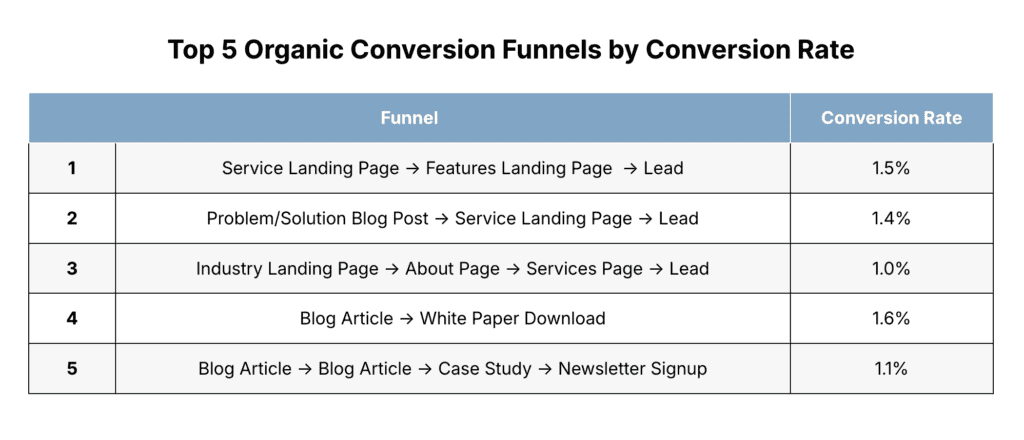
The gap between funnel types is narrow; a good agency identifies where your specific visitors are dropping off rather than defaulting to a single “highest-converting” path. If you’re building an internal perspective before hiring, our guide to A/B testing content walks through what to evaluate.
Measuring performance and ROI from organic channels is getting more difficult as AI reshapes attribution. Our Measuring Organic Growth research report covers how B2B marketers are rethinking what to track and how—get your copy.
5. Integration with your organic and paid traffic channels
CRO applied in isolation from the channels driving traffic to a page misses the most important signal available: why visitors are arriving and what they expect when they get there.
A visitor arriving from an AI Overview comparing CRO agencies is in a different evaluation frame than one clicking through from a branded paid search ad. Thus, the same page design will perform differently for both. The gap matters most when the team managing CRO isn’t the team managing the traffic channels.
When the CRO agency doesn’t know what keywords are driving your blog traffic or which AI search answers are referencing your pricing page, it’s already designing hypotheses without the intent context that makes them meaningful. Add in a paid campaign landing visitors on tested pages with a different headline promise, and the gap only widens.
Omniscient Digital builds CRO as part of the same organic growth program managing SEO and AI search, so every page change is grounded in the actual intent of the traffic feeding it.
How to choose the right conversion rate optimization agency for your growth stage
The seven agencies on this list aren’t interchangeable. They solve different problems for different kinds of companies, and the right choice depends more on your current situation than on any absolute ranking.
- Omniscient Digital: B2B software companies whose SEO and AI search traffic is growing but not converting into pipeline, and who want CRO integrated with their organic program rather than run separately from it.
- Speero: Mid-market and enterprise SaaS companies with leadership buy-in on experimentation and a need to build a systematic testing capability, not just run individual tests.
- Spiralyze: Teams that want speed, a data-driven prediction engine, and a 30% lift guarantee with no long-term contract—at a higher price point (see: our interview with Spiralyze CEO Sahil Patel).
- Conversion Sciences: Companies that want fully managed CRO with a results guarantee and an agency that will keep testing until the target is met.
- Invesp: Teams that want a no-lift, no-fee structure with a proprietary analytics platform included at no extra cost.
- GetUplift: Companies whose conversion problem is rooted in messaging and buyer psychology—high traffic, low conversion, and unclear why visitors aren’t persuaded.
- Conversion Rate Store: Businesses generating $3M+ in annual revenue that want to pay only for verified conversion uplift, not for effort.
The most common mismatch isn’t about quality—it’s about fit. Define what your conversion problem actually is before evaluating which agency’s methodology addresses it—and use conversion rate optimization strategies to build that framing before you make a call.
If you’re a B2B software company looking to turn your organic and AI-driven traffic into qualified pipeline, book a free strategy call with Omniscient Digital to see what an integrated CRO program looks like for your growth stage.
Before you brief an agency, it helps to know exactly where your blog is already converting—and where it isn’t. Get the free Airtable Blog CTA Mapping Template to map your offers to posts at every funnel stage.
Frequently asked questions about conversion rate optimization agencies
How much does a CRO agency cost per month?
CRO agency pricing varies widely based on the engagement model and scope.
At the lower end, dedicated CRO retainers start around $5,000–$7,000 per month for smaller programs or agencies with a no-lift structure (Invesp starts near this range). Mid-tier full-service programs run $10,000–$20,000/month (Omniscient Digital, most of the agencies on this list). At the top, Spiralyze’s flat-fee model is $25,000/month.
Performance-based models—where you pay per percentage point of uplift rather than a fixed monthly fee—don’t have a flat starting price but may have a minimum threshold for revenue, for example.
What’s the difference between a dedicated CRO agency and a full-service agency that offers CRO?
A dedicated CRO agency is one where conversion optimization is the primary and often only service. The team’s entire operational model, hiring profile, and tooling are built around running experiments, analyzing user behavior, and improving conversion metrics.
A full-service agency that offers CRO alongside SEO, paid media, web design, and other services treats CRO as one of many service lines. This typically means a smaller dedicated team, less specialized tooling, and hypothesis generation that doesn’t draw on the same depth of conversion-specific experience.
The risk with full-service CRO is that it gets treated as a bolt-on rather than a program. The agencies on this list are either dedicated CRO specialists or, in Omniscient Digital’s case, agencies where CRO is integrated into a focused organic growth program rather than bundled into a broad digital marketing retainer.
For AI-driven CRO specifically, the distinction matters even more. The methodology for optimizing pages for AI search traffic is new enough that most generalist agencies haven’t developed it yet.
How long does it take to see results from a conversion rate optimization agency?
It depends on traffic volume, conversion event type, and the testing methodology the agency uses.
Agencies like Spiralyze, whose prediction engine front-loads proven patterns, report first wins within 43 days. For agencies using a research-first approach (GetUplift, Invesp, Conversion Sciences), the first test typically goes live within 60 days after the research and audit phase. However, meaningful, compounding improvement usually shows up around months 3 to 6.
For B2B SaaS companies with lower traffic, the timeline extends because statistical significance takes longer to reach on any single test.
The realistic answer for most B2B companies: expect 60–90 days before the first experiment completes with actionable data, and expect the program to compound meaningfully over 6–12 months rather than producing a step change in the first quarter. Agencies that promise faster results without qualifying traffic volume requirements are worth scrutinizing.