Most B2B content programs produce content. Fewer produce revenue. According to the Content Marketing Institute, only 22% of B2B marketers say their content marketing is extremely or very successful. Are you among them? If not, you might consider working with a content creation agency to turn the tide.
Yet, for mid-market and enterprise B2B companies, the challenge isn’t finding an agency that can write. It’s finding one that connects what you’re publishing to pipeline rather than just page views. This is a curated shortlist of seven digital content creation agencies evaluated specifically against that standard.
Table of contents
- At a glance: The best content creation agencies
- The best B2B content creation agencies for midmarket and enterprise
- Omniscient Digital: Best for comprehensive organic growth programs
- Animalz: Best for thought leadership and editorial depth
- Graphite: Best for growth-stage SEO and AEO combined
- Draft.dev: Best for companies with technical audiences
- Grow and Convert: Best for conversion-focused Pain Point SEO
- Codeless: Best to build content systems for in-house use
- Siege Media: Best for GEO-focused B2B SaaS brands
- What to look for in a content creation agency
- How to choose a content creation agency for B2B growth
- Frequently asked questions about content creation agencies
Disclosure: This guide is published by Omniscient Digital. We’ve included ourselves because we work in this space and believe our approach is worth evaluating alongside our competitors. However, every agency on this list was evaluated against the same criteria.
At a glance: The best content creation agencies
| Agency | Best for | Starting price | Key differentiator |
| Omniscient Digital | B2B SaaS organic growth tied to pipeline | From $10,000/month | Full-service SEO, GEO, AEO, content, and CRO in one program |
| Animalz | Long-form editorial and AEO for B2B SaaS | Custom | Decade-long track record; dedicated AEO service line |
| Graphite | AI-powered SEO for growth-stage B2B SaaS | Custom | AI-first topic prioritization; full-stack coverage |
| Draft.dev | Technical content for developer-facing B2B SaaS | From $9,000/month | 300+ vetted engineer-writers; developer audience only |
| Grow and Convert | Conversion-driven SEO content for B2B SaaS | From $10,000/month | Pain Point SEO targeting conversion-intent keywords |
| Codeless | Building owned in-house content capabilities | Custom | Build-Operate-Transfer model; full playbook handoff |
| Siege Media | GEO and LLM visibility for B2B SaaS | Custom | Proprietary GEO technology; proven LLM citation wins |
How we evaluated these content creation agencies
We used four criteria to evaluate every agency on this list:
- B2B SaaS focus and portfolio. Does the agency have a demonstrated track record with B2B software companies, not just general business clients?
- Scale for mid-market and enterprise. Can the agency support programs running dozens to hundreds of content pieces monthly, across multiple stakeholders and content types?
- Strategic alignment and revenue-tied content approach. Does the agency connect content output to pipeline, qualified demand, and measurable revenue outcomes — or is success measured in traffic alone?
- AI and GEO readiness. Is the agency actively building for AI-driven discovery—LLM citations, answer engine optimization, and zero-click surfaces?
According to the Content Marketing Institute, 45% of B2B marketers lack a scalable model for content creation. The agencies on this list were selected specifically because they’ve solved that problem and have the results to prove it.
The best B2B content creation agencies for midmarket and enterprise
Each of the seven agencies below was evaluated against the four criteria above. Dig in to find out which one might be the best fit for you.
Omniscient Digital: Best for comprehensive organic growth programs
Best for: B2B SaaS companies seeking a comprehensive organic growth program that connects SEO, content, and AI search to pipeline and revenue
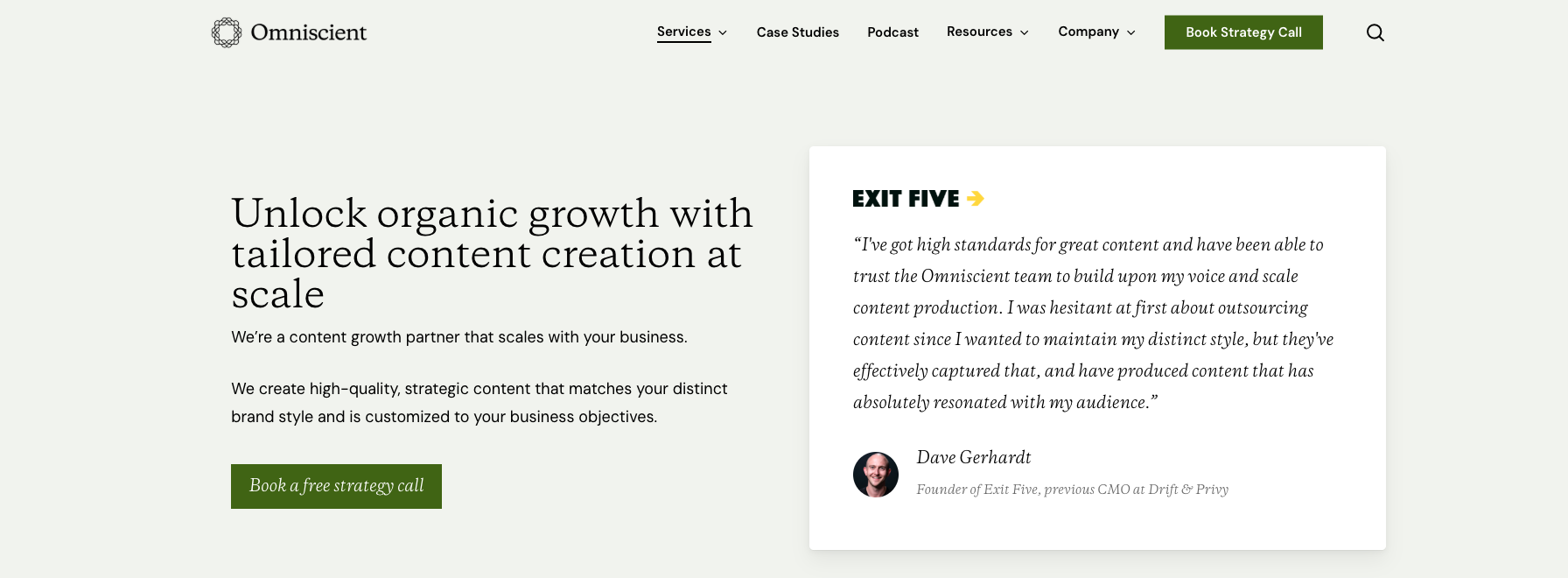
Omniscient Digital is an organic growth agency for B2B software companies. We cover SEO strategy, content production, GEO, programmatic SEO, technical SEO, digital PR, link building, and CRO. These operate as a unified program rather than a bunch of disconnected services. Our positioning centers on connecting organic content to pipeline and revenue, not just traffic growth. We’ve worked with a range of B2B software clients from the likes of Loom and Jasper to highly technical brands like HashiCorp and Hex.
Pros
- We use the barbell approach, which explicitly balances high-volume, keyword-driven content with high-risk, high-reward content experiments. It’s designed to scale output without trading quality for quantity.
- Our “Surround Sound SEO” approach is designed to improve visibility across search engines and LLM platforms.
- Revenue-tied content strategy means our organic programs are anchored in pipeline metrics, qualified demand generation, and closed deal attribution.
Pricing: Full-service engagements start at $10,000/month.
Results: Smartling generated $3.7M in qualified pipeline and a 31,250% increase in blog conversions through a content and SEO partnership with Omniscient Digital, delivering a 12.8x ROI on their organic search investment. Similarly, we helped Jasper achieve $4M in blog-attributed annual recurring revenue, increasing product signups by 400x.
Animalz: Best for thought leadership and editorial depth
Best for: B2B SaaS companies prioritizing thought leadership, editorial depth, and SEO/AEO programs built for compounding growth over time
Animalz is a content marketing and SEO/AEO agency for B2B SaaS companies. Their core positioning is editorial quality at depth—producing content that builds category authority and survives AI-driven search change. The agency has a decade-long track record partnering with B2B SaaS companies from seed through enterprise scale, with clients including Amplitude, Airtable, WorkOS, Google, Atlassian, Intercom, and Ramp.
Pros
- Animalz has a decade-long track record partnering with B2B SaaS companies from seed through enterprise scale.
- Proprietary tools (a content refresh tool and an SEO forecasting tool) give clients independent capability to audit content performance and forecast organic growth between agency touchpoints.
- LinkedIn thought leadership and survey-driven whitepaper services extend content programs into founder and executive voice, beyond the blog and SEO channel.
Pricing: Contact Animalz for a custom quote.
Results: SupportLogic grew qualified organic traffic by 500% and expanded its keyword footprint by 450% in 12 months through a diversified content strategy built with Animalz. The agency also built a content engine for Amplitude from the ground up. By the end of a years-long engagement, the engine generated 200,000 organic visits per month.
Graphite: Best for growth-stage SEO and AEO combined
Best for: Growth-stage B2B SaaS teams seeking an AI-powered SEO and AEO program built around high-leverage topic prioritization over content volume
Graphite is an AI-powered growth agency covering SEO, AEO, programmatic SEO, and content strategy. Their positioning is built around a core principle: 95% of SEO work is waste, and their AI-driven methodology is designed to identify and execute only the 5% of content and topics that actually drive results. Services span editorial, technical, programmatic, and AEO capabilities.
Pros
- Graphite uses an AI-first methodology for topic identification. It maps content to specific buyer personas and journey stages, concentrating resources on highest-impact content rather than publishing volume.
- AEO is a dedicated service line with AI citation insights, AI Share of Voice tracking, and AI-focused content strategy built into the engagement rather than offered as a future add-on.
- The agency is SOC 2 certified, which may matter for enterprise clients with vendor security requirements before onboarding agency partners.
Pricing: Contact Graphite for pricing.
Results: Graphite helped BetterUp increase monthly traffic from 74K to 3.8M, even publishing as many as 40 articles per month for the client at one point in the engagement.
Draft.dev: Best for companies with technical audiences
Best for: B2B SaaS companies with developer or technical audiences that need expert-written content practitioners will actually trust and cite
Draft.dev builds technical content engines for developer tools and platforms. They focus exclusively on audiences of software developers, DevOps engineers, data engineers, and technical practitioners—people who can easily sniff out content written by non-experts. Their network of 300+ vetted engineer-writers and every piece goes through developer review and professional technical editing before delivery.
Pros
- Draft.dev uses AI-assisted research and drafting workflows, with every completed piece reviewed by real developers and edited by professional technical editors before delivery.
- Draft.dev typically publishes its first pieces within three weeks of kickoff, then maintains a weekly content-delivery cadence.
- Draft.dev provides full developer content funnel coverage across tutorials, comparison pages, landing pages, lead magnets, content refreshes, and technical product guides.
Pricing: Plans start at $9,000/month with a three-month minimum commitment.
Results: Sinch Mailgun achieved 20–45% click-through rates on content, saving weeks on content that previously required direct developer involvement. On the other hand, Shorebird saw their first Draft.dev-produced pieces rank within the first month of publishing, with visitor-to-signup conversion rates holding consistently at 10–15%.
Grow and Convert: Best for conversion-focused Pain Point SEO
Best for: B2B SaaS companies seeking bottom-funnel content that drives product signups and qualified leads rather than top-of-funnel traffic volume
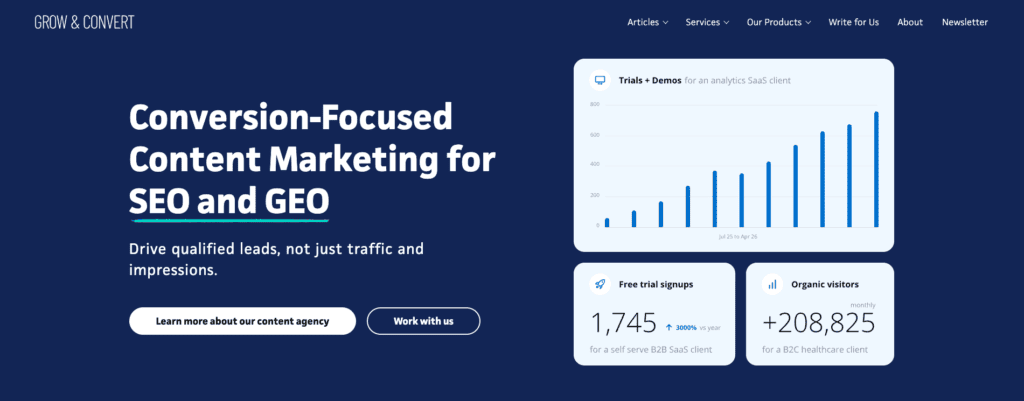
Grow and Convert is a content-focused SEO and GEO agency built around its Pain Point SEO methodology — a framework that prioritizes bottom-funnel search queries where buyers are actively evaluating solutions rather than browsing for general information. The agency’s core positioning centers on conversion accountability, measuring success by product signups and qualified leads rather than traffic volume alone. The client portfolio spans B2B SaaS and technology companies including Patreon, ServiceTitan, Leadfeeder, and Yelp.
Pros:
- The agency manages the full content production process — keyword research, subject matter expert interviews, writing, publishing, link building, and performance analytics — as a single integrated workflow rather than requiring clients to coordinate separate vendors.
- Grow and Convert offers a membership community and course designed to teach its Pain Point SEO and content marketing strategy, enabling businesses to bring conversion-generating content creation in house when they’re ready to transition away from agency support.
- Monthly conversion reporting attributes signups and qualified leads to individual content pieces, giving marketing teams direct visibility into which articles drive pipeline rather than relying on traffic proxies.
Pricing: Plans start at $10,000/month.
Results: Leadfeeder scaled content-attributed signups to over 200 per month through Grow and Convert’s content program. Vocal Video ranks on the first page for 49 keywords, with 13% of signup volume attributed to agency-produced content.
Codeless: Best to build content systems for in-house use
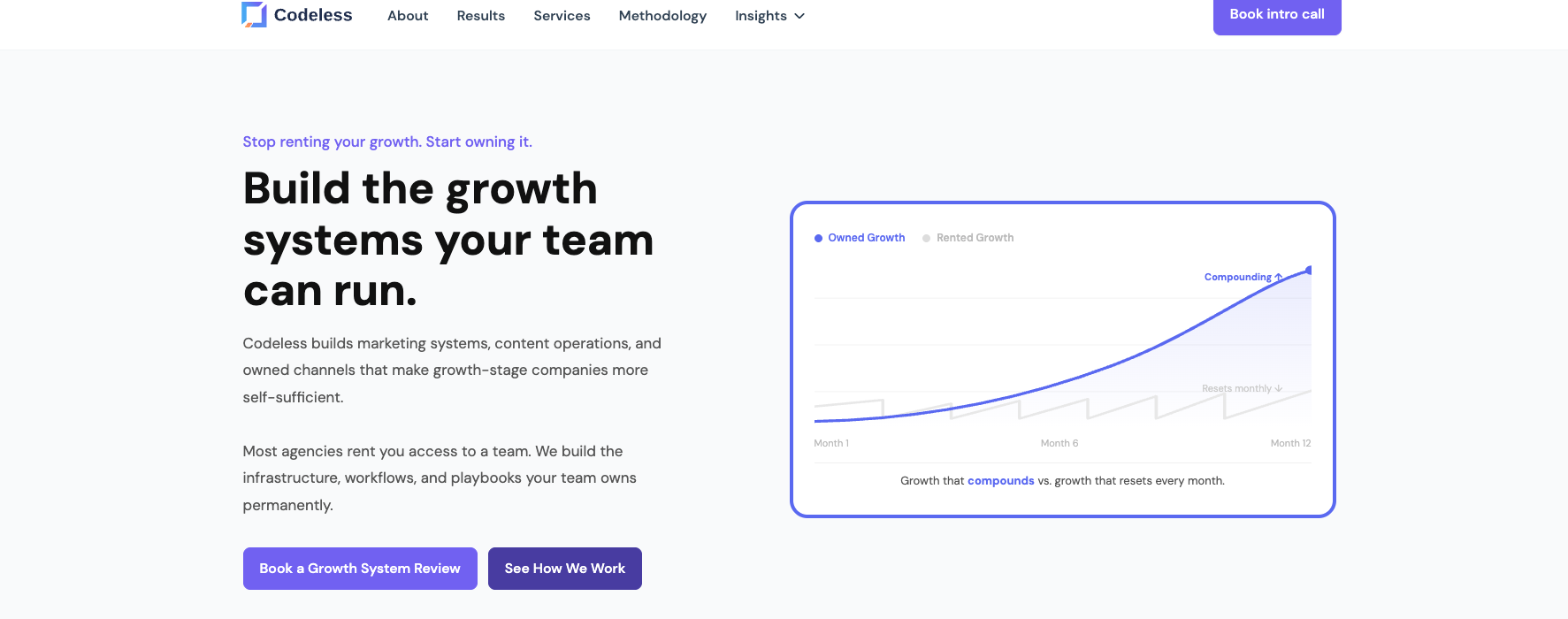
Best for: Mid-market B2B SaaS companies that want to build an owned in-house content capability rather than maintain a permanent agency dependency
Codeless is a content marketing agency and growth systems builder for B2B SaaS companies. Their differentiating Build-Operate-Transfer (BOT) model is structured to hand off documented playbooks, workflows, account access, and operator training to internal teams permanently. With a team of expert writers, designers, and strategists, the firm delivers high-volume, editorial-quality content paired with keyword research, briefs, and performance reporting to drive organic visibility and pipeline growth.
Pros
- Codeless takes a diagnostic-first approach: every engagement begins with a growth waste audit to identify where marketing budget leaks before any content build begins.
- The Build-Operate-Transfer model means that the content engine keeps running after Codeless steps back, without ongoing agency fees.
- Client accounts are handled by senior content marketers who work closely with clients’ in-house teams. Each client also gets a dedicated account manager.
Pricing: Contact Codeless for pricing.
Results: monday.com grew from 12,586 to 304,000 monthly blog visitors and built 140,000 owned organic keywords through Codeless’s content engine and topic architecture. The agency also helped Remote increase site keywords by 96% in 6 months through an SEO system and editorial workflows.
Siege Media: Best for GEO-focused B2B SaaS brands
Best for: B2B SaaS brands seeking a GEO-first agency with demonstrated LLM citation wins, digital PR, and proprietary content technology
Siege Media is a full-service organic growth agency that has expanded its practice to include generative engine optimization (GEO), building brand presence for AI-powered discovery surfaces alongside traditional search and SEO. Services span content marketing, digital PR, affiliate partnerships, and two proprietary technology platforms. Its SaaS portfolio includes Zendesk, Asana, HubSpot, and Zoom.
Pros
- The agency offers editorial-grade content production backed by a multi-role workflow (writers, SEO strategists, designers, editors) to ensure quality, search-optimized assets.
- Siege’s proprietary BlueprintIQ and DataFlywheel systems support AI-enhanced content strategy and systematic content refreshes, helping clients prioritize, create, and update content on an ongoing basis.
- Siege Media’s integrated Digital PR service is designed to build third-party authority signals and earned-media visibility that can support traditional search performance and broader AI-search visibility.
Pricing: Contact Siege Media for a quote.
Results: Zapier grew traffic value by $7.2M and increased monthly organic traffic by 290% during a partnership with Siege Media. On the other hand, Mentimeter generated 124,000 ChatGPT sessions over 6 months through Siege Media’s bottom-funnel content and GEO strategy.
What to look for in a content creation agency
If you’re handling marketing at a mid-market or enterprise B2B company, your evaluation criteria aren’t the same as those of a startup. They can make do with a small inventory of decent content assets while they start building a presence.
You, on the other hand, need an agency that understands how complex B2B programs actually work. That encompasses:
- Multiple content types running simultaneously
- Stakeholder review processes
- Brand governance at scale
- Content that has to connect to pipeline before it earns executive buy-in
These are the factors that separate agencies built for that environment from generalist content shops.
B2B buyer journey expertise
B2B buyer journeys are not linear, and content that doesn’t account for that rarely drives the outcomes it promises. The most effective B2B content agencies understand the difference between:
- Awareness content that surfaces a problem
- Consideration content that maps solutions
- And bottom-of-funnel content that moves a specific buying decision forward
What this looks like in practice: agencies that map content to explicit buying stages and account for multi-stakeholder decision-making. Not to mention designing content to move buyers through the funnel rather than simply populate a keyword grid. The average B2B deal involves six to ten stakeholders, so content built for a single buyer persona misses most of that buying committee.
Ask any agency you’re evaluating how they think about content across the buyer journey. Can they show you examples of content that actually influenced qualified pipeline?
Curious how today’s B2B buyers actually move from discovery to decision, including how LLMs now factor in? Download our B2B Buyer Behavior research report.
Revenue-tied content strategy
Content strategy that doesn’t connect to revenue is just publishing. 56% of respondents in one survey flagged tracking customer journeys and attributing ROI to content efforts as the top two content performance measurement challenges.
The agencies worth hiring have frameworks for closing that gap. They:
- Create editorial roadmaps that connect to the revenue goals on your leadership team’s slide decks
- Connect content performance to pipeline metrics—opportunities influenced, SQLs attributed, deals sourced from organic
- Build reporting dashboards that surface what’s working in revenue terms, not to a keyword universe built in isolation
Agencies that are strong on revenue alignment will ask about your CRM setup, your attribution model, and how you define a qualified lead before they talk about content formats. If that conversation doesn’t come up early in the engagement scoping process, it’s probably time to start talking to another agency.
AI and GEO readiness
Search behavior has shifted structurally. AI-powered surfaces like ChatGPT, Perplexity, and Google AI Overviews increasingly intercept queries before a user reaches a traditional search result. 73% of B2B buyers now use AI tools in purchase research. So, the content that gets cited in AI responses is just as strategically important as the content that ranks on page one.
Leading agencies are building for this reality with dedicated GEO (generative engine optimization) practices. These include citation engineering, structured FAQ content, llms.txt implementation, and third-party citation building through PR and earned media.
They’re not treating GEO as a future-state add-on. The top agencies are running it as a parallel track to traditional SEO, measuring LLM Share of Voice and citation volume the same way they track keyword rankings.
Understanding the content types most commonly cited in LLMs is a useful starting point for evaluating an agency’s GEO capability. So is knowing what content engineering looks like in an AI-first content program. When evaluating any agency on GEO and AEO, ask:
- Do they offer AEO?
- How do they measure it?
- What content types do they produce specifically for AI retrieval?
- Can they show you a client example where LLM citation volume moved meaningfully?
Grab the AEO Field Guide: It covers the three modes of influence, owned content roadmap strategy, off-page compounding, and measurement. That way, you know what a real AEO approach looks like as you evaluate agencies.
Scale and production capacity
Scale means different things depending on where you are. For a mid-market B2B company running 20 pieces per month, scale is about maintaining editorial quality as volume increases. For an enterprise program running 100+ pieces across multiple teams, it’s about governance. Who approves what, how brand consistency is maintained across contributors, and how a program avoids becoming a content factory with no strategic center.
The agencies built for genuine scale have documented production systems that go beyond just a roster of freelancers. They have:
- QA processes
- Editorial SOPs
- Dedicated project management
- And reporting that shows how each piece connects to a broader program goal
When evaluating agencies on scale, ask for their production workflow documentation and how they handle brand guideline enforcement across a large contributor network. The answer tells you whether they’ve actually solved this problem or are just describing it.
Content quality
Quality in B2B content isn’t just well-written sentences. Information gain is critical. A piece that restates what’s already published by ten other agencies adds nothing to the conversation and signals nothing to a search engine or an LLM evaluating whether to cite it.
The best B2B content reflects genuine expertise: original perspectives, client-specific data, and evidence that the writer understands how practitioners actually talk about a topic.
Ask any agency for recent examples of content that performed well. Outside of performance metrics, look at what makes it qualitatively good. Does it:
- Surface a counterintuitive point?
- Reference proprietary data?
- Read like it’s from someone who has worked in this space, or like a summary of other summaries?
Those are the signals that separate content that compounds over time from content that fills a publishing calendar.
How to choose a content creation agency for B2B growth
For mid-market and enterprise B2B companies, choosing a content creation agency is a strategic partnership decision. It’s one that shapes how your content program connects to pipeline and how it evolves as your growth stage does. The agencies on this list each represent a different model. Just to recap a few:
- Omniscient Digital runs a comprehensive organic growth program tied to revenue.
- Draft.dev specializes in technical content for developer audiences.
- Codeless uses a Build-Operate-Transfer approach for teams building toward in-house ownership.
The right choice depends less on which agency has the most impressive case studies and more on where your program is today and where it needs to go. An enterprise program running at scale needs different support than one building its first content function. A SaaS company targeting DevOps engineers needs different expertise than one selling to Heads of Finance.
A few questions worth anchoring your evaluation on:
- What does success look like in 12 months — traffic, pipeline, LLM citations, or all three? For instance, need a revenue attribution framework built into the engagement? Choose a digital content creation agency that builds those by default without you having to nudge them.
- Do you need to build a content capability or run one? If you have the in-house team to eventually own the program, an agency like Codeless is structured for exactly that transition. If you need a long-term partner who functions as an extension of your team, a retainer-based full-service model fits better.
- How technically specialized is your audience? If your buyers are software developers, the content expertise required is genuinely different—it’s not something a generalist agency can approximate. In that case, it’d be wise to go with an agency like Draft.dev that exists to solve that specific problem.
If you’re evaluating B2B content creation agencies for a mid-market or enterprise program, Omniscient Digital offers a strategy call to talk through fit, scope, and what the right engagement looks like for your stage. Book your strategy call today to get started.
Frequently asked questions about content creation agencies
What does a content creation agency do?
A content creation agency plans, produces, and distributes content on behalf of your company. Depending on the agency’s scope, that can include blog posts, whitepapers, case studies, video scripts, social media content, landing pages, and more.
In the B2B context, the best content agencies also handle strategy. This includes keyword research, competitive analysis, editorial roadmapping, and measurement. The distinction matters because content without strategy tends to produce traffic without business outcomes.
How much does a content creation agency cost?
Content agency pricing varies significantly by scope, specialization, and engagement model.
Point-solution agencies that price by the piece may start as low as a few thousand dollars per month. Full-service agencies with strategy, production, optimization, and reporting typically start at $5,000 to $10,000 per month. Enterprise-level programs with integrated SEO, GEO, AEO, and content production can run $15,000 to $25,000+ per month.
What is the difference between a content creation agency and a content marketing agency?
The terms are often used interchangeably, but there’s a meaningful distinction.
A content creation agency focuses primarily on producing content. In other words, drafting, editing, and delivering finished assets. A content marketing agency takes a broader view, typically including distribution strategy, SEO, performance measurement, and sometimes paid amplification alongside production.
For B2B companies trying to drive pipeline through content, the marketing-focused model is usually more appropriate. Production without a distribution and measurement strategy rarely measurably moves revenue.
How do I know if I’m ready to hire a content creation agency?
Most B2B companies are ready to hire an agency when content is clearly a lever for growth but internal bandwidth is the constraint. Signs you’re ready:
- You have a defined target audience and some understanding of what they search for.
- You have a CRM or attribution system that can connect inbound leads to source.
- You have someone internally — even at 25% of their time — who can serve as an editorial point of contact and approver.
If you don’t yet have a clear sense of what search intent your buyers have, or how content connects to your pipeline, start with a strategy engagement before committing to ongoing production. Agencies built for mid-market and enterprise B2B will tell you this upfront. The ones that don’t are often more interested in closing a retainer than in setting a program up for measurable success.