We put a common question to our own pipeline: does the source our CRM records actually reflect the customer journey? For AI-sourced leads, first-touch attribution misses 85% – often filing them instead as “Organic” or “Direct.”
Key takeaways
- 6.8× — for every AI-sourced lead first-touch credited to “AI Referrals,” 5.8 more told us an AI tool sent them but were filed under another channel.
- 15% — first-touch captured only 28 of 189 self-evidenced AI-sourced leads; the rest were bucketed in Organic Search (95) and Direct Traffic (59) or Referral/Other (7).
- Growing gap — for two years, first-touch credited at most ~1 in 5 AI-sourced leads, and the number it missed grew from 6 to 50 per quarter.
- 87% — of the AI citations that mention us, 87% sit on third-party pages, whose upstream AI exposure is invisible to first-party and server-side tracking.
The AEO Attribution Gap
Many marketing teams measuring AI search lean on the same instruments: the acquisition source their analytics or CRM stamps on each lead.
In our case that is HubSpot’s Original Source – a first-touch model, designed to record where a contact first came from. We have long believed in adding color to our pipeline data via “how did you hear about us” form fields and sales call analysis. In a high touch business model like an agency, influence is often buried underneath more salient touch points, which limits our understanding of how leads actually find us.
In AI search, that’s more true than ever. We have data across dozens of clients that shows a large discrepancy between AI-sourced leads from click-based attribution and self-reported attribution.
We were also inspired by Graphite’s research with n8n that showed a ~10x delta between last-click attribution in GA4 and post-conversion surveys.
So we looked at our own data on what leads say when we ask them directly how they found us. In our analysis, the click-based system and the self-reported system disagree by nearly seven times.
Of the 213 leads who left a free-text answer to “how did you hear about us,” 189 named a generative engine — ChatGPT, Claude, Gemini, Perplexity, or a generic “AI.”
HubSpot’s first-touch source credited just 28 of them to “AI Referrals.” The other 161 were stamped Organic Search or Direct Traffic or Referral/other: people who saw us in an AI answer, then arrived later through a branded search or a direct visit.
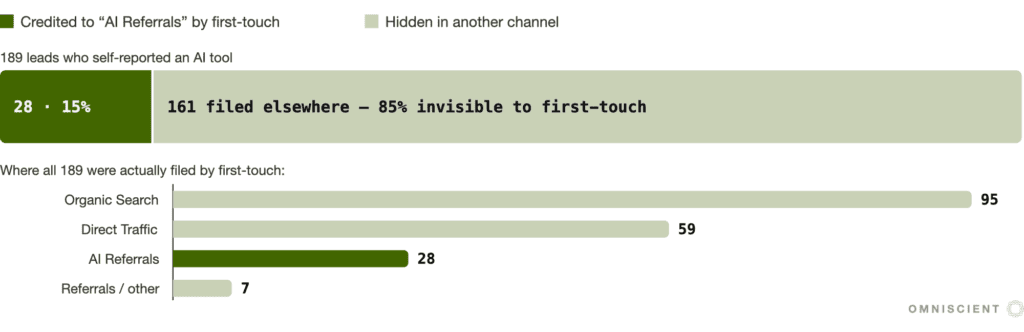
189 leads self-reported an AI tool as their source; first-touch credited 15% of them. The hidden 161 were assigned Organic Search (95), Direct Traffic (59), and referral/other channels. This analysis includes only leads who completed the optional field, so it likely understates the absolute number of AI-influenced leads we received.
Why Click-Based Attribution Often Misses AI Search
First-touch (or last-touch, or any click-based measurement) can only record a source once there is a tracked click/session to read it from, and in the case of first-touch, it credits whichever tracked touch lands first. Graphite’s last-click study gave evidence to the same gap, though used a different click-based attribution model.
AI search, evidently, breaks that in three places, and the gap above is the sum of all three.
Most AI influence never produces a click. In a single month, our highest-retrieved page appeared in AI answers 210 times and drew 10 referral sessions; the homepage drew 226. Being cited is potential exposure, but not always traffic – the same view-through dynamic that has always made TV and display hard to attribute directly.
The first touch it can see usually isn’t the AI one. A buyer discovers us in an AI answer, sits on it, and arrives days later via a branded Google search or by typing the URL. Or, they click on a blog post to read information about the future of AI search, but it’s not until they are in consideration for an agency that they turn to Perplexity to shortlist AEO agencies. This is, of course, how click-based attribution works, but it fails to identify the sources of influence that don’t produce a click. Whatever the case, AI search was salient and meaningful in their journey, but first-click (or last-click) misses the AI search influence if it didn’t generate a click.
A solid amount of the influence isn’t even on our site. Of the citations that mention us, 87% live on third-party pages – listicles, reviews, comparisons, media mentions, interviews – which no first party or server-side tracking can observe (data from Peec AI).
“I’ve done SEO in the past, but with the AI shift I wanted to work with someone who knows about getting into AI results. I found you through chat — if they know of you, I figured that was a good sign.”
— Inbound lead, filed by first-touch as “Organic Search,” August 2026
The “Dark Funnel” Gap Isn’t New, But It Is Widening
In every quarter for the past two years, first-touch has credited only a small fraction of the leads who said an AI tool sent them, and because that volume is growing, the absolute number it misses grows with it.
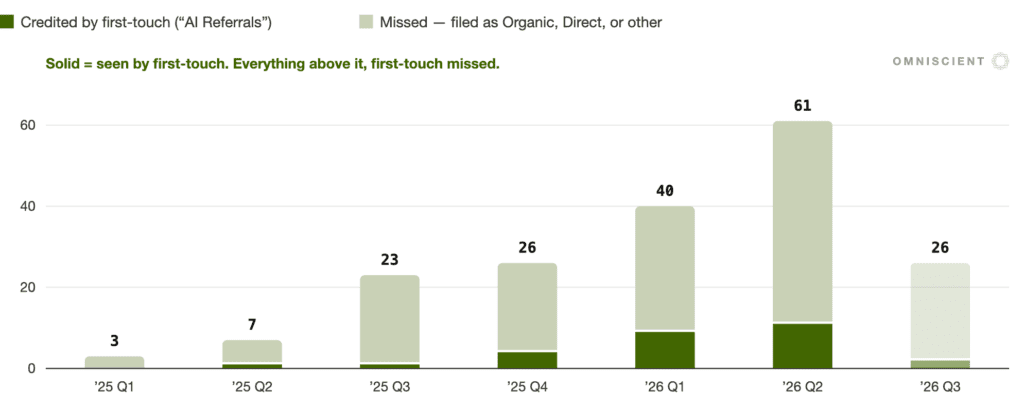
Each bar is the AI-sourced leads that quarter (self-reported); the solid portion is what first-touch credited to “AI Referrals.” Capture never exceeds ~1 in 5, while the missed count climbs from 6 to 50 per quarter. The most recent quarter is partial.
This isn’t new. Zero click marketing, coined by Amanda Natividad, is a common phrased used to describe social media platforms and their seeming unwillingness to link out to owned websites. The influence happens, often, on the platform, with no click to measure the direct performance.
Chris Walker spoke for years about “dark social” and why B2B attribution models fundamentally miss key value points on the customer journey.
AI search is in some ways a continuation of these trends, but also those of search itself, where featured snippets and search features answered questions directly years before LLMs came on the scene.
Takeaways
If you are judging AI search by the “AI Referrals” line in your analytics, you are looking at the 15% (or 5%, or 10%) of the influence and concluding the channel is small. AI search likely has a much larger impact than click-based attribution systems can measure.
- Instrument self-report as a first-class metric. A single “how did you hear about us” field, mined and classified, identified 6.8× as many AI-influenced leads as first-touch attribution. It is the cheapest, highest-signal instrument you have for the dark funnel. Consider mining sales call recordings for additional color, clarity, and insight.
- Don’t judge – or defund – AI search solely by the “AI Referrals” line. AI referrals and click-based tracking are still useful. But in many cases, they are measuring platform, model, or user experience changes more so than demand or marketing performance issues. For example, if ChatGPT adds fewer links or makes them less salient, your click-based referrals and leads may drop, but your presence in those answers could be stable or growing.
- Measure exposure upstream, not only clicks. Track brand mentions, citation share, bot crawls, and which third party pages mention your brand, as these inputs lead to downstream visibility, which may lead to downstream lead generation.
Methodology & limitations
Data. One organic growth agency’s own records: HubSpot self-reported attribution via an optional form field (“how did you hear about us”), cross-tabbed against HubSpot’s Original Source property — a first-touch model that records the first known source a contact came through; GA4 AI-referral sessions (2026-07-06 → 08-04); and Peec AI citation tracking (2026-07-07 → 08-05). Self-reports were classified by the AI engine named; spam and personal referrals were excluded.
How to read these numbers. Self-report is a lower bound – only leads who completed an optional field are counted, so the true gap is likely wider, not narrower. The comparison is apples-to-apples: the same self-reported leads, sorted by the source first-touch assigned them. Citation figures are a single monthly snapshot, used to illustrate the mechanism rather than to make a causal claim. The most recent quarter is partial. This is one company in one vertical — directional evidence of a mechanism, not a universal constant.
SRA. There are known downsides to self-reported attribution, namely the limitations of human memory. What self-reported attribution tracks is fundamentally different than what click-based attribution tracks, even before AI search came into play. In this case, however, the salience of AI search leading to ready recall is a significant advantage in the measurement tool; taken at face value, it allows you to calibrate to the actual influence of the channel. Digging in, you can understand deeper insights into which prompts, considerations, competitors, or needs were part of the AI search touch points.
First-Touch vs Last-Touch. We primarily use HubSpot, which defaults to a first-touch model, but we also use GA4, which defaults to a session-based / last-touch model on many default reports — the strictest lens of all. I spot checked that data, and for the past 90 days, GA4 last-touch attribution shows 9.39% coming from AI search (with 49.7% coming from Organic Search and 29.28% coming from Direct). Of course, GA4 misses many “offline conversions” entered into the CRM manually, representing referrals and network-sourced deals. In any case, the weighting of the click-based model may vary, but the directional point is obvious from our data, Graphite’s data, and all other studies we’ve seen: click-based attribution doesn’t accurately model the influence of AI search on pipeline or conversions.