Hey you, quick question:
How did you hear about this newsletter?
Your answer to that question is called “self reported attribution.”
That’s in contrast to the quantitative analytics marketers would usually look at, which, for a newsletter signup, might be a key event in GA4 (which I can then reference against channels and sources or landing pages or many different dimensions) or perhaps a HubSpot report that looks at form submissions for our email newsletter or gated offers (which I can also reference against various dimensions).
These are measured based on clicks and pixels, which is a fairly good system for tracking email newsletter signups (though click-based models are starting to decay here, too, for the reasons we’ll cover in this essay).
With AI search, click-based attribution, in isolation, is almost certainly telling you the wrong story.
The Humblest Instrument
I spent years working on analysis and experimentation, and there, I developed a distrust for self reported data.
A friend and mentor, Dr. Rob Balon, wrote excellent pieces on why what we say and what we do often don’t match up, and how human memories fail to construct even very recent behavior.
The research was fairly clear on many of these lines.
Recall bias distorts memory. Respondents confuse channels (e.g. they say “Google” when they mean the ad, the organic result, or something they saw on LinkedIn last Tuesday). Temporal telescoping compresses timelines. Social desirability bends answers toward whatever feels most flattering or coherent in hindsight.
But to really spell it out, think about your last purchase and try to remember where you heard about it.
For example, I recently went to Mystic, Connecticut with my girlfriend. It was lovely.
She asked me where I had heard about Mystic, and I couldn’t remember if it was the movie Mystic Pizza (which I had never seen until we went to Mystic), ChatGPT conversations about day trips from NYC, or a friend mentioning it in passing. Probably it was many of these combined.
So, for experimentation, we relied mostly on transaction logs, click paths, and statistics. Why would you ask the customer when you could observe the customer?
Of course, observable behavior is still very important for measurement, but in the face of AI search, many of the models and tools we previously used are functionally inept at communicating value, diagnosing issues, or opportunity sizing campaigns and tactics.
Lots of traffic generated via AI engines lands on your website as “direct.”
I don’t know the exact number. I found a few pieces of research, but I couldn’t fully validate the findings. This site estimates that “34% of Direct traffic is actually AI-referred traffic that lost its referrer header.” They also reference a Digital Bloom study that found around 70% of traffic from AI engines lands on your site with no referrer data, which makes it invisible in GA4.
Again, just think for yourself here. Recall the last time you used ChatGPT to find a recommendation. Did you click a citation source? Or did you open a new tab and search the brand or go directly to the website?
So we return to the oldest trick in the attribution book: asking people where they heard about you.
One of the downsides of self-reported attribution (namely, that salient touchpoints are more memorable) helps here, as AI engines will often be more memorable to users because of the relative novelty of the experience. You can also triangulate self reported data with click-based measurement to understand the nuanced picture (that’s what we do).
The oldest trick in the book is, for the moment, probably the best one we have.
The Delta Between Clicks and Conversions
Sometimes people use a little trick to dismiss AI search. It isn’t as common anymore, but the phrase went something like this:
“Only 2% of traffic to my website comes from ChatGPT.”
There are obvious flaws in this logic, namely that the map is not the territory.
But if you’ll follow me for a thought experiment: Google removes the ability to click through to any website tomorrow.
Does ranking still matter? Sure, for the right queries. Obviously. Because the click was never the value, just the approximation of the value or the value we could measure.
Does a restaurant need to attribute which percentage of patrons find them via Yelp for Yelp to matter to their business?
The value is the real estate and the “product” or the content that you place within the real estate. You occupy a position at a moment of intent, the same way an ad slot does. We conflate the two constantly: the thing, and the instrument we used to measure the thing. And then we talk past each other because we’re each holding a different ruler.
This was true even in classic search. A click was not automatically valuable, and not all clicks were equal, yet we aggregated click reports and shared aggregated case studies. Rank for “best healthy soda alternatives” and you can pull a flood of clicks; if you sell SEO, you’ll monetize none of it. “Inspirational sales quotes” and “sales software” are the same house on paper and different neighborhoods in practice (one used to drive a ton of clicks before AI overviews, one is positioned for demand capture). Yet we aggregated clicks as if a click were a click.
AI search just makes the gap impossible to ignore, because most of the conversation is invisible. Only about 18% of ChatGPT conversations trigger a web search at all (Profound, Feb 2026); many are answered straight from the model’s training data. No URLs to click, but possibly a brand mentioned in the answer. And where clicks used to flow, they’re drying up.
Now, a healthy question to ask is: what’s the delta between what click-based models show me and what self-reported attribution shows me for AI search?
Graphite put out some good data on this with n8n. According to GA4, AI search accounted for roughly 1% of conversions. According to the survey, it accounted for roughly 9%. A 9X delta.
Interestingly, organic search and paid search showed similar proportions across both measurement methods, showing that common tracking tools and telemetry methods do not capture the full picture.
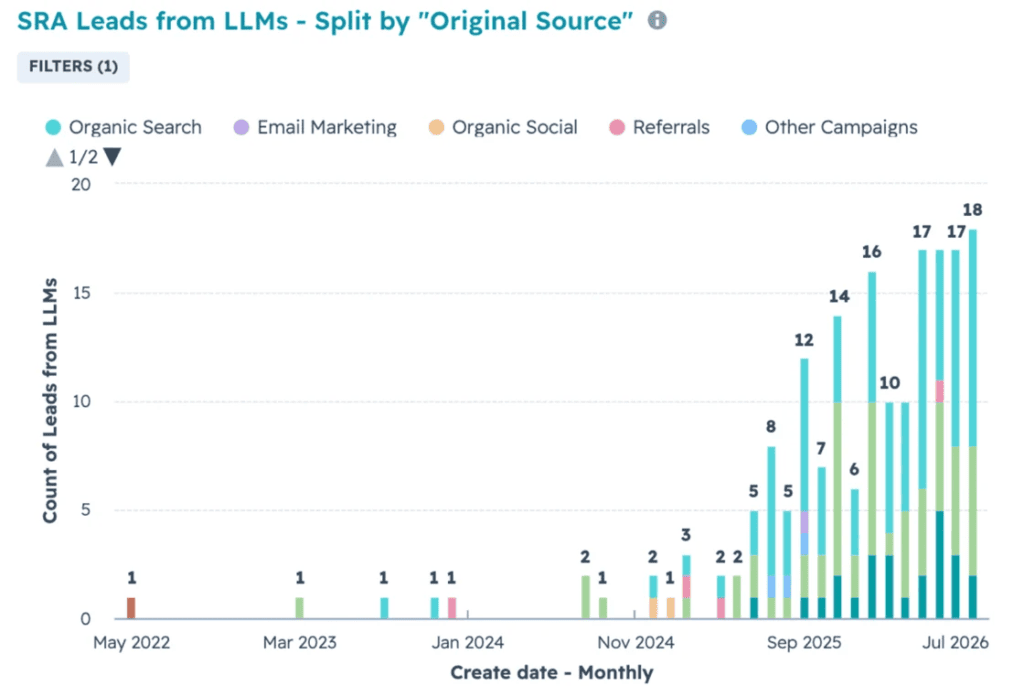
Our data, while it varies from client to client, suggests a similar delta. Our own Omniscient lead data shows roughly a 4-5X delta between click-based attribution and self-reported attribution for AI search leads.
Or in other words, Chris Walker was right.
His research at Refine Labs measured a 90% gap between software-reported and customer-self-reported attribution for social media across a 12 month, 620-conversion, $21.5M ARR study. That was before AI search existed as a channel. The dark funnel has only gotten darker.
Meanwhile, SparkToro’s latest data shows that 68% of US Google searches in early 2026 end without a click to anywhere. Add AI search’s zero-click discovery on top of that, and the portion of your demand generation that is invisible to click-based tracking is now, for many B2B companies, the majority.
Self-reported attribution is the highest-fidelity signal for AI search specifically because the characteristics that make surveys unreliable for other channels (low salience, high frequency, ambiguous source) are inverted here. The AI recommendation is high salience, low frequency, and unambiguous in the user’s memory.
The Downsides, Honestly
I’m not going to pretend self-reported attribution is a silver bullet. It isn’t. I’ll tell you what, nothing in attribution is, but that should not preclude the value of measurement and attribution.
Douglas Hubbard puts it well in How to Measure Anything:
“If we incorrectly think that measurement means meeting some nearly unachievable standard of certainty, then few things will be measurable even in the physical sciences.”
Still, let’s take a look at some of the limitations of self reported attribution and how to compensate for them:
- Sample size and representativeness. Not everyone fills out the form. Response rates on “how did you hear about us?” fields vary wildly if it’s optional and buried below the fold. You’re working with a sample, not a census. The sample is likely biased toward more engaged or more deliberate buyers.
- Channel confusion. People still say “Google” when they mean fifteen different things. Someone who saw your brand in a Perplexity answer might report “search” or “Google” because the mental model hasn’t caught up to the channel taxonomy. The more granular your dropdown, the more you’re testing the respondent’s knowledge of marketing channels rather than their actual journey.
- Recency bias. Self-reported attribution over-indexes the last memorable touchpoint and under-indexes the long tail of awareness-building that preceded it. A buyer might report “ChatGPT” as their source when ChatGPT was the tipping point, but they’d been passively absorbing your brand through LinkedIn posts and podcast mentions for months. The survey captures the catalyst but not the full context.
- No volume signal. Self-reported attribution misses reach and proportion of users who found you via the channel. While you can calculate impressions, clicks, conversions, and ROAS with an ad campaign, a form field asking users to self-report doesn’t tell you how many people the channel reached who didn’t convert. You can’t calculate an AI search “conversion rate” from self-reported data because you don’t have the denominator. This is why marketers are resorted to analyzing conversion rate by AI referral traffic; because at least they can see the numerator and denominator (as lossy as the data may be)
These are limitations and they are very well known, academically and within business environments. The limitations, I would argue, pale in comparison to the signal you get from tracking it.
Calibration and Triangulation
We’ve shifted our thinking from “north star metrics” to “metric constellations.” This is because AI search compresses multiple channels into a single answer or thread, but also because many of the legs of the journey break down with click-based models. So we shine several flashlights in the room hoping to illuminate enough of it to find our way to the door.
Two ideas matter here:
- Calibration – comparing your measuring device to known standards to calibrate precision
- Triangulation – using multiple data points to converge on a more trustworthy conclusion
Here are some ways in which you can calibrate and triangulate self-reported data with other metrics to better measure performance and inform strategy:
- Branded and direct search lift. While it captures a broad set of inputs, much of your AI search mentions will result in either branded search lift or direct traffic lift. Of course, branded search volume could also be an input variable into AI search performance (so causality is difficult).
- AI referral sessions in GA4. These numbers are structurally undercounted – we’ve established that. But there is a signal here. Especially if you run a page-by-page analysis, and if you’re running bot crawl analyses, you should be able to corner the set of pages that align with a set of prompts tracked in your AI visibility tool. Of course, model changes can drive high variability in referral traffic, so this measures the platform changes as much as it does demand or demand capture on your part.
- AI visibility and share of voice. We’ve done many deep dives on how best to track AI visibility and how to choose prompts. It’s an incredibly useful diagnostic, particularly when tagged and segmented.
- Econometric modeling. This is the media mix modeling approach, i.e. statistical models that use aggregate time-series data to estimate the incremental impact of each channel on pipeline. The advantage: it doesn’t rely on individual level tracking, so it’s less swayed by the referrer stripping problem. The disadvantage: it requires significant data volume, time-series depth, and econometric expertise. For companies with 12+ months of consistent AI visibility investment and clean pipeline data, this is the most rigorous validation of self-reported signals. For most companies, it’s a future investment, not a current capability.
Self-reported data tells you the direction and approximate magnitude. It also gives you a qualitative signal with which you can dig into specifics on sales calls (what prompts did you track, who else came up, what were the outputs). You can then feed these back into your prompt tracking for greater fidelity.
Branded search (and direct traffic) tells you whether the macro trend confirms it, though needs to be weighed against other campaigns active that may be driving branded search and direct traffic. Decoupling these is difficult, though SRA helps here as well.
GA4 referral sessions and bot crawls give you a lower bound and page-by-page analysis of website influence. And if you’re sophisticated enough to build the econometric layer, you get causal estimates that can survive a CFO’s scrutiny.
I don’t believe that at this point a single method is conclusive, but each does give you additional clarity, reduces uncertainty, and helps you make better decisions. Combining them into a holistic view, you get convergence and an increased trust in your measurement. It’s not necessarily “attribution,” but more so triangulation. And it’s actually how a lot of science works.
The Field on the Form: Tactics
Okay, how do you set this up?
I mean, don’t overthink it. An optional field on your form goes a long way:
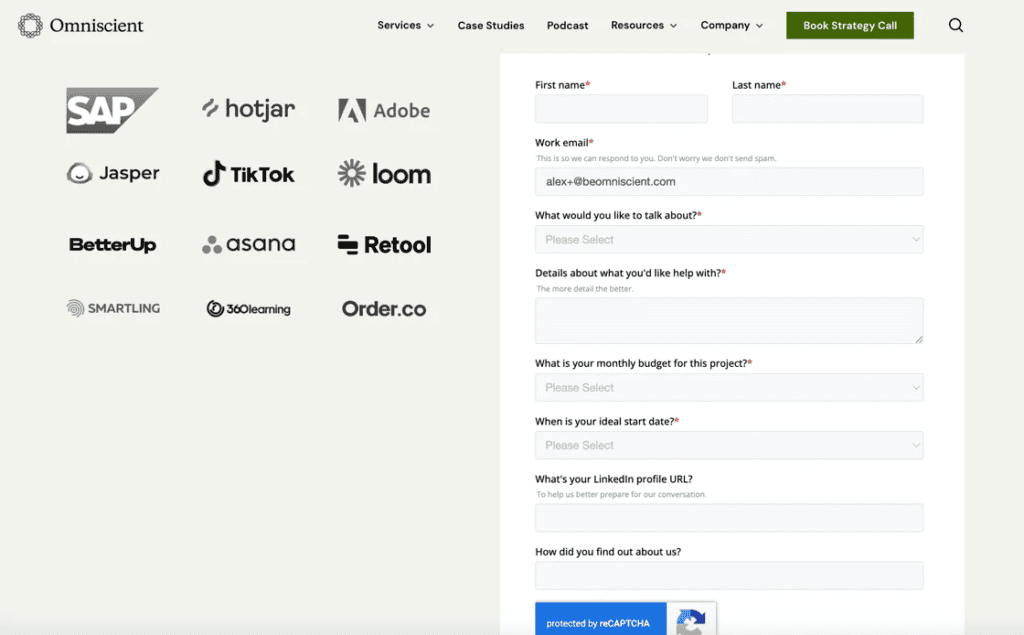
If there’s hesitation internally, ask post-conversion, not pre-conversion. You can do this on a follow up screen after the form has been submitted (or a purchase in a direct ecommerce scenario). You can also ask on a sales call if you train your team to do so regularly and in an unbiased way.
Use an open text field, not a dropdown. This is counterintuitive if you come from a data analysis background where structured data is king. But dropdowns test the respondent’s channel taxonomy, not their experience. “I asked ChatGPT for the best CRM and it recommended you” is infinitely more useful than a dropdown selection of “AI Search.” The open text captures nuance, specificity, and often verbatim prompt descriptions that inform your GEO strategy. You can always code it into categories later. Also, hard won learning: people tend to pick the first option on a list of dropdowns because they are lazy.
Make it optional but prominent. Mandatory fields on a demo form are hostile and may reduce conversion rates. But burying the field below three other optional fields all but guarantees low response rates. The sweet spot: prominent placement, clearly optional, with framing that signals you actually care about the answer.
Track it longitudinally. The individual response is useful, but the trend is so much more useful. We’ve found, for instance, that rates of AI referrals have steadily increased over time in proportion with direct (WoM or referral) and organic (search). But we’ve also found increased specificity over time (many will fill out specific platforms or prompts even in the form fill).
There are many ways to do this, so try to get going with the lowest friction option. For many of our clients, it is difficult to simply implement a new form field, so we will run Gong call analyses and model self reported channel sources using a sample set of calls. Better than nothing.
Want more insights like this? Subscribe to Field Notes