AI drafts content in minutes. A brand’s credibility still depends on what’s in those drafts, which is why more content teams are adding human-in-the-loop review to their AI workflows. A polished draft can hide an unsupported statistic or messaging that sounds nothing like the company publishing it. Content leaders need a repeatable way to catch these problems before customers do.
Human review only helps when reviewers stay independent. A 2025 study published in Findings of the Association for Computational Linguistics examined 350 annotators and 7,000 annotations. AI suggestions swayed the annotators’ labeling decisions without speeding them up. So a human checkpoint pays off when reviewers have clear standards and the freedom to question what the AI hands them.
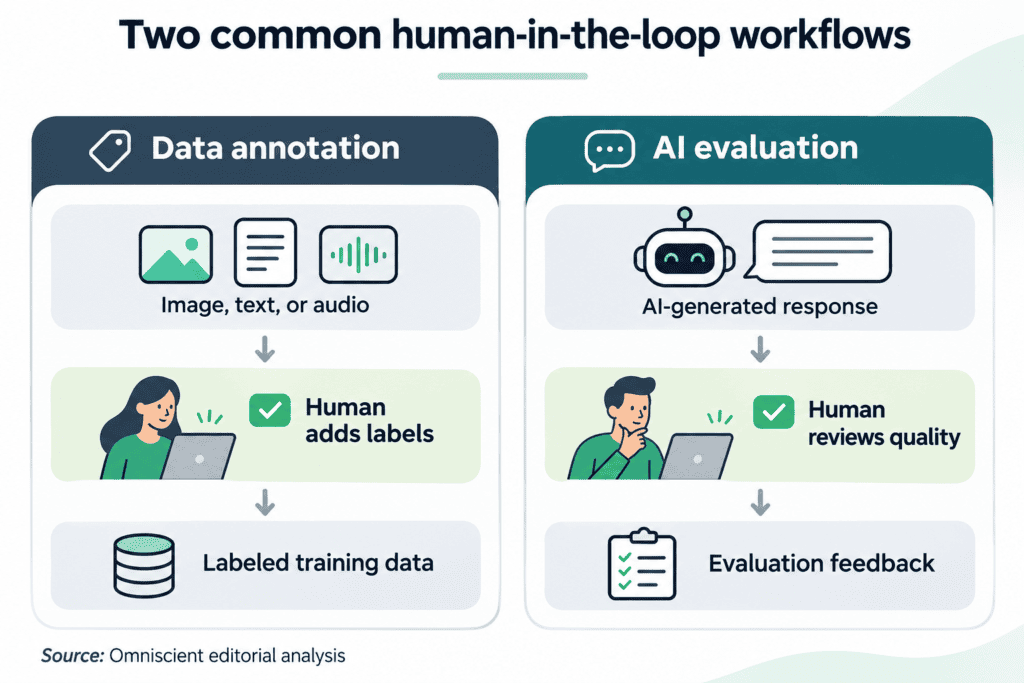
Human-in-the-loop (HITL) platforms support that process at two different layers. Some help marketers govern and review finished content. Others supply the human feedback and labeled data that improve the AI systems themselves. Below, I’ve split eight platforms into those two groups, followed by a practical workflow your team can put in place.
What is a human-in-the-loop AI platform?
A human-in-the-loop AI platform brings people into an automated process at set points to approve, correct, or reject AI outputs. In content marketing, an editor might check a generated article’s sources. A subject expert verifies technical claims, and an authorized reviewer signs off on the final copy.
Content quality covers what readers see: accuracy, original insight, readability, brand voice, and compliance. Data quality covers the labels, examples, and evaluations used to train and test AI. The two overlap, and many teams end up needing a separate tool for each.
Why AI-generated marketing content still needs human review
Confident claims still need sources
A generated article can present a convincing benchmark with no sample, methodology, or date. Picture a B2B brand publishing a comparison of customer acquisition costs built on a figure like that. The error misleads readers and weakens the argument. Editors should trace every important figure to a primary source and confirm the comparison holds up.
Brand voice depends on judgment
Style guides enforce capitalization and preferred terms. Positioning and perspective take an editor. Two articles can be grammatically flawless and still feel interchangeable. Omniscient’s discussion of objective content quality and the limits of tone-of-voice rules explains why editorial assessment has to go deeper than surface consistency.
Search performance depends on usefulness
A readable draft can still miss the searcher’s real question. Content teams should evaluate search intent, evidence, expertise, differentiation, and how the piece connects to the buyer’s decision. Omniscient’s write-up on how its team uses AI for SEO makes the broader case. AI should support strategy, and people should own it.
What to look for in an AI content quality platform
Start by finding where your quality problem begins. Inconsistent brand terminology calls for style enforcement. Fragmented approvals call for governance. Unreliable model responses call for evaluation, and weak underlying datasets call for annotation and quality assurance.
Useful capabilities include brand and style enforcement, claim and source review, configurable approvals, role-based permissions, and revision history. Look, too, for compatibility with your content management system (CMS) and writing tools, plus a way to feed corrections back into prompts and standards. Few products offer all of these, and most marketing teams won’t need every one.
8 human-in-the-loop AI platforms compared
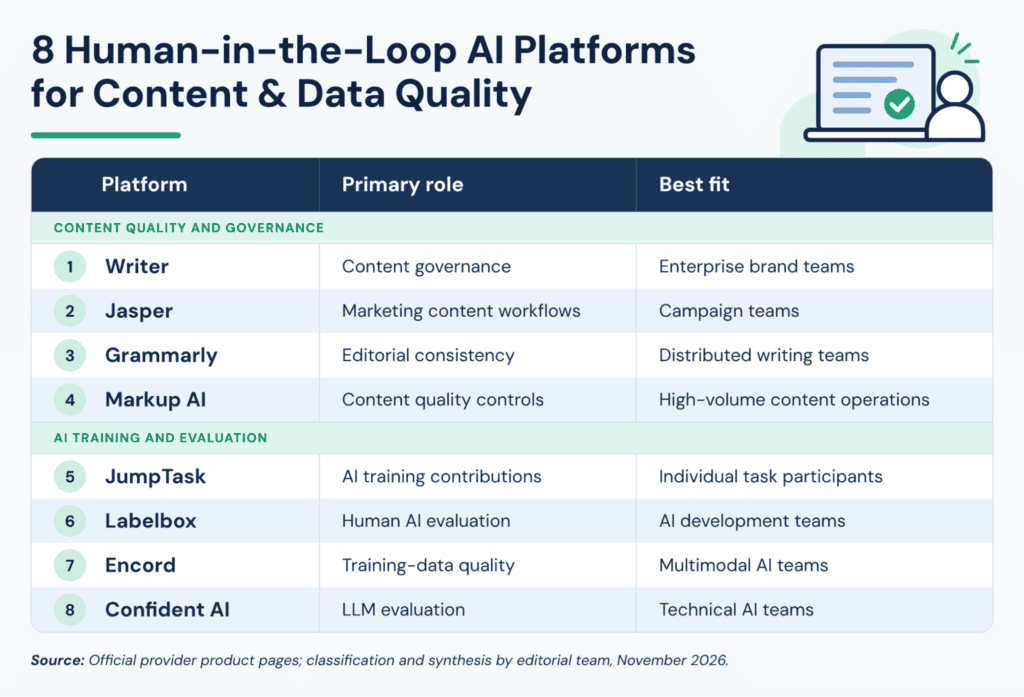
The first four platforms help marketing teams review and govern what they publish. The second four work upstream, where people label data and evaluate model outputs before anything reaches a reader.
Content quality and governance platforms
1. Writer: Enterprise content governance
Writer fits organizations where several departments produce material under one brand. Its enterprise AI platform combines organizational knowledge, brand settings, workflow controls, and governance features. Marketing and product teams can produce content inside the same guardrails.
Writer’s value is consistency across teams. Implementation is the tradeoff: governance only works as well as the rules and approved sources an organization keeps up to date.
Strengths: Enterprise brand controls and knowledge connections give distributed teams a shared framework for AI-assisted content.
Limitations: Advanced governance takes setup and may require an enterprise agreement. Editors still need to verify original claims and strategic relevance.
2. Jasper: Campaign content production
Jasper centers on marketing workflows. Brand Voice, audience context, and reusable knowledge help teams build related assets like landing pages and emails. Nobody has to rewrite the same instructions for every draft.
Say a demand generation team is running a product launch across five channels. Jasper keeps the messaging coherent from the launch email to the last social post. Someone still has to verify the product claims and decide whether the creative angle suits the audience.
Strengths: Marketing-specific context and reusable brand guidance keep campaign assets consistent.
Limitations: Drafts still need research and human approval. Advanced governance features vary by plan.
3. Grammarly: Writing consistency across contributors
Grammarly handles the everyday variation that creeps in when many people write for one brand. Its suggestions, style guides, and brand tone features apply language rules across supported writing environments. That matters when employees, agency writers, and subject experts all contribute public-facing material.
Grammarly flags a misspelled product name or a tone that drifts. Whether the piece makes a meaningful argument is still an editor’s call. As Omniscient explains in its guide to writing well, clear structure and useful ideas matter as much as polished sentences.
Strengths: Shared style rules catch preventable language inconsistencies before final editorial review.
Limitations: Grammarly doesn’t replace primary-source fact-checking or expert approval.
4. Markup AI: Systematic content quality controls
Markup AI, formerly Acrolinx, enforces content standards across high-volume operations. It checks brand language, terminology, clarity, and related rules. Editors spend less time fixing the same mechanical issues over and over.
Large documentation libraries and sprawling product catalogs benefit most. Nobody on a 20-person content team will memorize hundreds of style rules, so a system that applies them automatically earns its keep.
Strengths: Repeatable checks keep large content operations consistent.
Limitations: Teams must define meaningful standards first. Passing those checks says nothing about whether a claim is supported or a page has an original point of view.
AI training and evaluation platforms
5. JumpTask: Individual contributions to AI training
Quality starts long before publication. AI systems depend on people who rate generated answers and label the information models learn from. JumpTask works at this contributor layer. Adults take on short digital tasks such as rating AI responses, labeling images, and recording voice, photo, or point-of-view video data.
Contributors don’t need specialized AI experience. JumpTask’s guide to how data annotation works shows how these small tasks add up to training data. For marketers, the platform gives a concrete look at where human judgment enters a model long before that model writes a single draft.
Strengths: Accessible task instructions and a mix of text, image, voice, and video work make human feedback and data annotation easy for individual contributors to understand.
Limitations: Task availability varies. JumpTask doesn’t enforce company brand rules, connect to a CMS, or run marketing approvals.
6. Labelbox: Human evaluation of AI systems
Labelbox sits closer to model development than to everyday publishing. Its annotation and human evaluation workflows help teams prepare training data and assess model outputs. For a SaaS company building an AI product assistant, that’s a different kind of quality assurance from proofreading the website.
Marketing experts can contribute evaluation criteria, such as whether answers describe product capabilities correctly. Technical teams manage the datasets and testing. A team that only needs an editorial calendar or publishing approvals can skip infrastructure at this level.
Strengths: Human evaluation and annotation let teams examine model performance systematically.
Limitations: Implementation usually needs a technical owner and clear evaluation standards. Labelbox doesn’t replace editorial planning.
7. Encord: Training-data quality assurance
Encord focuses on annotation and quality workflows for AI development, especially visual and multimodal datasets. Reviewers apply labels and inspect annotations so models learn from consistently structured examples.
Companies building visual AI products or handling complex training data get the most out of it. Content teams checking blog posts for citations and search intent can look elsewhere.
Strengths: Structured annotation and review workflows keep complex training datasets manageable.
Limitations: Its core features serve AI data operations, with little for day-to-day marketing approvals.
8. Confident AI: Evaluating LLM applications
Confident AI helps technical teams evaluate the outputs of large language model (LLM) applications. Say a company deploys an assistant that answers product questions. Repeatable evaluations catch inaccurate or irrelevant responses as prompts and models change.
Automated tests surface recurring problems. Human feedback adds context when a judgment won’t reduce to a simple rule. Marketing teams can help define what a good answer looks like, while engineers or AI product teams usually own the implementation.
Strengths: Repeatable LLM evaluation reveals output quality patterns that individual spot checks miss.
Limitations: Confident AI doesn’t handle content production, publishing approvals, or brand strategy.
How to build a human-in-the-loop content quality workflow
The workflow around a platform decides whether human review improves quality. Here’s how to set one up.
1. Define editorial standards before prompting
Write down the target audience, the claims that need primary sources, brand terminology, expected expertise, search intent, and the purpose of each content type. Omniscient’s guidance on raising editorial standards is especially useful here. Put review criteria in writing so every reviewer applies the same ones.
2. Let AI draft and run preliminary checks
Use AI to organize research and build an initial structure. Then run automated checks for formatting and terminology. Treat every generated citation and numerical claim as unverified until a person checks the source.
Some of the best AI use cases sit outside drafting entirely. Omniscient’s roundup of AI use cases beyond writing content covers research, analysis, and other jobs where AI saves editors time and leaves the judgment calls to them.
3. Route content according to risk
A short social update about an approved article may only need a light check. A product comparison needs a product expert. Regulated claims require a specialist with authority to approve them. Route each piece by what an error would cost.
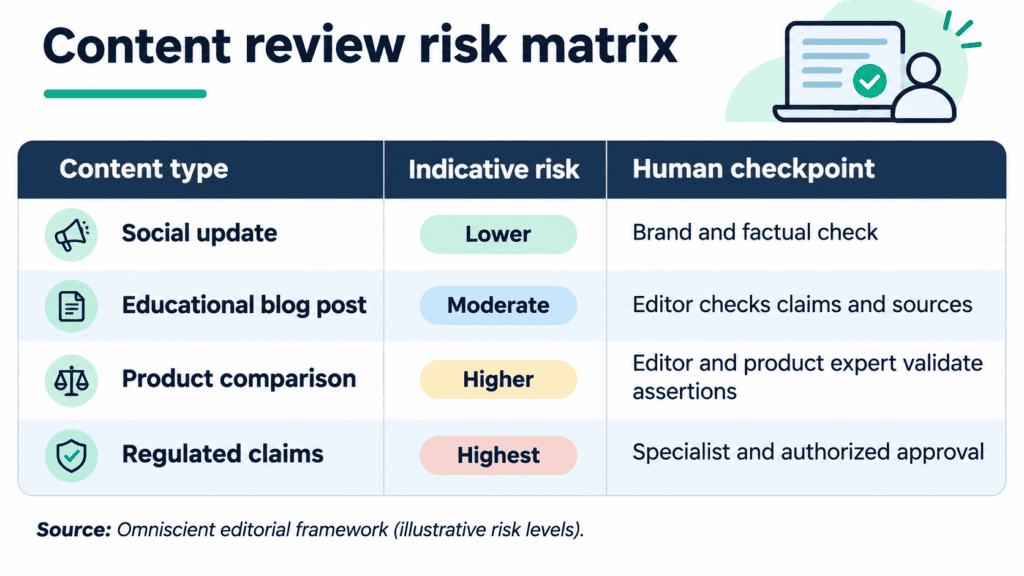
| Content type | Indicative risk | Human checkpoint |
|---|---|---|
| Social update | Lower | Brand and factual check |
| Educational blog post | Moderate | Editor checks claims and sources |
| Product comparison | Higher | Editor and product expert validate assertions |
| Regulated claims | Highest | Specialist and authorized approval |
Matching review effort to risk also keeps AI use sustainable. Omniscient’s take on balanced AI use makes the same argument. Let automation handle low-stakes work and save expert attention for the pieces that need it.
4. Make final approval a human responsibility
The final reviewer should read the material as the audience would. Does it answer a real question? Does it back up its claims and reflect the company’s perspective? For technical subjects, bring in people with real domain knowledge, since a copyeditor can’t catch a wrong technical claim.
5. Feed corrections back into the process
Recurring editorial problems are operational data. Repeatedly invented statistics point to a sourcing weakness, and brand-language errors point to a rules problem.
Generic explanations usually mean the draft lacked expert input. Update prompts, examples, and QA criteria so the next draft starts from better guidance.
How to choose the right platform for your team
If your main challenge is governance across departments, start with Writer or Markup AI. Jasper suits coordinated campaign drafts, and Grammarly handles writing consistency. Labelbox, Encord, and Confident AI matter most to teams building and evaluating AI applications. JumpTask shows how individual contributors feed human evaluations and labeled data into AI training upstream.
Bring a short list of questions to vendor conversations:
- Can nontechnical editors configure the rules?
- How does the system record human corrections?
- Does it work with our writing tools and CMS?
- Which features require a higher-priced plan?
- Who owns final approval?
Their answers will show you how the tool fits your team day to day.
Not sure where human review fits in your own content program? Omniscient helps B2B SaaS teams build editorial systems that use AI and keep their accuracy and voice intact. Book a strategy call to talk through your workflow.
Frequently asked questions
Can AI check content quality without human review?
AI catches many language and consistency issues. Accountability for factual claims and strategic decisions stays with people. Human review matters most for original research and high-stakes technical comparisons.
What is the difference between content quality and data quality tools?
Content quality tools assess what a company publishes. Data quality platforms label, organize, and evaluate the information used to build AI systems. Some organizations need both, though different teams usually own them.
How does human feedback improve AI accuracy?
People spot incorrect responses, supply more reliable labels, and explain why an output fails a quality standard. Feedback helps most when reviewers are qualified, instructions are clear, and their observations flow into the next evaluation cycle.