Key takeaways on generative engine optimization tools
- Buyers now reach for an AI assistant before they reach for your website. Forrester’s Buyers’ Journey Survey found twice as many business buyers named generative AI or conversational search as their most meaningful source.
- AI visibility is a diagnostic instrument, not a scoreboard. A single blended visibility score gives you almost nothing to act on. The tools worth paying for break it down by prompt, engine, and cited source.
- Several GEO tools support many AI surfaces, but limit which ones are available per plan. You need to know which ones your audience uses to choose the right tool and tier.
- The real split in this category is between tools that measure and tools that act. Every option here surfaces guidance of some kind. The gap between a ranked opportunity list and software that rewrites and publishes pages is the gap between buying capacity and buying judgment.
- Before going into a demo, expect to pay roughly $80 and $700 a month. Above that, pricing goes quote-only fast, and what drives the quote is prompt volume, engine coverage, and number of domains rather than seats.
Generative engine optimization tools track how AI assistants describe, cite, and recommend your brand—and increasingly, they try to help you change it.
Bain & Company found that roughly 80% of consumers now lean on zero-click results in at least 40% of their searches, trimming organic traffic by an estimated 15% to 25%. Classic web analytics tools cannot see that shift, which is precisely why this category exists.
Below, you’ll find 10 platforms compared on what each one does, what it costs, and the job it’s built for.
Table of contents
- Key takeaways on generative engine optimization tools
- At a glance: the 10 best generative engine optimization tools
- The 10 best generative engine optimization tools
- 1. Peec AI: best for lean teams that want a prioritized to-do list
- 2. Goodie AI: best for AI search attribution
- 3. Profound: best for depth of AI answer data
- 3. Writesonic: best for pairing visibility with content execution
- 4. AthenaHQ: best for testing GEO before committing budget
- 6. Scrunch AI: best for making your site legible to AI agents
- 7. Conductor: best for unified AEO and SEO at enterprise scale
- 8. Geostar: best for ecommerce brands wanting software or a managed service
- 9. Ahrefs Brand Radar: best for teams already in the Ahrefs suite
- 10. Semrush AI Visibility Toolkit: best for existing Semrush users
- What to consider when choosing a GEO tool
- How much do generative engine optimization tools cost?
- How to choose the right generative engine optimization tools
- Frequently asked questions about GEO tools
At a glance: the 10 best generative engine optimization tools
| Tool | Features | Starting Pricing | G2 or Clutch rating |
| Peec AI | Actions recommendations, six default engines, source and citation attribution | Brands from $80/month billed annually; agencies from $205/month billed annually | 4.8/5 (G2, 18 reviews) |
| Goodie AI | Multi-model visibility tracking, prompt and demand research, prioritized optimization actions | From $399/month | 5.0/5 (G2, 1 review) |
| Profound | Multi-engine answer tracking, consumer-panel prompt volumes, AI crawler log analytics | Brands from $99/month billed annually; agencies from $99/month plus $399 for client workspaces | 4.5/5 (G2, 1,128 reviews) |
| Writesonic | Ten-platform AI answer crawling, query fan-out tracking, prioritized Action Center | From $79/month billed annually | 4.7/5 (G2, 2,125 reviews) |
| AthenaHQ | Source-level citation attribution, prompt and demand intelligence, brand integrity and crawlability checks | Free tier; paid from $245/month billed annually | 4.9/5 (G2, 41 reviews) |
| Scrunch AI | Agent Experience Platform, eight-surface monitoring, automated or manual page optimization | Brands from $250/month billed annually; agencies from $500/month billed annually | 4.6/5 (G2, 73 reviews) |
| Conductor | Prompt-level sentiment and citation attribution, unified AEO and SEO, MCP server and Data API | Contact for pricing | 4.5/5 (G2, 788 reviews) |
| Geostar | Citation source tracking, AI bot analytics, managed execution tier | From $249/month billed annually | Not rated on G2 or Clutch |
| Ahrefs Brand Radar | Six-surface AI Visibility Index, cited pages reporting, Looker Studio connector | From $199/month for the AI Visibility Index | 4.5/5 (G2, 714 reviews) |
| Semrush AI Visibility Toolkit | Multi-engine prompt tracking, sentiment and share of voice, AI-cited media analysis | From $99/month per domain billed annually | 4.4/5 (G2, 4,033 reviews) |
How we evaluated these generative engine optimization tools
These four standards are what a GEO tool had to satisfy to be worth shortlisting below:
- Multi-engine coverage across the main AI search surfaces. A tool has to report on more than one of ChatGPT, Google AI Overviews and AI Mode, Perplexity, Gemini, Copilot, or Claude. Your buyers are not all in the same place.
- Data depth beyond mention counts. A share-of-voice figure on its own gives you nothing to work with, so we looked for prompt-level detail, sentiment, or citation and source attribution.
- Actionable recommendations. The platform has to tell you something about what to do next, in whatever form, rather than handing you a dashboard and leaving the interpretation to you.
- Ability to integrate with your existing SEO stack. An API, a native integration, or at minimum a clean export, so the numbers sit beside the rest of your reporting rather than in a tab nobody opens.
The 10 best generative engine optimization tools
The ten platforms below are ordered by how narrowly each one is built for a specific job, starting with the leanest monitoring tools and moving toward the enterprise suites and managed options.
1. Peec AI: best for lean teams that want a prioritized to-do list
Best for: Small in-house teams without a dedicated analyst, where the constraint is people to interpret data rather than access to it.
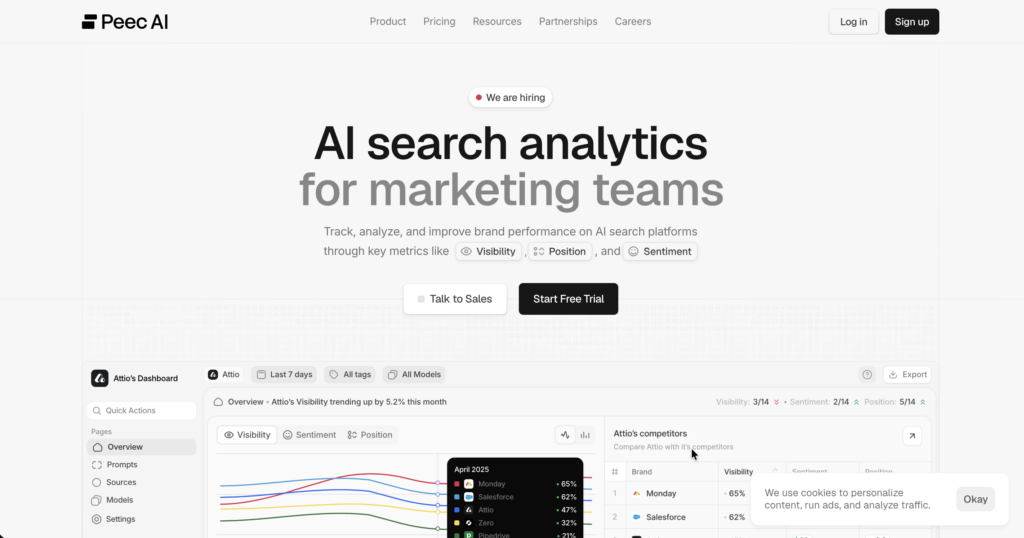
Peec AI is another AI search analytics platform that tracks how brands are mentioned, ranked, and described across generative engines. It includes six default engines—ChatGPT, Google AI Overviews, Google AI Mode, Perplexity, Gemini, and Microsoft Copilot. The interface is deliberately narrow, and reporting resolves to a shortlist of things to do rather than an exploratory dashboard. Against the heavier platforms in this comparison, Peec trades configurability for the ability to get a small team from data to decision quickly.
Pros:
- Peec’s Actions feature clusters related sources, surfaces the places rivals are pulling ahead, and proposes concrete next steps, sorted into owned and earned work.
- Two separate measures are reported: where you place among brands when you do appear, and how favorably models characterize you when they do.
- Peec supports CSV export across plans, Looker Studio from the Growth agency tier upward, and API plus MCP access on the Comprehensive agency tier.
Pricing: Peec has separate annual pricing for brands and agencies. Published rates for brands range from $80 per month to $420 per month, with custom enterprise pricing. Rates for agencies start at $205 per month and range up to $675, with custom enterprise rates also available.
Results: Momentum, an AI data orchestration platform, recorded a ten-fold rise in AI search visibility and a doubling of session visits from AI search. Its visibility had already doubled one month after rollout.
2. Goodie AI: best for AI search attribution
Best for: Companies running several brands or product lines that need visibility segmented by brand and tied back to revenue.
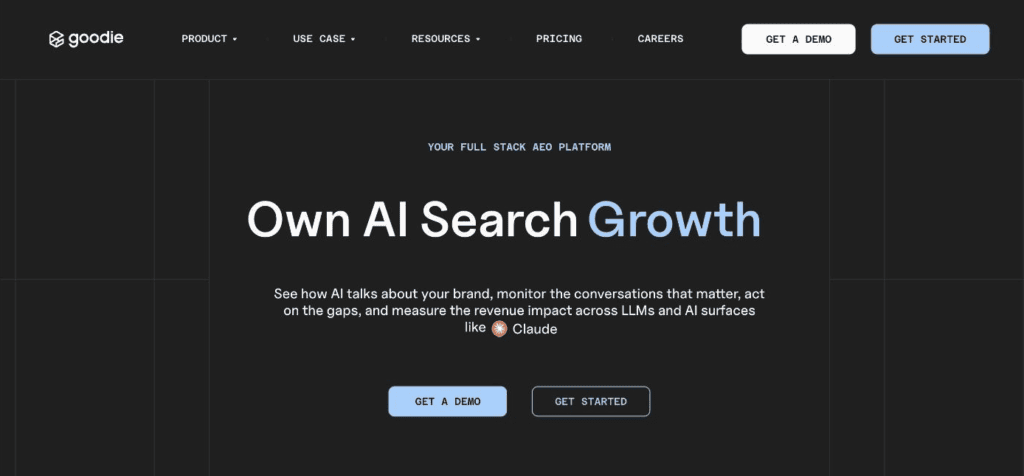
Goodie AI is an AI search visibility and answer engine optimization platform built around breadth of model coverage. It tracks mainstream assistants alongside surfaces most competitors ignore, including Meta AI and Amazon Rufus. It also pairs that tracking with a remediation workflow, so you can take action on the findings. Additionally, attribution and agentic commerce sit at the center of the current positioning, which is a different problem from the one most tools here are solving.
Pros:
- Its prompt research pulls the questions buyers genuinely ask and orders them by volume and intent. Output arrives as a ranked remediation plan, so you can sequence which conversations to fight for first.
- Enterprise portfolio companies can track each brand against its own competitor set and still pull one consolidated report across all of them.
- Goodie states SOC 2 Type II compliance alongside role-based access controls and audit trails, which matters when you have a procurement team that reviews vendors before you can sign.
Pricing: Goodie’s Explorer plan is priced at $399 per month, while Pro and Enterprise are quote-only through a demo request.
Results: SteelSeries more than tripled its AI search conversions within six months of working with Goodie. The company also saw visibility gains on Gemini from 62 to 85 and on ChatGPT from 51 to 73.
3. Profound: best for depth of AI answer data
Best for: Teams that need to defend their AI visibility numbers to a skeptical executive, particularly at companies with the budget for enterprise-tier engine coverage.
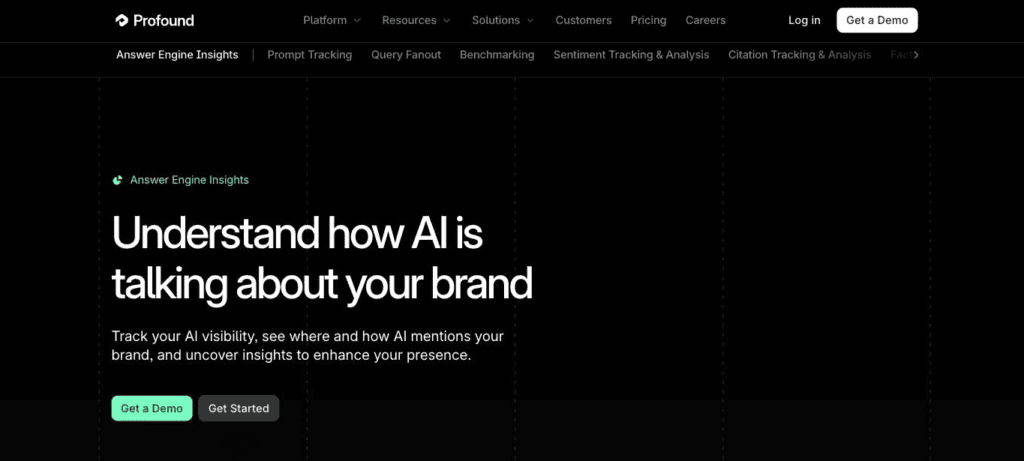
Profound is an answer engine optimization platform that tracks how brands are represented and cited across AI assistants, then deploys agents to act on what it finds. What sets it apart from the monitoring dashboards it competes with is where its demand data comes from. Rather than modeling AI query volume from traditional keyword tools, Profound’s Prompt Volumes feature uses data from double opt-in consumer panels and real answer-engine conversations. That gives the platform a demand signal underneath its visibility scores, which is the piece most competitors in this category don’t have.
Pros:
- Nine engines are named in the platform’s coverage: ChatGPT, Perplexity, Claude, Microsoft Copilot, Google AI Overviews, Google AI Mode, Gemini, Grok, and DeepSeek.
- Profound’s bot analytics are built on server log data rather than a JavaScript tag, so crawlers that never run scripts still register.
- Citations arrive pre-sorted by type—your own pages, rivals, earned coverage, wires, social, institutions. This turns a raw list into a work queue.
Pricing: Brand pricing starts at $99 per month billed annually, with a $399 plan and custom enterprise plans also available. For agencies, the lowest tier is $99 per month plus $399 for full client workspace, with enterprise rates also available.
Results: Within one short month and using Profound’s Answer Engine Insights, Ramp pushed its accounts payable solution from 3.2% to 22.2% AI search visibility. It climbed from 19th to 8th among fintech brands in its category.
3. Writesonic: best for pairing visibility with content execution
Best for: In-house teams that want AI visibility data and the content workflow to act on it in one subscription.
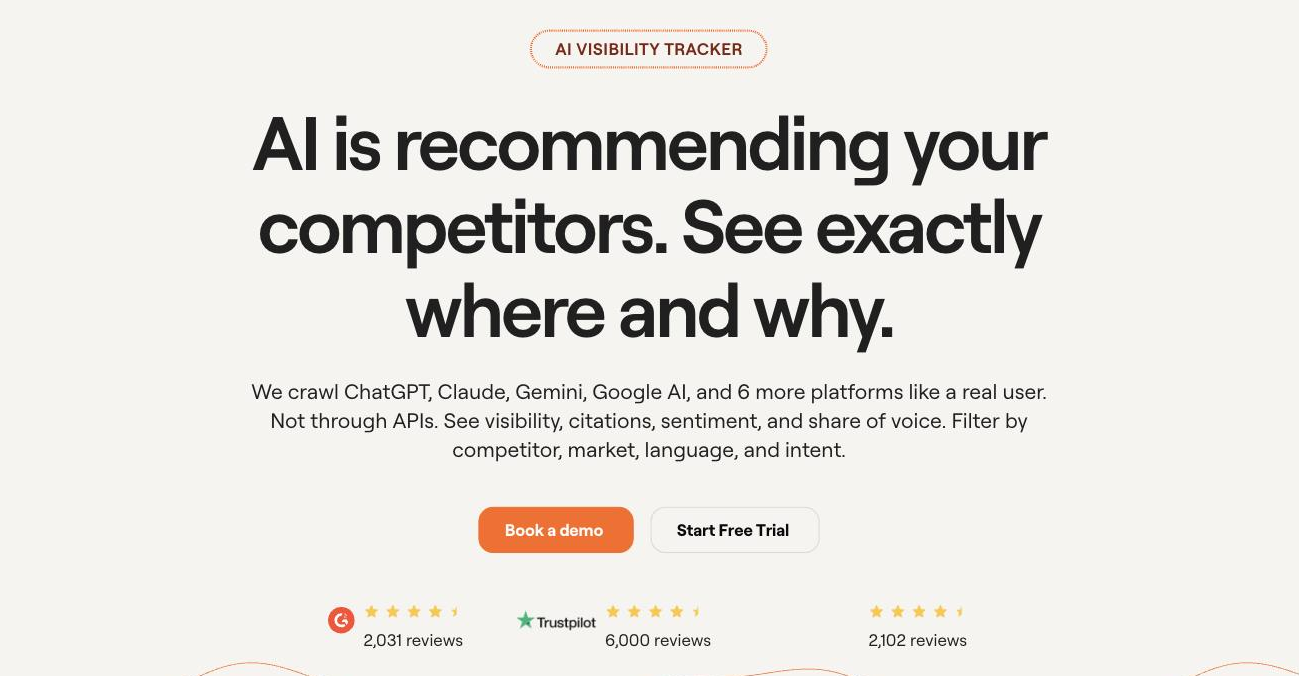
Writesonic started as an AI writing platform and has repositioned around generative engine optimization, which shows in how the product is built. Where most competitors stop at measurement and hand you a report, Writesonic routes findings straight into content, citation, and technical fixes inside the same tool. Its collection method is also unusual for the category: rather than querying model APIs, it crawls the live AI interfaces the way a person would, which gets closer to what your buyers actually see on screen.
Pros:
- Category-level reporting breaks out the URLs and domains AI engines draw on, separating your citations from competitors’ and grouping them by source type.
- Writesonic also exposes query fan-out. Most mention-count products never surface the chain of sub-queries a model spawns before it answers.
- This tool lists Google Search Console, WordPress, GA4, and Looker Studio integrations, and says its data can be connected to other systems like CMSs.
Pricing: Writesonic’s entry paid tier is $79 per month billed annually, rising through Basic at $199 and Growth at $399, with Enterprise quoted custom.
Results: Blue Star Ferries lifted its AI visibility by 15% over six months, ending with 473 pages cited by AI, including 100 new citations.
4. AthenaHQ: best for testing GEO before committing budget
Best for: Teams that need to prove AI visibility is worth a line item before they can request one, and want real data to make the case.
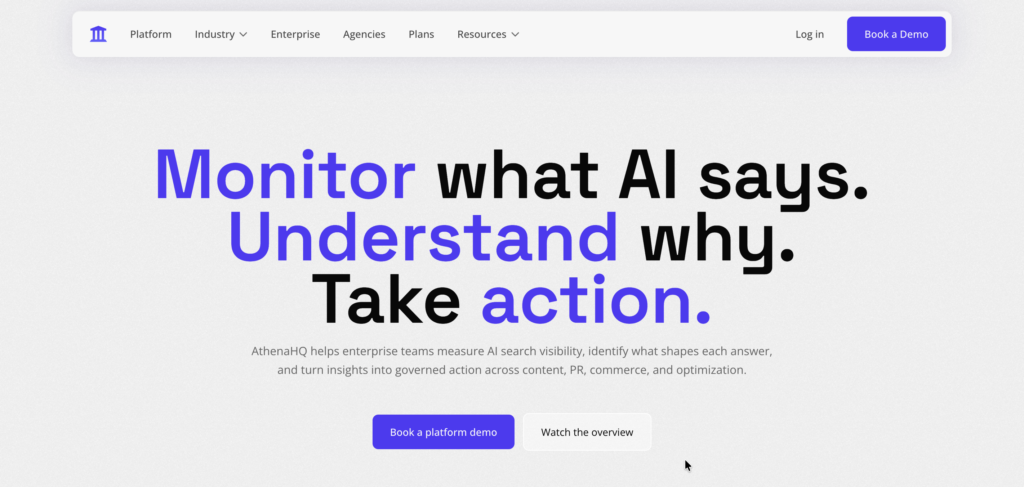
AthenaHQ is a generative engine optimization platform built on the premise that monitoring by itself is not the product. It traces each AI answer back to the specific sources, claims, and technical factors that shaped it, then routes that intelligence into work across content, PR, and commerce teams. It’s the only platform here offering an ongoing free tier rather than a time-limited trial, and that changes the buying process. It means that a team can track its own category for a month and walk into the budget conversation with data rather than just a vendor deck.
Pros:
- Metrics go beyond raw mentions into citations, sentiment, and competitive movement, segmented by platform and by market.
- Prompt and demand intelligence surfaces the questions shaping how customers discover the category.
- AthenaHQ catches false statements circulating about the brand and pages that AI crawlers cannot reach at all. The latter is a technical check most trackers omit.
Pricing: AthenaHQ has a free Essential tier with $25 of credit, a Starter tier at $245 per month billed annually, and a custom-priced enterprise plan.
Results: While using AthenaHQ, Grüns recorded a six-fold share-of-voice lift over 60 days.
6. Scrunch AI: best for making your site legible to AI agents
Best for: Technical SEO teams whose diagnosis is that AI crawlers cannot parse the site properly.
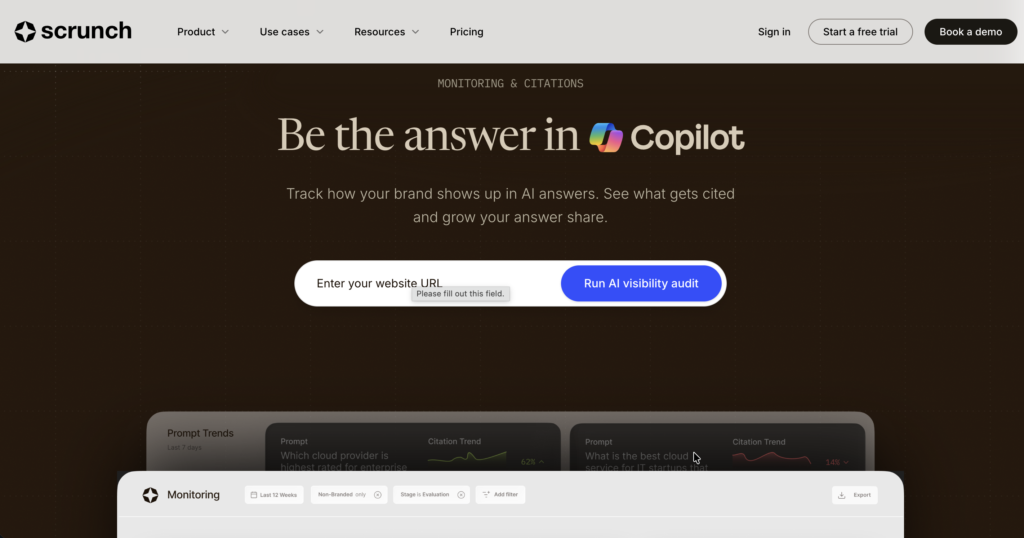
Scrunch AI monitors how brands appear across large language models and then acts on what it finds, which puts it in the same bracket as several platforms here. Its distinguishing factor sits one layer down.
Scrunch treats AI crawlers as an audience in their own right and operates an Agent Experience Platform that serves a separate, machine-readable version of a site directly to them. Nothing else in this comparison addresses the retrieval layer that way, and for a site where the content is fine but the delivery is not, that’s the difference that matters.
Pros:
- Deployment happens through your existing CDN—Akamai, Cloudflare, and Vercel are all supported—so nothing about the site itself has to move.
- Only live AI retrieval bots receive the rewritten version; the traditional indexing crawlers still fetch your standard pages, which keeps an existing search program insulated.
- You can hand the changes to Scrunch’s software outright, or take the recommendations and have your own team apply them.
Pricing: For brands, pricing for the Core plan is $250 monthly when billed annually, while agency pricing starts at $500 per month billed annually. Both brands and agencies require custom quotes for enterprise pricing.
Results: After adopting Scrunch, Strapi recorded a 226% increase in citations for non-branded prompts within just 3 months.
7. Conductor: best for unified AEO and SEO at enterprise scale
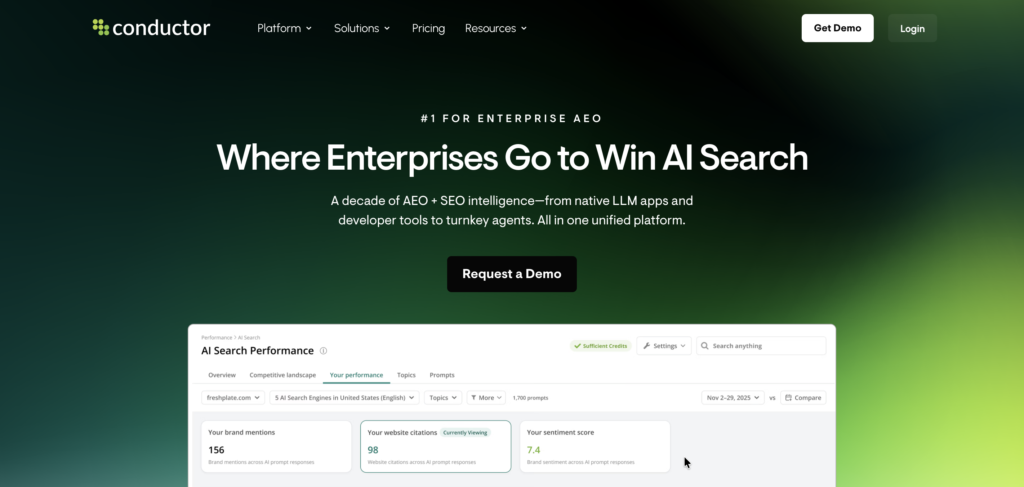
Best for: Enterprise teams already running an organic program who need AI visibility reported alongside traditional search.
Conductor is an enterprise organic marketing platform that has repositioned around answer engine optimization, combining AI search tracking, content creation, and site monitoring in one system. The pitch is unification rather than novelty: instead of adding a point solution beside an existing SEO platform, Conductor runs both in one place and is informed by more than a decade of accumulated search data. For a team whose reporting problem is reconciling two vendors’ numbers every month, that consolidation is the advantage.
Pros:
- Sentiment resolves to a 1-10 score split across positive and negative components, reported alongside the source URLs behind each answer.
- Rather than accepting a fixed bundle, teams pick their own engine mix from ChatGPT, Claude, Gemini, Perplexity, and Google AI Overviews.
- Conductor’s dataset moves into an existing BI environment or a bespoke agent build through an MCP server and a Data API.
Pricing: Conductor names Essentials, Growth, and Enterprise tiers and describes a usage-based model, but publishes no pricing. Contact the team for details.
Results: Outdoor apparel retailer Title Nine reported that AI citations increased by more than 100% over a year, while AI-driven sessions also grew by 1,000% within that timeframe.
8. Geostar: best for ecommerce brands wanting software or a managed service
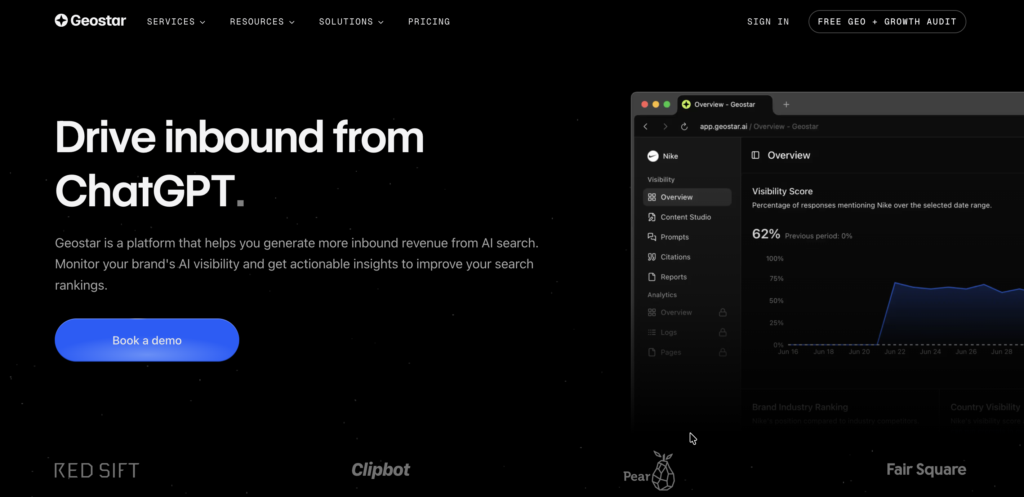
Best for: Ecommerce teams that know AI visibility matters but don’t have anyone free to work on it (i.e., they’d rather buy the outcome than the dashboard).
Geostar tracks and improves how brands appear in AI search engines, including ChatGPT, Google AI Overviews, Perplexity, and Claude. What makes it unusual is the commercial model rather than the technology. It is the only entry here sold both as a self-serve platform and as a managed tier where Geostar’s own team runs strategy and execution for Shopify brands. Every other option assumes you have people to act on the data.
Pros:
- At the Full-Service tier, an account manager runs monthly strategy sessions, produces and optimizes the content, and handles outreach to citation sources.
- Reporting drills down to the individual pages, studies, and publications a model leans on when your brand comes up.
- Bot-level logging shows which crawler hit which page, so you can see how different AI models actually consume your site.
Pricing: Geostar’s self-serve Lite plan starts at $249 per month (billed annually), while both the Enterprise and managed Full-Service tiers are custom quoted.
Results: RedSift, a cybersecurity company, lifted its AI mentions 27% across a three-month engagement with Geostar.
9. Ahrefs Brand Radar: best for teams already in the Ahrefs suite
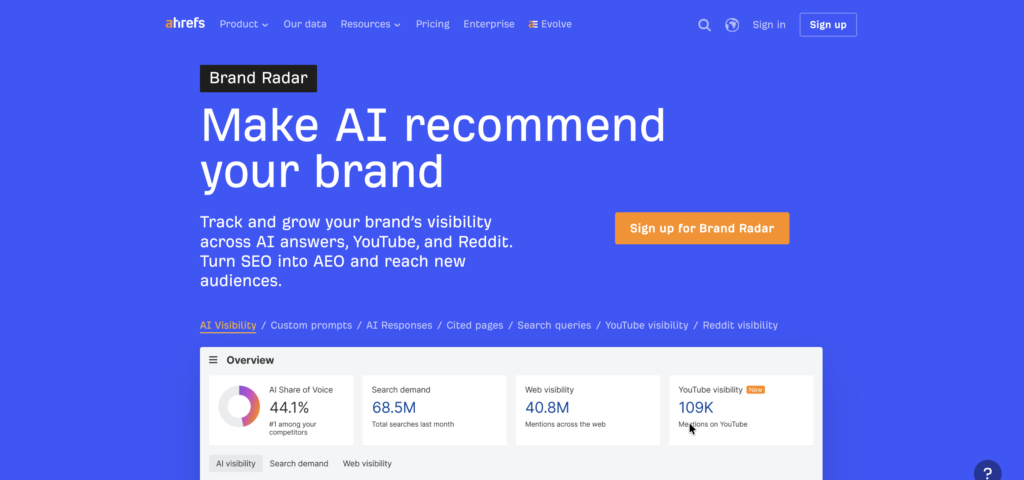
Best for: SEO teams already paying for Ahrefs who want AI visibility sitting beside their existing rank and backlink data.
Ahrefs Brand Radar measures how often a brand is mentioned and cited in AI-generated answers across the major AI search surfaces, and benchmarks that against competitors. It runs on the same account and draws its AI Visibility Index from Ahrefs’ real-world search-demand and keyword data. As a result, AI visibility becomes another report in a familiar rank-tracking and backlink workflow rather than a new tool to adopt and defend.
Pros:
- Six surfaces are covered in Ahrefs’ AI Visibility Index: AI Overviews, AI Mode, ChatGPT, Perplexity, Gemini, and Copilot. Custom Prompts additionally support Claude.
- When a model surfaces your brand, the report names the pages behind that answer, which gives content and digital PR teams somewhere concrete to aim.
- An API for Brand Radar reports, plus a Looker Studio connector, carry the numbers into whatever reporting already exists.
Pricing: Brand Radar AI starts at $199 per month for the AI Visibility Index, while custom-prompt packages start at $50 per month. Ahrefs lists $699 per month for access to all models, and standalone Brand Radar purchases include an Ahrefs Free account.
Results: One mid-market Ahrefs user said in a G2 review: “The addition of AI-specific data points keeps [our company] current with the modernization of search.” Other reviews echo similar sentiments.
10. Semrush AI Visibility Toolkit: best for existing Semrush users
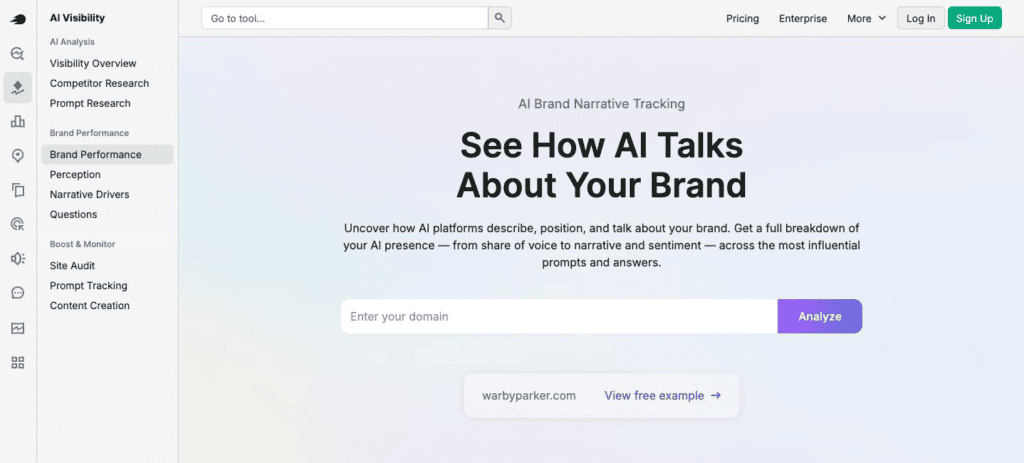
Best for: Teams with a Semrush subscription, a single primary domain, and no desire to add another tool to their stack.
The Semrush AI Visibility Toolkit measures how often and in what terms a brand surfaces inside AI-generated answers, then feeds that into optimization work. Like Brand Radar, its argument is contextual rather than technical. The data sits next to the same account’s keyword, content, and traditional SEO tooling, so nobody has to reconcile two vendors’ definitions of visibility.
It’s also worth noting that answers are collected from genuine user-facing requests instead of model APIs. This keeps Semrush’s dataset closer to what a buyer would encounter.
Pros:
- Six separate reports ship rather than one dashboard. One is an audit written specifically around whether AI crawlers can read the site.
- The toolkit ranks the publications models lean on most in your category, turning a visibility gap into a pitch list.
- Semrush’s prompt corpus now reaches 32 countries, which matters for anyone reporting on more than one market.
Pricing: The AI Visibility Toolkit starts at $99 per month per domain with annual billing, covering 25 tracked custom prompts and one domain in the Brand Performance report.
Results: SEO company Sure Oak used the AI Visibility Toolkit to achieve a 286% increase in Google AI Overview appearances and a 41% increase in ChatGPT referrals MoM. 40% of the agency’s leads now come from AI search surfaces.
What to consider when choosing a GEO tool
Ten entries in, the pattern is hard to miss: the feature lists across this category have converged to the point where the marketing pages read as interchangeable. What separates them in practice sits below the feature name: how a capability is delivered, which tier it lives on, and whether the output is something a person can act on this week.
1. How engine coverage is gated by plan tier
Several platforms here advertise eight, ten, or eleven AI surfaces and then, for example, cap the entry plan at one engine or three models. But if your brand’s pipeline comes from Google AI Mode and Meta AI, you gain nothing from a plan that tracks only ChatGPT.
If you don’t note limitations like this upfront, you could end up paying extra for a different plan to get the coverage you really need.
To avoid choosing the wrong tier, work out which engines your buyers actually use before you compare coverage at all. One simple but effective recommendation we give is to add a “How did you hear about us?” question to your website forms. The responses will give you at least a foundational understanding of whether people find you most often through ChatGPT, Claude, and other AI answer engines.
2. Where the prompt data actually comes from
Besides coverage, data source also matters. Two platforms can report wildly different visibility scores for the same brand in the same week. The reason is almost always the prompt set, not the measurement.
Some vendors build their corpus from observed search demand. Others generate plausible-sounding questions synthetically, which does give you a score, but it’s one that’s based on questions no real buyer ever asked. To help your CMO build trust in the provided figures, you need to be able to point to the former.
The platforms worth shortlisting also let you add your own prompts, because the questions that decide your deals are rarely the generic category ones. A tool that doesn’t allow this caps how good your data can get. So before you buy, ask the vendor where their prompts come from and how many of your own you can add. Then, get to work on building a defensible prompt set.
3. Citation and source attribution
A mention count tells you that a model said your name, while citation data tells you which page the AI read to inform its response. You can only influence one of those directly by implementing LLM optimization tactics.
The pages feeding AI answers are mostly not yours. The proof? Omniscient’s analysis of how LLMs source brand information found that earned media accounts for 48% of citations while owned brand content accounts for 23%. This means a tool that only reports on your own domain is showing you less than a quarter of the picture.
Accuracy is the second reason to insist on source data. Research from the European Broadcasting Union covered more than 3,000 AI responses across 18 countries. It found that 45% carried at least one significant issue and 31% showed serious sourcing problems. In other words, it’s safe to assume that some share of what AI says about your brand is wrong and needs tracing back.
If a model is describing your product from a stale review or a competitor’s comparison page, you need to know which page that is. For any generative engine optimization tool you’re considering, check whether it names specific URLs or stops at domains.
4. Whether the tool executes or only recommends
Every platform here satisfies some version of “actionable recommendations,” but they do differ in terms of the output at the end of a workflow. Broadly, there are three models on offer:
- Prioritized opportunity lists. The tool ranks what to work on and leaves the work to you, which suits teams with writers and developers already in place.
- Assisted execution. The platform drafts, audits, or restructures content that a person reviews before it ships, trading some control for speed.
- Automated delivery. Software makes and serves the changes itself, including at the retrieval layer, which is fastest and gives you the least editorial oversight.
None of these is better in the abstract. The right one depends on whether your constraint is knowing what to do or having anyone free to do it. Pick the model that matches the bottleneck you actually have.
5. Multi-brand, region, and language coverage
Most pricing pages are built for a company with one brand, one market, and one language, and the assumption is invisible until it costs you. Single-region and single-language caps sit on entry and mid tiers across the category. Unfortunately, this means that per-domain pricing multiplies quietly as soon as you add a second product line.
A company with three brands and two markets can watch a $99 or $295 plan resolve into a five-figure annual contract once the real footprint is priced.
To avoid this type of surprise, bring your actual structure to the first pricing conversation. Every brand, every market, every language you need reported separately. Ask for the quote against that.
Get the strategy behind the tooling—read the AEO Field Guide: Feature checklists tell you what a tool can measure, not which signals actually matter in AI answers. The guide lays out the three modes of influence and the metrics worth tracking, so you can judge any platform against a strategy rather than a spec sheet.
How much do generative engine optimization tools cost?
Coverage, data depth, and execution all show up in the price, which is where this category turns least transparent. Published entry pricing runs from roughly $79 to $250 a month, and full-coverage plans can reach $699 before anyone talks to a salesperson. Above that band, most vendors stop publishing figures.
What drives a quote up is rarely the number of seats, which is the pricing model most teams arrive expecting. The variables that actually move the number look like this:
- Prompt volume. Tracked prompt count and refresh frequency are the primary metrics across most of this category. Daily tracking costs meaningfully more than weekly.
- Engine coverage. Adding surfaces raises the price on a per-index or per-tier basis, and full coverage is usually two to three times the entry figure.
- Domains and brands. Per-domain pricing is common, so a portfolio company’s costs multiply.
- Regions and languages. Multi-country tracking is a mid-to-upper tier feature almost everywhere.
- Data access. API access is the single most frequently gated capability in this category, and it usually sits at the top tier.
Then there are the costs that sit outside the license. Onboarding and implementation appear on enterprise quotes rather than self-serve checkout. And managed tiers, where the vendor’s team does the work, are priced as a service retainer rather than software.
It doesn’t hurt to look into how brand visibility is measured in LLMs, so you’ll know which signals hold up in front of a finance team when click attribution does not.
Attribution is the hard part of the business case. The difficulty with a GEO budget is rarely the license fee—it’s defending the line item when AI search sits between the query and the click. Our organic growth measurement research covers how B2B teams are handling that measurement gap now.
How to choose the right generative engine optimization tools
Cost is the easiest variable to compare and the weakest one to decide on. The most expensive mistake in this category is buying a platform before deciding what question you need it to answer.
For instance, a blended visibility score is a nice number for a slide but a poor basis for a decision. It collapses branded, categorical, and competitive prompts into one figure that moves for reasons you can’t pinpoint. In contrast, treat AI visibility as a diagnostic instrument, and the shortlist narrows quickly.
Start from the bottleneck rather than the feature list. For example:
- If you can’t see which pages feed AI answers about your category, buy for citation depth.
- If you can see the gaps but have nobody to close them, the managed and execution-layer options are the best route.
- If your problem is that AI crawlers cannot parse your site at all, that is a technical fix, not a content one.
The tooling decision is also smaller than it feels.
Though a platform tells you where you stand in AI answers, it doesn’t build the earned coverage, reviews, and third-party corroboration that change where you stand. When Convert moved on those inputs, its LLM visibility rose 81% and AI citations 140% within 60 days.
Measurement told them where to push, but the work is what actually moved the numbers. Many teams find that they need similar support on the execution side and opt to work with reputable GEO agencies like Omniscient.
To pressure-test whether that’s the right move for you before committing budget, book a free strategy call. We’ll look at your category, what AI assistants say about you now, and whether tooling is the right first purchase. Our generative engine optimization service is built for teams who want measurement and execution handled together, inside a broader revenue-driven SEO strategy rather than as a standalone experiment.
Know where your buyers actually start. Tooling shows you what AI answers say; it doesn’t tell you what a buyer does after reading one. Read the buyer behavior report for insight into where B2B buyers begin their research and where LLMs sit in the decision.
Frequently asked questions about GEO tools
What is the difference between GEO, AEO, and SEO?
SEO optimizes for ranking positions in a list of links in traditional search results, while GEO and AEO both optimize for inclusion in an AI-generated answer. In practice, the two newer terms are used interchangeably by most vendors, with AEO leaning toward direct-answer formats and GEO toward generative responses across assistants.
The distinction matters less than the shift underneath it. Ranking first no longer guarantees a click, and a citation no longer guarantees a visit. That is why measurement here looks nothing like rank tracking.
Do free GEO tools give you usable data?
Free tiers and free checkers are genuinely useful for one job: establishing whether you have a problem. A one-off scan showing you absent from the answers your buyers see is enough to justify a deeper look.
They break down on continuity and breadth. Free tools typically sample a handful of prompts on one engine at one moment, which cannot show a trend, attribute a change, or name the source behind it.
How long does it take to see results from GEO?
Published case studies here cluster between one and six months. The fastest movement lands on branded and long-tail prompts, where competition is thin. Competitive category prompts—the ones where a model recommends a shortlist of vendors—move considerably slower.
The variable is what the model already believes about your category. Where a consensus set of brands has formed, shifting it takes sustained earned coverage and third-party corroboration rather than on-page work. That runs in quarters, not weeks.