
In 1923, a psychologist named Daniel Starch founded a company to answer a question that had never been answered empirically: did anyone actually read advertisements?
His method was to send researchers door to door, find people who had read a particular magazine, and ask them which ads they remembered. He called this the Starch Test. It was painstaking, expensive, and slow. It was also the first time any company had systematic evidence of whether its marketing worked.
A year later, Procter & Gamble established one of the first corporate market research departments. They sent a chemist named F.W. Blair on a six month tour of American kitchens and laundry rooms to observe how people actually used their products.
This was the state of the art.
Customer insight was an expedition. You assembled a team, secured a budget, went into the field, and came back with findings that started to decay the moment they were captured, like a new car driven off the lot.
Things have come a long way.
I worked in experimentation and analysis through my career, and I saw the sweeping changes in online research, product development, and user experience. Optimizely launched a few years before I started my career, and today, in 2026, it is trivial to set up an online controlled experiment.
I remember being dazzled by session replay videos, post-purchase surveys, and user testing. You could uncover bottlenecks in the user experience, bolster hypotheses, build prioritized testing roadmaps.
Still, it required specialized expertise and was still not fast, cheap, or dynamically updating. Specifically, voice of customer research was challenging. Customer research was treated like a project, with a start date, end date, and deliverable (that was sometimes actioned on).
Of course, things changed with AI.
The Emerging Corpus of Unique Insights
Every winning company is built on a distinct advantage.
While there’s no reason to reinvent the wheel in every way, you need to ask the question, “why do we deserve to win?”
For instance, if you are going to adopt the same automation tools, run research against the same keyword database, and produce content that could reasonably be confused with everyone else’s, why are you uniquely advantaged here? Why not the other 20-100 companies who are doing the same thing?
Perhaps you have a funding advantage, or you’re leaning on incumbency. Perhaps it is a tangential play related to distribution.
Or perhaps, you can question the assumption that everyone else is doing it the right way and start with a different presupposition. What if the data everyone else has access to, whether by subscription or MCP, is the wrong starting point? What if you’re already sitting on the data needed to differentiate?
Every company running Gong, Fireflies, Chorus, or any conversation intelligence tool is now sitting on a continuously updating corpus of buyer language.
Every sales call transcribed, every support ticket logged, every onboarding session, QBR, and churn conversation captured in full text. Unlike the past century, this research was not commissioned, it is simply running in the background.
In an essay early last year titled The New Gold, I positioned proprietary data as one of the three emergent values in the AI era (along with credibility and affinity). I split it into two components:
- Data as a Marketing Engine – The ability to surface unique insights that fuel thought leadership, create defensible content, and build brand authority.
- Data as an AI Advantage – The ability to train, refine, or enhance AI models with proprietary information that competitors don’t have access to.
We work with several dozen clients, and the most successful AEO programs are already rooted in voice of customer. Our own GTM is centered almost completely around our customer and market insights.
As I noted, I do not think I am revolutionary in saying “know your customer” or focus your marketing efforts on their needs. I am not inventing anything here.
What I am saying is it’s easier than ever to do so, and because of shifts in consumer behavior and AI search, it is now crucial to do so.
The Keyword Vs Language Gap
Traditional keyword research tells you what people type into a search box.
This, on its own, is fairly remarkable and I don’t think should be denigrated in totality. It compresses tons of valuable information into a small phrase, and that allows you to understand market demand, nomenclature, intent, and competition.
However, user behavior is changing as a result of chat interfaces. For example, “Best CRM small business” is a compression artifact, a four word reduction of a question that, asked to a colleague over coffee, would sound like: “We’re a twelve person team and our sales process is basically a spreadsheet and I need something that won’t take six months to implement and isn’t going to cost us Salesforce money. What should I look at? What are you using?”
LLMs restored the coffee conversation.
It is, so far, unclear to me exactly how much longer LLM prompts are than search queries (the research varies, and it tends not to distinguish unique JTBD in search or LLMs). But this study shows that LLM prompts are 6x longer than search queries.
N of one, but I can tell you my variance is much higher now. I sometimes still use shorthand, but other times, I will feed and LLM paragraphs of context and even attach artifacts. That same behavior is bleeding through to Google search, as I know AI overviews will answer my long queries and I can continue in AI Mode.
That’s not even taking into account memory and personalization, which are embedding these modifiers even if you do type “best AEO software” into ChatGPT (it would already know I run an organic growth agency that works with B2B brands).
There have been attempts at prompt libraries and databases, but I have found no better way to calibrate demand than by simply using the language your buyers are using.
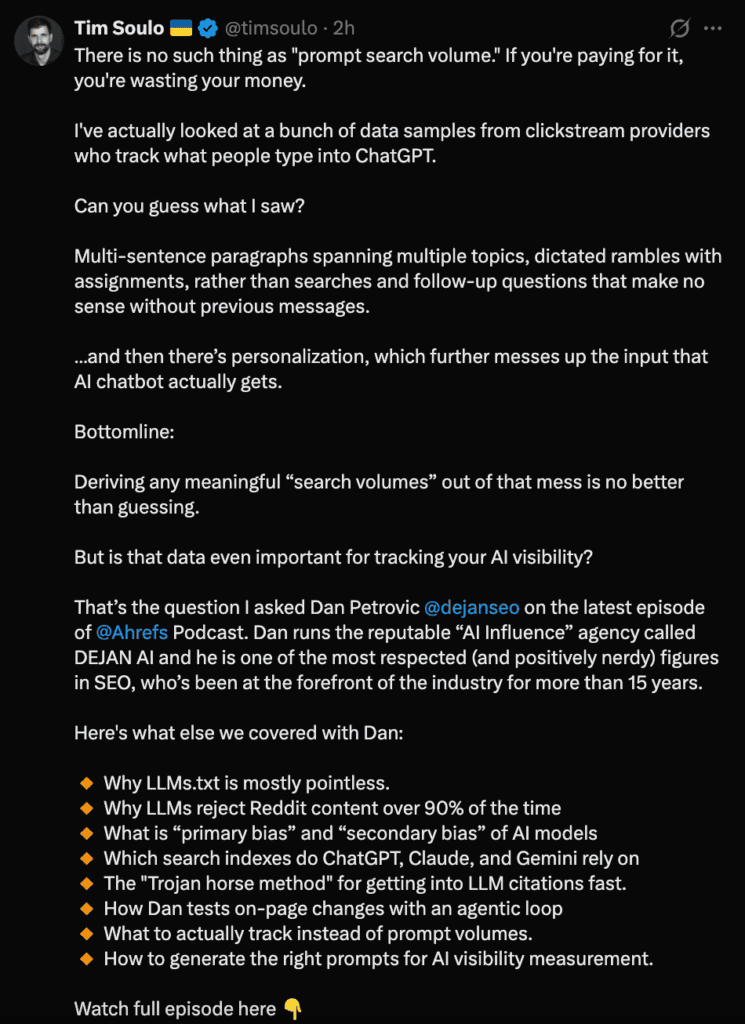
The way a prospect describes their problem to your AE is closer to how they’ll prompt ChatGPT than any keyword list will ever be. The corpus is the query before the query.
Of course, you need a methodology to group, cluster, and weight these against products, personas, and customer journey stages. But at the end of the day, what better way to understand demand than by gauging it against your target market?
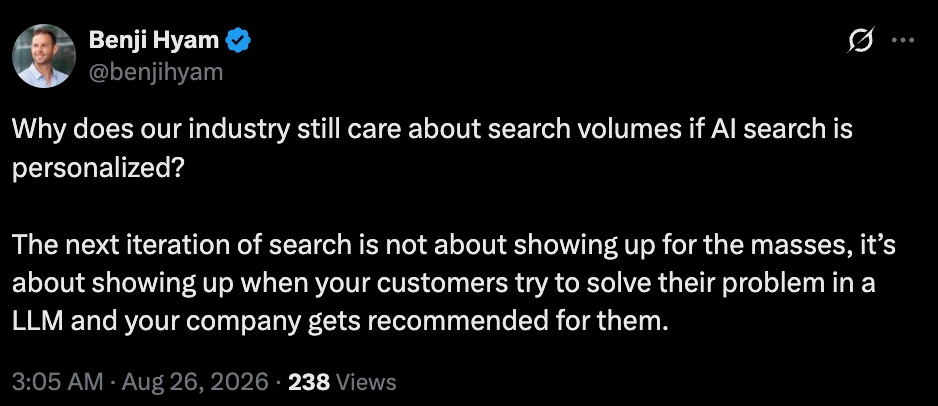
Mapping Language to Prompts
This is where the two trends intertwine.
LLMs retrieve information using natural language. Your transcript corpus contains natural language. The mapping between the two is quite direct.
When a prospect on a Gong call recording says “we need something that integrates with our HRIS and doesn’t require a six month implementation for our frontline workforce,” that sentence is a prompt template, or if not that exact wording, then the intent behind it is. It tells you the category framing, the constraints, the competitive set, and the primary objection. Keyword research may show you “HRIS integration,” at 480 monthly searches and lose the rest.
Companies mining their conversation corpus and building content around the actual language of their buyers are producing material that maps to how LLMs retrieve, because both the model and the buyer are operating in natural language.
The content mirrors the query because it mirrors the conversation that preceded the query.
From Calendar to Corpus
The quarterly content calendar was the planning instrument of the keyword era.
You did keyword research in January, built a roadmap in February, started producing in March, published through June. The assumption was that buyer questions were stable enough to anticipate months in advance.
While there is clearly stability in the highest order clusters, the specifics break down for a few reasons.
First, AI search surfaces questions that keyword tools don’t track, like long tail, contextual, combinatorial queries that never appeared in any database because nobody typed them into Google that way.
Second, the questions shift faster because buyers are having conversations with AI, not running static searches. A buyer who asks ChatGPT about HRIS integration and gets a recommendation might follow up with “what about for companies with mostly hourly workers in retail?”
For better or for worse (IMO, for better), we are optimizing not for a data point, but for coverage across a customer journey.
The listening layer changes the feedback loop.
New objections surface in sales calls. New category framings emerge in customer success calls. New competitive positioning shows up in churn conversations. Each of these is a signal that content should exist, not because a keyword tool says there’s search volume, but because a buyer just told you, in their own words, what they need to know.
Personally, I’ve been able to calibrate my market point of view (which is strong) with the “digital watercooler” (conversations happening on LinkedIn, podcasts, and panels), and how that affects the pain points, questions, and needs customers have. I have been able to detect meaningful changes in the market’s understanding of AEO in nearly real time based on the questions and tone of my discovery calls and our client calls.
This, then, gets reflected back in the content I produce for LinkedIn, my newsletters, and our podcast preparation. Quite regularly, I pull transcripts from sales and customer calls and identify the top 8-10 questions, how they have changed since the past period, and simply sit down to write answers to those questions.
I can’t give my competitors all our data, but here’s an example of a very small draw from the past week and some trends. Conversations are centering around positioning and category alignment, “dark funnel” attribution, and puzzling reallocations of website value. These hardly map to keywords:
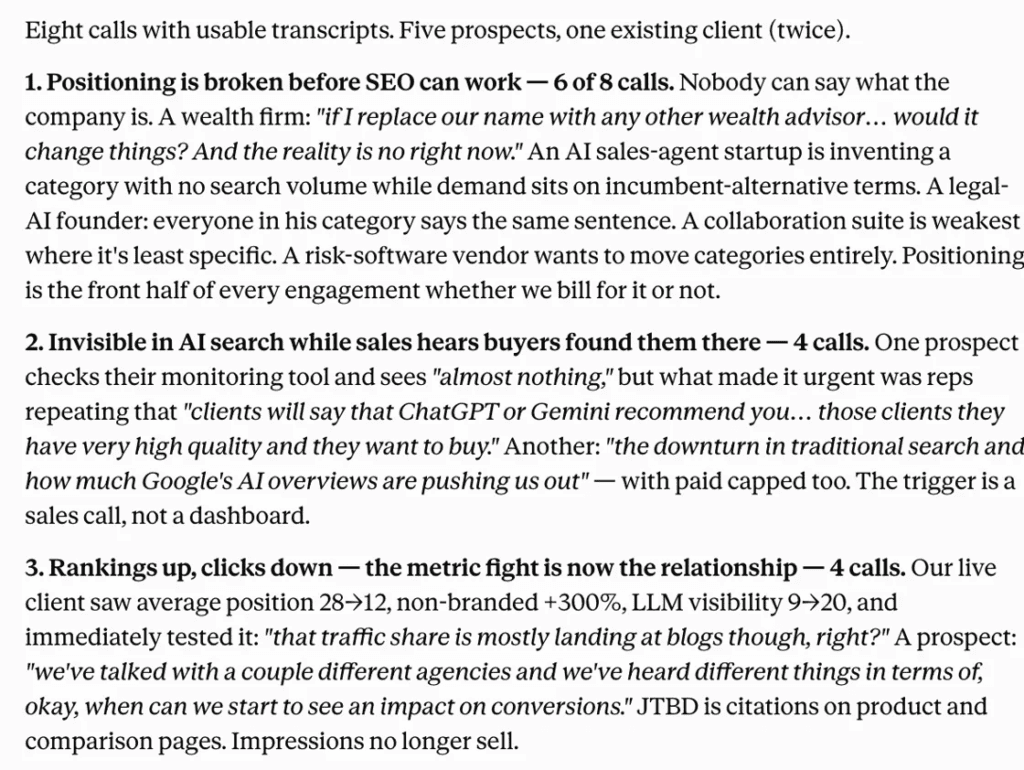
In essence, the content roadmap (and your website portfolio) becomes a living, dynamic document that updates based on what the corpus is hearing, not a static plan based on what the keyword tool reported in Q1.
Go to the Ground
I’m a big fan of what they call Demand-Side Sales.
This is a fancy way of saying get out of your office and go figure out what is happening on the proverbial streets.
In Robert Updegraff’s 1916 parable Obvious Adams, a hat company has two retail stores in the same city. One is profitable. The other bleeds money.
The executives spend three hours in a conference room reviewing sales reports and debating ad strategy. Nothing comes of it.
So Adams is sent to the city with one instruction: go look.
Adams found the first store easily. It was situated on a prominent corner, display windows on both streets.
The second store took him 45 minutes to find, and he’d passed it three times while looking.
It was on the main retail street but had a narrow front. He stood on the opposite corner and watched.
He counted foot traffic in five minute intervals. People walking up that side of the street had their eyes focused ahead, watching for the crossing signal.
People crossing the intersection had their backs to the big display window.
Nearly 50% more pedestrians were walking up than down. The store was functionally invisible despite its expensive rent.
Adams went back to his hotel, drew diagrams, confirmed the rent figures, and took the train home.
The store moved when the lease expired – problem solved.
Oswald’s explanation: “It’s that everlasting obviousness in Adams that I banked on. He doesn’t get carried away from the facts; he just looks them squarely in the face.”
Before scheduling another internal meeting, it might help first to go to the street and watch consumer behavior. The answer often becomes “obvious.”
Lobby Bar vs Conference Stage
While I’ve found social media listening useful, it is often filtered through the lens of public perception. In other words, don’t index too heavily on what people are saying on LinkedIn.
It’s like the difference between what a well-known speaker says on stage versus what they say at the lobby bar when the cameras and recorders are off.
While there’s probably a level of that hesitancy that comes when someone knows an AI notetaker is on the call, I try to get as close to “lobby bar insights” as I can.
For example, here’s a little alpha for you from my conversations the past few weeks:
The public conversation is about Reddit citations dropping, but the private conversation fits more into “strategic confusion,” making sense of the data, and actually having a team or system that can execute against the data. What people are actually saying is “I bought an AEO tool – now what do I do with the data?”
You want to get close proximity to those “closed doors” questions.
The Moat and the Gap
The corpus is proprietary.
No competitor has your sales call transcripts. No keyword tool can replicate the specific way your buyers describe their problems in their language.
This is first party data in the truest sense.
A few points of nuance:
- You have to calibrate voice of customer in demand and business value. A strong fraction of your data might be asking for something that is not valuable for you to build or promote. Weight by business strategy as well.
- Segment and prioritize. We, like many brands, offer services that span category entry points and personas. We do not want to overweight a less propitious segment at the expense of a quieter minority that maps to our vision and ideal customer profile.
Those points are just to say you shouldn’t take aggregate data at face value, which is true of any data.
But when you contextualize this data, your moat compounds.
Content built from buyer language matches the queries buyers write. The brand gets associated with the category vocabulary. The model’s pre-search shortlist – the one Suganthan showed is compiled before any page is fetched – starts to include you because your language and the buyer’s language and the LLM’s language are converging on the same patterns.
And yet, this is still underutilized at many companies.
The data sits in a transcript archive that sales uses for deal review and nobody else touches. Marketing doesn’t query it. Editorial has never seen a sales call transcript. The people who own the listening tools (sales ops, revops) don’t own the organic roadmap, and the people who own the organic roadmap don’t have access to the transcripts.
This is not a technology problem, it’s an organization problem – as we’ve seen is the case with many AEO problems.
And speaking from experience and observation, if you are able to connect your customer and market listening to your organic marketing efforts, you will be able to see trends and opportunities before they show up in 3rd party data sets. That’s alpha.
Want more insights like this? Subscribe to Field Notes