The promise of inbound marketing was that it could win both hearts and minds.
Instead of pushing your message out, you pulled prospects in with useful content, tools, and experiences. These experiences contained elements of personality, differentiation, and brand that, together, turned this informational funnel into something that produced conversions, yes, but also fans.
It was never that clean, but anyone who has run these programs knows there’s truth to it.
When I worked at CXL, we built the center of gravity for experimentation, data-driven marketing, and conversion rate optimization. We did this through our blog, research, speaking, and conferences. People would come in not just as leads, but as fans.
I didn’t take sales calls at HubSpot, but I went to a few INBOUNDs. People there LOVED HubSpot.
I’ve felt this building Omniscient, as I run both marketing and sales.
Here’s what warm inbound sounds like:
“We’re excited to talk with you about AEO. We’ve followed your newsletter for years. When we started building out our SEO program, our team actually used your barbell framework to do planning – and it was super helpful! We’re just hitting a point now where we’re plateauing. I’ve listened to your podcasts about AI search, but I think we need an expert to come in and lead us through the fog.”
Here’s what cold inbound sounds like:
“We’re looking to grow our AI visibility and we’re talking to a few companies. Can you tell me a little bit about Omniscient? How much do you charge?”
Cold inbound is, of course, still inbound. It’s still producing lots of revenue. It is just a different timbre than the warmer inbound built on affinity and thought leadership.
The New Shortlist
Here’s an increasingly common customer journey:
A buyer prompts ChatGPT or Perplexity with something like “best AEO software,” or more likely, “our organic traffic is down and I’m tasked with figuring out AI search. We are a 250 person company with a small marketing team. I need something that fits our budget, integrates with our stack, etc.”
The model returns a list of five. The buyer submits contact forms for all five.
In this case, they may get a list of Profound, Peec, AirOps, Scrunch, and Evertune.
They haven’t read the companies’ newsletters or research. Maybe they’ve seen a social post or two. Which one just raised that big round?
ChatGPT has told them which are focused on agentic execution, analytics, or MCP/API access. But they have little sense of each brand’s point of view, case studies, or differentiation.
It’s a bit of a bake off.
Of course, the “five company bake off” existed before AI: Gartner lists, G2, “best X” Google searches, analyst reports, RFPs, etc.
What AI plausibly changes is the frequency and friction of this behavior. It can construct a personalized shortlist instantly, without forcing the buyer through the brands’ own content. So it’s not that AI search created cold inbound, it just industrializes or accelerates the shortlist first buying journey.
And of course, the reality of the customer journey is more nuanced – not all AI search users go directly to the website to fill a form. Some will read the websites. Others will ask Exit Five, browse Reddit, or check review sites.
So here’s the crux:
AI search separates intent from affinity. It can deliver buyers who are highly qualified and ready to purchase without having done the brand building journey that traditionally accompanied inbound.
Marketers therefore have to deliberately rebuild that missing context in other touch points.
The Features Problem
I recently spoke with our highly respected frenemies Benji Hyam and Devesh Khanal of Grow and Convert. They built much of their agency through long form thought leadership.
Here’s how Benji put it:
“We got people to buy into our way of thinking. If you read a bunch of stuff on SEO and content marketing, or you were a marketer for years and you’ve tried a bunch of stuff and it didn’t work, then someone landed on our blog and we’re actually speaking to the real challenges they’re facing in the role.
We’re like, ‘Yeah, this one approach didn’t work, but here’s how we think about it differently.’ And they’re fully bought in from reading our content. Then they read through it and they’re like, ‘Okay, this agency actually resonates with exactly what I’ve been wanting, or just how I view the marketing world.'”
That’s the dream sales call: the positioning, messaging, and brand work happened upstream. The promise of inbound was fulfilled.
However, Devesh says that is changing with AI search. Here’s how he put it:
“And that is a type of lead and a lead path that, at least from our experience, feels like it’s disappearing because of AI.
Because now, even if you get the gold standard of AI visibility—a brand mention in a product-related prompt: ‘the best GEO agencies,’ ‘SEO content agencies’—and even if the sentiment analysis is positive, like ‘Hire Grow and Convert because they’re good at XYZ.’ You don’t get that scenario anymore. You don’t get that human moment of someone falling in love with your brand, because it’s just summarizing.
And then they’re reaching out to five agencies, filling out lead forms, and being like, ‘Okay, what do you do? What are the deliverables? What’s the price comparison?'”
Brand does a lot of invisible work: filtering, positioning, warming.
An AI answer strips a lot of that away.
What most reliably survives the summarization layer is legible information: what the product does, what it costs, what category it occupies, positioning and differentiation as related to the core features, product, or services.
Research on agentic commerce has shown that rich brand narratives, premium positioning, and differentiated value propositions tend to disappear in AI-generated summaries, replaced by descriptions that sound interchangeable with every other product in the category.
The buyer arrives comparing integrations, pricing tiers, and feature checklists – the dimensions where you may be least differentiated. The frame is already set.
Setting the Frame, Filling the Gap
Air is well known among marketers as one of the most creative brands in B2B.
Here’s a list of some of their stunts:
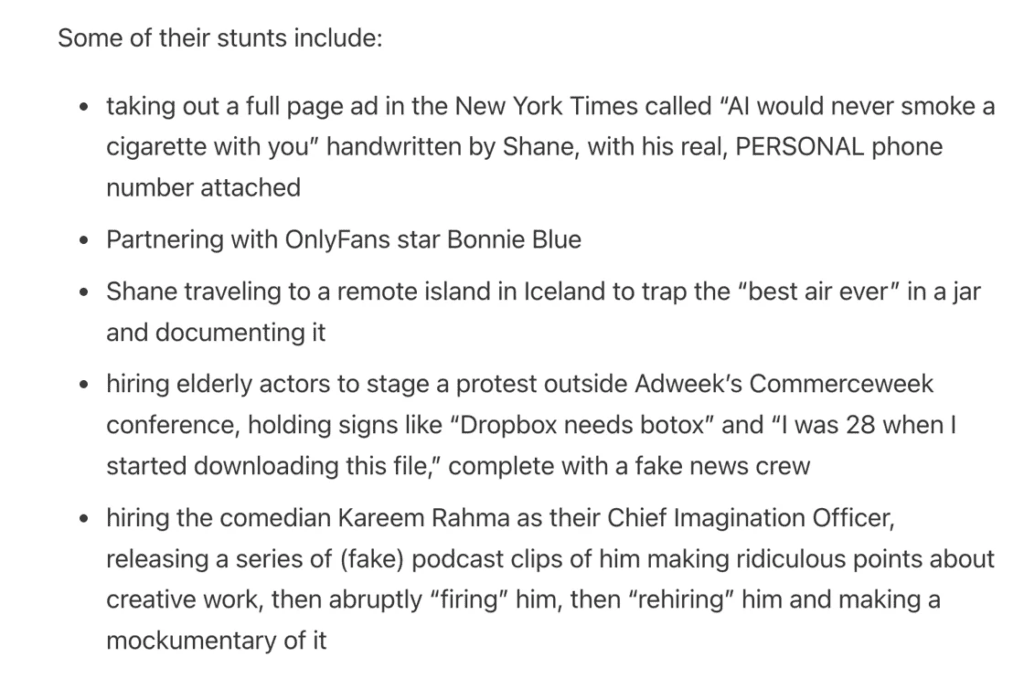
This is how I know Air.
But if I were in market for a creative operations platform – let’s say I’m investing much more in Omniscient’s own brand efforts – I may start the journey here:
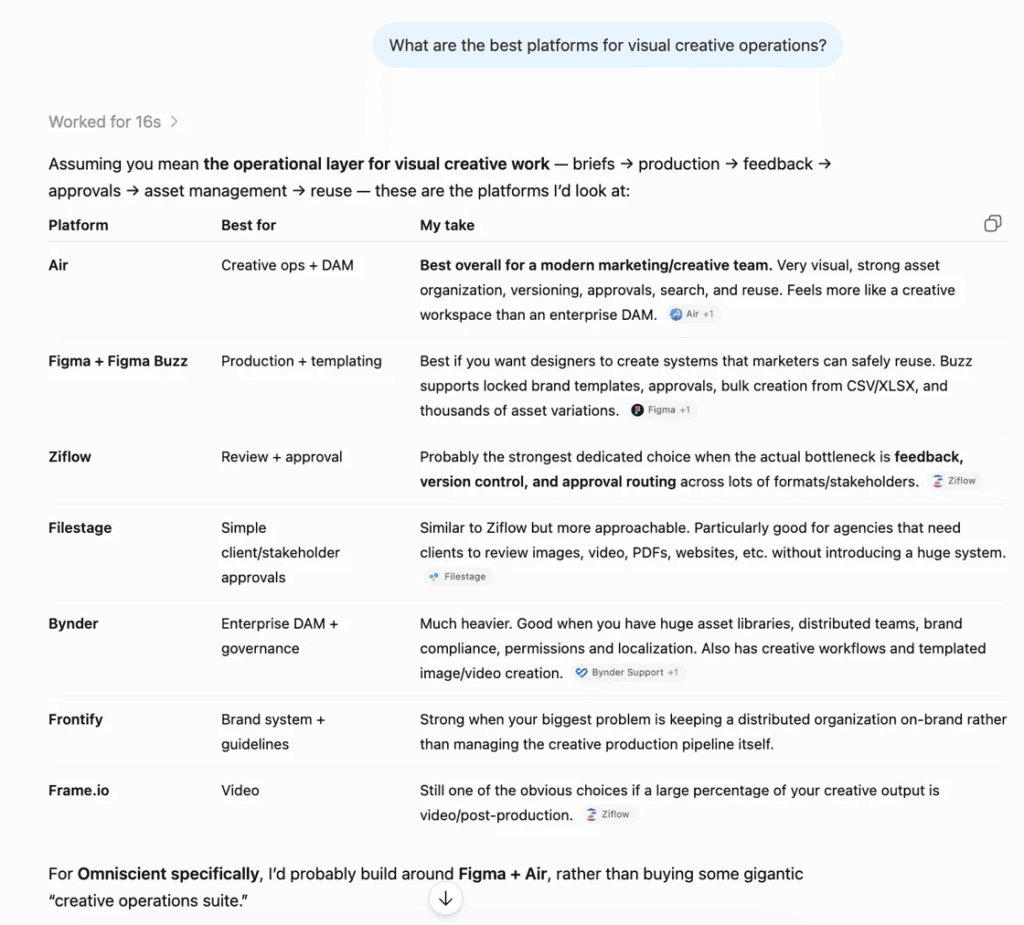
Not a lot of that personality gets pulled through, does it?
This isn’t a problem with AI search. AI search is pretty clearly an excellent user experience. It reduces friction to nearly zero. Most of us use it to source recommendations.
The marketer’s challenge is to win AI visibility without sacrificing the differentiation that warms buyers downstream.
If the warming function can no longer be assumed before the lead arrives, it has to be redistributed.
A few places it can go:
1) Into the sales process.
April Dunford’s Sales Pitch framework is built for exactly this problem.
Instead of leading with your product or your deliverables, you lead with a point of view on the market – the insight that frames the problem, the landscape of alternative approaches, and the tradeoffs between them. Then you position your solution within that frame. When the content layer gets bypassed, the sales conversation has to do it instead.
We’ve restructured our own pitch deck along these lines: the first half is education, the second half is engagement. We’ve also focused more marketing efforts on prospects in the sales cycle, including guides, insights, and even product.
2) Into the website.
Even if they hear about you in ChatGPT, they usually have to go to your website to request a demo.
I believe we’re seeing a turning of the tide with website optimization. When I came into my career, it was all about A/B testing and performance.
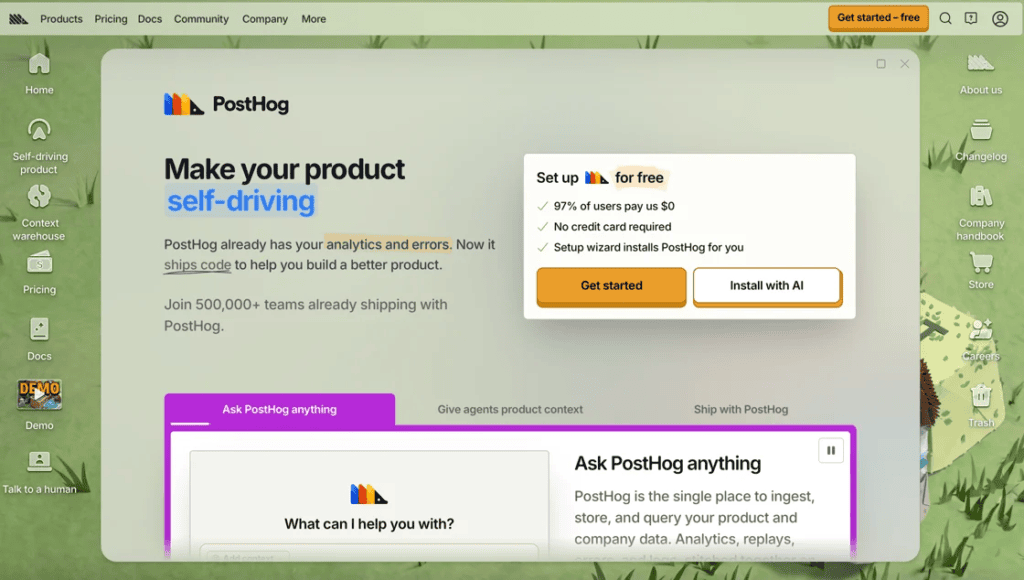
Booking.com was the celebrity – a functional website that converted like crazy. Still think there’s room for that, but I’m seeing brands – even “boring” B2B ones – implement highly creative websites. PostHog is the obvious example here:
3) Into the post-form experience.
Between form submission and the first sales call, there’s a window.
Most companies fill it with a calendar link and a confirmation email. That window is where the warming can happen now: a short sequence that delivers the thought leadership the prospect skipped. Not your salesy drip campaign of yesteryear, but a deliberate, curated set of your best thinking: one essay, one case study, one point of view piece. Enough to give the prospect context before the conversation starts.
4) Into the AI answer itself.
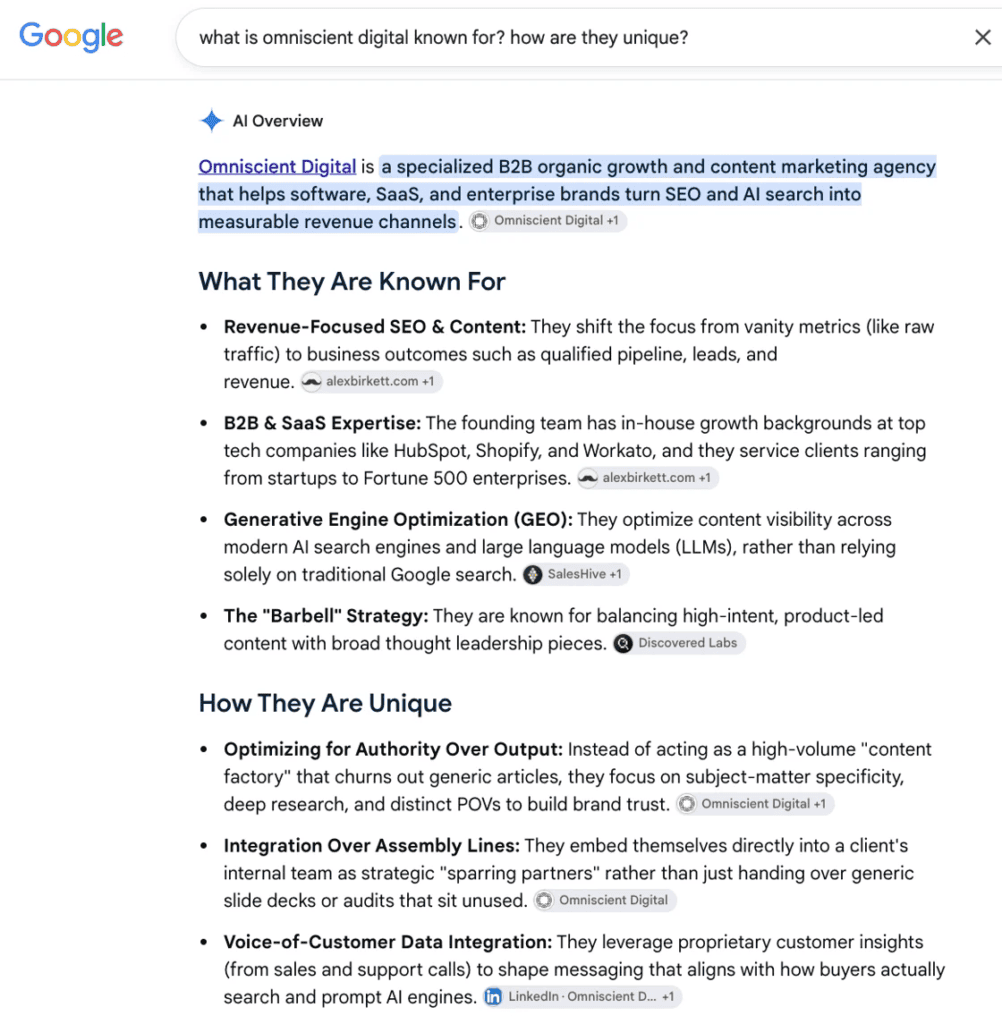
The long game is to influence how the model describes you, not just whether it mentions you.
If the AI’s summary of your company includes your positioning (not just your category but your specific point of view) the lead arrives warmer. This is harder and slower than the other three, but it’s the long term approach that addresses the problem at the source. An emergent and large portion of the work we do for clients is “sentiment engineering,” which is not just designed to increase visibility, but to shape messaging and perception within answers.
5) Into brand.
When your name appears on a shortlist of five, the prospect who already associates your brand with a specific point of view is more likely to choose you, and more likely to arrive at the sales call with context.
Brand investment that operates outside the search channel entirely (newsletters, podcasts, speaking, community) makes the cold inbound warmer before the conversation starts. I will say, also, that this stuff is probably the most impactful stuff for AI search as well. We call this “shape the narrative,” as it lies upstream of brand mention outreach or content creation. You do things worth talking about and, lo and behold, people talk about you – and then the model talks about you.
One of my favorite projects we worked on was a print magazine with Eppo by DataDog.
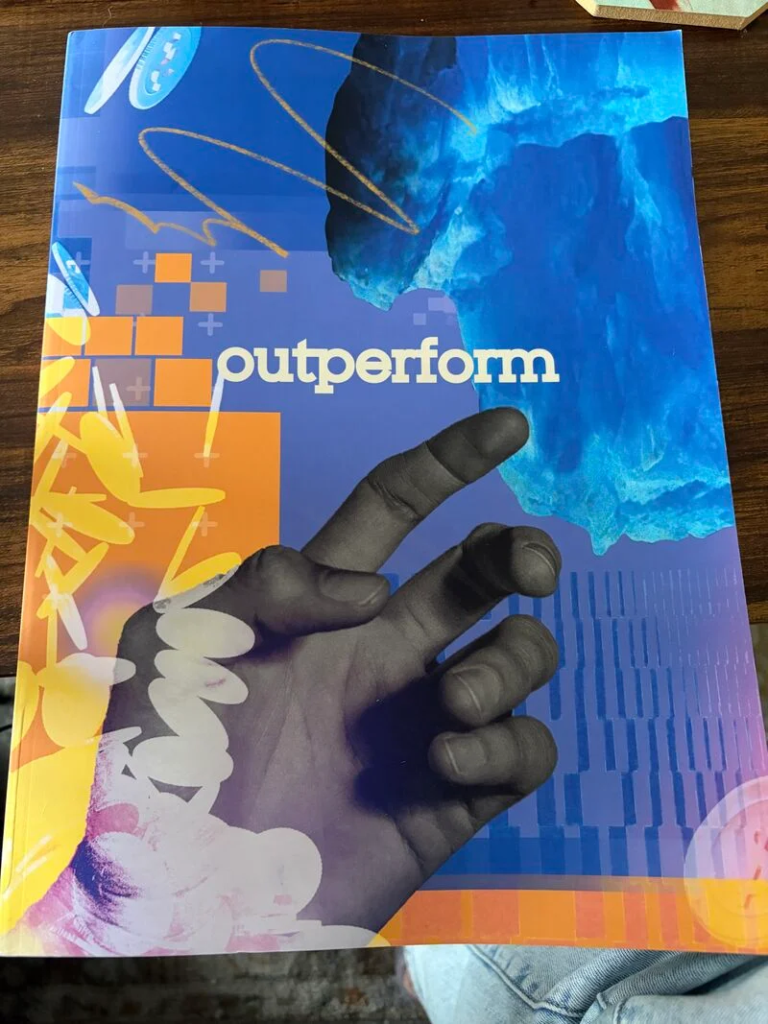
This is the fun stuff, anyway.
The Barbell Returns
Let’s say you engineer your way into AI answers.
You publish useful bottom-of-funnel content, cover the SEO fundamentals, and earn mentions through affiliates, creators, and good old fashioned outreach.
You do all of this and get lots of leads. Then what?
Then the question becomes: why you?
This brings me back to the barbell strategy: protect the downside while retaining exposure to uncapped upside.
This is an allocation framework that seeks to prevent catastrophic downside while maintaining exposure to uncapped upside. You ignore the middle, the mediocre – the ultimate guides, the bland webinars, the sea of sameness tactics. Instead, you index the largest portion on predictable but low upside work, but keep an open basket of experimental, highly open and uncorrelated bets.
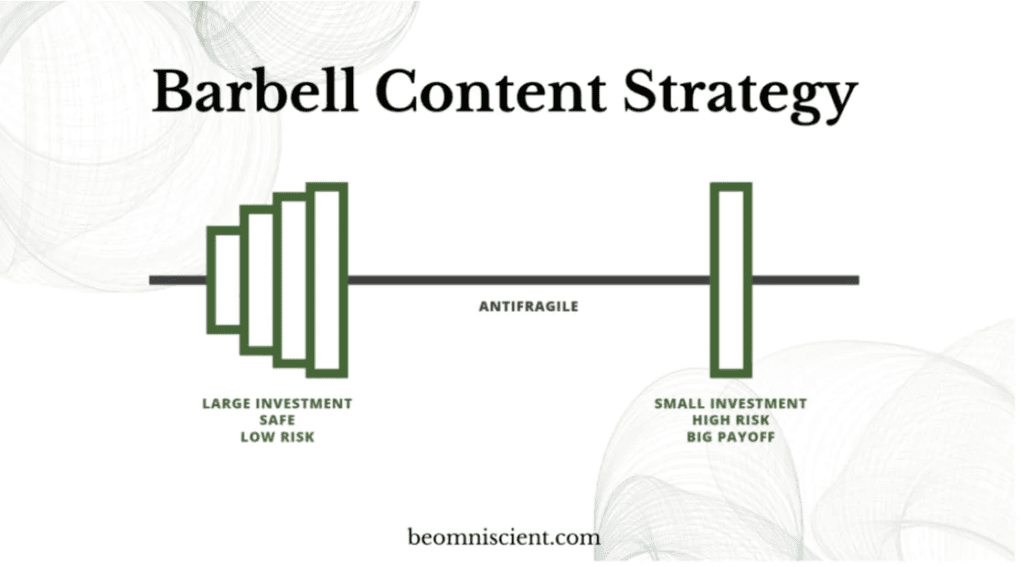
We originally borrowed this framework to apply it to content planning. Since then, I’ve updated it for the AI era. Your allocation will be unique, but here’s how I’m looking at it:
- In marketing, the “middle” is generic AI-assisted content, modest campaigns, mediocre webinars, and half-committed channel experimentation, i.e. activity that produces enough results to continue, but not enough differentiation or learning to compound.
- Keep most investment in durable, first principles bets. Roughly 70–90% should go toward things likely to survive platform shifts: brand, owned audiences, search fundamentals, strong content, reputable third party mentions, customer reviews and case studies, and other channels rooted in enduring human behavior rather than temporary tactics.
- Use a smaller portion for asymmetric upside. The speculative side includes creative brand bets (think Air), hyper-personalized ABM, print magazines, suites at Knicks games for CMOs, a marketing meetup centered around manifestation and fortune telling (don’t steal that idea), custom branded guitars, ragebait billboards, a branded pub crawl, Corgi cafe, a company punk rock band, proprietary research and first party data utilization, content engineering, and AI-enabled product building – areas where being early could create compounding advantages (or fail entirely)
The broader thesis: AI pushes value toward two extremes – extreme efficiency and extreme humanity. “Pretty good” marketing gets commoditized.
You can’t just get stuck in the efficiency loop. Differentiation requires an edge both inside the AI answer and outside it.
In a world where an AI summarizes the web and returns a shortlist, the bundling breaks.
Lead generation still works. But pre-qualification, education, and trust building increasingly happen somewhere else: in sales, nurture, brand, and the model’s own description of you.
Cold inbound isn’t a new problem nor is it a temporary problem. In a sense, it’s the perennial marketing problem that has now been accelerated by a primary discovery engine that intermediates answers about your brand before they visit your site.
That makes “thought leadership” more than a top of funnel activity – it’s something that will need to be woven through touchpoints where differentiation matters, so when it comes to the five company bake off, “why you” is an obvious answer.
Want more insights like this? Subscribe to Field Notes