I recently ran an AEO analysis on a $3B company.
They’re very well known, have tons of press, and sit at the center of an industry where large organizations run their complex, high-value financial operations through the product.
They are, in other words, the category leader.
They built it the old fashioned way: a great product, a well-oiled sales machine, PR and executive communications, partnerships, and word of mouth.
However, they have never invested in organic growth – they’ve got a big back catalog of content, very little of which performs in search or organic discovery more broadly.
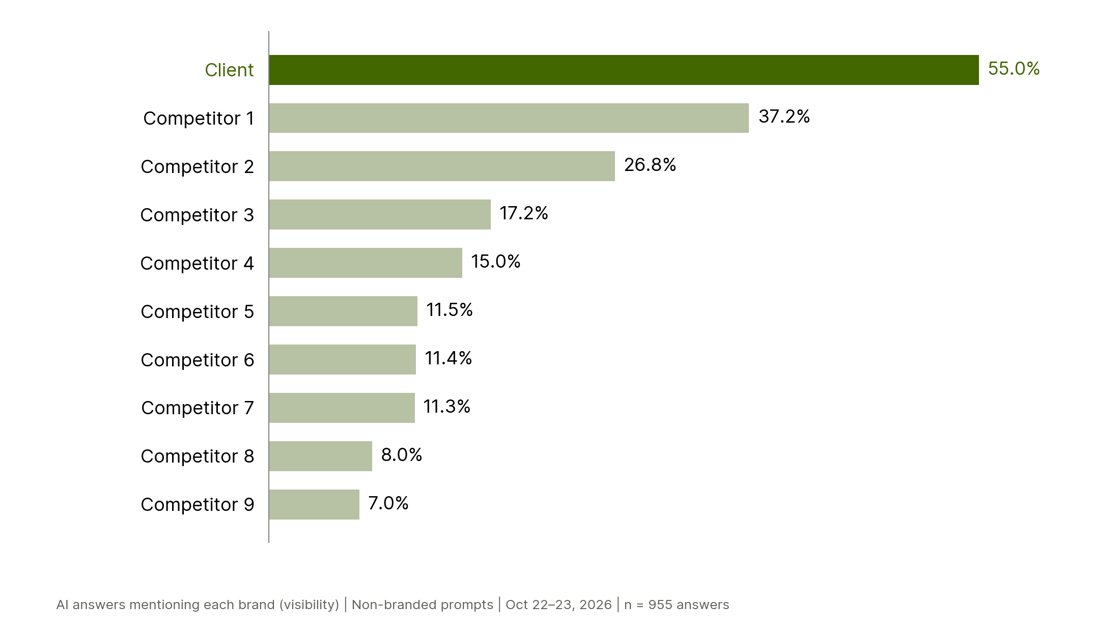
When we ran an AI visibility audit, the top line number confirmed what everyone expected. 55% visibility on non-branded queries – first in their category by a wide margin.
Great, AEO game won, let’s move onto the next thing – right?
We dug a bit deeper.
First, we segmented out branded queries, questions buyers ask when they already know the brand name (where visibility trends towards 100%, of course). Things like pricing, reviews, comparisons, limitations, etc.
On those questions, competitor pages were retrieved 1,341 times. The client’s own content: 23.
Woof.
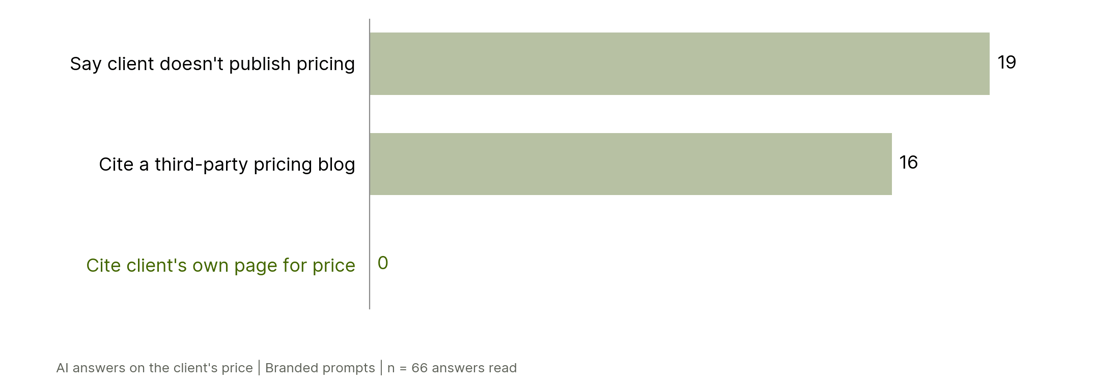
On pricing specifically, zero of 63 answers cited a page the client had published. Competitor blog posts were setting the frame around this company’s pricing.
And of course, this extended beyond branded prompts.
Looking at the entire landscape of commercial opportunities, prompts that would warrant an evaluation or shortlisting of solutions, pain points…anything…this company essentially had zero source material showing up against the answers.
They were ceding control of their brand narrative, but also the industry narrative at large.
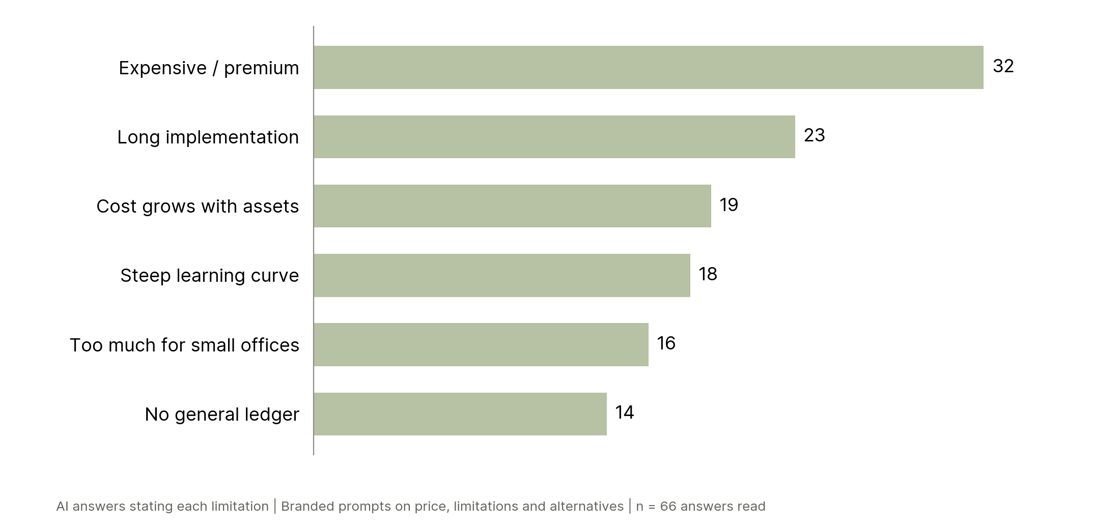
Of course, their competitors were quick to label them expensive, unscalable, difficult to use, and all of the other positioning frames they likely use in sales calls and store in competitive battlecards.
This backs into something important about AEO that is talked about far less often than visibility or citations: it’s not just if you show up in answers, but how you show up in answers.
This frames your perception, which tracks into your sales calls, and affects your GTM effectiveness as a whole.
The Data Void
In 2019, Michael Golebiewski and Danah Boyd introduced the concept of the data void: a search query for which the available relevant data is limited or nonexistent.
Their concern was disinformation.
Basically when authoritative information is absent, bad actors can fill the space.
It’s an inventory problem.
Search engines retrieve what exists. When little exists, whoever publishes first controls the answer.
The same mechanism exists in AI search, but the exploiters are not (always) disinformation campaigns. They are competitors, or at the very least, third parties who may or may not have the full information about your brand.
From the example above, this company had published no pricing page, and of course, no comparison pages against their main rivals. Not even adequate foundational pages for their industries served, personas, or “FAQ” type content that answers simple questions like, “is this right for a smaller firm.” No implementation timeline documentation, no easily extractable reviews or customer proof points.
And in the absence of first party answers, the models did what models do: they retrieved what was available.
Marketers are used to the concept of a “content gap,” but more so in the way of a missing blog post or an untargeted keyword cluster.
This, however, is a narrative void.
A brand’s silence on evaluative questions creates an information vacuum, and competitors fill it with pages engineered to be retrieved on exactly those queries.
How the Comparative Sausage is Made
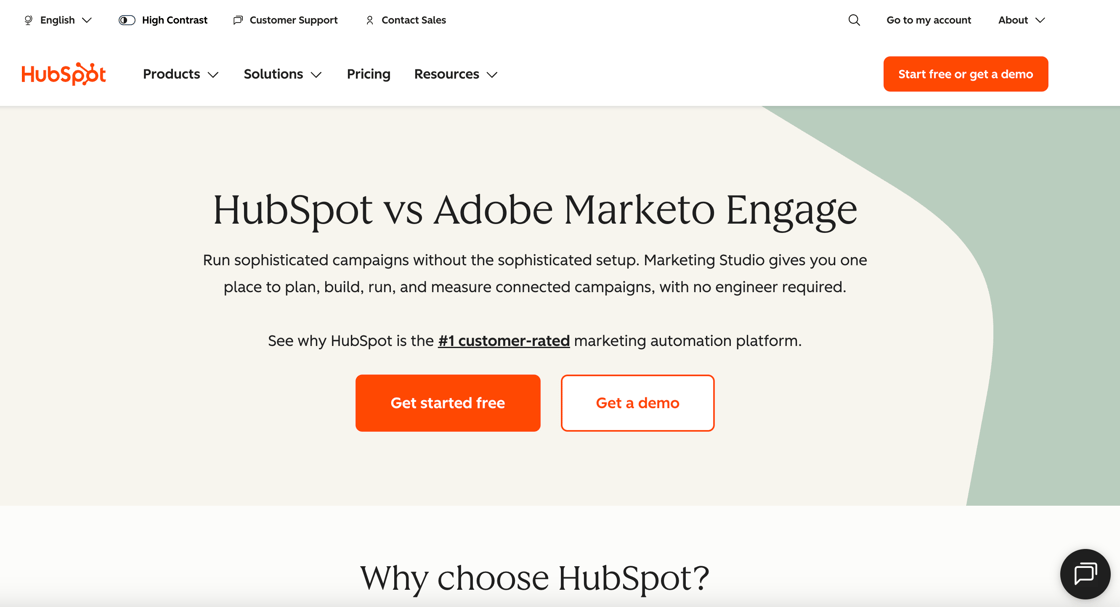
The competitive “alternatives page” strategy is deliberate and widespread. Always has been, in a sense. Remember working on these at HubSpot because they converted so well.
AI search gives an added advantage of categorical association.
Smaller vendors publish “Brand X Alternatives,” “Brand X Pricing,” and “Brand X vs. Us” pages because they understand these pages get retrieved on branded queries about the larger brand.
The play is twofold: associate your name with the category leader for visibility, and frame the category leader’s weaknesses on your terms for narrative control.
Look at your own AI visibility data and you’ll see it is increasingly common.
We, for example, get dozens and dozens of reviews published about us from agencies we have never heard of. Bizarrely (in my opinion), we also have companies who are writing comparison pages between us and competitors, presumably because we both have enough brand awareness to piggyback on:
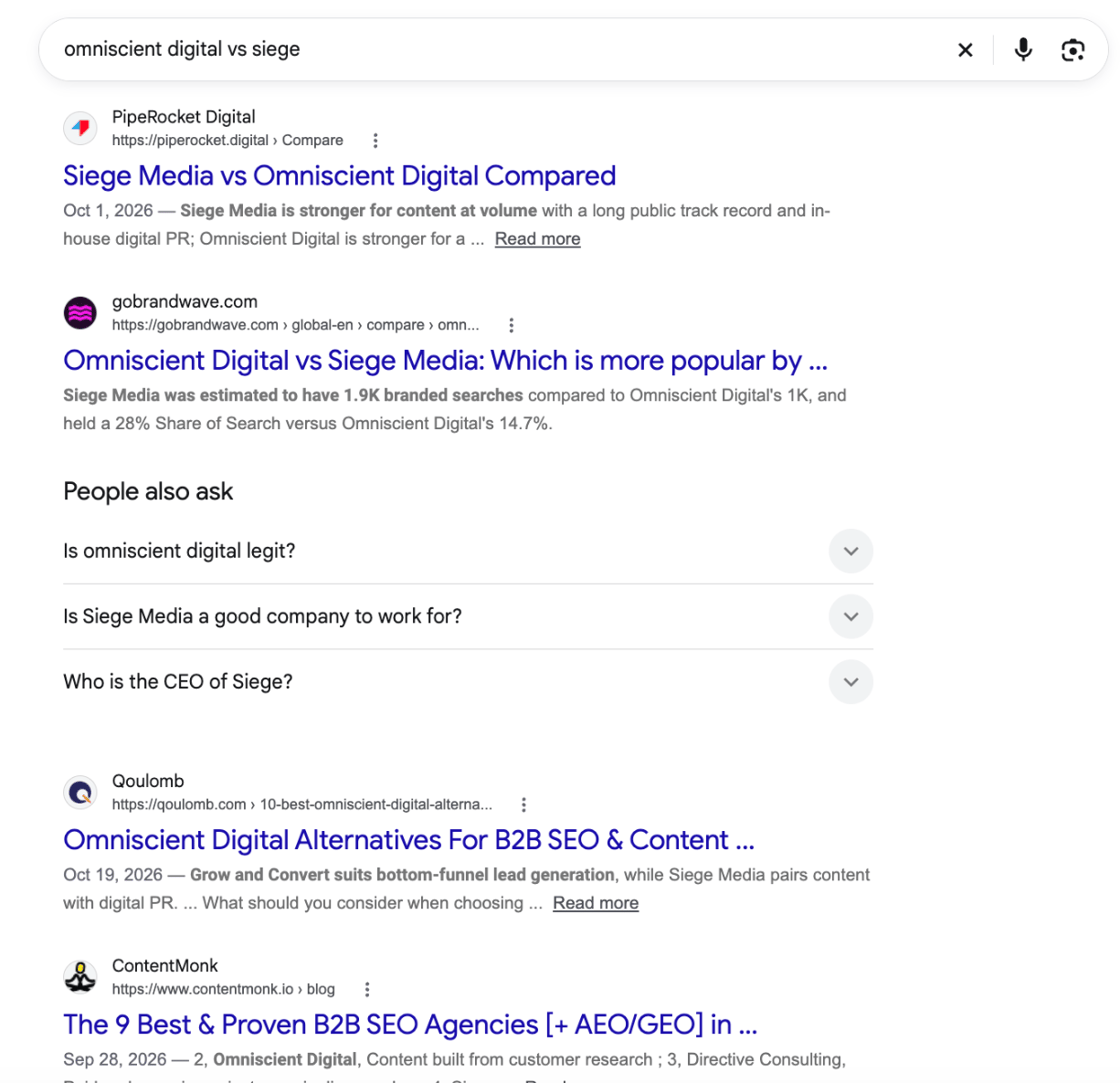
Where do they pull this information? Who knows. But unless it is made up from thin air (this happens), or the author has done deep investigative research (this never happens), the information typically comes for your own site or from third party review sites (usually through the proxy of Claude, which is composing the content).
We’ve actually had bad actors who have published dozens of articles targeted at Omniscient (reviews, pricing, comparison, listicles) with deliberately false and negative information. I’ll cover more on that below, because I think it is also, unfortunately, becoming more common. There are defensive and offensive plays when this happens.
But back to why this happens…
Basically, models are looking for topical relevance in retrieval. A competitor’s page titled “Brand X Pricing: What It Actually Costs” is topically perfect for a pricing query – more relevant, often, than the brand’s own product page, which discusses features rather than cost.
A paper accepted to EMNLP 2026 tested a version of this dynamic.
The researchers introduced a benchmark that rewrites product information on retrieved web pages and measures how often an LLM recommender adopts the manipulated framing.
When a manipulated page occupied the top retrieval slot, models adopted the false recommendation 27% percent of the time. In slots two through ten, the rate dropped to 1-4% percent. Retrieval position determines narrative authority.
So if competitors get good at optimizing for retrieval, and you’ve got little owned content answering these questions, you’re setting up a scenario where the odds are in favor of the competitor content getting cited.
Simply put, a competitor has every incentive to emphasize your weaknesses and position their strengths against them. And when that framing occupies the top retrieval slots on branded queries, the model treats it as the authoritative account.
In our client’s audit, 32 of 66 branded answers audited described them as expensive. Implementation time was stated as “6-12 months” in answers sourced from competitors and “30 days” in answers sourced from the client’s own site.
Back to the Boring Pages
You don’t necessarily need to build a high octane content marketing operation to combat narrative poisoning. In fact, the core website pages that are often viewed as product marketing, web strategy, or conversion rate optimization property are where a lot of the factual information is derived.
That’s one example of why we say AEO is a cross-functional team sport.
The pages that close the narrative vacuum pricing pages, comparison pages, implementation documentation, FAQs, product pages, industry and persona pages, and the often forgotten About Page.
Of course, this information then emanates outwards into informational blog content as well as PR and external publications. But it starts on your owned, core web pages.
This is where the product or brand marketers sits at the upstream kernel of AEO success – by identifying customer pain points, product differentiation points, and a narrative and point of view, you can construct messaging documentation that is disseminated through teams and related efforts.
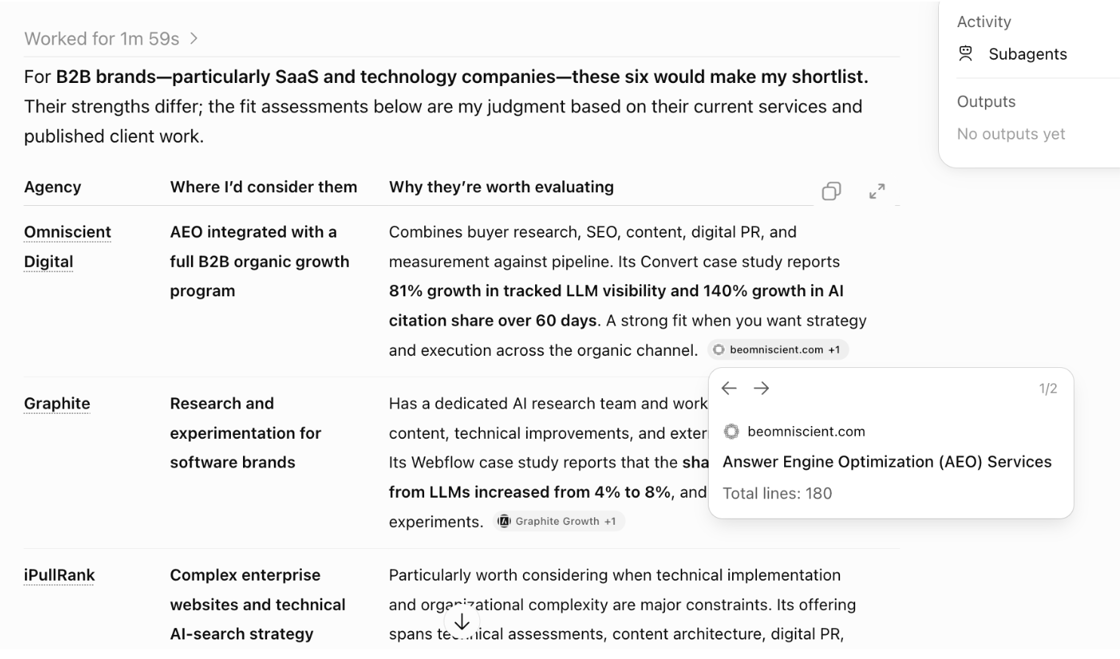
For what it’s worth, in this brand we analyzed, they did have a few core pages published.
And when they had a published page, the answers sourced from those pages were neutral to positive.
Even a little bit helps.
Mirrors, Misinformation, and Which Problem to Solve
As I mentioned above, we had a little known competitor write dozens of negative pages about us.
This was, very clearly, deliberate and malicious. Their site also included all the common AEO black hat stuff – prompt injections, hundreds of scaled pages, etc.
In this case, the information was clearly contradicting publicly available information, saying things like Omniscient doesn’t do AEO (when we have dozens of pages, case studies, newsletters, and published research about it), or Omniscient doesn’t do technical SEO (when we have dozens of pages, case studies….you get it).
If this is the case, you are in a narrative battle.
But here’s another separate scenario:
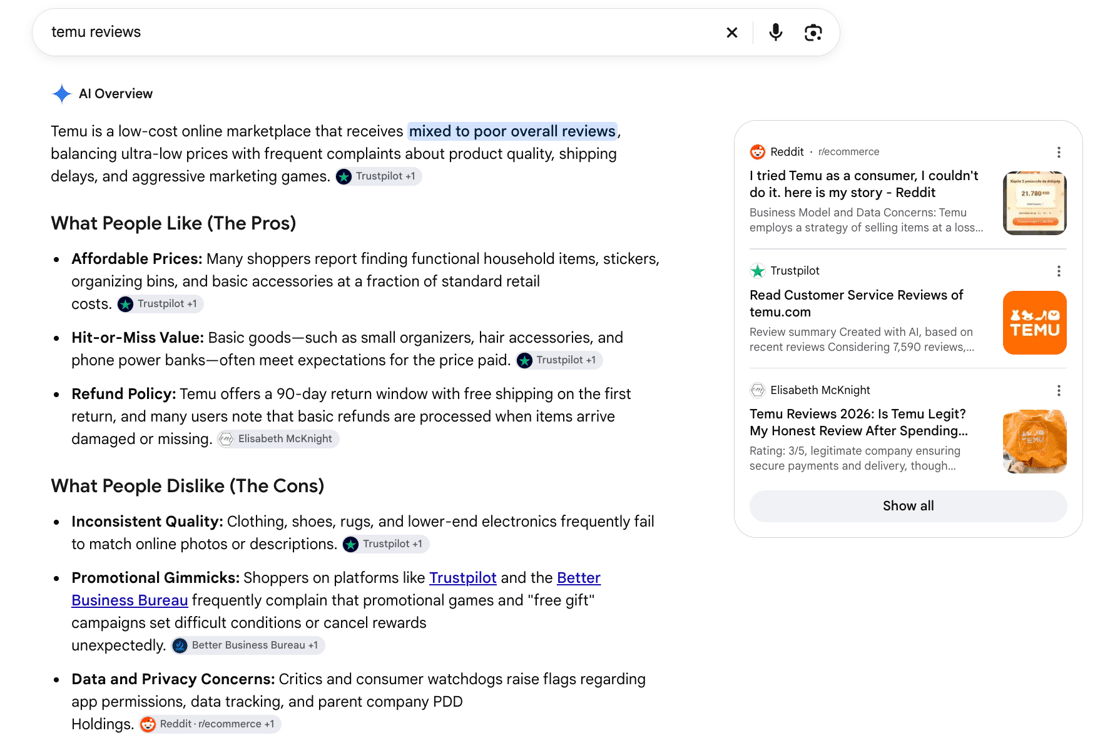
We were approached by a very well known (super bowl ad scale) company that has quite low sentiment. The perception of their product is not great.
They wanted help with AEO, specifically Reddit sentiment management, because they had thousands of comments calling them things like “cheap,” and “scam.”
Could some AEO help here? Possibly. But this is a different scenario.
This is a case where AEO is a mirror and you need to fix core product, brand, and customer experience problems.
Otherwise AEO is a game of whack a mole and your owned information would contradict the general consensus. Not a battle you want to fight with content alone.
Okay, so let’s cover the first of the two scenarios.
What do you do if you have competitors writing negatively framed content about you?
Two categories of response, both required simultaneously:
- Defensive
- Offensive
The defensive work makes your narrative harder to displace.
Zendesk probably has the most famous version of this, where they targeted the query “Zendesk alternative” by starting a real band and creating a page for the band:
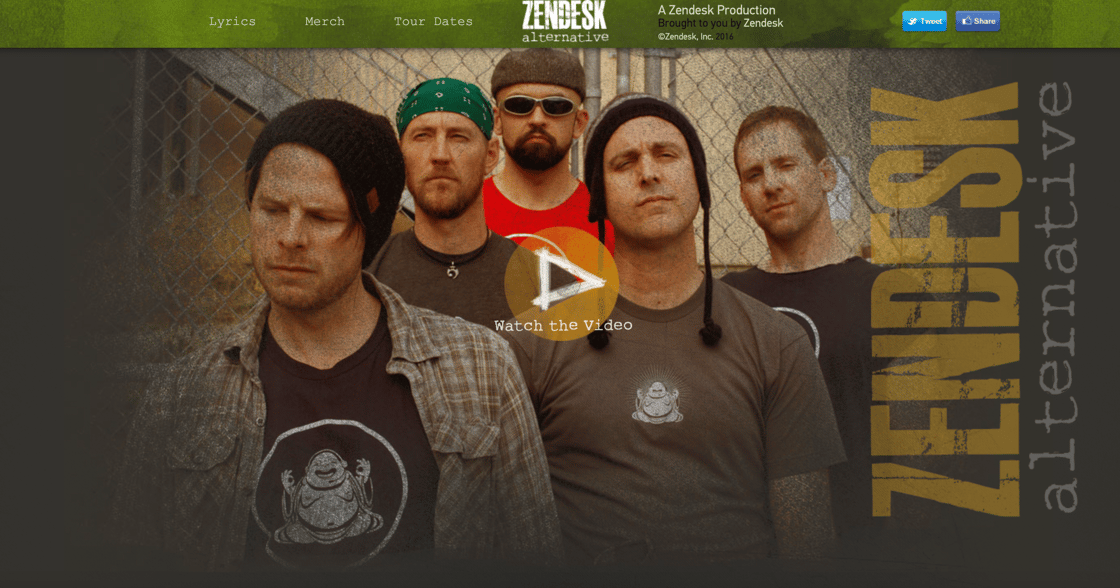
That also means building a robust body of information about what you do, who you serve, how your product works, and what customers can expect.
For the company above, that would include explaining how pricing works, documenting implementation timelines, publishing honest comparisons, and showing what different types of customers have achieved. Customer reviews and independent coverage strengthen that foundation by giving buyers evidence beyond the company’s own assertions.
Ideally, you build this before someone else starts explaining your business for you.
In our case, the negative competitor content exposed places where our own foundation needed strengthening – so in a way, I thank them for that.
We sought more public customer reviews, bolstered the proof on our website, and published an openly disclosed “Omniscient Digital Review” that addressed inaccurate claims.
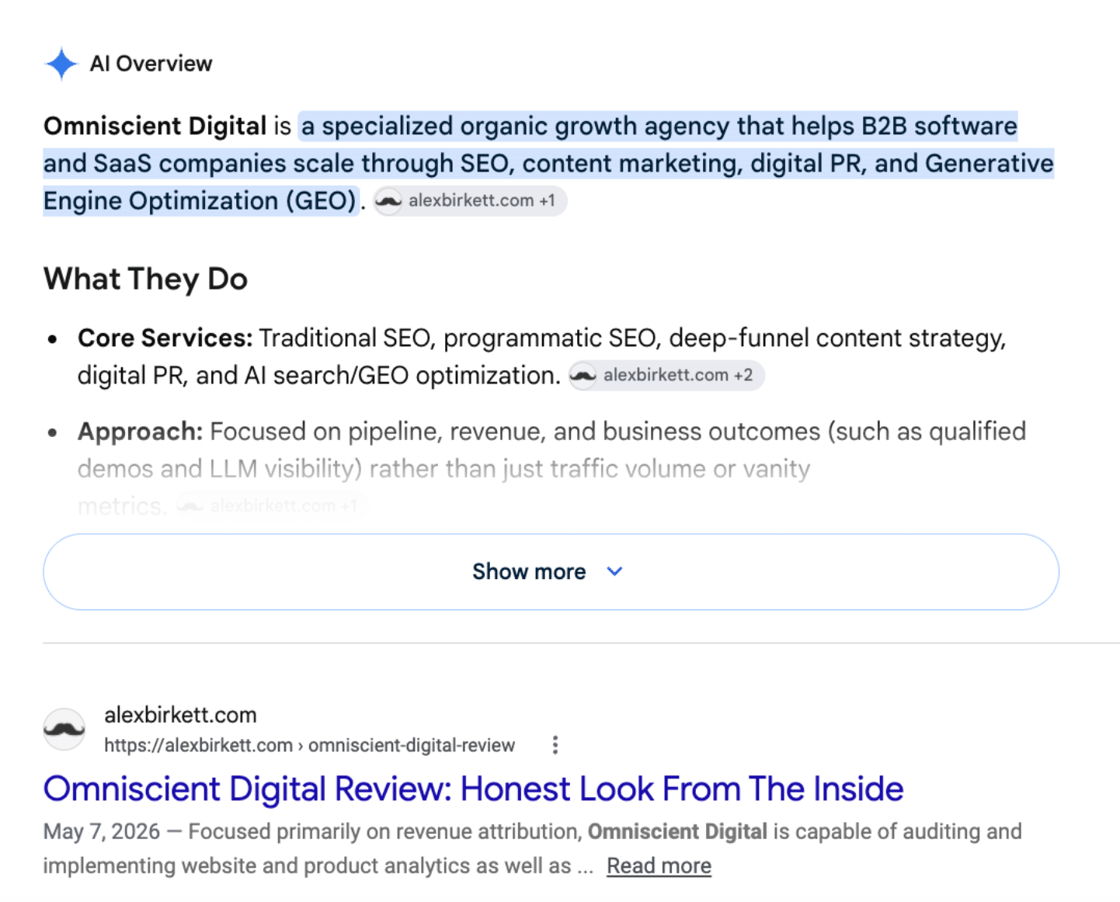
I look at the personally published review as an opportunity cost on my time, but it was worth doing, as I got to correct claims with verified facts and proof, and now it is often cited on our branded queries.
Some of this work is also reaching out and correcting outdated or inaccurate information, whether it is benevolent or intentional (your lawyers can help if it’s the latter).
The offensive work is taking ownership over the industry framing, which drips into your brand framing. This is via positiva brand and content work that operates as anchor points by which the industry discusses your research, point of view, or angle on a product or problem.
This often starts with a point of view or a point of differentiation: what matters in your industry, where the prevailing approach falls short, and what a better approach looks like. You develop that argument through research, education, customer evidence, and the work itself.
HubSpot’s early inbound marketing push is a good example.
They advanced a view of how marketing should work: attract people by publishing things they find useful, then help them become customers. They put that philosophy into practice through their own marketing and spread it through books, the INBOUND conference, and original research such as the State of Inbound reports.
The strategic advantage, as I see it, was that HubSpot helped establish the vocabulary and criteria for the conversation. A company explaining its approach to inbound marketing was entering territory HubSpot had helped define. It could adopt that framing, extend it, or argue against it. HubSpot’s software had a clear place within the approach the company was teaching.
You can do this at a smaller scale, too. A useful framework, a research finding, or a well supported argument can change which questions buyers ask.
The New Agenda Setters
McCombs and Shaw wrote about the press in 1972. The press told people what to think about.
The AI model doesn’t necessarily tell people what to think about (though does seem to sway executive decision paths), but it frames how to think about products, brands, and information.
It does so in a way that, too many people, feels divinely derived.
Of course, everyone reading this understands to a degree how the sausage is made. Yet, how many people understand query fanouts, synthesis, and LLM poisoning?
Of course, on the consumer side, we will all have to build better judgement and discernment. That’s evergreen.
And the models, too, will likely get better at this discernment.
But the data void is real, so someone needs to provide the information that they retrieve and cite. If it’s about your brand, it should probably be you.
Gaetano, per usual, put it clearly and succinctly here:
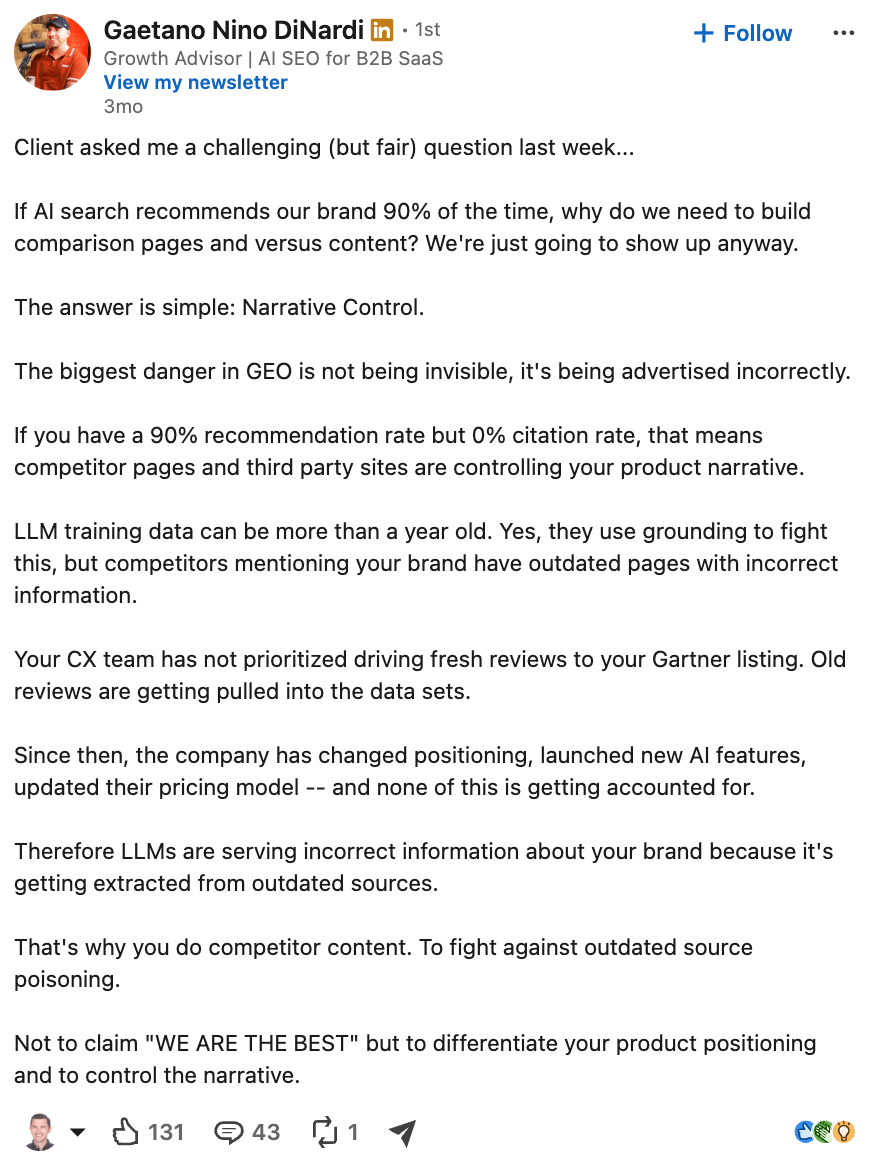
High visibility without narrative control can be a liability.
Of course, I’d rather be on the list than invisible (see the retrieval-recommendation gap).
But I would prefer to own the framing of my brand and product, which requires a deeper question than “are you visible?”
It then becomes, “what is being said when you are?”
Want more insights like this? Subscribe to Field Notes