Follow me for a minute of inside baseball:
I recently talked to a company who was serious about investing in organic.
They had the revenue, budget, and a big opportunity in front of them as evidenced by a quick and dirty organic TAM analysis. We were looking at a $280k annual contract to start.
We turned it down.
I had some inklings it may not be an ideal fit early in the conversation. While they were successful from a revenue standpoint, they had primarily grown through a very large paid search program.
Nothing wrong with that, in fact, a great sign of acquisition efficiency.
The rub was they really didn’t have a brand.
I don’t mean that in the “sleek website design” sense (though that was true, too), more so that they had close to an exact match domain, had little “shape” to their existence, and it was nearly impossible to find any information about the team or the company like offices, mission, or market point of view.
Then, during the discussions, they started spitballing ideas that showed me they were thinking about SEO and AEO as an arbitrage, similar to their paid search program. If this were 2018, I would have taken it on. Why not? That’s the way the game was played.
But in 2026 and beyond, that is just fundamentally not a way to win at AI search.
This essay explains why.
The Old Arbitrage Mindset
In SEO, you could build a domain.
This needn’t be an actual brand – niche sites, affiliate sites, exact-match domains, all could monetize their SEO traffic. You didn’t need to “be” anything. My own personal website, which I have been writing on since college, made a lot of affiliate revenue from 2016-2021 (RIP extra spending money).
In this world, you identify high traffic keywords, you rank for them, and you monetize the traffic – only sometimes through a product which is represented by a “brand.”
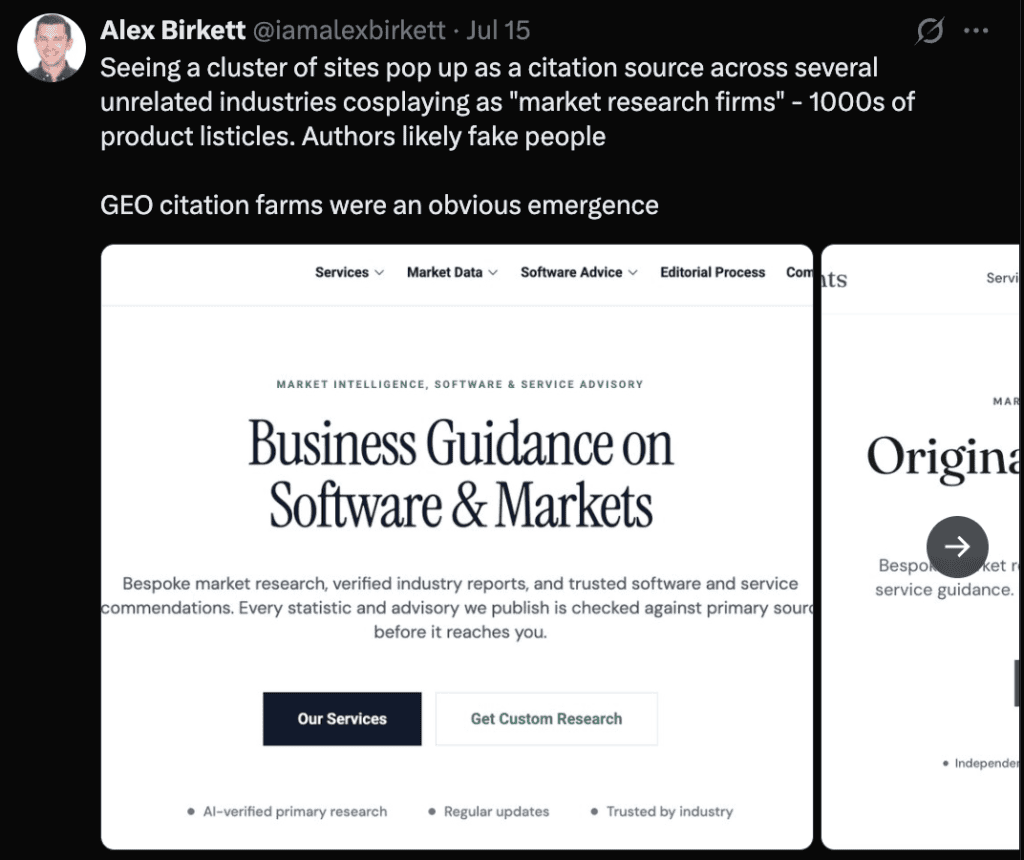
Now, I’m not saying this world is entirely behind us. There’s a world of AEO PBNs popping up right now with exact match domains like “bestblendersreviewed dot com,” some of which are owned by brands and used to build brand mentions, and some of which are built at scale by scrappy marketers hoping to sell the inventory to brands who are building brand mentions.
House of cards, eh?
Anyway, my point is that the model has largely broken down for many reasons which we’ve written about ad nauseam here like declining click-throughs, AI overviews, instance access to answers, and generally the decline of the traffic trap illusion.
Also, success in AEO requires not only your website creating experiences that rank, but also the rest of the web echoing and corroborating who you are (we call that Brand Gravity).
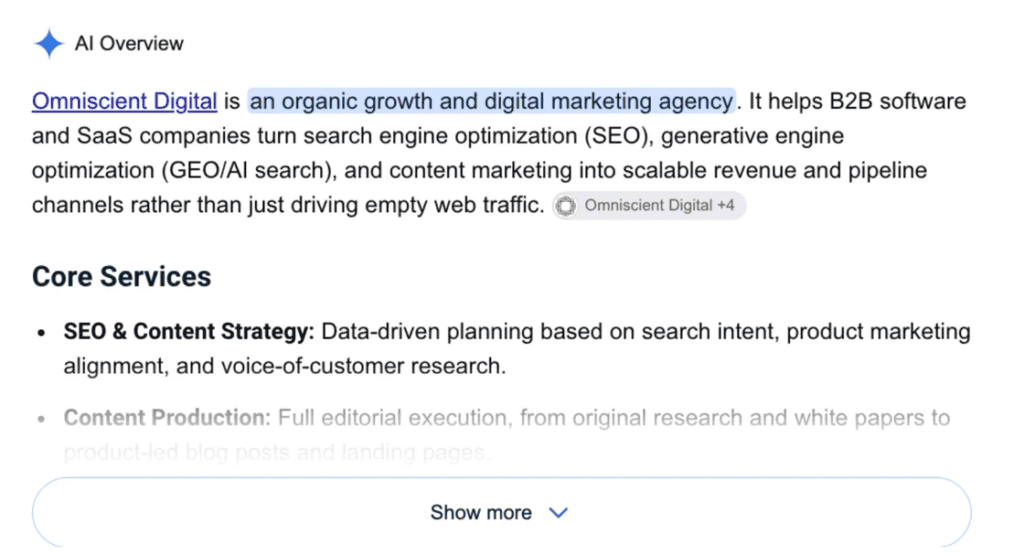
Example: I could change all of Omniscient’s blog posts to be about kava, but the rest of the web would still call us an organic growth agency. Would take a lot to steer that ship in a different direction.
The Shortlist Is Compiled Before the Search Runs
It’s fairly well understood now that sources beyond your website matter for AEO success. This simple logic that was the basis for Surround Sound SEO took a long time to reach mainstream acceptance, but now there are services dedicated to Reddit marketing, brand mention outreach, review site management, and more, all in the name of AEO.
Okay, but this is still very tactical and looking at a single snapshot in time: the list of citation sources you are analyzing against a set of prompts.
What I’ll argue here, and what others are pointing out, is much of the influence that gets you in these is going to occur upstream of the citation sources.
This piece by Suganthan, titled “ChatGPT Already Knows Who It’ll Recommend Before It Searches,” explains this well.
Basically, ChatGPT writes brand names into its own search queries (query fanouts) before fetching pages. In his research, 21 of 27 conversations had brands in the first query (the user never typed in these brands explicitly). The shortlist isn’t simply retrieved, it’s got a priori logic that is built on category leadership and, well, brand.
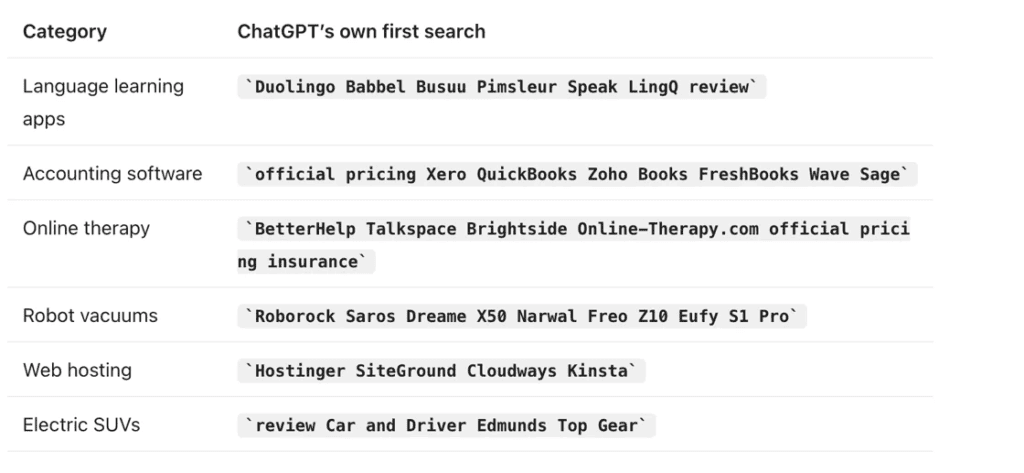
It’s recalled – from training data, from the model’s existing understanding of who matters in a category.
Being on the shortlist = 68.9% chance of appearing in the answer. Being findable but not on the shortlist = 2.1%. A 33X gap. Massive.
Granted, this is an N of 1 case study, but I suspect it speaks to a directional truth about these tools: they are looking for harder to fake signals that a recommendation will be a quality one. Just like you would before booking a trip, buying a watch, or choosing a new show to watch.
Niche sites with no brand presence just don’t make it into these conversations, whether at a cocktail party or in your AI tool of choice.
Category Eligibility, Not Ranking
Ayomide Joseph published a great piece on Gaetano’s newsletter that hits this same point from a different angle.
They took 270 queries across ChatGPT, Gemini, Perplexity and found, broadly, that AI search behaves like a category inclusion/exclusion filter, not a ranking system.
Once 4–5 brands consolidate as the consensus set, challengers can’t bulldoze in with optimization tactics, outside of marginal advantages in long tail and hyper specific criterion.
Examples: Microsoft Entra ID took #1 in 71% of Okta-alternative queries. Zendesk owned 55% of Kustomer-alternative queries. This brand pool was basically decided by years of reviews, analyst coverage, comparison content, and organic authority (what they call “accumulated signal infrastructure” and again, what I call “brand gravity”).
And notably, ChatGPT answered 56% of those queries from training data alone, never searching the live web.
Brands have signal infrastructure, not just pages.
What “Being a Brand” Actually Means Here
I feel uncomfortable speaking about brand in the same way I feel uncomfortable taking a line dancing lesson.
Not because it’s not beautiful or awesome, but because I am not an expert in it and am scared I will look foolish doing it.
I’ve read Al Ries and Jack Trout, and I’ve done my best at building a brand of my own. But I don’t proclaim to be the guru here.
Here’s how I look at it: brand as an entity, a defined shape in the information ecosystem. I’ve found some incredibly interesting content on how to quantify this shape, but I’ll stick to the basics here:
- Consistency across sources. Your brand is described the same way on your site, in reviews, in analyst reports, in Reddit threads, in listicle mentions. The model can triangulate a coherent identity.
- Category association. You are discussed in the context of a category. Not mentioned blindly, but categorized and contextualized. “X is a [category] tool that does Y” appearing across multiple independent sources is what builds the association Suganthan observed in the pre-search query.
- Third-party corroboration. Your claims about yourself are echoed by others. The LLM doesn’t trust your homepage alone. It trusts the consensus of the web about you.
Those do, of course, start with positioning documents, website messaging and owned content initiatives, but they flow through to sources that are less and less controllable (partner websites > analyst reports > reviews > Reddit > social). Orchestration is key.
Timelines, Escape Velocity, and Maturity Curves
More inside baseball for you: we plot our clients and prospects on a maturity curve (which is quantitatively and qualitatively diagnosed and updated with increased data and feedback).
This essay explains the framework in detail, though we typically delineate by three stages:
- Foundations: escape velocity
- Scale: expansion, and efficiency
- Category leadership
There’s no real barrier preventing an early stage startup from becoming a category leader (if there were, there would be very few people attempting startups). But it’s foolish to apply the same strategy, resource allocation, and tactics as an early stage startup that you would at Microsoft. I wrote about this with regards to experimentation programs. It’s true of AEO.
Ayomide’s research suggests 18–24 months for the compounding investments that determine category inclusion – original research, review aggregator depth, community presence, category defining content (the stuff we talk about all the time on this newsletter).
While some AEO tactics can help, especially from nascent starting points, this points to a much broader surface area of influence.
This is brand building on a timeline that many AEO plans haven’t accounted for, in a competitive environment where the incumbents’ advantage compounds faster than the challengers’ effort.
Tactical Excellence and Local Maxima
If you’re a brand just getting started, there’s no shame in publishing your core product pages, help documentation, and bottom of the funnel content. Foundations have to be built.
Similarly, if you have zero external presence, it’s nearly offensive when thought leaders opine on brand building. Chicken and egg problem, right?
So you have a few options:
First, getting yourself listed in all review directories is free, and if you have customers, asking them to review you is fairly low hanging fruit.
Second, figuring out how to get on those listicles. Lots of talk on this. I won’t add to it (mainly because I said my piece in 2018 and all the discourse has been the same since).
You’ll learn that at some point, due to game theory and cumulative advantage, you’ll hit an invisible threshold as incumbents fortify their defenses and achieve organic and automatic mentions across the web. You simply can’t move fast enough to overcome the gap.
This is a growth stall, or what is known as a local maximum.
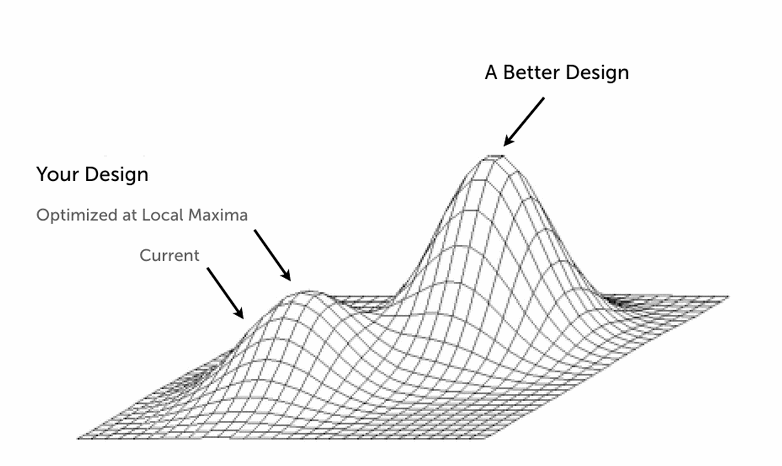
No matter how excellent the execution, copying a standardized playbook or set of best practices almost always leads to a local maximum, unless you have a secret weapon like scale, network effects, or a way to reinvest margin.
This is what I wrote in 2019:
“In almost all cases, the best case scenario by copying someone’s strategic playbook is that you’ll hit some local maximum that lies somewhere near mediocrity.”
In other words, some day you’ll have to look upstream and find a way to making competing in the trough of tactics mostly irrelevant or at least nominal.
Brands, Sub-brands, and Positioning
There’s a solid paper floating around from Stanford Business School folks that covers the state of AI search.
It’s good because it does a remarkable job covering the landscape – what has changed, what big problems remain, the mindset needed to do well in AEO.
This is a prediction they make within it:
“Therefore, as brands optimize for LLM recommendations, we expect to see a “hyperspecialization” of smaller brands and segmentation of larger brands. That is to say, small brands will further invest in and emphasize their niches, while larger companies will segment their offerings into different brands so that each can be adequately specialized toward their corresponding products. Larger companies segmenting into sub-brands should have an advantage since their history provides credibility, but as large companies are notoriously slow-moving, it is difficult to determine which group will dominate future markets. In either case, the resulting market composition is similar and involves a new layer of brands operating between consolidated manufacturers and consumers.
The shift from large conglomerates to specialized brands would fundamentally change how we think about branding as a competitive advantage. Instead of a single powerful asset that allows large companies to easily expand into new markets, brand equity becomes localized to specific markets. This process contrasts sharply with current marketing dynamics and raises questions about the sustainability of firms that rely primarily on broad brand equity as their core advantage.”
Bolding is mine.
Obviously, this is just a prediction and no one can predict the future, but it seems likely.
In this world, sheer size is a double edged sword. You retain the classic advantages of resources and distribution, but unlike in SEO, you have to battle a well worn brand and positioning history as a large brand. Smaller brands can carve out specialized niches easier. Thus, the prediction for brands to segment into sub-brands.
I am skeptical many large brands will move quickly on this, as it feels inherently risky. And even if they do, they are competing against hungrier startups on a more even playing field.
Whatever the case, we return to the most fundamental of marketing practices: positioning.
Where links and content used to play, we now have category alignment conversations
Want more insights like this? Subscribe to Field Notes