A client wants to know where they rank against their competitors. Often, agencies open four tabs, run four separate reports, and stitch the numbers together by hand in a spreadsheet, making the service more of a data-entry task with a subscription fee attached.
Competitor rank tracking tools help close that gap. The right ones help pull your rankings and your competitors’ rankings into one view, refresh their numbers daily, and hand you a client report that can be read without a glossary. The weak ones give you a number and leave the interpretation to you.
The difference is evident when you’re managing more than a handful of clients. A tool that just dumps raw position data in a spreadsheet might suffice when there are only a few clients.
The situation turns into an SEO nightmare the moment you run position checks across multiple accounts. It escalates quickly when you factor in that each client has their own keyword set, unique list of competitors, and reporting cadence.
What’s worse, these situations earn the spotlight only when there is a client report due with a tight deadline, and you’re stuck with a tool that offers little to no help building the deliverable.
This list features seven tools agencies are actually running client work through in 2026, from full-suite platforms to trackers built for nothing but ranking data. A few are built specifically for agency needs, such as white-labeling and multi-client dashboards. Others are broader SEO suites where rank tracking is one module among many.
Why competitor rank tracking is different than it did two years ago
Ranking position used to be a simple process of finding where a page sits in the list of ten blue links.
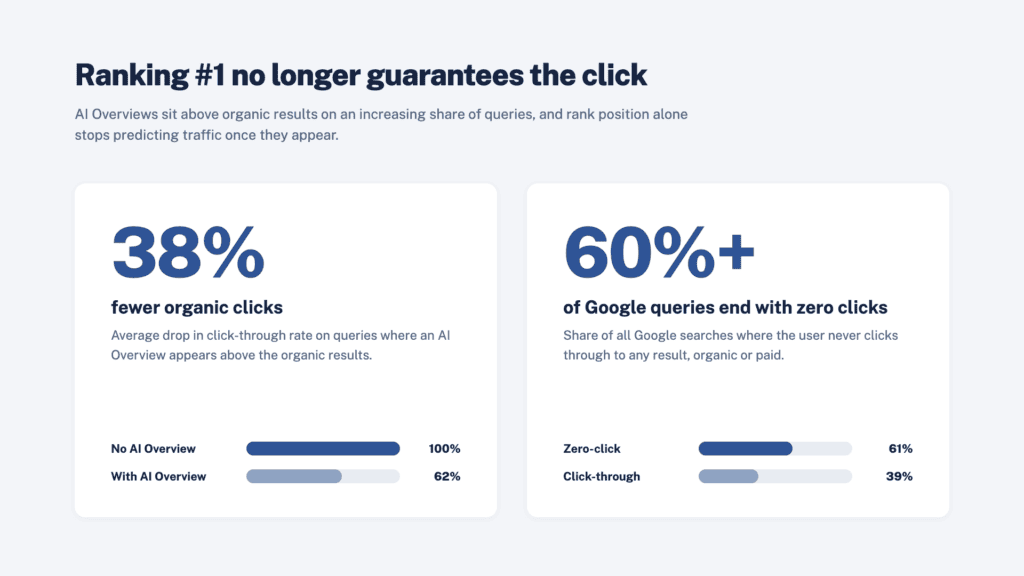
That question got more complicated once AI Overviews started reshaping the search results page. A study from Search Engine Land found AI Overviews cut organic clicks by 38% on the queries where they appear. Zero-click search has climbed past 60% of all Google queries. A page can rank first and still see traffic collapse if an AI Overview sits above it and pulls the click before the searcher even scrolls down.
That shift changes what a rank tracking tool needs to show an agency, as position alone doesn’t tell the full story anymore. Whether a client’s page gets cited inside an AI Overview, and how a competitor’s citation compares, has become part of the same conversation as traditional SERP position tracking. A few tools on this list have already built that tracking in, while others still treat it as a separate product.
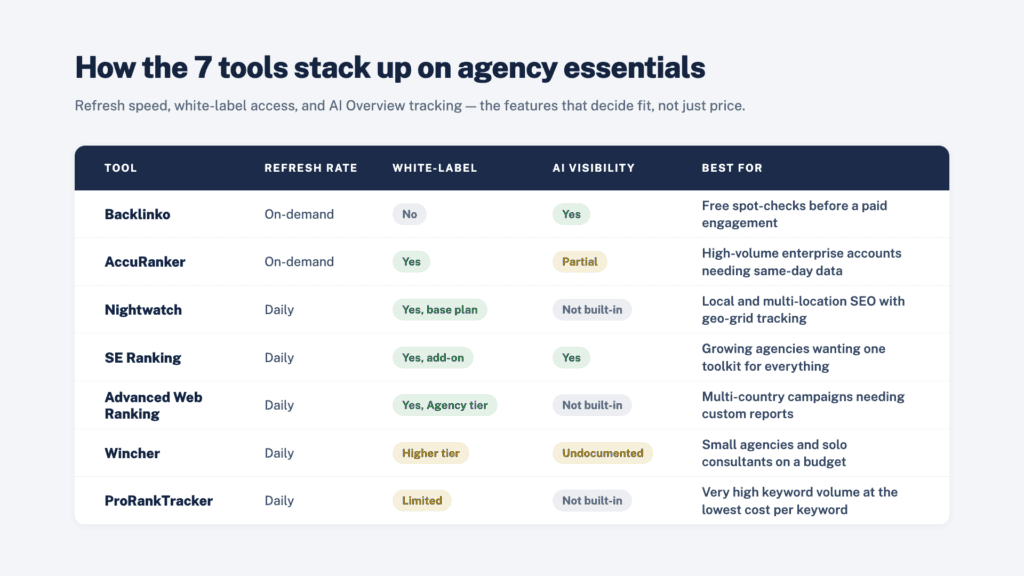
Visualization generated with AI
1. Backlinko
Backlinko’s free SEO tools hub offers 15 free tools, and the set includes exactly what a rank tracking workflow needs before agencies commit a client to a paid platform. Its free SEO checker audits your URLs and returns a prioritized list of on-page issues, a useful first pass before comparing rankings against competitors.
Backlinko’s Keyword Rank Checker shows where a domain ranks for a target keyword without an account or a subscription. It’s a fast way to spot-check a client’s position or a competitor’s before scoping a full tracking engagement. Pairing this tool with its Competitor Analysis will provide a snapshot of traffic, keyword, and backlink signals for any competing domain without needing to open a paid tool.
Backlinko also runs an AI Visibility Checker that queries ChatGPT, Perplexity, and Gemini directly to show how often a brand gets mentioned against named competitors. Given how much AI Overview visibility now factors into the ranking conversation, it makes a meaningful addition for agencies fielding AI visibility questions from clients who don’t yet want to pay for a dedicated citation tracking platform.
However, these tools won’t replace a dedicated agency rank tracker for daily monitoring across hundreds of keywords. What it does well is give an agency a free, credible way to check a client’s position and competitive standing before deciding whether the client needs a paid subscription.
Best for: Agencies that need to track rankings and competitive data before moving clients to a paid rank tracker. Good for solo consultants who manage a small roster and don’t have the need for daily automated tracking.
2. AccuRanker
Most competitors refresh rankings once a day. However, AccuRanker built its reputation on speed by offering on-demand checks. Agencies don’t have to wait for the next scheduled crawl as they can pull a fresh ranking the moment a client reaches out.
It tracks rankings across Google, Bing, and YouTube and monitors over 50 search engine results page (SERP) features. Its Share of Voice metric shows competitor visibility as a single trackable number over time. Its dashboard supports full branding, whereas its application programming interface (API) lets you pipe data straight into a client portal directly.
The tradeoff for most agencies is its steep pricing. As costs scale with keyword volume, large accounts may feel their budget scaling rapidly.
Best for: Agencies running high-volume campaigns for enterprise clients that seek same-day ranking confirmation.
3. Nightwatch
Built for agencies, Nightwatch’s base plan makes the biggest difference. Its base plan includes white-label reporting, unlimited user seats, and API access, whereas most competitors charge extra for the same features.
Rankings update daily across Google, Bing, YouTube, and DuckDuckGo. The local tracking is what sets it apart. Nightwatch supports geo-grid monitoring across more than 100,000 locations, so an agency running local SEO for a multi-location client can see rankings shift block by block rather than city by city.
Best for: Growing agencies that need client-ready, white-label reports without the enterprise-tier. Particularly good for agencies that run local SEO work.
4. SE Ranking
SE Ranking bundles rank tracking with site auditing, backlink monitoring, and keyword research, and its pricing is noticeably lower than that of the bigger all-in-one suites. For agencies managing anywhere from three to 10 clients, that combination covers most of what a standard SEO retainer demands.
Every plan includes daily position tracking across the top 100 results, split by desktop and mobile, with reporting across more than 35 SERP features, including featured snippets and AI Overviews. The AI Results Tracker extends that further, providing visibility across ChatGPT, Gemini, Perplexity, and Google.
The white-label Agency Pack adds scheduled client reports and custom branding for a modest add-on fee, keeping the platform accessible to agencies still building out their client roster.
Best for: Growing agencies that want a full toolkit in one platform without paying enterprise pricing for it.
5. Advanced Web Ranking
Advanced Web Ranking’s core differentiator is its comprehensive reporting and geographic precision. Agencies get granular location control while running campaigns across multiple countries or highly localized service areas.
Custom report building is the other differentiator. Agencies don’t have to work from fixed templates. They can construct reports around exactly the metrics a specific client cares about, then automate delivery on a schedule.
However, that flexibility comes at a cost. The learning curve is steeper than that of simpler competing tools, and white-label access is behind the Agency tier.
Best for: Agencies serving clients across multiple countries or regions. Firms that need tailor-made ranking reports.
6. Wincher
Wincher is the budget option on this list, and it doesn’t pretend otherwise. Entry pricing starts well below that of most competitors, making it a reasonable starting point for a small agency or a solo consultant managing a handful of accounts.
The feature set is leaner than the platforms that are built specifically for agencies. White-label lives behind a higher tier than competitors like Nightwatch. Also, AI Overview tracking isn’t clearly documented on Wincher’s own pages, so agencies that need that specific feature must verify it directly before committing.
Best for: Small agencies and freelance consultants managing a limited client roster who need accurate rank data without burning a hole in their marketing budget.
7. ProRankTracker
ProRankTracker’s pitch is simple. It costs less per tracked keyword than almost anything else on this list. It is a practical fit for agencies tracking thousands of keywords across a large client base or once volume climbs past a few hundred keywords.
The interface is rather basic when compared to AccuRanker or Nightwatch, and the reporting templates are not as flexible. What it delivers is accurate daily data at a price that scales sensibly, without the feature overload of a full SEO suite an agency might not need for pure rank tracking.
Best for: Agencies tracking very high keyword volumes across many clients that seek cost efficiency over polish.
What separates a good rank tracker from mediocre ones
While every tool in this list tracks position accurately, they seldom track it the same way. And the method matters more when you’re subjected to your client’s questions. Here are some key aspects that make a tool stand out in a sea of competitor rank monitoring solutions.
1. Refresh frequency
Tracking ranks daily has become the standard now. However, the term daily can mean anything from once a day, fixed crawl to on-demand rank checks available over the day. For instance, if your clients made an impactful change to their site and want to check its result in a day, then only a handful of tools in this list can help you accomplish that.
2. SERP feature coverage
If the rank tracking tool of your choice only captures ranks, then it misses more than half the mark, as featured snippets, local packs, and AI Overviews all sit above or beside the traditional ten blue links. Your client’s real visibility may depend more on whether they’re capturing one of those features than on where they sit in the standard list.
3. Historical data retention
If your tool shows only the ranking history of the past month, then it might be hard to prove the impact of your campaigns that run over a month. So, it is ideal to check retention limits before committing your client to a new rank tracking platform.
Also, while you’re in the evaluation phase, make sure that you validate the accuracy of your chosen tool. You can do this by running the same keyword across two different trackers across distinct time zones and locations to detect any discrepancies. While small discrepancies are normal and negligible, a large gap may warrant careful investigation and adequate caution.
Matching the tool to how your agency actually works
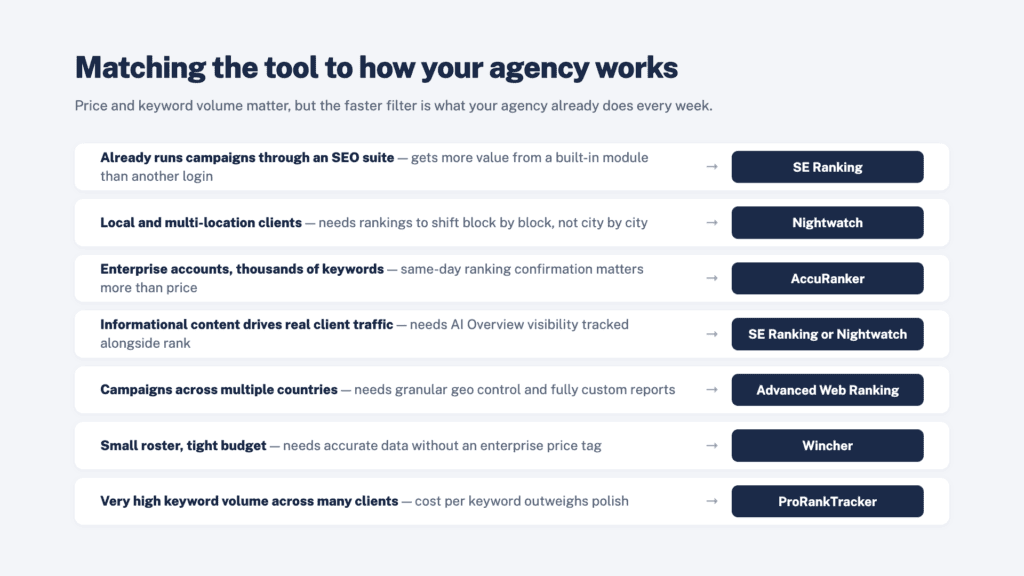
While looking for an ideal tool, price and keyword volume matter, but the more useful filter is what your agency already touches every week.
Visualization generated with AI
An agency running SEO campaigns through an SEO suite usually gets more value from the built-in rank-tracking module than from adding another login. An agency built around local clients gets more from Nightwatch’s geo-grid data than from AccuRanker’s raw refresh speed, even though AccuRanker wins on paper for enterprise accounts tracking thousands of keywords.
The AI Overview question deserves its own line in that decision.
If your client portfolio includes sites where informational content drives meaningful traffic, a tracker with built-in AI visibility saves you from running a second tool just to answer the question every client is now asking. That’s SE Ranking, Nightwatch, and Backlinko’s free AI Visibility Checker at the moment. AccuRanker offers partial coverage and is pushing deeper AI-answer tracking to a separate product.
Rank data and predictive SEO analytics are their own numbers in a spreadsheet. What makes them useful is pairing that movement with the actions that caused it, whether that’s a content update, a new competitor entering the SERP, or a shift in how often AI Overviews appear for a given query set. The agencies getting the most from these tools are the ones asking why the ranking moved, and building the next month’s strategy around the answer.
Building that kind of tracking and reporting workflow from scratch takes real time most agencies don’t have spare.
If you’re weighing whether to build it in-house or bring in a team that’s already run this for other B2B software companies, the Omniscient team is happy to talk through what that would look like for your specific client mix.