Key takeaways on AI SEO strategy
- Being cited and being recommended are not the same outcome. An AI platform can reference your content and still route the actual recommendation to a competitor with stronger reviews or a louder community presence.
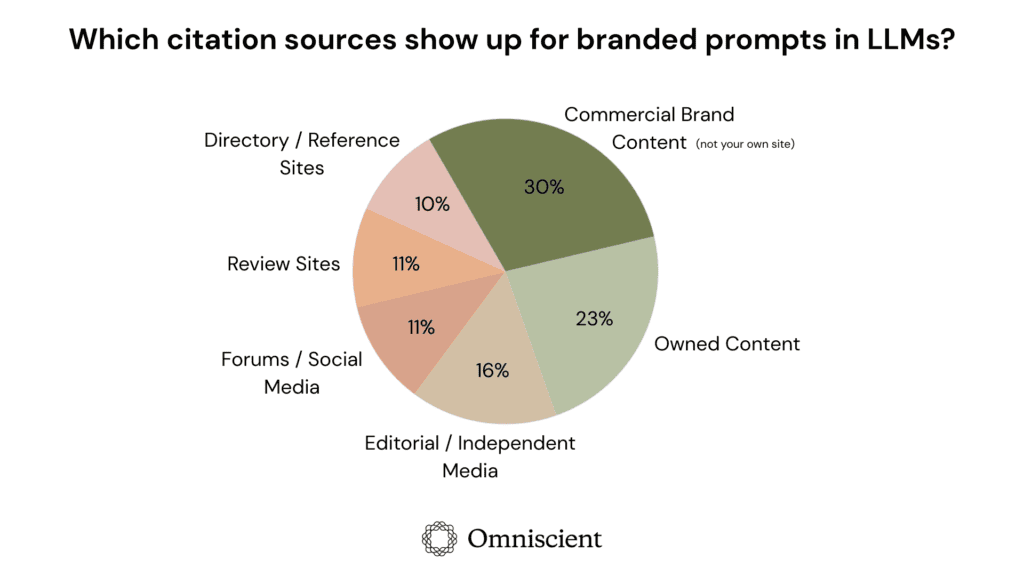
- Most of what shapes an AI answer sits outside your own website. Earned media accounts for 48% of branded AI citations against just 23% from owned content, so a strategy confined to your blog leaves most of the surface unmanaged.
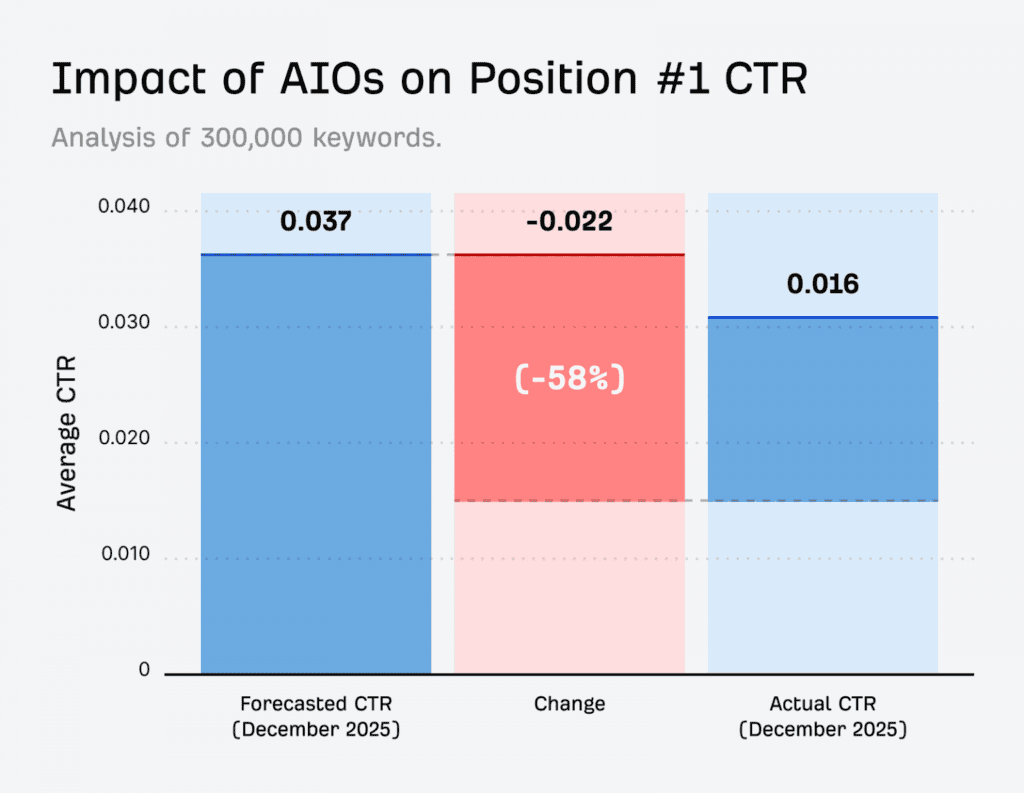
- Ranking first no longer guarantees the click. Pages ranking first see 58% lower click-through once an AI Overview appears, which means you now have to track visibility and traffic as separate things.
- A prompt list built from guesses underperforms one built from real buyer language. The teams seeing results start from sales calls, support tickets, and actual search behavior, not a spreadsheet of assumed questions.
Table of contents
- Key takeaways on AI SEO strategy
- What is an AI SEO strategy?
- How is AI SEO different from traditional SEO?
- How do you build an AI SEO optimization strategy step by step?
- How do you measure AI search strategy’s impact on pipeline?
- Build an AI search strategy that compounds, not just ranks
- Frequently asked questions about AI SEO and answer engine optimization
You’re probably not short on AI visibility data anymore. Chances are, you’ve got a tool tracking brand mentions across ChatGPT, Gemini, and Perplexity, with dashboards full of citation counts. But you may be stumped on how to turn those numbers into a plan.
Or maybe you even have a prompt list that you’re tracking. But where did it come from? If it’s built from guesses about what buyers actually ask, the visibility gains won’t show up in pipeline.
And these aren’t the only reasons an AI SEO strategy can fail. It’s easy to get caught up in optimizing your own site, but forget that most of what large language models cite lives on third-party pages, reviews, communities, and analyst coverage. An AI SEO strategy that stops at owned content leaves most of what influences those answers untouched.
This piece lays out how to close those gaps. It’s a framework grounded in real buyer research, technical foundations, and third-party visibility, measured against pipeline rather than citations alone.
What is an AI SEO strategy?
An AI SEO strategy is the system that makes your brand visible and credible across both traditional search and AI answer engines. It rests on three things:
- Technical foundations that let crawlers and AI agents parse your site
- Content built to be extracted and cited, not just read
- Off-page signals, reviews, mentions, third-party coverage, that tell a model your brand is worth recommending
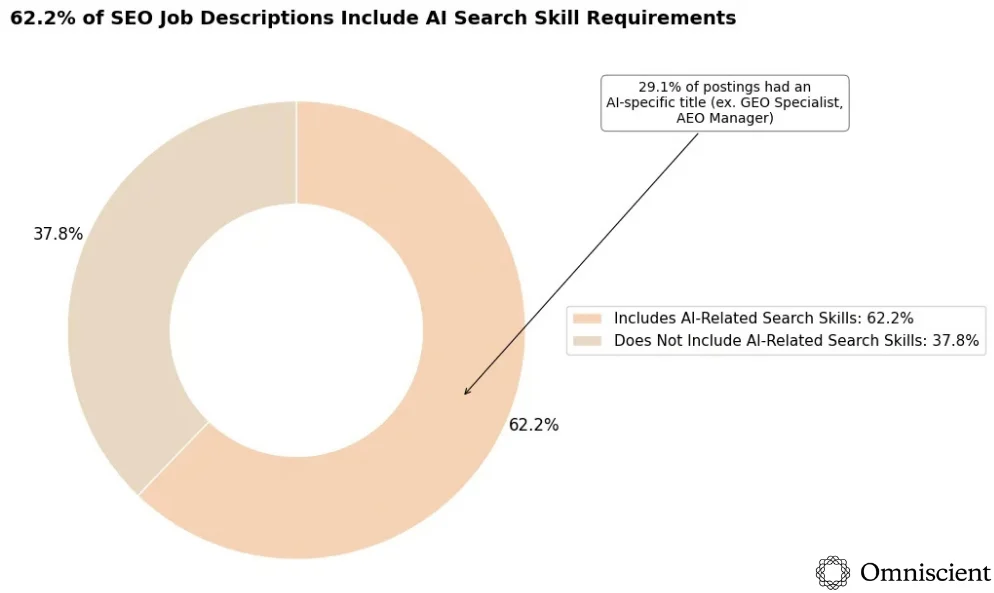
It isn’t a new growth lever bolted onto what you’re already doing. Case in point: AI search skills now appear in 62.2% of SEO job postings, up from roughly a third the year before. This goes to show that, while related, SEO and answer engine optimization (AEO) are distinct disciplines.
That said, it’s also possible to have a head start on getting cited and recommended by AI tools, for example, if you already had strong product-market fit and a clear market position. The AI layer amplifies what’s working rather than manufacturing demand from nothing.
None of that is a shortcut, though: tactical execution alone won’t get you an edge here, either. AI tools have closed the gap on basic SEO mechanics for everyone, so your advantage shifts to what’s harder to copy: original research, editorial judgment, and how widely that work gets reinforced beyond your own site.
How is AI SEO different from traditional SEO?
Traditional SEO optimizes for one outcome: rank high enough on the SERP to be visible and earn clicks. AI search complicates the value of “visibility”.
You can rank first and still lose most of your traffic. Ahrefs’ analysis of 300,000 keywords found that once an AI Overview appears, the top-ranking page sees 58% lower average click-through. The ranking didn’t change. The value of the ranking did.
That doesn’t mean SEO fundamentals stop mattering. Technical health, topical authority, and real buyer research still carry most of the weight. But what’s changed is the surface those fundamentals need to perform on. A site that’s fast, well-structured, and backed by genuine expertise is in a stronger position to get extracted and cited than one that’s just fast.
Brand familiarity cuts both ways here, too. AI models default to recommending companies they already recognize, which sounds like an advantage. Until a smaller or newer competitor earns a slightly better rating or a sharper point of differentiation and takes the recommendation away. Incumbency only buys you a head start, not a guarantee.
So there has to be a clear reason why an AI platform, or a buyer reading its answer, should pick you over the four or five others that also showed up on the shortlist. Let’s get into how to develop a strategy that provides solid justification.
How do you build an AI SEO optimization strategy step by step?
How long you spend on each step depends on how far behind, or ahead, your current visibility already is. Benchmark progress against your own starting point, not someone else’s published case study.
1. Audit your current visibility and buyer demand
If you’re in a niche B2B category especially, your buying committee asks different questions at different stages, and a generic keyword list will miss most of them. Instead, start with buyer demand.
This is where things often go wrong. Many teams skip this research and create a prompt list based on assumptions about what their target buyers type into ChatGPT. But 51% of B2B buyers start their research with an AI chatbot more often than with Google, so you can’t afford to guess if you want to be visible to them.
Build a model of the questions, comparisons, and buying criteria your buyers actually use. These may come from sales call transcripts, support tickets, win/loss interviews, and the comparison and alternative searches already showing up in your analytics.
Once you have that model, see where you stand. Answer these three questions:
- Where do you currently rank, organically, for the keywords that matter (i.e., high purchase intent keywords that actually fuel pipeline)?
- When you run those same queries, and their natural-language equivalents, through ChatGPT, Gemini, and Perplexity, does your brand show up at all?
- When it does show up, how is it described, and who’s it being compared against?
Wondering if your prompt list reflects how your buyers actually think, or just how your team assumes they do? B2B Buyer Behavior in 2025 breaks down how buyers in the LLM era actually research, build trust, and decide, straight from Omniscient’s own research.
2. Build content and technical foundations AI can trust
Once you know what buyers are asking, your content and technical work has a target to aim at.
- On the technical side: clean crawlability, logical information architecture, structured markup that gives AI systems an easy path to your content.
- On the content side: write to be extracted, not just read. Cite sources, back claims with actual data, quote credible voices instead of asserting things in the abstract.
That last point isn’t a style preference. A generative engine optimization study from Princeton and IIT Delhi found that adding citations, quotations, and statistics to content improved its visibility in AI-generated answers by 30 to 40%. Vague, uncited claims are easy for LLMs to skip right past.
Technical and content foundations are only half the picture once AI agents start reading your site. The AEO Field Guide covers the mental models and pitfalls worth knowing before you build further.
3. Expand authority with digital PR and off-page signals
Next is the step many AI SEO plans skip or at least underestimate. Omniscient’s citation research, spanning more than 23,000 AI citations, found that 48% of branded citations in AI answers come from earned media, press coverage, review sites, and third-party mentions. By contrast, owned content rings in at just 23%. Most of what shapes the answer isn’t on your site at all.
Also worth noting: “Being cited and being endorsed are different things,” per our Director of Organic Growth Strategy, Ben Major. An AI platform can reference your content and still send the actual recommendation to a competitor with stronger reviews or a louder community presence.
Digital PR, analyst relationships, and review site management aren’t optional additions to your AI SEO strategy. They’re the mechanism that gets you recommended instead of just mentioned.
4. Operationalize measurement and iteration
No single number tells you the whole story, so treat AI visibility as a set of diagnostic signals rather than as a single scorecard. Omniscient calls this a “metric constellation“.
Segment visibility by prompt intent, product line, and ICP, then pair what you see there with self-reported attribution and branded search trends. That diagnostic habit is also what lets you iterate faster than your content calendar probably allows: B2B content teams that borrow testing habits from performance marketers, shorter planning cycles, component-level reads on what’s working, catch what’s not landing months before a quarterly review would.
Knowing your AI visibility is up doesn’t tell you if it’s working. Measuring Organic Growth in 2025 looks at how marketers are rethinking attribution and confidence in organic metrics as AI reshapes the funnel.
How do you measure AI search strategy’s impact on pipeline?
Running the process above is a proven way to set yourself up for success, but of course, you still need to verify whether your AI SEO strategy is performing as expected.
Citation counts and share-of-voice dashboards are diagnostic, not proof: what your leadership actually cares about is whether any of this touches pipeline, and most first-party analytics can’t answer that on their own.
Our attribution research found that first-touch captured only 15% of AI-sourced leads. That’s a 6.8x gap against what buyers reported themselves when asked how they found the company, and the reason for this is no mystery: 87% of the brand citations behind those leads sit on third-party pages, invisible to any tag you control.
The solution is to pair prompt-level visibility tracking with self-reported attribution, branded search volume, and sales feedback on whether prospects are showing up already informed. A single survey question on a demo request form does most of the self-reported attribution work. It’s the same approach Omniscient uses in its own AEO work: tie visibility and citation patterns back to qualified pipeline instead of treating them as the finish line.
Build an AI search strategy that compounds, not just ranks
Measurement tells you whether you’re on track currently, but where should you invest next? Our co-founder and CRO Alex Birkett’s barbell framework is a useful way to think about where to put your effort:
- Roughly 70% in stable, predictable bets, brand building, earned mentions, owned audiences
- About 20% in more speculative, innovative plays
- 10% on refinement efforts, such as conversion rate optimization
Your job was never to win every algorithm update. It’s to build a system of buyer research, technical foundations, and measurement durable enough to hold up regardless of which surface people search on next.
More AI SEO plans die from chasing last week’s algorithm change than from a flawed strategy. Focus primarily on what already works.
If you want to see what this looks like in practice, Omniscient Digital’s case studies show how B2B companies turned organic and AI search visibility into qualified pipeline.
Frequently asked questions about AI SEO and answer engine optimization
Is SEO still relevant now that AI search exists?
Yes, it is. Most AI answer engines still depend heavily on organic search infrastructure, crawlability, structured content, and authoritative backlinks to find and evaluate what to cite.
What’s changed is the scope of what counts as a successful outcome: ranking well is necessary but no longer sufficient on its own. You can rank first and still lose the click to an AI-generated summary.
Treat SEO and AI visibility as the same underlying system, not competing priorities.
How do you optimize content for AI search results?
Structure your content so a model can lift a clean answer out of it:
- Lead paragraphs with the direct answer before the supporting explanation
- Use descriptive subheadings
- Back claims with citable data rather than vague assertions
- Add schema markup where it’s relevant
- Keep your information architecture logical
- Make sure your pages load fast enough that crawlers, including AI crawlers, can access them without issue.
None of this is groundbreaking stuff. It’s the same technical and editorial rigor strong traditional SEO already required.
Do you need an AI agent for your SEO strategy?
Not as a starting point, no. AI agents and tools are useful for monitoring citation patterns, tracking prompt-level visibility, and flagging content gaps at a scale manual review can’t match. But they’re not strategists. A tool won’t tell you why a cluster matters to your pipeline or what to do about a sudden drop in visibility.
Treat agentic tooling as an accelerant for a strategy you’ve already built on real buyer research. It shouldn’t be a substitute for building one.