We work with a client who has historically invested in SEO.
Though they have had ups and downs (more downs than ups recently – as is the case with many companies), they typically report strong non-branded traffic acquisition and a corresponding performance in leads generated through organic channels.
When we ran an AI visibility audit, we found their visibility to be surprisingly low in aggregate.
This is brand visibility for non-branded prompts (so things like “best [category entry],” or “I need a [product type] to do X, Y, Z.”):
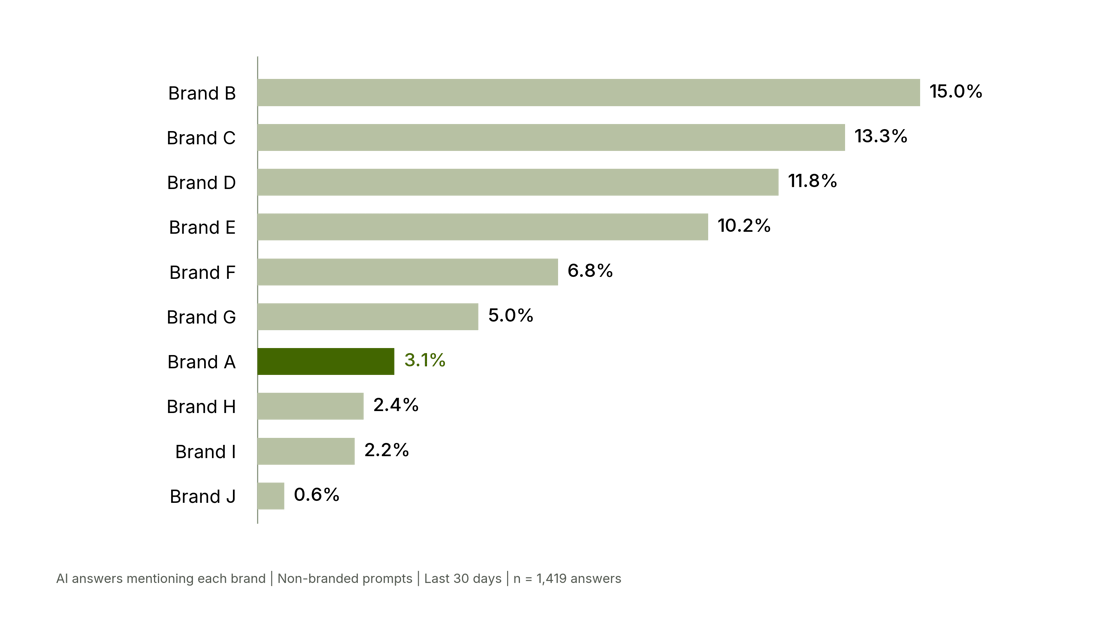
While I’ve anonymized the brands, for context, the top two are very large incumbents. The rest are within the same market tier as our client, so their 3.1% visibility was below what we had expected.
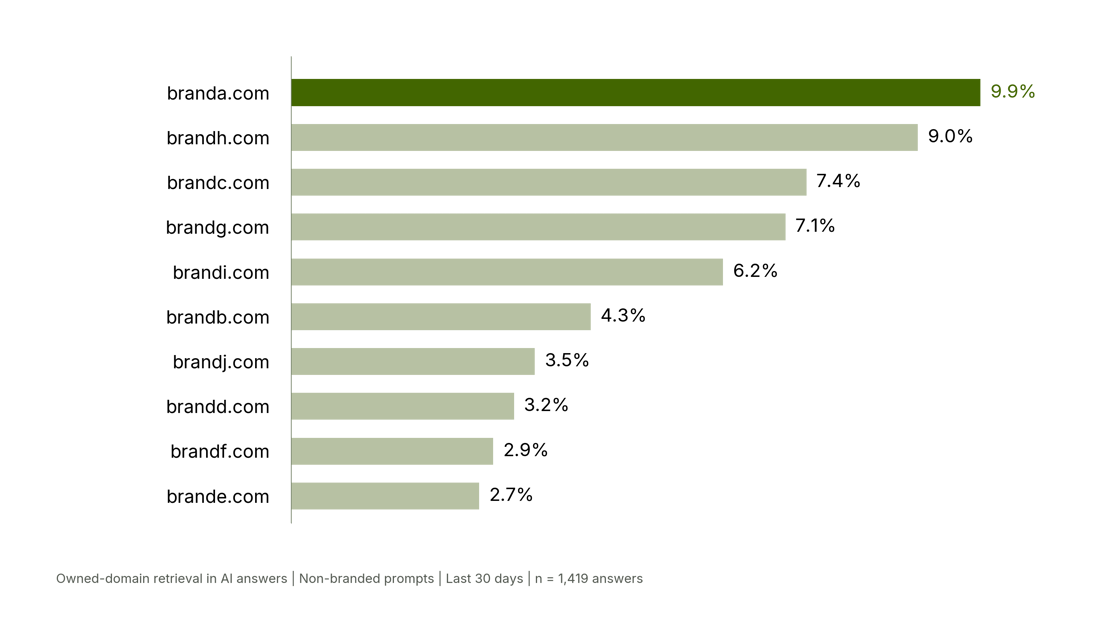
However, their retrieval rate was phenomenal.
AI engines were picking up their content, reading it, citing it – actually, at a much higher rate than direct competitors, as well as industry publications, Reddit, or any other domain:
The typical scenario for a brand that has historically invested in SEO and content marketing is that retrievals generally correspond to visibility, with some minor variation depending on the space and what shape their SEO program has taken (i.e. some programs have historically indexed more on bottom of the funnel content, which would naturally lead to higher retrieval rates when testing for BOFU prompts).
This was not the case for our client, nor their industry at large:
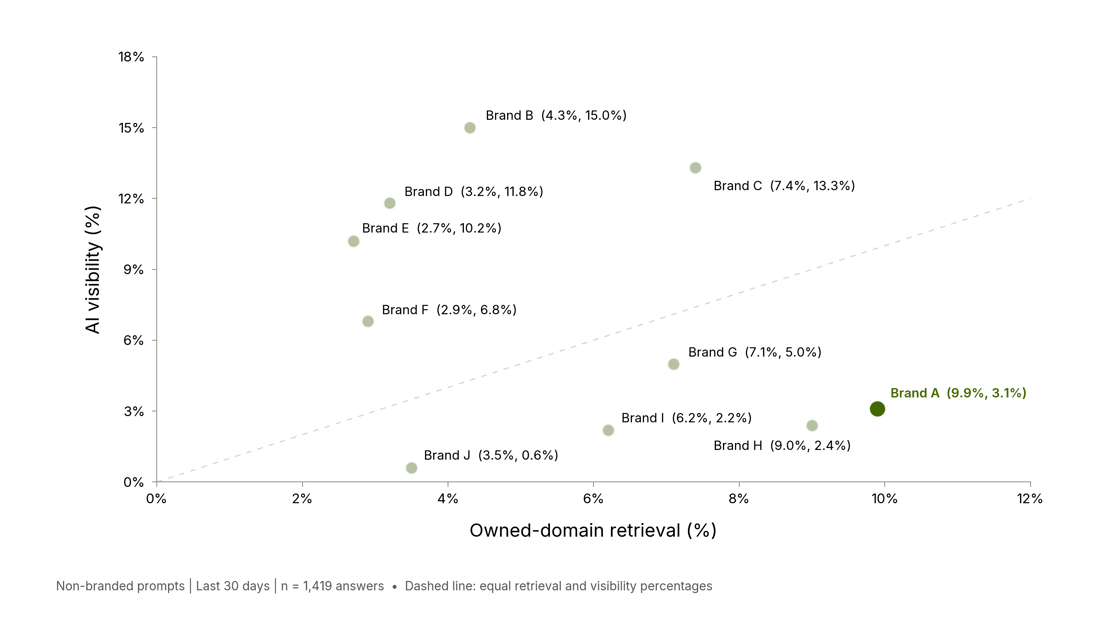
Our client, as well as two close competitors (Brand H and Brand I here), had substantially lower visibility than the rest of the cohort.
Of course, we then looked into their coverage on third party websites.
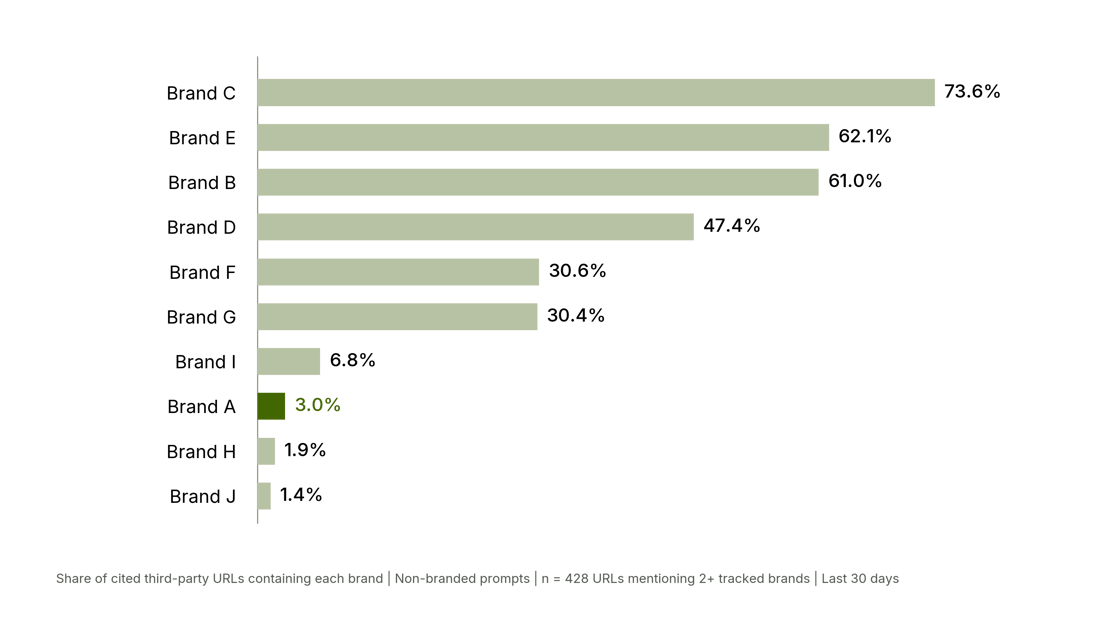
Turned out, as expected, they were rarely, if ever, mentioned on third party URLs. Only 3% of third party publications mentioned our client, whereas the category leaders (here Brand B and Brand C) were mentioned ⅔ to ¾ of the time. Huge, huge delta:
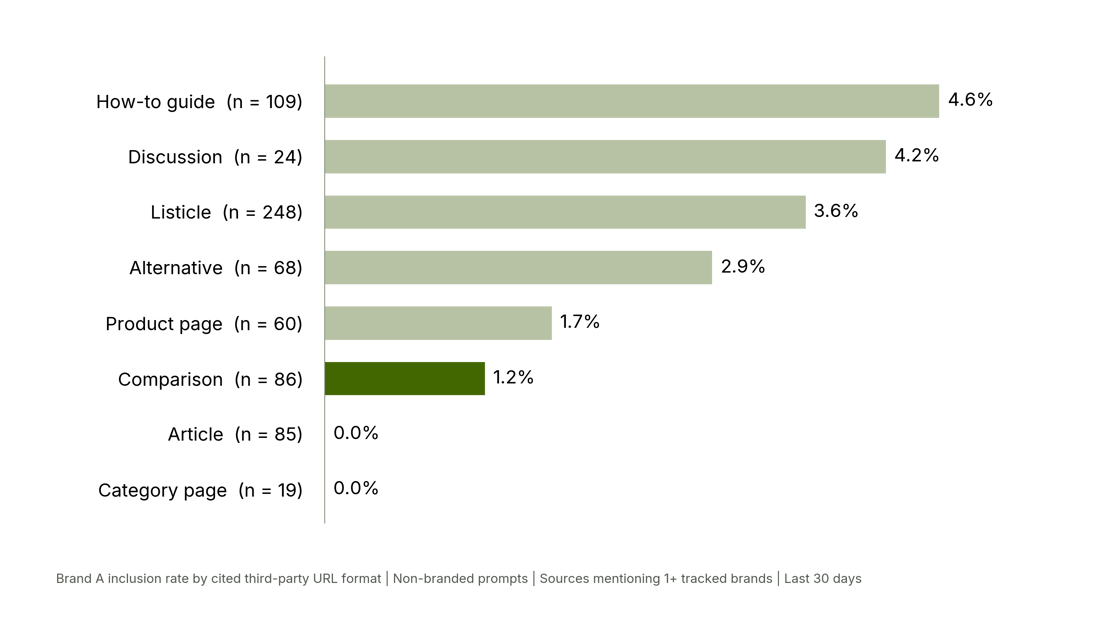
Broken down into specific page formats, they seemed to lack coverage in the places that are often leveraged by AI engines to inform answers about brand recommendations (listicles, comparison pages, alternative pages):
So what’s the story? Keep producing more content? Go reach out to all the third party sites and beg, buy, or build your way into being included?
Maybe, but I think there’s a larger story here, and I think it applies to many brands hoping to make AI search work for them.
The Ghost in the Machine
Seer Interactive published a study earlier this year that named this phenomenon “the ghost citation.”
They define a ghost citation as “when your content is trusted enough to be sourced, but your brand isn’t known well enough to be mentioned.”
Their hypothesis is that citations are generated post-hoc, almost like the choice-supportive cognitive bias, where you make a decision and only later rationalize why you made that decision.
Analyzing 541,213 LLM responses across twenty brands, they found that when a brand was mentioned in an AI answer, its underlying content was cited 53.1% of the time. When the brand was not mentioned, the citation rate dropped to 10.6%.
Kevin Indig, examining a separate dataset of nearly 4,000 domains, reported a similar finding: 62% AI citations are ghost citations, where the domain gets a source link but the brand name never appears in the answer text.
Now, there is a ton of nuance to this research, and I don’t have access to the full datasets. We cannot assume, for instance, that all content published by a domain is relevant or related to a product or service it sells. For example, my personal website writes (and is cited for) pages about AEO software. But “Alex Birkett” cannot feasibly be an answer when someone asks for “best AEO software” because I am a person and I am not AEO software.
But I’ve seen enough AI visibility data to know that this is happening to brands who sell products, create content about that product, and then get retrieved or cited but left out of the answer. That’s the AEO problem I’m thinking about.
Think Seer’s title puts it well, that “your content is working and your brand is not.”
This is a new kind of invisibility.
Retrieval vs Recommendation Mechanisms
Why does this happen?
Well, there is a certain opacity to these systems, so no one can give you a 100% certain answer.
But it seems to be structural as much as tactical.
In a retrieval augmented system, the retrieval step searches the available corpus, ranks information for relevance, and selects a subset to provide to the model as context. The generation step then uses that context (along with its instructions, the conversation, and what it already knows) to compose an answer.
That distinction matters because retrieval doesn’t guarantee influence. A page can be retrieved because it is relevant, authoritative, or contains useful information without meaningfully shaping the final response. A source may inform the answer without being cited. A brand may appear in the retrieved material without being mentioned at all.
Put simply, retrieval determines what information is available to the model. Generation determines what information actually shapes the answer.
Retrieval is largely about relevance. Generation is about which information becomes salient enough to use. They are related, but they are not the same thing.
A 37,000-run audit published in May 2026 tested this across 533 brands in 19 sectors, stratified by prominence level.
The researchers found that “failure modes” (meaning, the specific way a brand fails to get recommended by an LLM) differ by tier.
Lower prominence brands tend to fail at retrieval (i.e. the model never sees their content). But mid-tier brands, the kind with actual content and authority, tend to fail at generation. They are retrieved, enter the context window, and then the model passes over them in favor of names it considers more salient.
Being in the room is not the same as being called on.
Malthouse, Lee, Yang, and colleagues proposed a framework in September 2026 for measuring brand retrieval and brand recommendation as separate stochastic processes.
Their key finding was that conventional brand popularity, such that is measured by salience scores and market surveys, only tracks weakly with LLM recommendations.
A brand that dominates its category by traditional measures can be routinely omitted from AI answers about that category.
For what it’s worth, I don’t see this often in practice. Typically, well known brands, generally, perform well in AI search. But it’s not always the case.
The more interesting finding in the paper is that brands missing from generic answers can reappear when the user supplies distinctive positioning cues in the prompt. In other words, contextual cues, personalization, and longer tail prompts can shape model responses in different ways that generic prompts.
You know this, though: the model does not have a fixed brand ranking. It’s got a probability distribution that shifts with context.
This connects to what I wrote in Probability Engineering, covering the idea that AI search is a probabilistic system, not a deterministic one, and that the appropriate response is to shape a distribution of influence rather than hold a position.
The retrieval-visibility gap is what happens when you focus only on one probability distribution, namely that of your retrieval relevance, especially when divorced from contextual cues, positioning alignment, and presence in the broader web ecosystem. Or in other words, when a brand optimizes only for content performance without building a salient brand.
Salience, in both human and machine cognition, is winner-take-most.
Alba and Chattopadhyay’s 1986 experiments on brand recall found that increasing the salience of a single brand in a consumer’s memory suppressed recall of competitors. Even competitors the consumer knew well. There’s only so much mental space for the short list.
LLMs exhibit something analogous at the generation stage.
A ”fitted stage” model published in September 2026 maps this as a pipeline: real user demand, page fit, search and fan-out, evidence exposure, final selection.
A brand can pass every stage except the last one, which is where we find ourselves in the retrieval-recommendation gap.
The Positioning Problem
If the gap between retrieval and visibility is structural and is built into the architecture of these systems then the response cannot merely be more content, better optimization, or louder signals of the same kind, at least when dealing with a significant visibility gap.
The content already worked, and the model can already find it. The problem is that the model does not consider your brand as the best answer to the question.
This is, by and large, a positioning and proof problem, not an SEO problem.
Our client is cited but not mentioned because their content contributes to answers about their industry without establishing their brand as a category authority. The model treats them as a reference, a place to pull facts from, but not as an entity worthy of recommendation.
A retrieval provides information that could, in principle, come from anywhere. There’s an additional layer, often upstream, that associates the brand itself with the recommendation in a category.
Closing the Gap & Building for Recommendation
I recently ran a workshop for a PE firm and the marketing leaders at their portfolio companies.
We walked through a few case examples that would naturally lead to common AEO tactics like writing listicles or chunking a page for retrieval. I then reframed the strategic question as such:
First thought: “How do we optimize the [product page] for LLMs?”
Thought after thinking for more than a few minutes: “What would have to become true on [our website] and across the wider market for AI systems to believe [our brand] belongs in the [product category] consideration set?”
That’s the kind of thinking that leads to success in AEO and beyond, and it doesn’t naturally lead to any specific tactic.
With this situation specifically, however, you can imagine we would look into a few strategic levers:
- Bolstering first-party authority – while I said content wasn’t the problem, we do have an advantage, and that is we are already ranking and getting retrieved. Here, we can audit, sculpt, and improve our approach to not only provide information, but weave in unique data, point of view, and brand/product tie-in to associate the brand with the informational utility. Tactically, this looks like investing in proprietary data and original research, which this client has in abundance, and making distinctive claims that cannot be restated without naming the source. There’s also an opportunity to identify opportunities within the existing content retrievals to weave the product into the narrative to better associate it with the category and problem statements.
- Third-party corroboration – quite clearly, the brand is not mentioned often enough in earned media, analyst reports, review platforms, or the broader constellation of third-party sources that are showing up. Part of this is tactical (reaching out, running the well known playbooks), part of this is upstream positioning and brand work. This client in particular struggles with identity and positioning, so solidifying who they are, who they are for, and what they are best at allows more targeted digital PR work. This is intuitive: when the model encounters your brand name in multiple independent sources during retrieval, the associative weight increases. You move from background reference to foreground recommendation. Digital PR, in this frame, is less about links and more about training the model to associate your name with the category.
- Brand entity resolution – to me, this is the alignment of the vectors, beginning with foundational positioning and echoing through the technical infrastructure of the website, the content and how it is organized, and the third party ecosystem that corroborates claims. Some of this is tactical like schema markup, Wikidata entries, consistent naming conventions, and third party outreach. Some of this is tangential or even orthogonal to AEO, such as which conferences or podcasts the CEO speaks at and how ad dollars are allocated. It’s interrelated, because we are building a salient brand, only some of which comes from content marketing.
Then there are experiments, trials, and campaigns against subsegments of the categories we are tracking. But the holistic picture hopes to answer that question:
“What would have to become true on [our website] and across the wider market for AI systems to believe [our brand] belongs in the [product category] consideration set?”
The New Invisibility
The retrieval-visibility gap follows many trends we’ve seen play out the past few years, some of which feel like a broken promise. That implicit promise was that if you produced good work, the system would credit you for it with clicks, visibility, and value to your business.
Of course, we’ve seen the decay of informational content, cannibalized by featured snippets and then AI overviews and then zero click environments. I can’t imagine recipe website owners are popping champagne right now.
This invisibility is a bit different, though, in that it exposes a gap that always existed, namely that excellent content execution does not necessarily intertwine with brand or business relevance. There were always factors above, beyond, and around content production and optimization that drove inbound success.
Now, AI models can use your thinking without using your name, which may have a nominal benefit, but is fundamentally less valuable than being recommended as a solution against commercial queries.
The old game was getting into the index. The new game is getting into the answer. And we see several trends converging, such as the branded proportion of traffic increasing across our portfolio and more discovery happening in untrackable zero click environments before someone visits your website.
This, both in AEO and outside AEO, means that being a brand is the point.
Want more insights like this? Subscribe to Field Notes