I’m a talker.
I talk to VCs, CMOs, SEOs, and agency founders every week. Coffees, lunches, Meet chats, dinners, and a few cocktails.
I’m a listener, too. And the most common thing I’m hearing: it’s harder than ever to stand out.
Perennial problem in marketing, of course (perhaps the universal problem).
But now more than ever, it’s hard to get attention.
This is true tactically. AI has equalized median output.
AI-generated web pages grew from 82 million to 312 million per month in two years. The cost of a blog post dropped to the level of a premium Claude subscription. Seven and a half million blog posts are published daily. Yet only 6% of B2B marketers say AI tools have significantly improved content performance.
More content, same results. The treadmill is faster, but nobody’s getting anywhere.
Is anyone here enamored with the folks leaving AI-generated comments on their LinkedIn posts? Do you all read the listicles generated at scale by tech companies? Is this thing on?
But the noise problem exists upstream of tactics, too.
More companies are being built, and many of them sound the same. Folks call this the “sea of sameness” problem, and it’s only getting worse.
If you work in organic growth, AI search, SEO, etc. (and I’m sure you do if you’re reading this), how many times have you heard something like this on a homepage, LinkedIn post, or outbound email:
“If you’re not in ChatGPT answers, you’re invisible”
It’s, like, the most common refrain now. It may have replaced “AI won’t replace you – someone using AI will,” as the most vacuous mimetic phrase on LinkedIn. You’ll see these phrases quietly pop up over time 😉
That claim isn’t even technically accurate (I’ll be pedantic about probabilities and personalization elsewhere), but more importantly, it’s boring and trite. It sounds identical to a thousand other companies making identical assertions with identical confidence.
April Dunford calls the kernel of differentiation a “market point of view. This is your company’s informed and unique perspective on how the world works and why your approach is right.
Without a POV, you don’t stand out, and downstream tactics and channels suffer from lack of differentiation. You can publish 100,000 blog posts, but if there’s no there there, it’s like adding a bunch of small numbers up. It still equals a very small number. With a strong point of view, everything downstream gets sharper: positioning, messaging, content, sales conversations.
But where does a good market point of view come from? Sometimes from an ethereal realm, but most often it comes from original data and insight.
The Real Job of Content: Be The Source
When I worked at CXL, Peep communicated his editorial standard very simply:
Anything we publish should be the absolute best and most comprehensive resource on the subject. The reader shouldn’t have to read anything else about it.
This is the underlying heuristic that, to me, also applies to original research.
Your goal isn’t something superficial like outranking competitors or driving 3% MoM traffic growth to appease a waterfall forecast.
It’s to be the source – whether that is the source cited by AI engines, ranked by search engines, or bookmarked by your ICP.
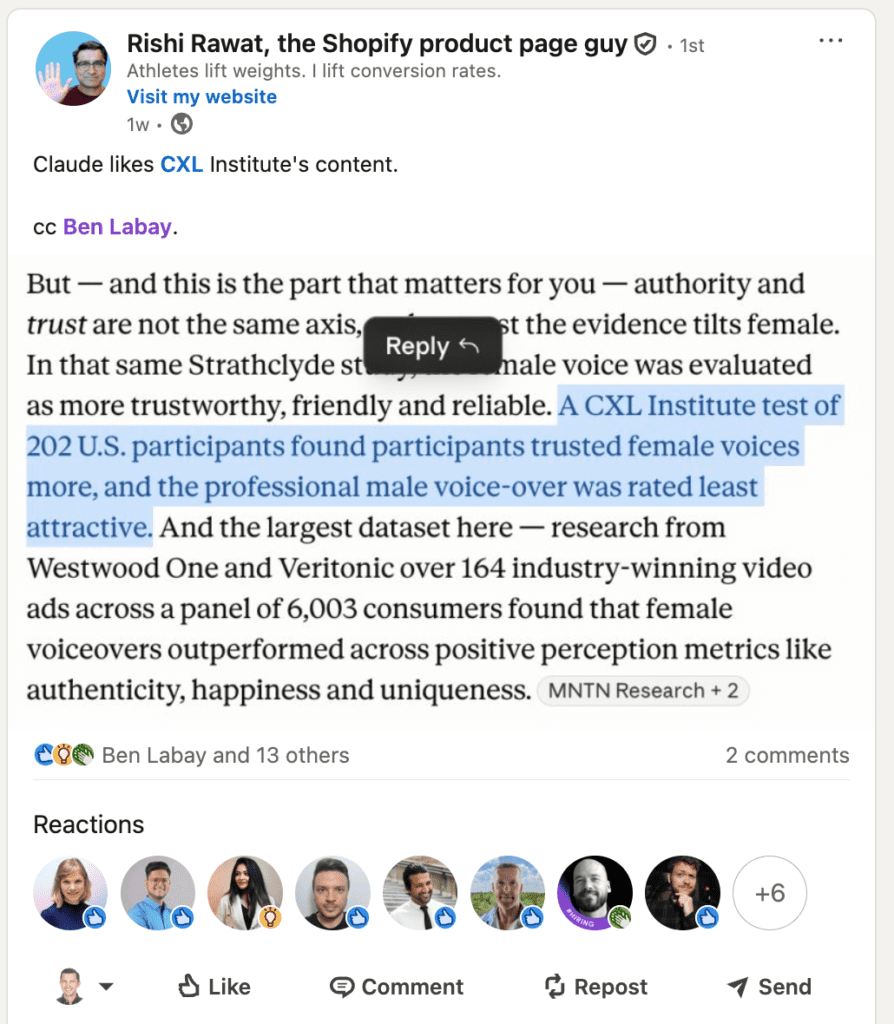
You’ll find (and I’ve seen) that this has long term and serendipitous effects, many of which are apparent in AI search (more on that later). See here an example of CXL’s research showing up in AI search:
AI search is complicated and evolving constantly, but we’ve whittled it down to a three prong framework any brand can use to improve performance.
- You can be the source (produce original content that AI models cite directly).
- You can be included in the source (get mentioned in content others produce that AI models cite).
- Or you can shape the narrative (change the conversation itself so the terms favor you).
Most of the AEO conversation focuses on levers one and two, and within that conversation, we as an industry tend to focus on visible and discrete tactics. Get on listicles. Add data points or personal stories to your blog posts. Change all your title tags from “Best” to “I tried” so it looks personal. Optimize for passage-level retrieval.
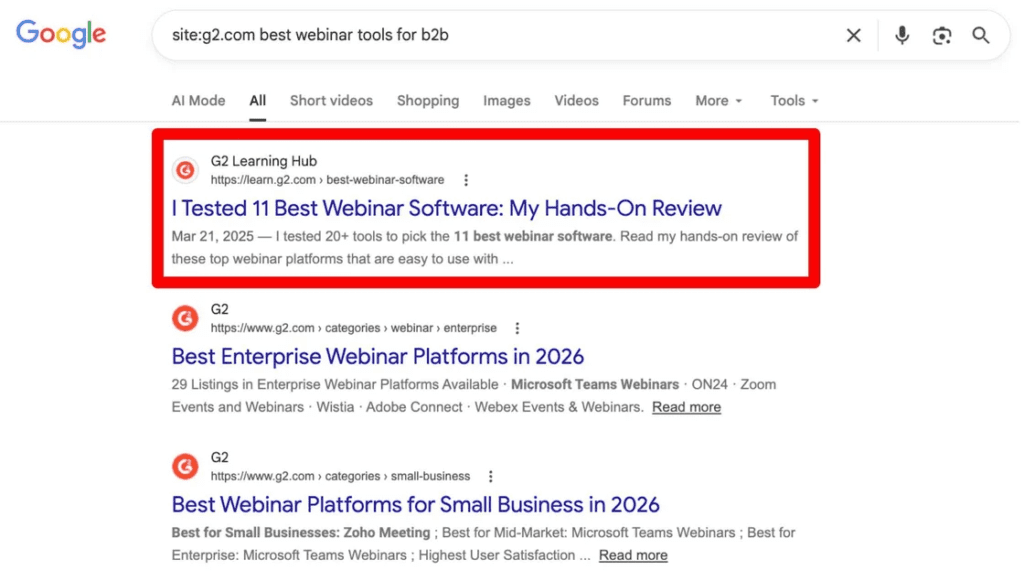
Not denigrating any of these. Let’s experiment, learn, move forward. I would never shame someone for trying out an LLMs.txt file, because the risk and effort is low and, hey, who knows.
But we need to consider that if a tactic is easily replicated, or “cheap” in another phrase, then it is likely not a substantive advantage over time. As Marc Andreessen put it, “when one thing becomes cheap, something else becomes valuable.”
Original research is a strong way to stand out and build a more robust owned content approach. Presence AI found a +112% citation lift for content containing original research across AI platforms. Averi’s benchmarks show original research and data-rich benchmark reports are cited at 3–10x the rate of standard blog posts.
Our own log file analysis confirms this, directionally. After homepage and service pages, our original research pages are the most frequently visited by AI crawlers, by a pretty strong margin. I ran a similar analysis for an AI recruiting software client and found the same pattern. Research pages punch far above their weight.
Over the long arch of time, AI models need to cite credible sources, lest they eat their own tail.
Original data with methodology, sample sizes, and novel findings is inherently more citable than a rehashed blog post summarizing someone else’s data. You can’t fake a dataset (ethically at least, though I’m sure SEOs will try – good luck with the brand backlash there).
The costly signaling framework applies: the expense and effort of producing real research is precisely what makes it a reliable signal in an environment saturated with cheap ones.
Think Beyond SEO: Shape The Narrative
Let’s ignore the whole “being cited” thing for a second. It’s unclear how valuable that is, and we don’t necessarily know what prompts people are tracking, what methodologies they are using, or how often these citation sources change.
In general, I’d rather sway the conversation than be a footnote within it.
This is Wil Reynolds’ Real Company Stuff. This is marketing.
Brand marketing can do this broadly. Artisan’s “Stop Hiring Humans” ragebait billboards shifted the AI-in-sales conversation regardless of whether you liked the take (editor’s note: I don’t, and I also have a distaste for ragebait).
Sometimes shaping the narrative requires a subtler approach. We have several enterprise clients whose AI answers surface inaccurate, outdated, or incomplete information about their brands. Sometimes, they surface negative stories from years past. What’s required is not more blog posts, more on-page SEO/AEO, or even more brand mentions in listicles. It’s rooting out the misinformation and replacing it with better stories.
For B2B brands without billboard budgets (or the stomach for incendiary brand or guerilla marketing), the most reliable narrative-shaping mechanism is original research.
The way it works is simple.
You publish a study. The findings become talking points. Those talking points spread through social posts, private dinners, newsletter mentions, conference talks, podcast appearances. You pull the most interesting ones into some of your sales materials.
One study is a drop in the ocean, but you conduct many of them, some of which hit on a real question or pain point, and YOU as a source begin to be recognized. Slowly, your research becomes the spine of the industry conversation. Instead of reacting to someone else’s framework (citing their data, arguing within their framing) you’re setting the terms. You’ve moved from player to rulemaker. For examples, see Profound and Ahrefs. Every day I see everyone on LinkedIn arguing about some data they’ve published.
Think about how this plays out in AI search specifically.
When someone asks ChatGPT or Claude or whatever about a topic your research covers (“how are AI overviews impacting search traffic?”), the model may find your study, but it also finds that many newsletters that quoted your study, the podcast episode where you debated the findings, the dozens of LinkedIn posts summarizing the research, and the media mentions from your syndication campaign.
It’s a surround sound effect for a data point.
Your single piece of research has seeded the citation network at multiple points. The probability of appearing in any given AI response increases not linearly with mentions but combinatorially because each derivative touchpoint creates a new retrieval path.
When people talk about LinkedIn as a citation source, it’s often due to this echo or ripple effect. Much of our own citation data shows LinkedIn posts referencing our research (and of course, some very terrible Pulse listicles):
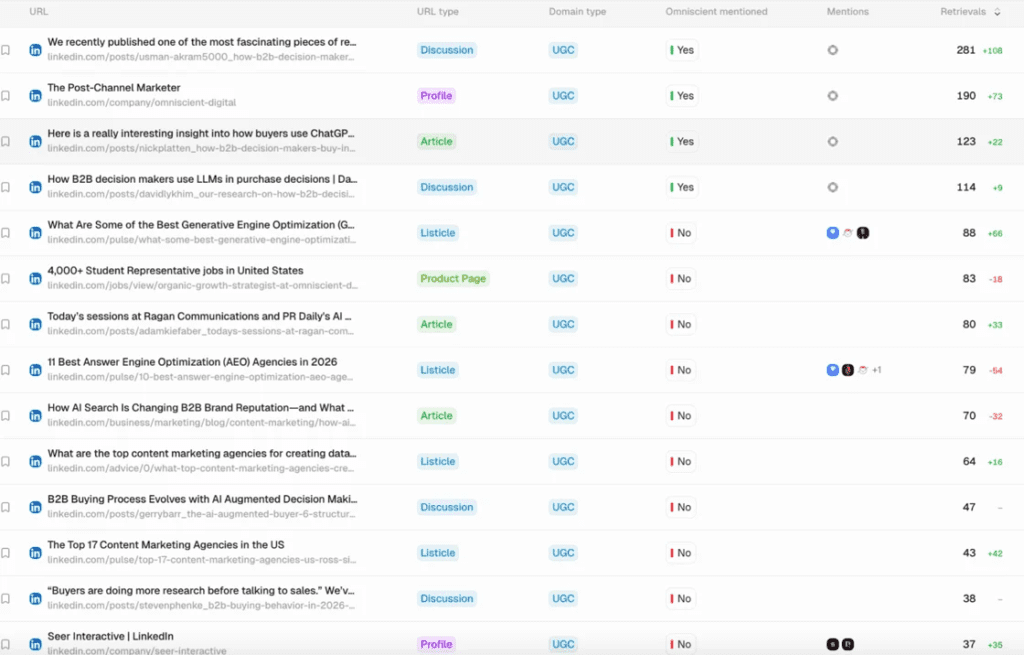
So we’ve experienced this directly as a function of AI search, but also in a broader and more fundamental way.
We use our own research heavily in positioning, messaging, and sales. While you’ll need to tell me your budget before I show you our sales deck, know that our market POV is backed by original data and so are our methodologies. The data gives us a point of view that’s specific, defensible, and impossible to confuse with anyone else’s.
And hey, our program is nascent. We’ve only published a dozen or so studies, and we’re just getting started. I would love to have a look at CXL or Wynter’s citation data and see the benefits of both time in market and high signal data-driven publications.
Original research provides the evidentiary backbone for your market point of view and helps shape the industry narrative around it.. It transforms an opinion, which anyone can have (and does have) and which AI can generate in seconds, into a position. Opinions are cheap. Positions benefit from proof.
The Research Flywheel
Original research is expensive, comparatively at least. It takes longer to produce than a blog post. It requires methodology, data collection, analysis, editorial judgment, and when done well, intellectual honesty.
This is precisely why it works: it’s a costly signal in a market drowning in cheap ones.
But the ROI math changes dramatically when you account for the derivative value.
A single research report generates: the report itself, cited by AI models and linked by industry publications. Social content sharing individual findings as standalone insights, each data point a post. Conference and podcast talking points (findings give you something to say on stage that nobody else can say, because nobody else has the data). Newsletter content for months. Sales enablement (think specific data points for specific objections, replacing vapid claims with evidence). Video content – walk through findings, debate implications, react to the data.
The majority of marketers who published original research said they’d invest again.
Each derivative format stands on its own as effective content. But the tangential benefit is that each one also builds your presence across the information ecosystem that AI models ingest. The social post, the podcast appearance, the conference talk, the newsletter mention – they’re all marbles in the bag that AI engines can pull from.
This is where the flywheel metaphor is apt, especially as SaaS 2.0 brands are seeing traffic and click declines across the board, largely due to a surplus of fairly consensus content pages getting eaten away by AI answers and increased competition.
It’s Cheaper Than It Looks
The objection is often cost.. Original research is 3–10× more expensive per piece than a standard blog post. But the comparison isn’t apples to apples.
First, one research report doesn’t equal one blog post even in terms of output. One research report creates many derivative assets, each of which attracts its own derivative benefits (links, shares, mentions) that impact your retrieval rate and brand visibility in AI, which increases your salience, which starts a flywheel effect.
Second, original research begets original research. What we’ve found is one study, conducted well, will open up several new angles and follow up experiments and research. Some of this can be run from the same dataset even, and some of it can be run across time. A good business question becomes its own sort of Hub and Spoke.
Signal in the Noise
The market is noisy and getting noisier.
AI has made it trivial to produce content that sounds, on the surface, smart. It has not made it trivial to produce content that is smart, whether grounded in hard fought experience, stylistic flair, or novel data and insights that help people make better decisions.
Many companies are trying to win by producing more content, faster, cheaper. Sometimes that’s the answer. Often, it’s a race to the bottom, subject to the capricious whims of the next algorithm update that wipes your chips off the board. I’ll take the robust play. I’ll take the long game.
Want more insights like this? Subscribe to Field Notes