
Most lists of technical SEO agencies look the same: a few criteria, a ranking, a number at the top you’re supposed to trust. What they rarely address is that technical SEO problems aren’t universal, and neither is the expertise to solve them.
For example, a B2B SaaS company fighting crawl budget on a JavaScript-heavy product site has a different problem than a retailer managing half a million SKU pages. This is just one scenario to illustrate that the right technical SEO agency depends on your stack, your scale, and what’s breaking.
The list below covers five trusted technical SEO agencies, along with the use cases they’re best for to help you make the right call.
Table of contents
- At a glance: The 5 best technical SEO agencies
- The 5 best technical SEO agencies by use case
- Omniscient Digital: Best for tying technical SEO to pipeline
- Onely: Best for fixing JavaScript rendering failures at scale
- iPullRank: Best for addressing technical debt and AI search visibility
- Amsive: Best for managing crawl and indexation at retail scale
- NP Digital: Best for running technical SEO inside a global marketing program
- What makes a strong technical SEO agency
- When to hire a technical SEO agency
- Choose the right technical SEO agency for your stack
Disclosure: This guide is published by Omniscient Digital. We’ve included ourselves because we offer technical SEO as a core service for B2B SaaS companies. However, every agency on this list was evaluated against the same criteria.
At a glance: The 5 best technical SEO agencies
| Agency | Best for | Starting price | Key differentiator |
| Omniscient Digital | Tying technical SEO to pipeline for B2B companies | $10,000/month | Pipeline-tied organic growth program |
| Onely | Fixing JavaScript rendering failures at scale | Contact for pricing | JavaScript SEO research and rendering |
| iPullRank | Addressing technical debt + AI search visibility | Contact for pricing | AI search + technical SEO integration |
| Amsive | Managing crawl and indexation at retail scale | Contact for pricing | Enterprise data stack and AEO |
| NP Digital | SEO inside a coordinated global marketing program | Contact for pricing | Global scale, content-structuring SEO |
How we evaluated these technical SEO agencies
We applied four criteria to every agency on this list: named technical SEO specialization with a documented process, crawl and indexation depth (crawl budget management, log file analysis, site architecture), JavaScript and modern web stack competency, and implementation support beyond the audit — developer-ready outputs, not just a PDF. According to the State of Technical SEO Report 2024 from Aira and Women in Tech SEO, 28% of technical SEO professionals cite technical debt as the biggest risk to technical SEO success, with organizational lack of resources second at 23%. That pattern makes the fourth criterion — implementation support — a meaningful differentiator, not a nice-to-have.
The 5 best technical SEO agencies by use case
The agencies below represent five distinct use cases. None of them is the best technical SEO agency for every situation. The right choice depends on your industry, site architecture, and whether you need a specialist or an integrated program.
Omniscient Digital: Best for tying technical SEO to pipeline
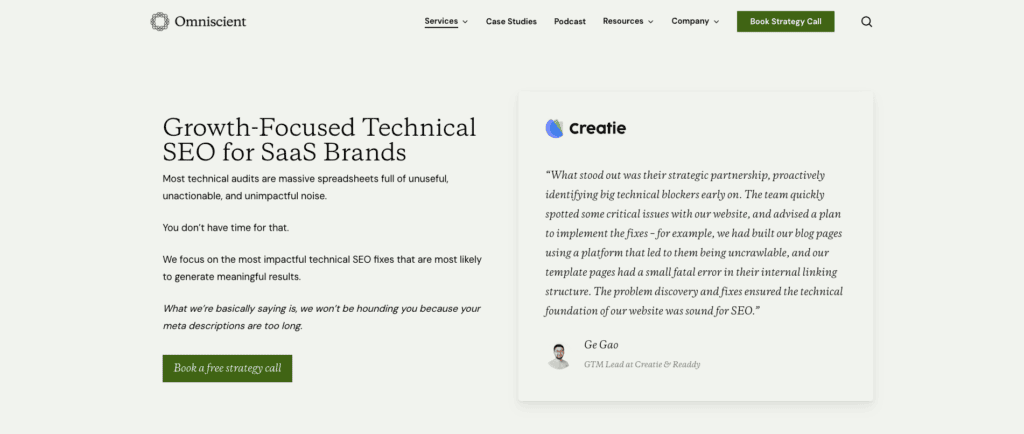
Best for: Tying technical SEO to organic pipeline in a B2B SaaS business—where performance is measured by revenue and qualified leads, not traffic volume alone
Omniscient Digital is an organic growth agency that works exclusively with established B2B companies. Our technical SEO service operates as a foundational layer within a broader organic growth program that spans B2B SEO strategy, content, digital PR, and generative engine optimization—all tied to pipeline and revenue rather than traffic metrics. Omniscient has a five-step technical SEO process: align on business goals, run the audit, document all action items, prioritize by effort and impact, present recommended actions. We deliver developer-ready tickets in Jira, Asana, or whatever project management tool you use to remove the handoff gap where most audit findings die.
Pros:
- Proactive bug monitoring, backlink building, and analytics tooling are ongoing components of the engagement rather than separate add-ons, which means technical issues are caught between audit cycles rather than only when a new project is commissioned.
- Service scope includes site migrations (domain migrations, CMS overhauls, structural restructures), international SEO (hreflang implementation, URL structures, cross-market content serving), and log file analysis. We cover the full technical surface, not just the standard on-page checklist.
- Omniscient applies AI to improve technical SEO strategy and identify which fixes are most likely to move the needle, so the engineering team focuses on the 20% of changes that matter rather than working through a long, undifferentiated list.
Cons:
- We’re not the best for early-stage B2B brands, or ecommerce and B2C companies.
- Engagements start at $10,000/month, so this may be cost-prohibitive for some smaller companies.
Pricing: Full-service organic growth engagements start at $10,000/month.
Results: Without help, GatherContent grew organic sessions 867% and blog-attributed leads 62%. AppSumo also grew organic traffic 843% and revenue from organic traffic 340%.
Onely: Best for fixing JavaScript rendering failures at scale
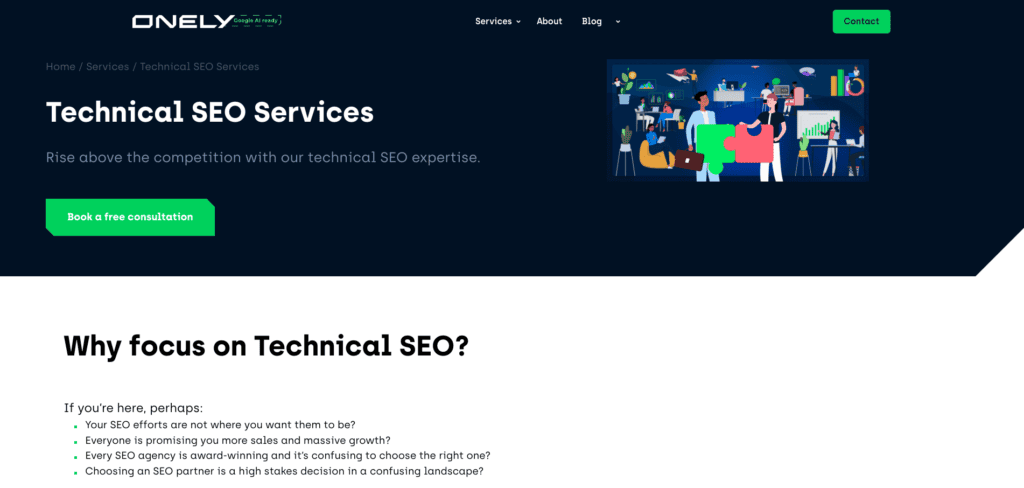
Best for: Diagnosing and resolving JavaScript rendering failures at scale, especially for e-commerce and marketplace sites where rendering delays are directly suppressing crawl coverage and indexation
Onely is a pure-play technical SEO agency with a research-first reputation built on original work in JavaScript SEO, including landmark rendering studies cited by search engineers and practitioners. The agency scopes every engagement around site infrastructure and rendering performance rather than content production or link acquisition. This model has attracted large e-commerce and marketplace clients for whom JavaScript rendering and crawl efficiency are the primary organic growth constraint. Clients include eBay, Realtor.com, RugsUSA, and Miele.
Pros:
- Founder Bartosz Goralewicz sits on the Bing Customer Advisory Board, giving the agency direct access to search engine advisory bodies that most boutique technical SEO agencies do not have.
- Onely pioneered JavaScript SEO research, including a landmark study confirming that Google requires significantly more time to crawl JavaScript-rendered pages than HTML. This work was work cited by John Mueller and Will Critchlow and is now foundational to how enterprise JavaScript sites approach rendering decisions.
- This agency offers a full technical service scope: JavaScript SEO, Core Web Vitals, server log analysis, information architecture, international SEO, AI-aware migrations, and traffic drop recovery. It covers many of the rendering and crawlability issues that compound fastest on large e-commerce and marketplace sites.
Cons:
- If you’re considering using the agency’s content strategy service in addition to technical SEO, you’ll need in-house resources or a separate agency to actually produce the content. Onely doesn’t do any content production.
- Pricing is determined hourly based on project scope — no retainer tiers, package pricing, or published rates are available, so clients cannot estimate cost before an initial discovery call.
- As a specialist boutique, Onely may face bandwidth constraints for large enterprises managing multiple simultaneous technical workstreams across many markets and subdomains at once. (This is an inference from their specialist positioning, not a stated limitation.)
Pricing: Onely charges an hourly rate based on project length and complexity, determined after an initial discovery call — there is no fixed retainer or published rate card.
Results: Europejski Fundusz Leasingowy SA saw a 129% increase in organic traffic after full implementation of Onely’s technical recommendations. On the other hand, Stratos Jet Charters recorded a 1,931% increase in overall SEO visibility and 195% growth in organic traffic following the engagement.
iPullRank: Best for addressing technical debt and AI search visibility
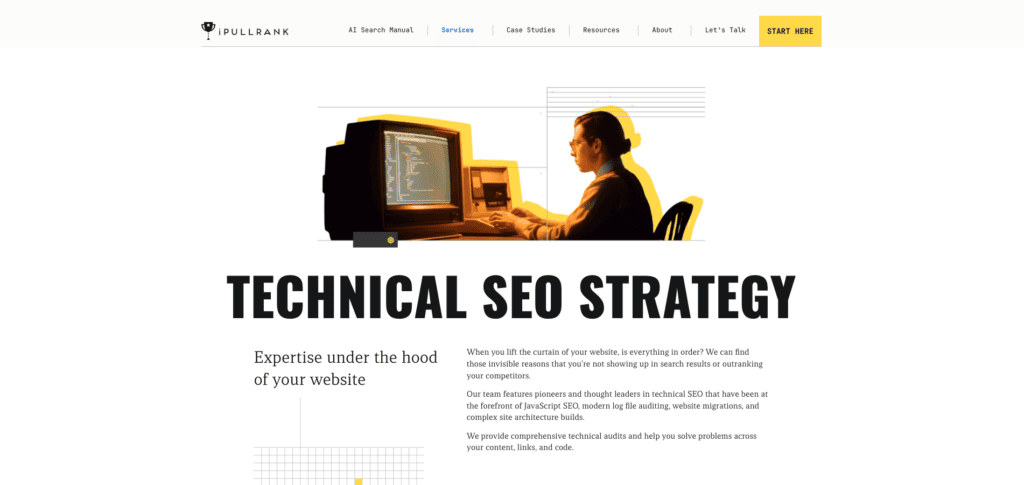
Best for: Addressing deep technical debt while building AI search visibility, particularly for enterprise brands managing multi-subdomain architecture or complex link profiles alongside AI search positioning
iPullRank is an enterprise search and content agency led by Mike King that has reorganized its service stack around AI search and relevance engineering while maintaining a deep technical SEO practice. The agency operates through a deliverable-driven model, including service products scoped to audits, new site builds, and link profile reviews. It claims $5 billion in organic search results delivered for clients across financial services, e-commerce, automotive, and media.
Pros:
- Technical SEO deliverables are structured as discrete products: an SEO Site Audit covering technical, content, link, and page speed issues with prioritized recommendations; a Technical Recommendations specification document designed for teams building new sites; and a Backlink Audit of the full external link profile.
- iPullRank offers a broader service stack, including AI Search Strategy, Relevance Engineering, and Content Engineering. This means technically complex enterprise brands can address both crawlability and AI search visibility under one agency relationship, without managing two separate vendor engagements.
- Confirmed enterprise clients include American Express, Under Armour, MLB, Adidas, Nordstrom, CVS Pharmacy, and The Wall Street Journal.
Cons:
- iPullRank doesn’t maintain a verified Clutch review profile (or similar), which limits prospective clients’ ability to independently validate the agency’s delivery track record.
- Case study clients are not named. For example, the mortgage and eCommerce marketplace cases are identified only as “one of the world’s largest banks” and “a global eCommerce marketplace”. This also limits your ability to independently verify the scope and outcomes.
Pricing: No pricing information is publicly available. Contact iPullRank to set up a discovery call.
Results: An unnamed global eCommerce marketplace generated $290M in revenue with a 175% year-over-year revenue increase, 5.4 million additional organic sessions, and a 43.5% improvement in transactions. This was attributed to a combination of AI content for category pages and technical SEO fixes, including broken links, XML sitemap canonicalization, and structured data.
Amsive: Best for managing crawl and indexation at retail scale
Best for: Managing crawl, indexation, and site architecture across a large-scale retail or enterprise page set
Amsive is a data-led performance marketing agency. It positions SEO as one channel within an integrated acquisition stack alongside programmatic media, direct mail, email, and creative services. Rather than operating as a standalone SEO specialist, the agency delivers organic growth as part of a coordinated, data-driven program. The model is designed to connect SEO performance to measurable acquisition outcomes across channels. Amsive serves large-scale retail, financial, healthcare, and enterprise clients with complex, multi-channel acquisition needs.
Pros:
- SEO service scope explicitly includes Answer Engine Optimization (AEO), Google Discover optimization, Google Algorithm Update Recovery, and publisher and news SEO. Amsive covers both traditional technical SEO and the AI-era organic discovery channels that large-scale retailers increasingly need to manage.
- Amsive’s tech stack includes nine tools: Botify, Screaming Frog, STAT, BrightEdge, Conductor, BrightLocal, Ryte, Google Search Console, and RioSEO. This is one of the most specific and verifiable tool stack disclosures of any agency on this list.
- The agency has won multiple Search Engine Land “Best Overall SEO Initiative” awards, a Conductor “Best in Class Agency” designation, and a “Best Use of Search” award from US Search Awards.
Cons:
- Amsive’s technical SEO practice is oriented toward complex, multi-channel enterprise environments, which can make its engagement model and resourcing less suited to mid-market or simpler site architectures.
- Amsive’s case study results are often presented for unnamed or aggregated clients, making it harder to validate outcomes for specific verticals or page architectures.
Pricing: Contact Amsive for pricing details.
Results: Amsive’s technical SEO work for an enterprise publisher delivered a 74.5% jump in organic traffic value amid Google core updates and increased competition, supported by an in-depth strategy spanning technical audits, internal linking, and content consolidation.
NP Digital: Best for running technical SEO inside a global marketing program
Best for: Running technical SEO as part of a coordinated global marketing program, specifically for enterprise brands that need schema, content hierarchy, and site architecture decisions aligned across multiple markets and channels
NP Digital is a global performance marketing agency co-founded by Neil Patel, operating across 28 countries with 1,000+ employees. The agency’s approach to SEO positions technical work within a broader earned media strategy—site health improvements typically arrive alongside content structuring, schema implementation, and pillar architecture changes rather than as isolated crawl or rendering fixes. This model fits enterprise brands that want SEO coordinated with campaign-level activity, including those in hospitality, media, and technology sectors.
Pros:
- For enterprise and eCommerce clients managing large page sets, NP Digital offers template optimization—applying SEO elements (titles, headings, meta descriptions) systematically across thousands of pages at once.
- Confirmed global scale: 28 countries, 1,000+ employees, and 270+ clients across North America, APAC, Europe, and LATAM — the largest geographic footprint of any agency on this list.
- NP Digital is a Google Premier Partner, Meta Business Partner, Microsoft Advertising Select Partner, and Amazon Ads Verified Partner. In Google’s case, Premier Partner status comes with platform-level training and direct access to engineering support, which may be an advantage for resolving indexing and crawl-level issues that require escalation beyond standard documentation.
Cons:
- Technical SEO is just one component within a broader SEO offering, so brands seeking a pure technical SEO engagement may find the scope broader than their needs.
- Some recent reviews on TrustPilot and similar sites suggest that not all reader feel they get the expected ROI and performance improvements based on their spend with the company.
Pricing: Submit an RPF for NP Digital’s website to get pricing info.
Results: Though not technical SEO-specific results, Claire’s saw a +2,068% increase in direct sales from organic search quarter-over-quarter. SoFialso grew funded accounts from SEO 120% year-over-year, generating 22,337 new funded accounts through organic search.
What makes a strong technical SEO agency
Comparing the best technical SEO agencies on service lists is only half of the battle. You need to dig into:
- How your prospective agency partner diagnoses the problem
- How clearly they prioritize fixes
- And whether they can bridge the gap between audit findings and engineering execution
Below are some positive signs (and red flags) to look for as you consider your options.
1. Technical SEO expertise
The first filter is whether the agency explicitly names technical SEO as a primary service. It shouldn’t be a bullet point under a broader SEO package, but a defined offering. Ideally with a stated audit process, listed deliverables, and a visible team or practice lead. Why so?
Agencies that fold technical SEO into a general retainer often treat it as reactive—they only fix what gets flagged in a crawl tool. In contrast, a technical SEO services agency with a dedicated practice builds proactive audits around issues that don’t surface in a standard Screaming Frog run. (We’ll talk more about what those audits include next.)
A smart request to make at the evaluation stage: “Walk me through your technical SEO audit process from kickoff to recommendations.” A vague answer, or one that leads with keyword research, is a signal.
2. Comprehensive SEO audits
The scope of an audit tells you a lot about technical depth. A surface-level audit covers 404 errors, redirect chains, duplicate content, and title tag issues. A rigorous one adds:
- Crawl budget analysis
- Log file review
- JavaScript rendering evaluation
- Structured data validation
- Core Web Vitals across representative page types
- Site architecture mapping
The distinction matters more at scale. A site with 10,000 pages running on a React front-end has fundamentally different technical risk than a 500-page static site. Therefore, a technical SEO site audit agency that applies the same audit template to both is likely to miss the problems that actually constrain organic performance.
To verify audit comprehensiveness: Ask for the table of contents from a recent audit for a comparable client. Even without seeing the full audit results, the structure of the audit will tell you a lot about how deep an agency goes.
3. JavaScript and modern web stack competency
Most enterprise SaaS and e-commerce sites run on JavaScript-heavy stacks. And as Google Search Central documentation notes, Googlebot processes JavaScript differently from HTML.
Pages that rely on JavaScript rendering may take significantly longer to be crawled and indexed. That delay compounds fast. New product pages, updated content, and category architecture changes can sit in a rendering queue for days or weeks. This can easily suppress the organic impact of changes you’ve already shipped.
That said, what’s the verdict on a technical SEO site audit agency that doesn’t explicitly address JavaScript rendering, or that substitutes generic mobile optimization guidance for rendering analysis? They’re applying a 2018 technical SEO framework to a 2026 crawling environment.
Ask this during the discovery call: “Have you worked with [our framework — React, Vue, Angular, Next.js]? How do you test for and diagnose rendering issues?”
4. Good, transparent communication
Outside of technical considerations, good old-fashioned communication is also key. We’ve seen many audits done by other agencies. Oftentimes, spreadsheets full of technical data get handed over to clients with no direction on how to fix issues or what to tackle first. This isn’t ideal.
A good agency will simplify and prioritize findings. If they’re helping with implementation, they’ll also give regular progress updates so you can keep track of what’s being done and when. This is the kind of partner you want to work with.
After all, technical SEO recommendations that never reach engineering never get implemented. You need an agency that translates audit findings into prioritized implementation tickets with effort estimates, impact projections, and step-by-step notes for the development team. That kind of partner removes the friction between audit and action that kills most technical SEO programs.
Also ask during the discovery call: “How do you deliver recommendations, and how involved are you in supporting the handoff to our engineering team?”
5. Positive reviews and case studies
Check out third-party reviews on sites like Clutch and G2 rather than basing your choice only on what an agency says about itself.
But it’s still worth reviewing an agency’s own case studies as well. Bonus points if they document a measurable technical SEO outcome—indexed pages, crawl coverage, Core Web Vitals scores—tied to specific technical interventions. If a case study only reports traffic lift with no attribution to the technical work specifically, it’s harder to evaluate what the technical part of the engagement produced.
When to hire a technical SEO agency
The question of when to bring in external technical SEO expertise is usually answered by in-house bandwidth, not ambition. Here are four scenarios where the cost of external support is clearly lower than the cost of leaving the problem unresolved.
Unexplained low traffic
Say that organic traffic is stagnating or declining despite a healthy content program and solid SEO fundamentals. Especially for teams running established enterprise SaaS SEO programs, the problem is often technical.
Slow page load times, crawl errors, JavaScript rendering delays, broken internal linking architecture, and duplicate content from faceted navigation can all suppress organic performance. Diagnosing which is the culprit typically requires dedicated tooling and a trained eye for log file data.
A Head of SEO who has ruled out content gaps and keyword cannibalization and still cannot account for the traffic drop is in exactly the situation where a technical audit earns its cost. The goal at this stage is not to discover that something is broken—you already know that to be the case. The objective is to determine the scope of technical debt and prioritize which issues to address first.
Starting a website redesign
Technical SEO problems are significantly cheaper to prevent than to fix after launch. A redesign that shifts site architecture, URL structure, or CMS without a technical SEO review embedded in the process can destroy years of link equity and break internal linking logic. Rendering issues introduced during the same build can take months to surface and remediate.
The right time to bring in technical SEO guidance for site architecture is before the new structure is signed off — not after launch, when the crawl data starts looking wrong. That means involving the agency at the wireframe or information architecture stage.
Scaling to more complex technical SEO challenges
For enterprise SEO programs especially, there’s a point where in-house capacity and general tooling are no longer enough. Think of some problems that require specialist tools and hands-on experience with the same class of infrastructure problem:
- Managing crawl budget across 500,000 SKU pages
- Handling hreflang at scale across 15 markets
- Diagnosing why a JavaScript-heavy product page is not being indexed on the expected crawl cycle
So let’s say that your in-house team is producing solid keyword research and content, but the technical layer keeps introducing friction. Maybe crawl coverage drops, indexation lags, or Core Web Vitals regress after releases. Those are signs that the technical complexity has outgrown the current resources.
An agency with experience at that scale can close the gap faster than internal iteration.
Conducting a CMS migration
Transferring from one content management system to another is one of the highest-risk technical SEO operations a site goes through. Done without careful planning, a CMS migration can:
- Break redirect logic
- Alter URL structures
- Introduce duplicate content at scale
- Strip structured data
- Temporarily remove pages from the index
Often, these issues won’t even trigger an immediate alert. You may only notice when organic performance drops sharply days or weeks after launch.
Technical SEO experts who have managed migrations at scale know where the failure points are. They build migration checklists and test redirects in staging environments. They validate canonical tags post-migration and monitor crawl behavior closely in the days following launch.
The cost of involving a specialist from the start is almost always lower than the cost of diagnosing and remediating a botched migration.
Choose the right technical SEO agency for your stack
The five agencies on this list cover five distinct use cases, acknowledging that technical SEO problems are not interchangeable. None of these is the right fit for every situation—for a broader enterprise comparison, our best enterprise SEO agency guide covers more options. Vertical fit, technical stack, and program scope all matter more than generic reputation signals.
Omniscient Digital sits at the B2B SaaS end of this spectrum. Omniscient builds technical SEO into a comprehensive organic growth program alongside content strategy, digital PR, and generative engine optimization—all accountable to pipeline and revenue, not traffic. We work best with established B2B SaaS companies ready to make their organic channel compound. If that describes your situation, book a free strategy call to find out whether we’re the right fit.