Traditional organic search is still how buyers find you when they’re actively looking. What’s shifted is that the shortlist is increasingly built before they reach your site: inside ChatGPT, Perplexity, or Google AI Overviews. An agency that understands this reality optimizes for both.
But that’s only part of the evaluation problem. The typical B2B SEO agency measures its own success with traffic and keyword rankings. That’s not what a VP of Marketing needs to justify the budget. You need pipeline contribution. In other words, leads that match your ICP, opportunities that convert, revenue attributed to organic.
This list exists because those two filters together eliminate most agencies: AI-era visibility and pipeline accountability.
We evaluated dozens of B2B SEO agencies and narrowed it to eight that meet both standards. Methodologies vary. Strengths vary. But every agency on this list has documented results, a named approach, and a clear sense of what B2B buyers actually need.
Table of contents
- At a glance: The 8 best B2B SEO agencies
- The 8 best B2B SEO agencies
- Omniscient Digital: Best for full-funnel B2B organic growth
- Straight North: Best for national and multi-location B2B
- Grow and Convert: Best for buyer-research-driven B2B SEO
- Seer Interactive: Best for enterprise B2B data-driven SEO
- Growth Plays: Best for B2B technology content operations
- iPullRank: Best for technically complex B2B products
- Sure Oak: Best for broad B2B across multiple verticals
- Flow Agency: Best for B2B SaaS and services startups
- What should you look for in a B2B SEO agency?
- Partner with a B2B SaaS SEO agency
- Frequently asked questions about B2B SEO agencies
Disclosure: This guide is published by Omniscient Digital. We’ve included ourselves because we’re a B2B SEO agency that meets every criterion on this list. However, every agency was evaluated against the same criteria as well.
At a glance: The 8 best B2B SEO agencies
| Agency | Best For | Starting Price | Key Differentiator |
| Omniscient Digital | Full-funnel B2B organic growth | $10,000+/mo | Pipeline-first SEO + GEO; OmniscientX framework |
| Straight North | National and multi-location B2B | Contact for pricing | 25+ years, 128 Clutch reviews, manufacturing and professional services depth |
| Grow and Convert | Buyer-research-driven B2B SEO | $10,000+/mo | Pain Point SEO methodology; content-first pipeline model |
| Seer Interactive | Enterprise B2B data-driven SEO | Contact for pricing | Supernova data platform; GEO service; B-Corp; 200+ team |
| Growth Plays | B2B technology content operations | Contact for pricing | pricing Content engine strategy; B2B SaaS and developer platform depth |
| iPullRank | Technically complex B2B products | Contact for pricing | Generative AI consulting; Mike King: 2025 AI Search Marketer of the Year |
| Sure Oak | Broad B2B across multiple verticals | ~$3,000/mo | AISO service; fintech, insurance, SaaS, professional services; 4.8/5 Clutch |
| Flow Agency | B2B SaaS and services startups | Contact for pricing | European Search Award 2023 (B2B SEO); boutique, senior-led |
How we evaluated these B2B SEO agencies
We applied four criteria consistently across every agency, including Omniscient:
- Pipeline and revenue focus
- B2B experience
- Full-funnel execution scope
- Methodology transparency
An agency had to demonstrate strength across these dimensions to make the list.
For a full breakdown of what each criterion means and what to ask agencies about it, see the evaluation guide below.
The 8 best B2B SEO agencies
Not every SEO agency has B2B SEO chops. The ones below know how to navigate longer sales cycles and committee-driven buying decisions, while also reporting on ROI metrics that matter at the VP level.
The right fit still depends on your vertical, company stage, and growth goals. A $200M enterprise software company has different needs than a Series B SaaS startup. This list reflects that range.
Omniscient Digital: Best for full-funnel B2B organic growth
Best for: B2B software companies ready to treat organic as a predictable revenue channel
Overview
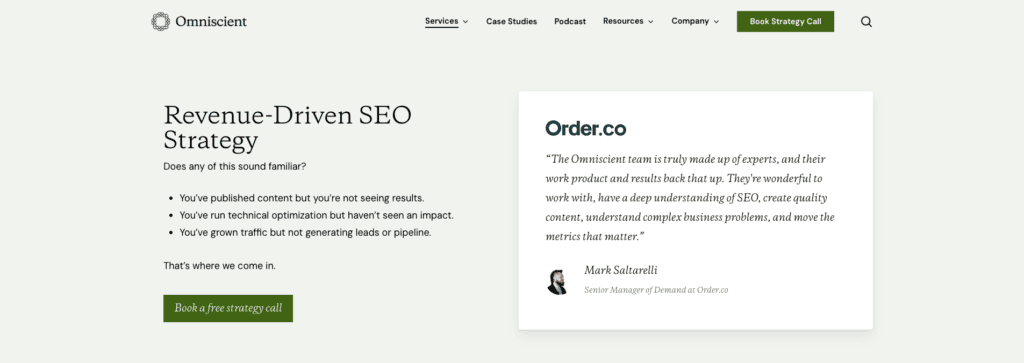
Omniscient Digital is a B2B SEO agency that covers the full program: SEO strategy, content production, link building, CRO, analytics, and generative engine optimization (GEO). We operate on a pipeline-first model, which means engagements are scoped around revenue contribution rather than traffic growth. Because we work almost exclusively in B2B, the end-to-end content production process is built for longer sales cycles and committee buying decisions, not single-session purchase journeys.
Pros
- The OmniscientX framework structures each engagement around four integrated phases so every deliverable connects back to a documented program goal rather than being produced in isolation.
- The Barbell Content Strategy is Omniscient’s content production model: it balances high-volume, intent-matched content at one end with high-authority, differentiated pieces at the other, so programs generate both consistent organic traffic and meaningful brand positioning.
- Omniscient’s client roster is concentrated in B2B software and SaaS, which means their content and SEO expertise is calibrated for the specific buying patterns, ICP complexity, and technical vocabulary those companies require.
Pricing: Engagements start at $10,000 per month. Contact for a strategy call to discuss what’s right for your program.
Results: Smartling generated $3.7M in pipeline attributed to content, a 31,250% blog conversion increase, and a 12.8X ROI. AppSumo saw 843% organic traffic growth and 340% revenue growth from organic.
Straight North: Best for national and multi-location B2B
Best for: B2B companies in manufacturing, professional services, and distribution targeting buyers across multiple U.S. locations
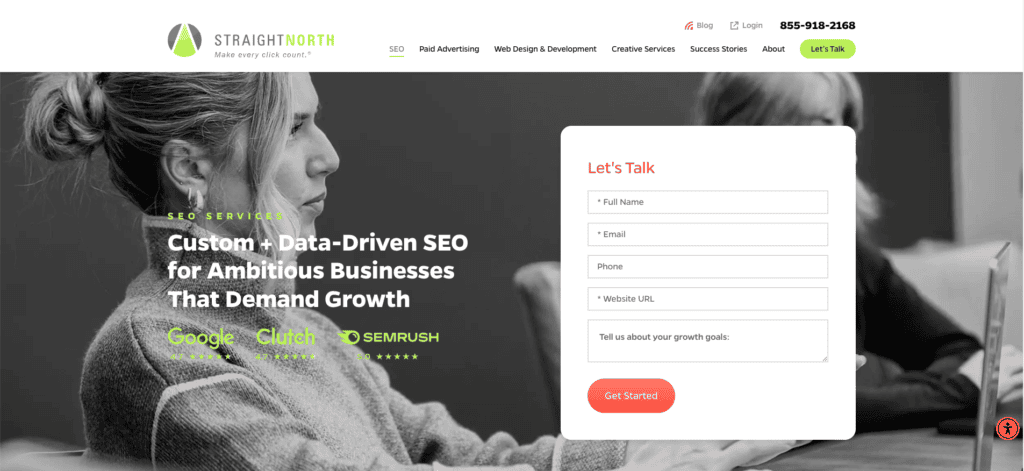
Straight North is a full-service digital marketing agency with 25+ years in B2B, concentrated in manufacturing, professional services, and distribution. Their model covers SEO alongside PPC, web design, email, and creative. This means you can consolidate vendors if useful, though SEO shares the firm’s attention with other channels. Among other types, they offer multi-location SEO for B2B companies with distributed footprints.
Pros
- With 25+ years in B2B digital marketing and 4+ star ratings across Google, Clutch, and Semrush, Straight North has a longer documented track record than most agencies on this list.
- Their vertical depth in manufacturing, professional services, and B2B distribution means they’ve written for the specific buyers—engineers, plant managers, operations leads—that those industries require.
- In addition to national SEO, Straight North also offers local, enterprise, and ecommerce SEO services to fit a variety of needs.
Pricing: Contact for pricing.
Results: Straight North helped Acieta, a B2B manufacturer, achieve a 1,200% increase in lead volume. Not to mention a 93% increase in organic search traffic and a 30%+ reduction in cost per lead.
Grow and Convert: Best for buyer-research-driven B2B SEO
Best for: B2B companies that want their SEO program built around how actual buyers think, search, and decide
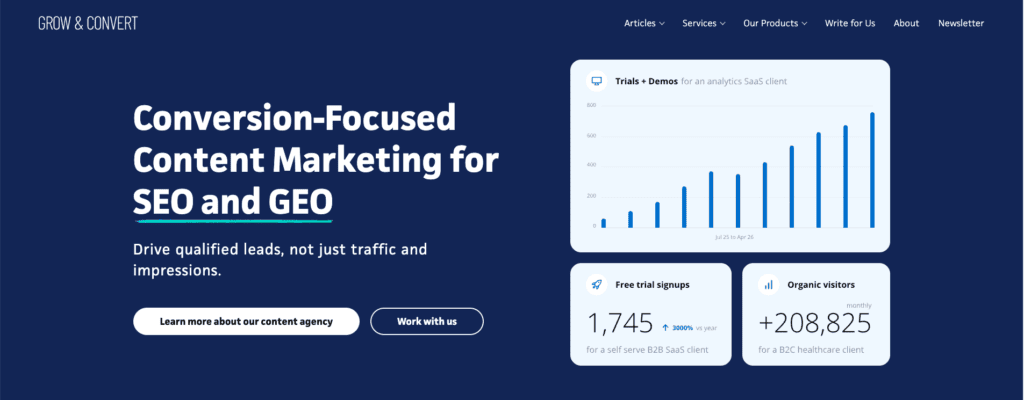
Grow and Convert developed Pain Point SEO. It’s a content methodology that calls for choosing keywords tied to active buyer problems rather than prioritizing high traffic volume above all else. The approach is research-first: they study how your ideal buyers think and search before building the content program. Their client roster is concentrated in B2B SaaS, professional services and other verticals, and the team is small enough that senior strategists are directly involved in the work.
Pros
- Grow and Convert’s research process includes detailed interviews with your product, sales, and customer-success experts—not just keyword tool analysis. This surfaces the language, pain points, and differentiators relevant to prospective buyers.
- They now publicly position around SEO and GEO/AI-search-related work, which is useful for teams thinking about traditional search and AI discovery together.
- Customer feedback on review platforms highlights hands-on involvement from the founders and a high level of strategic engagement.
Pricing: Grow and Convert’s starting price is $10,000 per month.
Results: Smartlook, a B2B SaaS product analytics tool, achieved dozens of top-three U.S. organic rankings and grew organic traffic to its blog posts to 18,000+ sessions per month through Grow and Convert’s Pain Point SEO program.
Seer Interactive: Best for enterprise B2B data-driven SEO
Best for: Enterprise B2B brands that want SEO tied directly to data infrastructure and business intelligence
Seer Interactive is a full-service search marketing agency that includes SEO, analytics, paid media, CRO, and creative services. The 200+ person team includes a Chief AI Officer and offers GEO service alongside traditional SEO. They’re a certified B-Corp, and Forbes and eMarketer have cited their work.
Pros
- Supernova—Seer’s proprietary platform—connects search data, audience signals, and business metrics in a single platform, which is the right infrastructure for enterprise B2B companies with complex attribution environments.
- Alisa Scharf’s role as Chief AI Officer gives the firm credible AI search positioning, not just a rebranded service description.
- Some reviews frame Seer as analytics-heavy, so it’s a good fit for data-savvy teams that feel comfortable digging into the details of program progress and have the bandwidth to do so.
Pricing: Contact for pricing.
Results: With Seer Interactive’s help, a B2B water technology company earned 11 conversions from a batch of just five articles, with estimated attributable revenue from the content strategy landing at $95,000+ overall.
Growth Plays: Best for B2B technology content operations

Best for: B2B technology and developer platform companies that need a systematic content engine mapped to complex buyer journeys and tied to pipeline attribution.
Growth Plays is a B2B SEO and content strategy consultancy that focuses on generating sales pipeline rather than pageviews. Founded by John-Henry Scherck, the firm designs owned-media content strategies mapped to complex, omnichannel buyer journeys. It pairs them with AI-powered content workflows to maintain production quality at scale. Their core positioning centers on treating content as a revenue system—building repeatable content engines instead of running strategy, production, and measurement as isolated workstreams.
Pros:
- Growth Plays has worked with well-known B2B SaaS and developer platform brands including Lattice, Calendly, LaunchDarkly, and LangChain.
- Their content revenue attribution services use tools like HubSpot, Bizible, or Roadway AI to connect content performance directly to pipeline and closed deals.
- Growth Plays has approximately a decade of experience focused exclusively on B2B technology brands and investment funds.
Pricing: Contact Growth Plays for a quote.
Results: Gremlin reported that Growth Plays’ content strategy “paid off 10x better than estimated” and generates demo-ready leads on a recurring monthly basis.
iPullRank: Best for technically complex B2B products
Best for: Enterprise and mid-market B2B brands with technically demanding products or architectures that need deep technical SEO plus content engineering
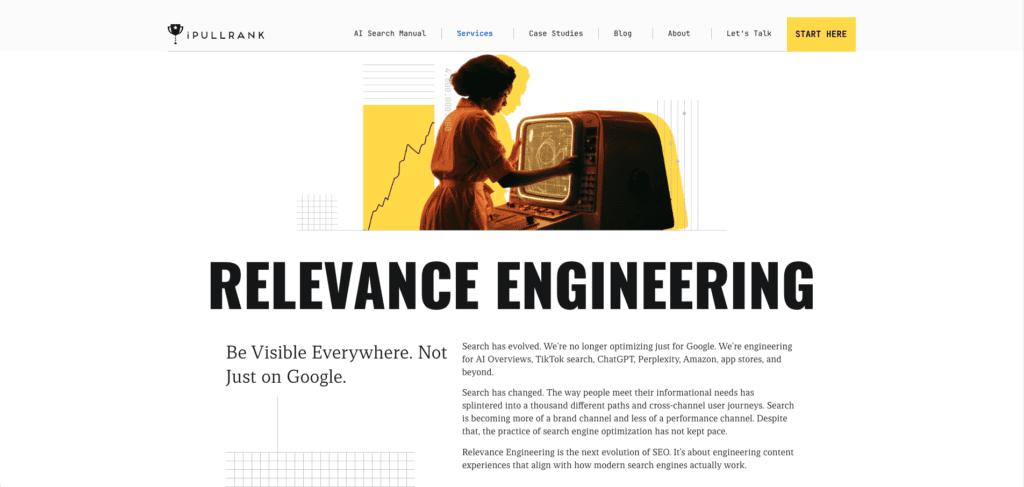
iPullRank positions at the intersection of technical SEO, content engineering, and generative AI consulting. Founder Mike King was named 2025 Search Marketer of the Year by Search Engine Land. His team’s work targets enterprise and mid-market brands with technically complex products and architectures that require more depth than standard SEO execution can offer.
Pros
- iPullRank’s technical SEO covers crawl architecture, JavaScript rendering, and information architecture at a level few agencies match.
- The content engineering discipline integrates strategy and production, which matters for technically complex products where those two functions need to be in sync.
- Public case study and third-party coverage point to large-scale outcomes, including more than $4B in client revenue impact and enterprise results.
Pricing: Contact the agency for pricing.
Results: One client in the financial services industry saw a cumulative increase of over 52% in organic traffic, along with a 121% increase in signups over a 6-month period.
Sure Oak: Best for broad B2B across multiple verticals
Best for: B2B companies in fintech, insurance, SaaS, or professional services looking for a senior-led SEO partner with AI search optimization built in
Sure Oak is a B2B SEO agency with years of experience across fintech, insurance, SaaS, and professional services. They offer AISO (AI Search Optimization) and take a customized approach to program design rather than applying standard retainer packages. The team is boutique-sized, so it’s small enough for direct senior access when needed.
Pros
- Sure Oak offers both local and global SEO, which not all agencies do.
- AISO (AI Search Optimization) services are also available to help boost and maintain clients’ visibility.
- With over two dozen Clutch reviews at 4.8/5, they have a strong client satisfaction signal relative to the size of the firm.
Pricing: Contact for pricing for SEO services. Link-building packages start at $3,500 per month.
Results: Maptive, a B2B SaaS mapping tool, grew organic traffic by 101% and increased demo conversions by 51% in five months of working with Sure Oak.
Flow Agency: Best for B2B SaaS and services startups
Best for: Early-stage and growth-stage B2B SaaS and professional services companies that want direct senior access without an account management layer
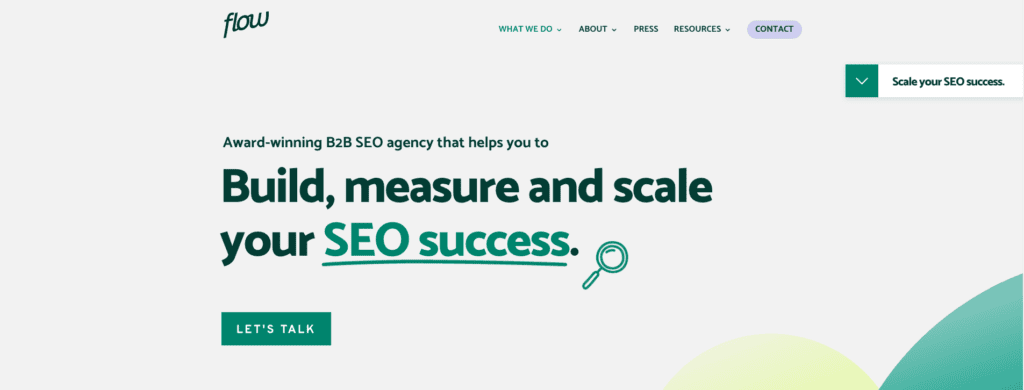
Flow Agency is a boutique B2B SEO agency for SaaS and professional services companies, notable for eliminating the account management layer that disconnects strategy from execution at larger firms. You work directly with the senior consultants doing the work. The firm’s client base is concentrated in growth-stage B2B SaaS companies, with work spanning European and North American markets.
Pros
- The 2023 European Search Award win in the B2B SEO category (for the Betterworks campaign) is a documented credibility signal for their B2B content work.
- Direct access to senior consultants without an account management intermediary means fewer communication gaps between what you’re asking for and what gets built.
- In 2023, Flow was shortlisted for 10 categories at the European Search Awards and has earned shortlists at the Global Search Awards since, suggesting that it’s good at what it does.
Pricing: Contact the team for pricing information.
Results: Flow’s Betterworks campaign delivered over 200% organic conversion growth year-over-year, earning the 2023 European Search Award for Best Use of Search—B2B (SEO).
What should you look for in a B2B SEO agency?
Evaluating an agency on output metrics alone like traffic growth, keyword rankings, and domain authority misses the point. Those numbers tell you something happened. They don’t tell you whether it mattered.
The five questions below are the ones a VP of Marketing should bring into every agency conversation.
Pricing and total cost of engagement
Agency pricing in B2B SEO varies more than most buyers realize, and the variation isn’t always correlated with quality. According to Backlinko’s research on SEO pricing, the average monthly cost for SEO services runs $1,000–$2,500 for most businesses, with enterprise programs starting at $5,000+/month. At the higher end of the agencies on this list, you’re looking at $10,000–$50,000+/month.
The question isn’t whether the price is high or low. It’s what the price includes. Some retainers cover strategy only and bill content, link building, and reporting as add-ons. Others bundle execution. Some require a 12-month commitment; others offer monthly flexibility.
Ask each agency to break down exactly what’s included in the retainer, what gets billed separately, and who on their team is doing the work. The answers will tell you as much about the engagement model as the pricing sheet does.
Industry specialization and B2B track record
General SEO principles apply to any website. But B2B buyer behavior—how prospects research, the length of the sales cycle, the role of technical content in the decision—is specific enough that vertical depth matters.
Ask to see case studies from companies in your vertical or adjacent to it. If you sell to CFOs in financial services, check whether the agency has written content for that buyer. If you’re in manufacturing, look for agencies with a track record in industrial or engineering-focused content programs.
The brands on the client roster and the specific buyer roles named in case studies are better signals than years in business or headcount.
Full-funnel service scope
SEO is not just technical audits and keyword lists. A full-funnel B2B SEO program covers strategy, content production, link building, and measurement. Ideally, it also integrates with your CRM so that pipeline impact is trackable, not just implied.
Ask where the agency’s scope begins and ends. Do they write and publish content, or do they hand you a brief? Do they handle link acquisition, or is that a separate engagement? How do they define success at the 6-month and 12-month mark, and how does that connect to revenue?
If you want to better understand what “full-funnel” means in practice, the in-house vs. agency vs. freelancer guide covers how different models handle execution scope differently.
Methodology, accountability, and reporting
The best B2B search engine optimization agencies tend to have named methodologies.
Naming things doesn’t automatically equal expertise, of course. But it can reflect a consistent, documented approach rather than ad hoc execution. It’s a positive when an agency can articulate how it works and why. Omniscient’s OmniscientX framework and Grow and Convert’s Pain Point SEO are two examples.
On a related note, accountability is also important. Before signing anything, ask the agency how they define success, what they’ll commit to measuring, and what happens if results don’t materialize. A reliable agency will give you a specific answer. A vague one is a red flag.
Additionally, look for reporting infrastructure that connects to your own data: GA4 integration, CRM linkage, attribution models that survive beyond last-click. Traffic dashboards alone are not enough.
Understanding what “good” looks like in organic reporting is its own skill. If you want a framework for tracking organic growth in terms that translate to revenue, download Measuring Organic Growth.
AI search and GEO readiness
B2B buyers now use AI tools like ChatGPT, Perplexity, and Gemini to research vendors, compare alternatives, and build internal business cases before they visit any vendor’s website. An agency that hasn’t adapted their approach for this reality is optimizing for a buyer journey that’s already changed.
Now, to be clear, optimizing for AI search is its own distinct discipline. While it’s not the same as SEO, GEO capabilities are becoming increasingly important. From the B2B SEO statistics we track, AI-influenced search behavior is moving faster in B2B than most marketers expect.
Not having GEO services doesn’t automatically disqualify an agency. However, if your ICP is using AI tools to shortlist vendors in your category, you want an agency that understands how to appear in those results.
The B2B buyer journey has shifted more in the past 18 months than in the decade before it. Download the B2B Buyer Behavior report to see how discovery, research, and shortlisting behavior is changing and what that means for your organic and GEO strategy.
Partner with a B2B SaaS SEO agency
There’s no universally right answer here. The right B2B SEO agency depends on your vertical, your stage, and what you’re trying to accomplish. Not on which agency has the most impressive client logos or the most aggressive growth promises.
What the evaluation criteria above will surface: agencies that understand your buyer, can execute the full program (not just recommend it), and measure success in terms you can bring to a revenue conversation. That’s a short list.
For B2B software companies ready to treat organic as a predictable revenue channel instead of a nice-to-have, Omniscient is where to start. Book a free strategy call to see how we approach pipeline-first SEO and GEO for B2B brands at your stage.
Frequently asked questions about B2B SEO agencies
How much does a B2B SEO agency cost?
Most B2B SEO agency engagements run $1,000–$10,000+/month depending on scope, team size, and service model. According to Backlinko, the average monthly SEO investment is $1,000–$2,500 for small and mid-size businesses, with enterprise programs starting at $5,000+.
The agencies on this list range from approximately $3,000/month (Sure Oak, Flow) to $10,000–$50,000+ for enterprise-focused firms like Seer Interactive and iPullRank.
What you pay determines what’s included. For example, strategy only, or strategy plus content, link building, and measurement infrastructure.
How long until a B2B SEO agency shows results?
Most agencies will tell you to expect meaningful movement at the 6- to 12-month mark for competitive B2B keywords. That’s accurate but incomplete.
Faster wins are usually available at the 60- to 90-day mark for lower-competition terms, freshly published content that matches clear buyer intent, and technical fixes that remove indexability problems.
A good agency will show you a roadmap that includes near-term signals, not just a promise about 12-month rankings. If an agency can’t articulate what “on track” looks like at 90 days, that’s worth pushing on before you sign.
What should I ask a B2B SEO agency before hiring?
Five questions that will give you real signal:
- What metrics do you report on, and how do they connect to pipeline?
- Can you show me case studies from companies in my vertical with similar ICP?
- What exactly is included in the retainer versus billed separately?
- How do you define success at 6 months, and what happens if we don’t hit it?
- Do you have an approach to GEO or AI search optimization, and how does that integrate with traditional SEO?
The answers will tell you whether you’re talking to an agency that optimizes for traffic or one that optimizes for revenue.