AI conversion rate optimization: key takeaways
- AI adds the most leverage in diagnosis, not optimization. Qualitative signal aggregation and funnel drop-off analysis are where B2B SaaS teams see the clearest gains—not real-time personalization, which requires traffic volumes most teams don’t have.
- Goal clarity is the prerequisite that makes everything else matter. An AI system will optimize for whatever it’s told to measure. If you’re tracking form fills instead of qualified pipeline, you’ll get more form fills. The precision AI adds to testing makes defining the right conversion goal more important, not less.
- The most common failure mode is deploying AI on top of broken tracking. Forty percent of teams using GA4 run it without downstream revenue attribution, meaning the patterns AI surfaces are patterns in incomplete data. A tracking audit before any AI CRO investment is the highest-return first step.
- Organic traffic quality sets the ceiling on CRO leverage. If the traffic reaching your conversion pages comes from misaligned intent or wrong-ICP audiences, conversion rate optimization is treating a symptom. Aligning SEO intent with conversion goals is the structural fix.
Table of contents
- AI conversion rate optimization: key takeaways
- What is AI conversion rate optimization?
- How does AI CRO differ from traditional CRO?
- Where AI adds the most CRO leverage in B2B SaaS
- Why AI-powered CRO fails: common pitfalls to avoid
- Where should you start with AI conversion rate optimization?
- Frequently asked questions about AI-powered conversion rate optimization
Most content about AI conversion rate optimization is written for e-commerce—high-traffic storefronts, immediate purchase intent, and conversion events that close in a single session. Running thousands of A/B test variants on a product page with five million monthly visitors is a tractable problem. For more strategic testing methods, consider exploring ab testing content to optimize conversion efforts.
But for a Head of Growth at a B2B SaaS company, the constraints look nothing like this. Traffic to a demo request page might be a few hundred qualified visitors a month. The buying journey runs weeks, sometimes months, involving multiple stakeholders who never see the same version of your site at the same time. The conversion event might be a trial signup, a booked demo, or an intent signal that doesn’t register as a conversion in any attribution model.
Figuring out how to optimize for those events—and whether AI actually helps—is where most B2B SaaS growth teams run into real ambiguity. This article covers what AI-assisted conversion rate optimization actually looks like in that context. Specifically: where it adds genuine leverage, where it doesn’t, and what you need in place before any of it matters. For more information on creating an effective data driven content marketing strategy, explore our guide on the topic.
What is AI conversion rate optimization?
AI-powered conversion rate optimization is the application of machine learning and behavioral data analysis to the CRO process. It has three main focus areas:
- Pattern detection in user behavior: Surfacing signals in session data that a human analyst would take weeks to find manually (or miss entirely)
- Test hypothesis generation and prioritization: Using patterns to suggest what to test, and in what order, rather than relying on gut feel or whoever has the loudest opinion in the room
- Experience personalization: Serving different versions of a page or element to different user segments in real time
These three capabilities exist on a spectrum of maturity and infrastructure requirements. Most teams have access to the first. Fewer have the data quality and traffic volume to make the second reliable. The third is often out of reach for the median B2B SaaS company, a point worth holding onto as you evaluate vendor demos that showcase real-time personalization as the headline feature.
One thing worth establishing early: AI augments the conversion rate optimization practice; it doesn’t replace it. The testing discipline, goal-setting, and judgment about what actually matters to buyers remain human jobs. We’ll get into how AI helps next.
How does AI CRO differ from traditional CRO?
Traditional CRO runs on heuristics, sequential A/B tests, and manual synthesis of customer voice data. It’s slow by design—you form a hypothesis, build a test, wait for statistical significance, call a winner, and start again. A well-run program might complete 20 to 30 tests in a year. Manual analysis of session recordings and support tickets happens when someone has bandwidth for it, which means it happens less than it should.
AI-powered conversion rate optimization changes two things about this model:
- The speed at which insights surface
- The volume of data a team can act on
A session recording platform with AI synthesis can cluster patterns across thousands of recordings in the time it takes a human analyst to review 30. That’s a real efficiency gain as long as the analysis is linked to the right goals.
Omniscient’s research on how marketers measure organic growth is crucial, as understanding metrics like SEO ROI can significantly impact strategy and outcomes. However, in reality, only 31.8% actually tie organic performance to those metrics in stakeholder reporting. This gap between stated priority and actual measurement isn’t new. AI doesn’t close it, but does make it faster to optimize for whatever you’re already tracking.
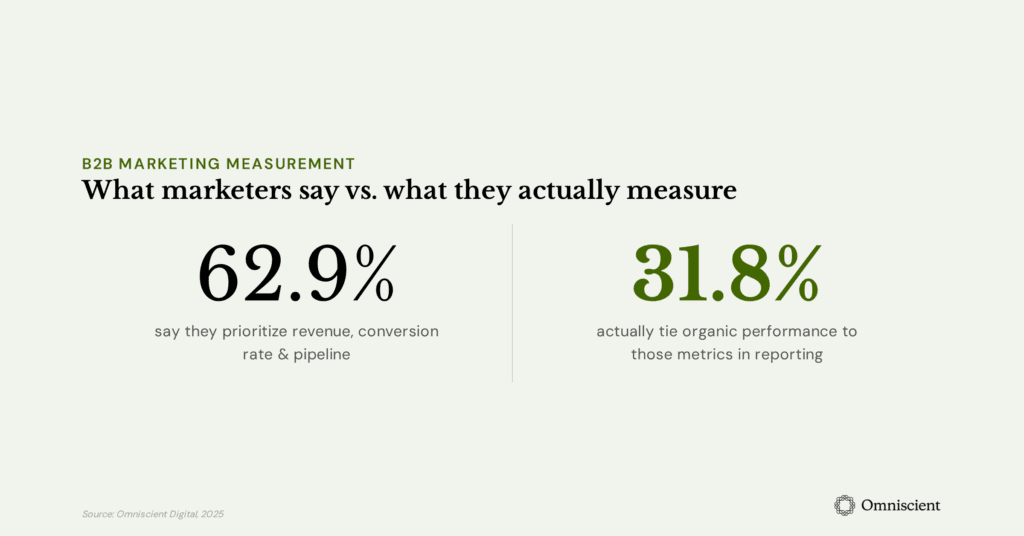
This is the under-discussed risk in AI CRO adoption. An AI system optimizing for demo request volume will find ways to improve demo request volume, including by lowering the quality bar for who submits a form. If your goal is “more demos” rather than “more qualified demos,” you’ll get exactly what you asked for. The precision AI adds to optimization makes goal clarity more important, not less.
Sahil Patel, CEO of Spiralyze, made this point clearly in a conversation about data-driven testing. The teams that get the most out of automated testing infrastructure are the ones with the clearest definition of what a good conversion actually looks like.
There’s also the question of the B2B buying journey itself. A buyer might read three blog posts, watch a webinar, check a G2 listing, and have a sales conversation before ever touching your demo request page. Traditional CRO only sees the last click. AI tools that analyze on-site behavior have a wider field of view, but they still can’t see the full picture—only what happens inside your domain. So understanding user intent in B2B marketing requires thinking further upstream than any on-site tool, AI-powered or otherwise.
How are B2B buyers actually researching before they reach your site? Omniscient’s 2025 B2B Buyer Behavior research maps how buying decisions form across the full journey, covering buyer behavior from first awareness through final purchase.
Where AI adds the most CRO leverage in B2B SaaS
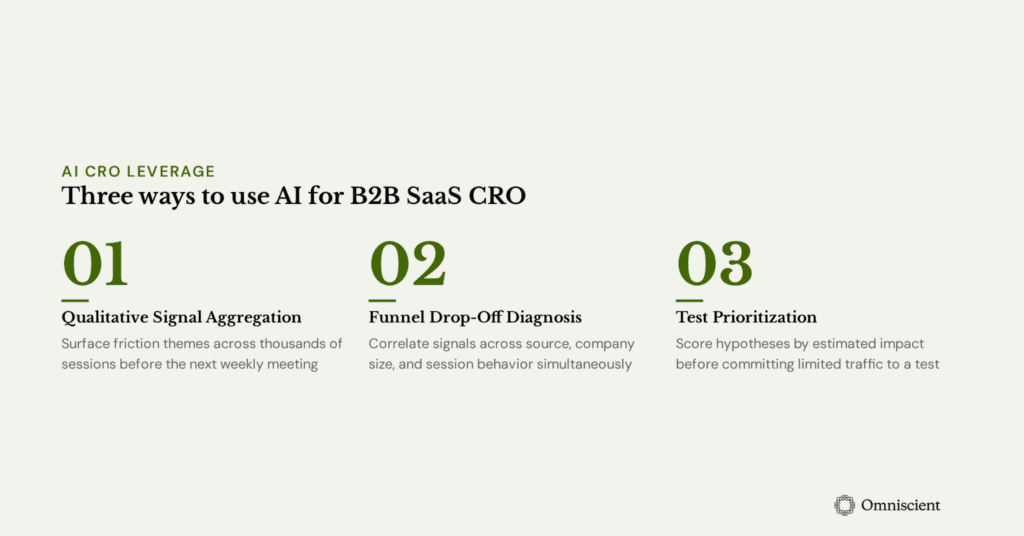
Lower traffic, complex journeys, and longer sales cycles are all common B2B SaaS constraints. That said, there are three areas where AI tools for conversion rate optimization can genuinely move the needle for growth teams.
Qualitative signal aggregation
Session replays, support tickets, sales call transcripts, and internal search queries all contain friction signals. The problem is volume: most teams can’t synthesize it all fast enough, so they work with samples and hope those samples are representative.
AI tooling that clusters and categorizes these signals at scale changes the economics of qualitative research. Instead of one analyst reviewing 50 sessions and drawing provisional conclusions, you can surface friction themes across 5,000 sessions before the next weekly meeting.
Funnel drop-off diagnosis
B2B SaaS funnels have multiple qualification stages—visitor to lead, lead to qualified, qualified to demo, demo to trial. Each stage has its own conversion rate, and each can fail for different reasons.
AI-assisted funnel analysis can do something manual analysis struggles to replicate at scale: correlate signals across multiple variables simultaneously.
A human analyst can identify which stage is losing visitors. But AI can cross-reference that drop with source channel, company size, session behavior, and page path at the same time—surfacing a “why” alongside the “where,” in a fraction of the time a human analyst would need.
Test prioritization
When limited traffic constrains how many tests you can run at once, bad prioritization is expensive. A low-impact test that runs for eight weeks costs you multiple higher-impact tests you couldn’t run in parallel.
AI hypothesis scoring models can estimate impact based on historical data, traffic patterns, and comparable tests, reducing the cost of a poor prioritization call. For B2B SaaS teams running maybe two or three simultaneous tests at any given time, this is where AI earns its keep.
One more AI capability that comes up in nearly every vendor evaluation: real-time personalization. It’s worth addressing directly.
Real-time personalization gets the most attention in AI CRO coverage, and it’s probably the least relevant capability for most B2B SaaS companies. Meaningful personalization—delivering different experiences to different buyer profiles in real time—requires traffic volumes that put most B2B SaaS sites well below the threshold for statistical reliability. It’s a worthwhile item for companies at significant scale. For everyone else, it’s a distraction from the three areas above.
Why AI-powered CRO fails: common pitfalls to avoid
AI tools for conversion rate optimization tend to fail the same way. Not because of bad engineering, but because they’re deployed into conditions that make good output impossible. Three preconditions determine whether any AI-powered conversion rate optimization investment delivers results.
Clean, complete event tracking
AI pattern detection is only as good as the event data it has access to.
Let’s say that your analytics implementation is missing key events, firing incorrectly, or tracking conversions inconsistently across device types. Yes, the AI system will still find patterns, but they won’t be real ones.
Our research found that 40.1% of teams using Google Analytics are running it on its own, without CRM or revenue attribution tooling. That means they lack the downstream data needed to know whether a conversion was actually valuable.
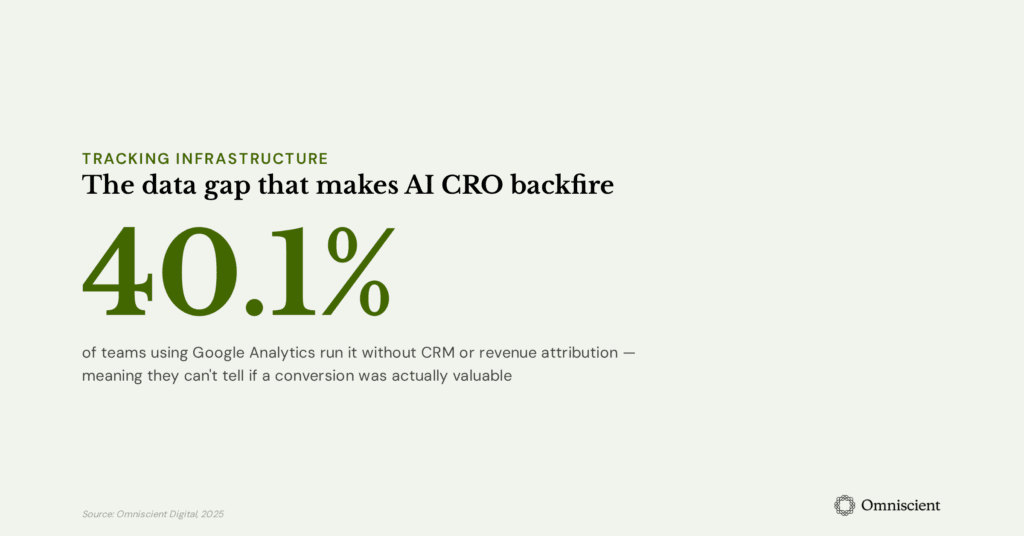
Without that revenue signal, the AI system has no way to distinguish a high-quality conversion from a junk form fill. As a result, it’ll optimize toward whichever one appears more frequently.
Attribution complexity doesn’t get simpler when you add AI. The 2025 Marketing Leaders Report covers how senior marketing leaders are approaching measurement and reporting in an environment where the full buyer journey is increasingly difficult to track with traditional analytics.
Sufficient traffic volume for valid tests
Sequential A/B testing has a traffic floor. Below it, tests either never reach statistical significance or reach it unreliably. The math is unforgiving, and AI tools don’t change it.
What they can do is help teams shift from confirmatory testing to diagnostic analysis. Rather than running tests to prove existing hypotheses, teams can use qualitative data to build stronger ones, ready to test once traffic eventually supports them. That’s a more honest use of AI-powered conversion rate optimization at early-stage traffic levels.
An existing hypothesis-driven testing discipline
AI helps prioritize hypotheses. It doesn’t create the organizational habit of generating and evaluating them. Teams that adopt AI tools for conversion rate optimization without a functioning testing practice usually just end up with a more expensive version of their current process. In other words, more dashboards surfacing the same inconclusive data.
The failure mode these three conditions share is identical: teams layer AI capability on top of infrastructure that can’t support it. The result is faster iteration on bad data, not better decisions. Broader data readiness for AI assessment can catch these issues before implementation by verifying that the underlying data is accurate, complete, current, machine-readable, and authorized for the specific use case.
That said, a data quality audit should come before you evaluate any conversion rate optimization AI platform. It’s one of the highest leverage investments you can make since it’ll pay off regardless of what tooling decision you make afterward.
Where should you start with AI conversion rate optimization?
The starting sequence matters more than the tool selection. Most teams get this backwards—they evaluate platforms, pick one, and discover the infrastructure gaps when the results don’t materialize.
A more reliable order of operations:
- Determine tracking completeness first. Before touching an AI tool, verify that your analytics setup captures the events that matter: qualified lead submissions, trial activations, demo completions—not just page views and click events. If you’re running GA4 without downstream revenue attribution, that’s the first problem to solve.
- Use AI-assisted session analysis to identify 3–5 high-confidence friction points. This is where the efficiency gain is real. The output should be specific and named. For example, “the form validation error on mobile is causing 23% of mobile form abandonment” is actionable; “mobile experience has friction” is not.
- Build a prioritized hypothesis backlog. Score each hypothesis by estimated impact and testability given your traffic volume. This backlog guides test sequencing for the next quarter and gives you a paper trail for what you chose not to test and why.
- Only then evaluate personalization or multivariate testing capabilities—and only if your traffic volumes actually support them.
Work through that sequence and you’ll avoid the most common infrastructure traps. But beware: organic traffic quality introduces a constraint that sits even further upstream.
Organic traffic quality sets the ceiling on what CRO can accomplish. A demo request page converting at 1% doesn’t necessarily have an on-page problem—it might have a traffic quality problem. If the visitors arriving at that page came from broad-match keywords or content that doesn’t speak to your ICP, no AI tool fixes the underlying mismatch. That’s the SEO strategy decisions you made six months ago showing up in your conversion rates today.
This is also why changes in AI-driven traffic composition matter for CRO programs. If your ChatGPT referral traffic has declined while organic conversion rates have shifted, the two are likely connected. The fix starts with understanding what changed in traffic composition, not with running more on-page tests.
Before optimizing conversions, it’s worth confirming you’re measuring the ones that connect to pipeline. Omniscient’s guide to measuring organic growth covers the metrics that actually connect to revenue, including how to evaluate whether your organic traffic is qualified enough to convert in the first place. Give it a read.
Frequently asked questions about AI-powered conversion rate optimization
How long does AI CRO take to show results?
It depends on which part of AI CRO you’re measuring. AI-assisted session analysis can surface actionable friction signals within days of setup. Running and concluding tests takes considerably longer.
At typical B2B SaaS traffic volumes, individual A/B tests often need 4–8 weeks to reach statistical significance. Getting to a compounding program where AI prioritization noticeably improves testing velocity typically takes 3–6 months.
The factor that most affects timeline is tracking quality: teams with clean, complete event data see faster signal. Teams starting from scratch should budget 4–6 weeks of setup before the AI layer adds meaningful value.
Can AI-powered conversion rate optimization work with low traffic in B2B SaaS?
Partially. Low-traffic sites can’t run valid A/B tests regardless of the tool, and AI doesn’t change the underlying math. What it does change is the value of qualitative analysis. AI-assisted session replay and behavior clustering can surface meaningful friction signals even at low traffic volumes, giving teams something more reliable than gut feel to build hypotheses from.
The right frame for low-traffic B2B SaaS teams is using AI for diagnosis rather than confirmation: to generate high-confidence hypotheses ready to test when traffic grows, or to identify problems fixable without a test at all.
What tools are used for AI conversion rate optimization?
AI-powered conversion rate optimization tools fall into three categories:
- Session intelligence platforms—Fullstory, Hotjar, Microsoft Clarity—use AI to cluster behavioral patterns, surface friction signals, and surface recordings worth reviewing
- Testing and optimization platforms like VWO and Optimizely have added AI-assisted hypothesis generation and test prioritization
- Personalization platforms like Mutiny and Intellimize focus on segment-level experience customization
Most B2B SaaS teams should start with session intelligence. It has the lowest infrastructure requirements and delivers diagnostic value regardless of traffic volume.