Conversion rate optimization strategy: Key takeaways
- Most CRO programs fail because they start testing before they understand the problem. Qualitative research, such as session recordings and exit surveys, are what turn drop-off data into actionable hypotheses.
- The pages with the most traffic are rarely the ones worth optimizing first. High-intent pages like pricing and demo requests sit closest to revenue, so even modest conversion lifts there outweigh big gains on top-of-funnel content.
- Statistical significance is not a finishing line. It’s a threshold a test can cross and uncross multiple times, so don’t let an early leader pressure you into a premature call.
- A single site-wide conversion rate flattens together pages with completely different intent and proximity to revenue. To determine where the real problem lies, break it into stage-level rates like visitor-to-lead, lead-to-qualified, qualified-to-meeting.
- Every testing program eventually runs out of runway. When the design itself becomes the ceiling, the next step is structural, not iterative.
Table of contents
- Conversion rate optimization strategy: Key takeaways
- What conversion rate optimization is and what it’s not
- Effective conversion rate optimization strategies start with research
- Website conversion rate optimization strategies by funnel stage
- How to run A/B tests that produce usable learnings
- CRO metrics to track for B2B SaaS
- Building conversion rate optimization strategies into organic growth
- FAQs about conversion rate optimization strategies
The conversion rate optimization (CRO) mistake that kills most programs isn’t running bad tests—it’s running tests before you understand what’s actually broken.
Most growth teams have a testing backlog: the hero headline, the form length, the button color. Some experiments work, most don’t, and after a year of effort, the conversion rate has moved a point or two. Then the needle stops. This is the local maximum problem where iterative testing has exhausted its marginal returns, and something more structural needs to change.
The solution is treating CRO as a system: one that starts with research rather than a testing queue.
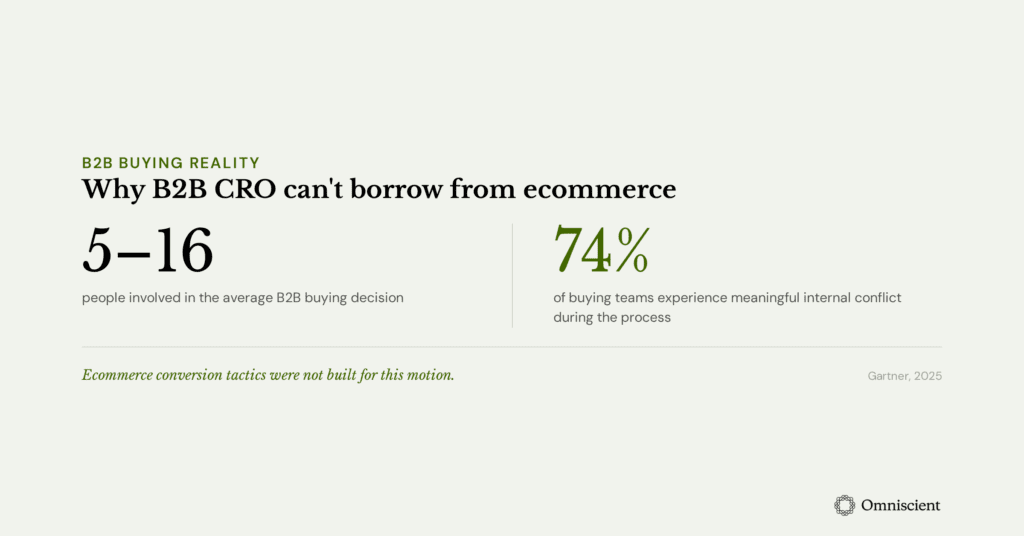
For B2B SaaS specifically, getting that system right matters more than most CRO content acknowledges. Ecommerce conversion rate optimization strategies—urgency, social proof, checkout friction reduction—don’t translate into a world where:
- Buying decisions involve five to 16 people across multiple functions
- 74% of those buying teams experience meaningful internal conflict during the process
- A form fill is often the beginning of a long qualification chain, not a quick conversion
So what do effective conversion rate optimization strategies actually look like for B2B SaaS?
What conversion rate optimization is and what it’s not
The first trap is optimizing for the wrong thing. Conversion rate, taken in isolation, is seductive—it’s measurable, responds to changes, and feels like progress. But lifting your overall rate without understanding what you’re converting can make your numbers look better while your pipeline gets worse.
For instance, when a B2B SaaS team lowers the barrier to form submission—removes fields, adds an incentive, simplifies the CTA—raw conversion rate goes up. But if that friction was also doing qualification work, the problem shifts downstream: more form fills, more unqualified demos, more time wasted by sales. The conversion rate improves, but the business doesn’t.
CRO in B2B SaaS is better defined as increasing the rate at which the right visitors take the right actions. “Right” must be calibrated against qualified pipeline and revenue, not volume. Conversion events span demo requests, trial signups, content upgrades, and sales-assist CTAs—each with a different relationship to revenue. The fundamentals of CRO don’t change across contexts, but how you define success absolutely does.
So define your measurement framework before your testing roadmap. Otherwise, you’re optimizing for a number that has nothing to do with the outcomes the business actually cares about.
How are B2B buyers actually making decisions in 2025? Our research report on B2B buyer behavior covers how buyers navigate channels, build trust, and reach decisions in the LLM era.
Effective conversion rate optimization strategies start with research
Analytics alone won’t tell you why visitors aren’t converting. A funnel showing 70% drop-off on your demo page tells you where the problem is, but it says nothing about why someone who clicked “Request a Demo” left without submitting.
Qualitative research is where that “why” gets answered: session recordings show the exact moment someone abandons a form; exit surveys catch departing visitors before they’re gone; user interviews reveal that prospects aren’t confused about the CTA but unsure whether the product handles their specific use case.
Such inputs form the backbone of a structured CRO research process covering at least four areas:
- Heuristic analysis—experienced eyes identifying friction points and clarity gaps
- Web analytics and funnel analysis—where the quantitative drop-off lives
- Mouse-tracking data—heatmaps and session recordings
- Qualitative inputs—on-site surveys, customer interviews, and exit feedback
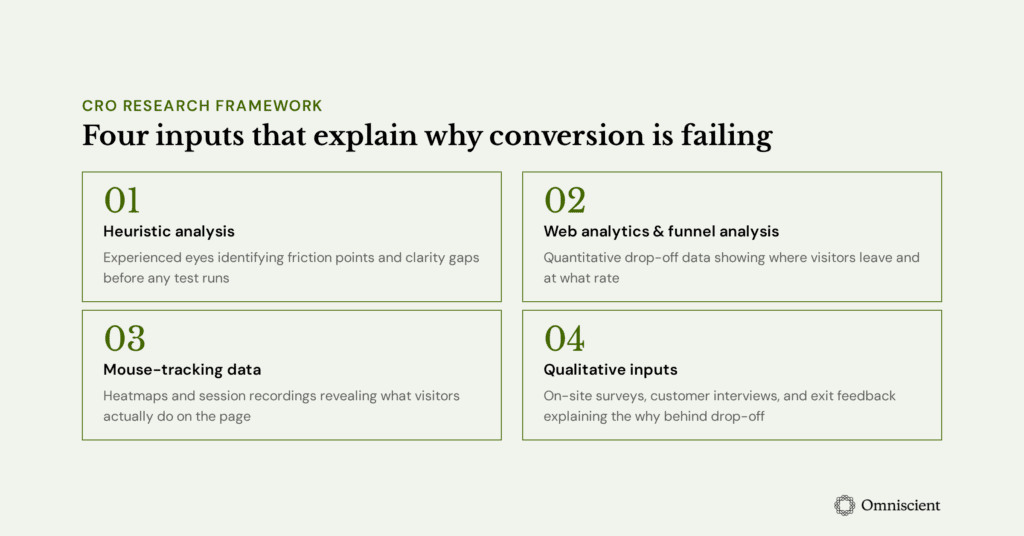
Together, these give you a map of why conversion is failing at each stage. That’s what good hypotheses are built from.
Building your hypothesis backlog
Unlike a guess, a hypothesis is a specific statement about what’s causing a conversion problem and why a specific change will fix it.
Weak: “Let’s try a shorter form.”
Strong: “Our exit survey data shows 34% of visitors abandoned the demo request form, citing concerns about sales follow-up cadence. Replacing ‘Request a Demo’ with ‘Get a 20-minute product tour’ and adding a ‘no high-pressure follow-up’ note should reduce that abandonment.”
Win or lose, a strong hypothesis produces a learning you can act on.
Prioritizing what to test first
Not all tests are worth running. A useful prioritization framework asks:
- Is the change above the fold?
- Will it be noticeable within a few seconds?
- Does it add or remove something meaningful?
- Does it run on a page with enough traffic to produce a valid result in a reasonable timeframe?
Traffic volume is the most under-appreciated constraint in B2B SaaS CRO. If your demo page gets 400 visits a month, you can’t run a meaningful A/B test in a reasonable timeframe. Build wins on higher-traffic pages first, then apply those learnings to higher-stakes, lower-traffic pages later.
With your measurement framework defined and your research process in place, you can start applying specific optimization levers—and where you apply them matters enormously.
Website conversion rate optimization strategies by funnel stage
Not every page should be optimized the same way. What converts a first-time visitor who landed on a blog post from organic search is completely different from what converts a VP who attended your demo last week and is now back on your pricing page with their CFO. Understanding user intent is the prerequisite to good funnel-stage CRO—without it, you’re mostly guessing.
Many B2B SaaS teams concentrate their optimization energy on pages with the most traffic: blog posts, top-of-funnel landing pages. This is understandable but backwards. The highest ROI from CRO often comes from pages closest to conversion, where intent is highest and even a small lift translates directly into qualified pipeline.
Bottom-of-funnel: pricing, demo, and trial pages
This is where B2B SaaS CRO investment is often underweighted. High-intent pages—pricing, demo request, and free trial—are where buyers who already want a solution come to decide whether yours is the right one. A 10% lift on your demo page at 500 monthly visits is worth dramatically more than a 10% lift on a blog post at 5,000 visits, because the intent gap between those visitors is enormous.
And yet most teams concentrate on content pages, because they have more traffic and tests run faster. This is the organic ROI trap applied to CRO: optimizing for the metric that’s easiest to measure (test velocity) rather than the one that actually moves the business (revenue per visitor on high-intent pages).
Bottom-of-funnel optimization usually comes down to three things:
- Answering the most common pre-sales objections directly on the page
- Reducing commitment friction (can a visitor understand pricing without talking to sales?)
- Making it explicit what happens after a form is submitted
That last one is consistently under-optimized. Buyers want to know whether they’ll hear back in 5 minutes or 5 days, and most B2B SaaS pages don’t tell them. The higher-impact version is giving them a way to find out immediately.
For example, replacing the post-submit confirmation page with a live calendar lets buyers book a time at peak intent, before the window closes. For teams not ready for instant scheduling, a simple commitment (“a team member will reach out within one business day”) will outperform silence.
Middle-of-funnel: landing pages and lead capture
Mid-funnel pages serve visitors who know they have a problem and are evaluating solutions. The optimization priority shifts toward clarity and credibility: does this page make clear what the product does, who it’s for, and why it’s the right choice for this specific need?
This is where data-driven content strategy pays off at the page level. Knowing which keywords brought someone to this page tells you what they were searching for, which tells you which objections need to be preempted. Key levers at this stage:
- Making social proof role- and outcome-specific—”Used by growth teams at [recognizable company] to increase qualified demo volume by 40%” lands harder than “Trusted by 500+ companies”
- Testing adjustments to label placement, error messaging, and trust signals
- Not asking for more information than you need at the point of first contact, since high field count can and does scare people away from converting
- Matching page messaging to the traffic source or campaign — a visitor arriving from a LinkedIn ad targeting RevOps leaders and a visitor arriving from a generic Google search aren’t the same buyer, and a page that treats them identically leaves conversion lift on the table
Account-level personalization (ABM landing pages) is a more advanced version of that last bullet. At a minimum, campaign-level variants tied to specific audiences are worth testing.
Top-of-funnel: content pages and blog posts
For organic content, conversion isn’t usually about getting someone to request a demo on their first visit. B2B buyers don’t work that way. The goal at the top of the funnel is progression: getting someone to subscribe, download something relevant, or engage deeply enough to come back. Key levers:
- Adding in-content CTAs tied to the specific topic someone is reading, instead of generic “Book a Demo” banners that don’t match readers’ journey stage
- Implementing progressive lead capture—email first, more fields later—which tends to outperform long forms on first touch
The impact of changes like these compound across thousands of organic visits over time.
Speaking of time, your patience (or lack thereof) can directly impact your ability to optimize conversion rate long-term.
Not sure which CTAs belong on which pages? The Blog CTA Mapping Template helps you systematically match your offers to each post so traffic doesn’t leave without converting.
How to run A/B tests that produce usable learnings
Imagine you’re two weeks into a test, and one variation is winning by 15%. It’s tempting to call it and move on.
Don’t.
Adjust your viewpoint on statistical significance
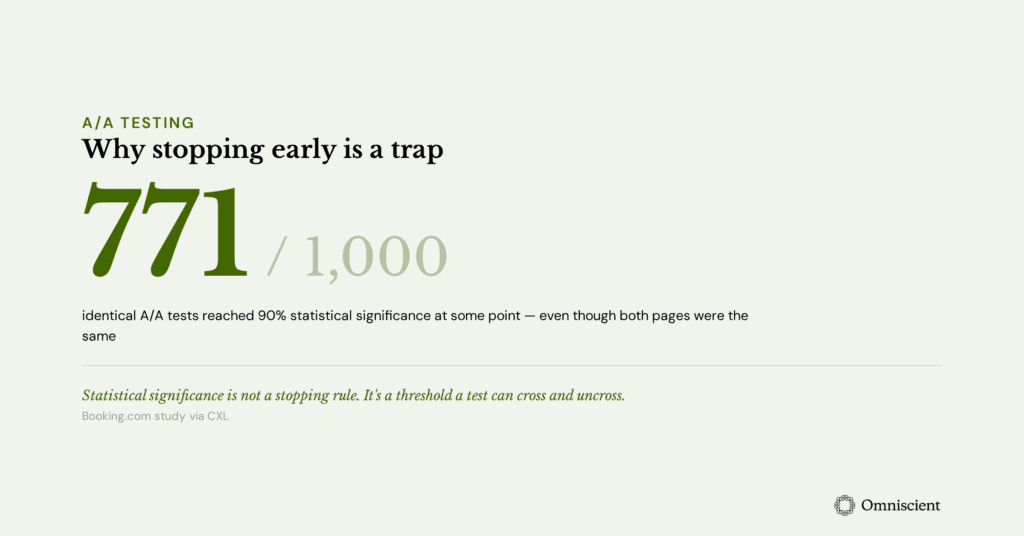
One of the most damaging errors in B2B SaaS A/B testing is stopping early. It feels like velocity. However, statistical significance isn’t a stopping rule; it’s a threshold a test can cross and uncross multiple times before it settles.
Case in point: a Booking.com study that ran 1,000 A/A tests (two identical pages against each other) found that 771 reached 90% statistical significance at some point. An A/A test technically shouldn’t produce a winner. Yet, most of them did, temporarily.
The right approach is to predetermine your sample size before the test starts, then run it for at least two full business cycles. After all, B2B traffic is non-uniform. Day-of-week patterns, pay cycle effects, newsletter send cadences, and return visitor behavior can all create the illusion of a lift that regresses to the mean once the test runs long enough.
Look beyond individual test outcomes
Another common underinvestment is knowledge management. Tests on content and structural elements produce institutional knowledge that compounds, but only if you archive it systematically. What did this test reveal about how your enterprise visitors respond to pricing transparency? About which proof points resonate with VP-level buyers vs. individual contributors? Those learnings outlast any individual test result.
This is also where the local maximum problem becomes relevant at the program level. At some point, no amount of incremental optimization will move the needle, because the design itself has become the ceiling. When a program hits this wall, the answer is a research-backed rethinking of whatever element has become the constraint: often a full landing page, a value proposition, or a key conversion flow.
Even well-designed tests are only as useful as the framework you use to report on them.
CRO metrics to track for B2B SaaS
Tracking a single site-wide conversion rate is almost always the wrong measurement. It averages together pages with radically different intent, visitor quality, and proximity to revenue.
More useful: tracking conversion rates at each discrete funnel stage.
- Visitor-to-lead: What percentage of site visitors take a lead-qualifying action—form fill, content download, demo request?
- Lead-to-qualified: What percentage of those leads meet ICP criteria after review or enrichment?
- Qualified-to-meeting: What percentage of qualified leads actually book and attend a demo?
Each rate points to a different problem when it drops. Low visitor-to-lead is usually a relevance or friction issue on the page. Low lead-to-qualified is usually a targeting or messaging problem upstream. Low qualified-to-meeting is usually a process issue: speed to follow-up, calendar friction, or routing logic.
Benchmarks to inform your CRO strategy
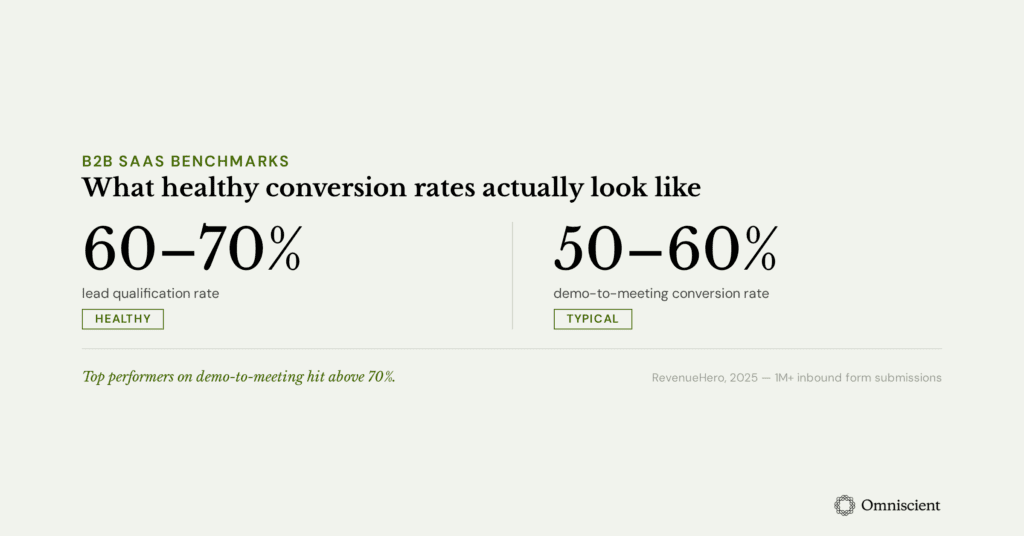
For context on where B2B SaaS programs should aim: RevenueHero’s 2025 analysis of over one million inbound form submissions across B2B software verticals found that a lead qualification rate of 60–70% is healthy for most companies, and 70–80%+ is strong. A demo-to-meeting conversion rate of 50–60% is typical, with top performers above 70%.
Though they dominate most “what’s a good conversion rate?” articles, ecommerce CRO benchmarks aren’t comparable. SaaS buying cycles are longer, qualification criteria are stricter, and visitors at each stage represent meaningfully different levels of intent.
Translating these stage metrics into language that leadership actually cares about is the final piece. If your demo page converts at 2.5% on 10,000 monthly visits, a one-point lift is roughly 100 additional demo requests per month. At your average deal size and close rate, that’s a much more defensible case for CRO investment than reporting that the conversion rate improved by 0.8%.
Need to model how conversion improvements translate to pipeline? The Organic Traffic Growth Model lets you project the revenue impact of lifting conversion rates at each funnel stage.
Building conversion rate optimization strategies into organic growth
CRO without traffic context is optimization in a vacuum. Traffic without conversion optimization is a leaky bucket.
At Omniscient Digital, we treat CRO as an integrated layer of organic growth programs, not a standalone workstream. That integration matters because the organic channel gives you something most CRO programs lack: the specific keywords that brought each visitor to each page and the intent behind those queries.
When you know why someone arrived on your demo page—whether from a branded search, a bottom-of-funnel comparison query, or a top-of-funnel educational article—every hypothesis is sharper. You’re not guessing at the visitor’s mental model. You know what they were looking for. That’s the difference between optimizing a page generically and optimizing it for the exact buyer intent driving its traffic.
The flywheel compounds. SEO and CRO work best as a loop: SEO brings qualified traffic, CRO turns more of it into pipeline, and conversion data helps you refine future content and landing pages.
If you’re building or improving a CRO program for your B2B SaaS business and want to see how organic growth and conversion optimization work together in practice, book a free strategy call with our team.
FAQs about conversion rate optimization strategies
What is a good conversion rate for a B2B SaaS website?
There’s no universal benchmark, because the right number depends entirely on what you’re measuring and where. Site-wide conversion rates are nearly meaningless in isolation—a high-traffic blog will always pull the average down.
Though variable, the useful benchmarks are stage-specific: for visitor-to-demo-request across the whole site, most B2B software companies fall well under 2%; for dedicated demo landing pages with qualified traffic, 3–5% is a reasonable target.
The most actionable metric is revenue per visitor on high-intent pages, tracked through a digital analytics framework built around pipeline outcomes, not aggregate conversion rate.
How long should you run a CRO test before making a decision?
Long enough to collect your predetermined sample size across at least two full business cycles—typically a minimum of two to three weeks, often four. Don’t stop because a test is “winning” at statistical significance. As noted from the Booking.com experiment, 771 out of 1,000 A/A tests reached 90% statistical significance at some point, which means early significance is nearly meaningless as a signal.
Calculate your required sample size before the test starts using a statistical power calculator. Run to completion. Resist the urge to peek at results mid-test, which only heightens the likelihood of calling false positives and implementing changes that won’t hold.
What’s the difference between CRO and UX optimization?
They overlap significantly, but the frame of reference differs. UX optimization asks: did users accomplish their goals? Was the experience clear and satisfying? CRO asks: did the right users take the right actions, and did that move the business?
In practice, many CRO improvements are UX improvements—reducing friction, improving clarity, answering objections on the page. But CRO prioritization is driven by revenue impact and testability, not user satisfaction scores alone. A page can be genuinely pleasant to use and still convert poorly. The gap between usability and conversion is where CRO lives.