Digital PR agencies: Key takeaways for B2B brands
- Earned media, not owned content, is now the dominant source of AI citations. A May 2026 Muck Rack analysis found that 84% of AI citations trace back to earned media rather than brand-published content, which changes what “SEO content” is supposed to accomplish.
- Over-indexing on one tactic limits the potential of digital PR programs. Original research promotion, listicle outreach, and SME commentary are each real tactics, but a program built on only one will leave visibility gaps that AI search engines are increasingly good at noticing.
- Pricing runs from a few hundred dollars per placement to five-figure monthly retainers. The difference usually comes down to what’s included. I.e., the quality of outlets, the strength of journalist relationships, and whether the program involves strategy and original research or just individual placements.
- First placements typically land in 30 to 60 days, but visibility that actually moves the needle takes one to two quarters. An agency promising faster than that is either overpromising or measuring the wrong thing.
- The agencies best equipped for the next two years of search are the ones already reporting on AI citation share, not just referring domains. That reporting gap is a good filter for picking a partner today.
If we had a dime for every time someone uses the terms link building and digital PR interchangeably…
Backlinks still matter for SEO but, in reality, link building is one component inside digital PR, not the whole category. It sits alongside media relations, research campaigns, and increasingly, Reddit and community visibility (the approach we call Surround Sound SEO).
The distinction matters more now than it did two years ago. Earned media drives 84% of the citations large language models pull when answering a query, while owned content trails behind it.
If your digital PR agency’s entire pitch is “we get you backlinks,” you’re paying for a fraction of what the category can do. Below are nine agencies actually worth evaluating, and what separates a full digital PR program from a link-building shop wearing a new name.
Table of contents
- Digital PR agencies: Key takeaways for B2B brands
- At a glance: The 9 best digital PR agencies
- The 9 best digital PR agencies for B2B brands
- Omniscient Digital: Best for B2B digital PR programs tied to revenue
- Fractl: Best for data-driven digital PR for high-growth brands
- uSERP: Best for B2B and SaaS link building with upfront pricing
- Siege Media: Best for digital PR reported alongside AI citation share
- Go Fish Digital: Best for earned media from top-tier outlets
- Reporter Outreach: Best for expert-quote placements and clear pricing
- Shout Bravo: Best for combining digital PR and influencer marketing
- Dofollow: Best for bundled AI-visibility placements for B2B SaaS
- Digital Olympus: Best for link-building PR and an active community
- What to ask when evaluating a digital PR agency
- How much do digital PR agencies cost?
- Start turning your earned coverage into pipeline
- Frequently asked questions about digital PR agencies
Disclosure: This guide is published by Omniscient Digital. We’ve included ourselves because digital PR is one of our core services, and we’ve run enough campaigns to know where the category’s weak spots are. However, every agency on this list was evaluated against the same criteria.
At a glance: The 9 best digital PR agencies
| Agency | Best For | Starting Price | Key Differentiator |
| Omniscient Digital | B2B digital PR programs tied to revenue | Contact for pricing | Ties placements to pipeline, LLM visibility, and AI citation share |
| Fractl | Data-driven digital PR for high-growth brands | Contact for pricing | Data journalism campaigns placed in outlets like Harvard Business Review and The New York Times |
| uSERP | B2B and SaaS link building with upfront pricing | $5,500/month | Published pricing tiers tied to specific link volume and domain rating targets |
| Siege Media | Digital PR measured by AI citation share | $12,000/month | Built around AI citation and LLM visibility tracking as a primary output |
| Go Fish Digital | Earned media from top-tier outlets | Contact for pricing | Uses a proprietary AI platform, Barracuda, to accelerate campaign development |
| Reporter Outreach | Reactive expert-quote placements, with transparent pricing | $3,000/month | Publishes per-placement pricing tied to specific package tiers |
| Shout Bravo | Full-funnel digital PR plus influencer campaigns | Contact for pricing | Combines digital PR with in-house content and influencer marketing under one team |
| Dofollow | Bundled AI-visibility placements for B2B SaaS | Contact for pricing | Visibility+ offering bundles editorial links, brand mentions, and listicle and comparison-page placements |
| Digital Olympus | Olympus Link-building PR, active community | Contact for pricing | Runs a public digital PR and link building community alongside its client services |
How we evaluated these digital PR agencies
Every agency on this list had to clear three bars before it made the cut. Especially since the best digital PR agency for a B2B buyer looks different from a strong pick for a consumer brand:
- More than one digital PR tactic—an agency limited to a single channel, like pure link insertion, can’t build the layered visibility that AI search rewards.
- Verifiable evidence of placement quality: named outlets, domain authority of the sites it earns coverage on, or case study results tied to real campaigns.
- Track record with B2B or SaaS clients specifically, since the buying cycle, content, and media landscape for B2B differs meaningfully from consumer categories.
Get The AEO Field Guide: Before you pick an agency to help you earn coverage, it helps to know how AI engines decide what to cite in the first place.
The 9 best digital PR agencies for B2B brands
These profiles cover what each agency actually does, who it fits best, and what it costs. This allows you to filter fast, whether you’re evaluating a specialist shop or a full digital marketing and PR agency.
Omniscient Digital: Best for B2B digital PR programs tied to revenue
Best for: B2B teams in competitive or credibility-driven markets who want digital PR tied to pipeline and AI visibility, not vanity link counts.
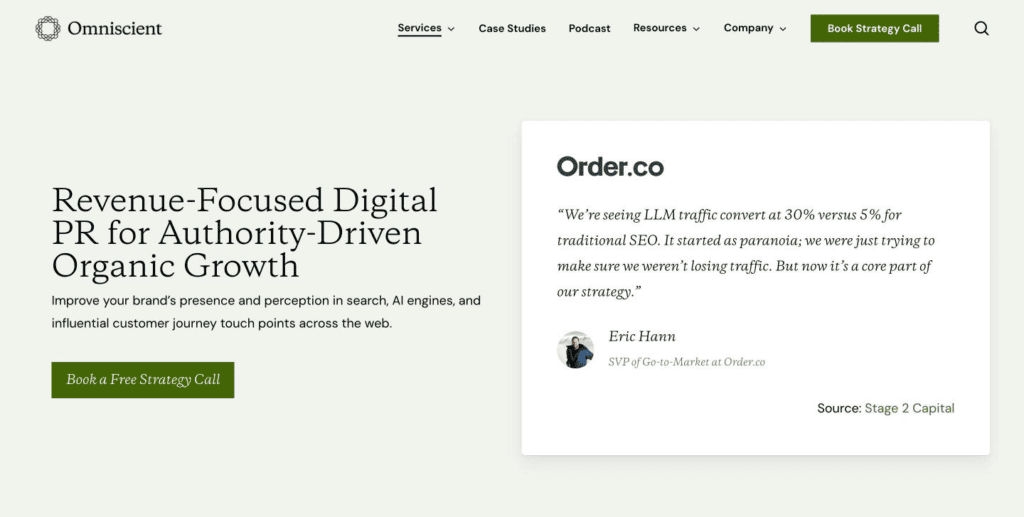
Omniscient Digital runs digital PR as part of a broader organic growth service that also includes SEO strategy, content, and answer engine optimization. Our approach centers on what we call “Brand Gravity.” In other words, building a consistent pattern of citations and mentions across the web that compound over time rather than chasing one-off press hits. This is also why we think of link building as one piece of a broader authority-building program rather than a standalone approach.
Pros:
- Our digital PR programs combine original research and data-driven content, targeted brand-mention and citation outreach, and off-page SEO rather than relying on a single earned-media tactic.
- Omniscient measures every campaign against visibility, citations, rankings, pipeline, and revenue rather than link counts alone. This includes AI visibility and citations.
- We’ve worked with numerous established B2B and B2B software companies, including SAP, Asana, Adobe, and Jasper.
Pricing: Contact us for a custom quote, tailored to your goals, bandwidth, and other key factors.
Results: During our work with Convert, we analyzed competitors’ referring domains to build a target list of roughly 400 high-quality domains trusted by large language models. We then secured dozens of brand mentions across that list, growing LLM visibility 81% and AI citation share 140% in 60 days.
Fractl: Best for data-driven digital PR for high-growth brands
Best for: Fortune 500 and established and scaling companies that want digital PR built on original data and research rather than reactive pitching alone.
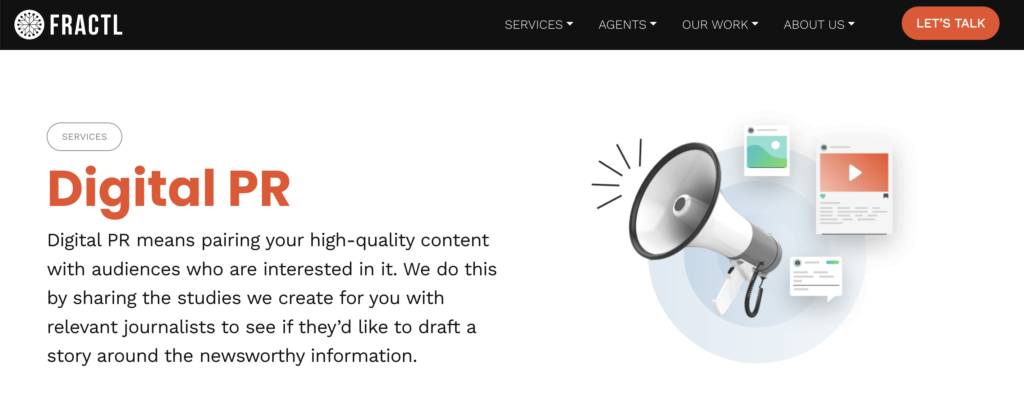
Fractl builds digital PR campaigns around data journalism—proprietary research and studies designed specifically to attract coverage from major and niche publishers. A data-backed study gives journalists a reason to cover a brand that a generic, reactive pitch doesn’t. However, the agency layers more traditional reactive and proactive PR work on top of that foundation. Ultimately, its client programs contain a mix of proactive and opportunistic coverage.
Pros:
- Fractl has secured coverage in national and trade publications. Think Harvard Business Review, The New York Times, MIT, and Fast Company.
- The agency measures digital PR against growth metrics. These include SEO lift, referral traffic, domain-authority gains, assisted conversions, earned links, and placements.
- Fractl also works as a white-label partner for other marketing agencies, delivering digital PR under those agencies’ own brands.
Pricing: Contact the Fractl team for a consultation and custom quote.
Results: Fractl’s campaign for Payless Power earned 1,208 press mentions, a third of which came from DR 60+ publishers. Additionally, over 16 months, the client saw a 55% increase in referring domains and 25% organic traffic growth.
uSERP: Best for B2B and SaaS link building with upfront pricing
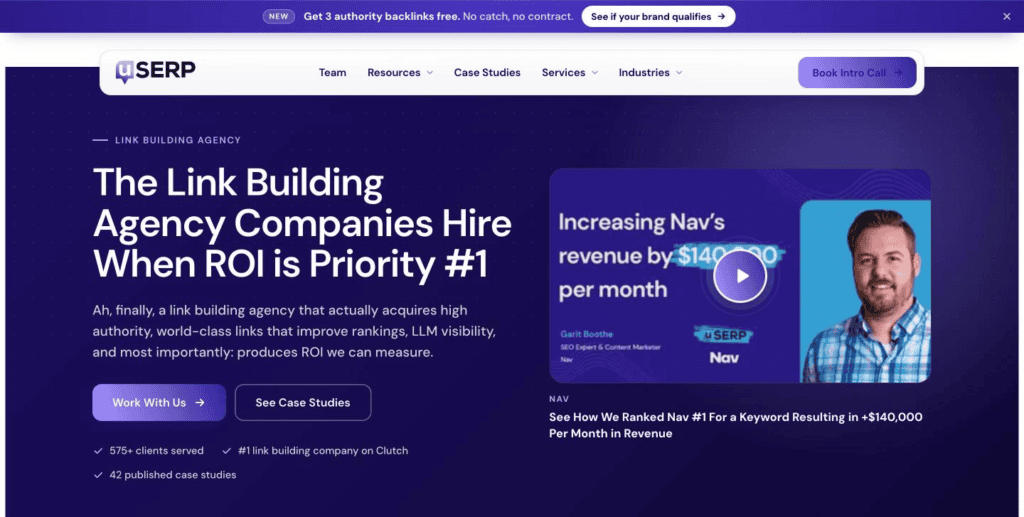
Best for: B2B and SaaS teams that want published pricing tiers and a defined link volume before signing a contract.
uSERP pulls on several levers, including editorial outreach, guest content, and journalist relationships to earn coverage for SaaS and B2B clients. The agency positions link building and digital PR as a single connected motion. The logic being that earned coverage and link acquisition often come from the same outreach relationships. uSERP’s approach is aimed squarely at SaaS and fintech buyers evaluating a partner for both goals at once.
Pros:
- The agency replaces lost brand mentions or features within six months with placements at equal or better metrics.
- Clients receive a portal with 24/7 access to live links and SEO deliverables, plus weekly updates and rank/KPI tracking.
- uSERP’s published pricing plans use a six-month initial term, after which engagements continue month to month to allow flexibility.
Pricing: Plans start at $5,500 per month for the Launch tier, which includes 5 links from sites with a domain rating of 60 or higher and 10 links from sites rated 20 to 59.
Results: uSERP’s work with Nav helped the company dethrone major competitors like NerdWallet to win the #1 spot for “business credit cards”. The agency’s efforts also helped this client generate $140,000 per month in additional pipeline revenue.
Siege Media: Best for digital PR reported alongside AI citation share
Best for: Brands that want a digital PR partner capable of integrating AI citation and LLM-visibility metrics into a broader GEO reporting program.
Siege Media positions itself around answer engine optimization. It describes its work as building the content, signals, and coverage that get a brand cited by AI systems. Digital PR often sits inside that broader GEO service alongside content marketing and affiliate partnerships. This is an advantage over agencies built around media relations alone.
Pros:
- Its digital PR team creates original assets, such as surveys, data studies, and visual content. This approach gives publishers a differentiated story, which can be more effective than relying only on routine product-news outreach.
- Siege Media reports campaign results using AI citation counts and LLM visibility percentages alongside traditional traffic value metrics.
- The agency serves SaaS, fintech, and e-commerce clients including Zapier, HubSpot, and Instacart.
Pricing: For engagements including both digital PR and content, starting prices range from $12,000 to $15,000 per month.
Results: Siege Media’s work with Zendesk achieved 98% LLM visibility and a $731,924 increase in traffic value.
Go Fish Digital: Best for earned media from top-tier outlets
Best for: Brands prioritizing coverage in nationally recognized publications over volume of smaller placements.
Go Fish Digital runs digital PR under its “Owned & Earned Media” service line, building what it calls tangential content. These are stories related to but not directly promoting the client’s business, and they’re designed to tie into active news cycles and earn coverage from major outlets. That tangential-content approach may appeal more to editors at national publications. The agency positions itself as a fit for brands chasing recognizable mastheads over sheer placement volume.
Pros:
- The agency reports an average increase of 3 Domain Rating points per year per campaign, along with 3 backlinks per campaign from DR 70+ sites.
- Go Fish Digital’s proprietary Barracuda platform includes a PR ideation engine trained on the agency’s own past campaigns. This can speed up how quickly the team identifies newsworthy angles for a new client.
- Go Fish Digital has secured client coverage in outlets including The New York Times, CNN, and Business Insider.
Pricing: Go Fish Digital does not publish pricing and asks prospects to request a custom proposal.
Results: Go Fish Digital’s work with SimpleTexting produced a 500% year-over-year increase in organic sales-qualified leads through its digital PR program.
Reporter Outreach: Best for expert-quote placements and clear pricing
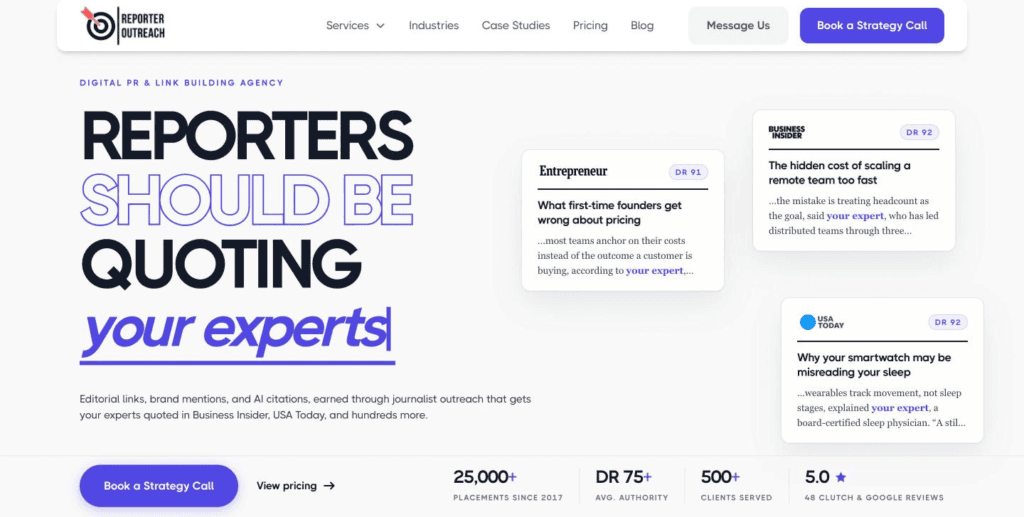
Best for: Teams that want a defined monthly placement count and published pricing rather than a custom-quote conversation.
Reporter Outreach specializes in earning expert quote placements by connecting clients with journalists actively writing stories. However, it also creates full-feature articles and does link insertions. The agency’s site shares 5 elements that make its pitches effective, so potential clients can get an idea of the team’s approach. After starting an engagement, Reporter Outreach also offers a live tracker where clients can keep tabs on all placements.
Pros:
- Reporter Outreach has earned placements averaging a domain rating of 75 or higher across client campaigns.
- Links roll over into the next month if the monthly minimum isn’t met. Plus, the agency swaps out any placements that don’t meet its agreed quality standards for domain rating, traffic, and relevance.
- Reporter Outreach has experience spanning across 13 verticals, running from SaaS and ecommerce to fitness and healthcare. It has established journalist relationships within each.
Pricing: Plans start at $3,000 per month for 7 placements, or roughly $375 to $429 per placement depending on tier.
Results: Reporter Outreach’s campaign for Qooper involved securing placements in publications like CMSWire and Her Campus. Within only 6 months, Qooper saw a 2,203% increase in organic traffic.
Shout Bravo: Best for combining digital PR and influencer marketing
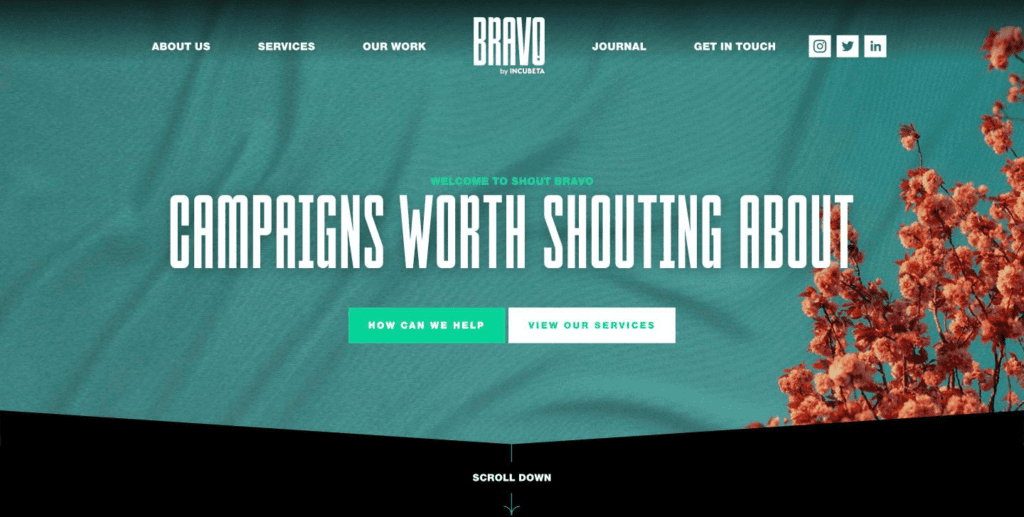
Best for: Brands that want digital PR handled by the same team running content and influencer marketing, rather than coordinating three separate vendors.
Shout Bravo offers digital PR alongside in-house content marketing and influencer marketing. Its team manages campaigns from initial concept all the way through content creation and outreach under one roof. The agency frames its work around securing genuine press interest rather than distributing generic announcements.
Pros:
- Shout Bravo’s team includes digital PR specialists, SEO experts, and former journalists. Campaigns have access to editorial experience alongside search-focused expertise.
- The agency’s public portfolio includes campaigns for brands in sectors such as online retail, technology, business services, and travel. This scope is a bit broader than some other agencies on this list that are more B2B SaaS-focused.
- Following its acquisition, Shout Bravo clients gain access to Incubeta’s data analytics, automation, and AI-driven insights. That’s in addition to Shout Bravo’s own PR and content expertise.
Pricing: Shout Bravo does not publish pricing. Contact the agency for a quote.
Results: Shout Bravo’s campaign for VPNOverview earned over 40 links and placements in outlets including Tech Radar, The Express, and Gadget Match. The agency’s work helped to position the brand as an authoritative voice in cybersecurity.
Dofollow: Best for bundled AI-visibility placements for B2B SaaS
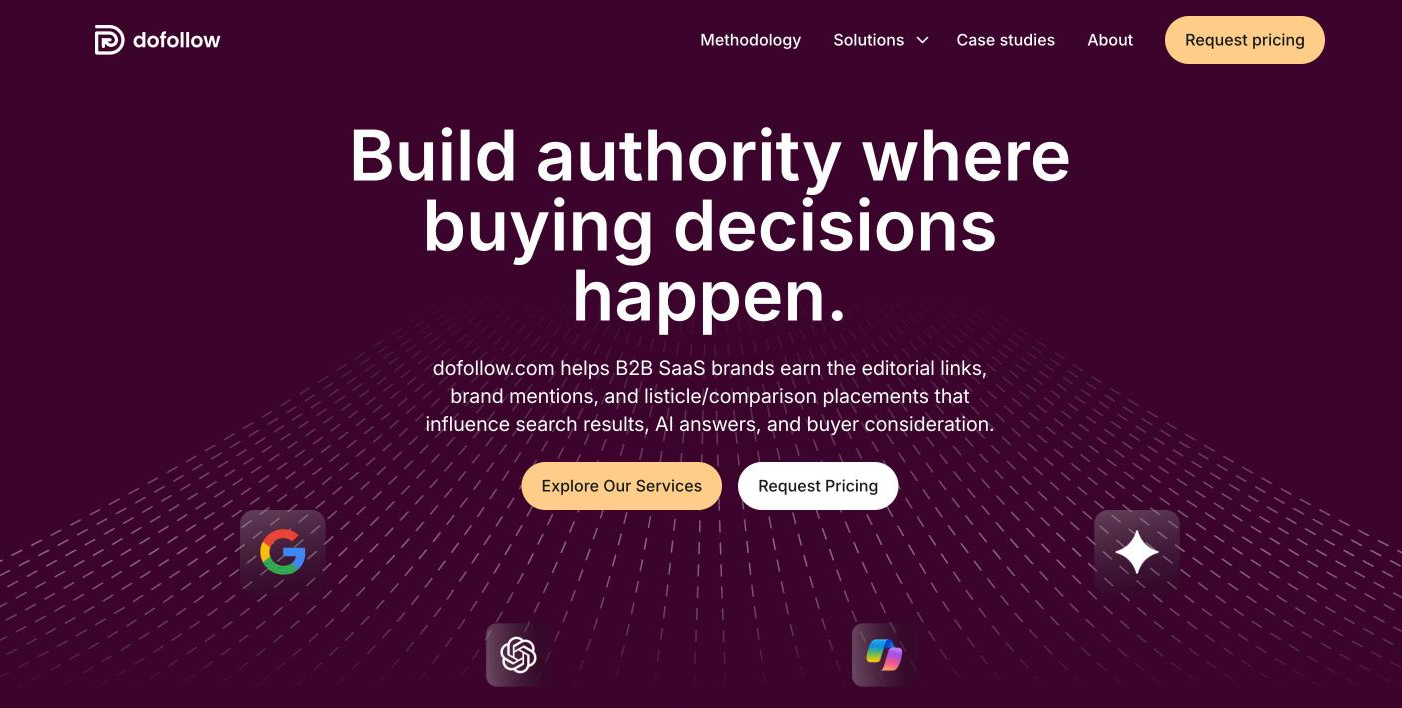
Best for: B2B SaaS teams that want mentions, listicle inclusion, and comparison-page visibility bundled with link building rather than sold separately.
Dofollow built its Visibility+ service specifically to address a gap that pure link building leaves open. A brand can rank well on Google and still be absent when a buyer asks an AI assistant which companies to consider. The service bundles editorial links with brand mentions, listicle placements, and comparison-page visibility.
Pros:
- The agency’s AnswerOS intelligence system identifies the prompts, sources, and citations shaping AI recommendations. That way, the team can make informed recommendations on what digital PR levers to use.
- Dofollow assigns clients a dedicated strategist, which can help maintain consistency and alignment throughout an engagement.
- The agency focuses specifically on B2B SaaS companies rather than serving a broad mix of industries.
Pricing: Contact Dofollow to request a custom quote for your project.
Results: Dofollow’s campaign for Nectar increased monthly organic traffic by 3,900% and took monthly demo requests from zero to more than 50.
Digital Olympus: Best for link-building PR and an active community
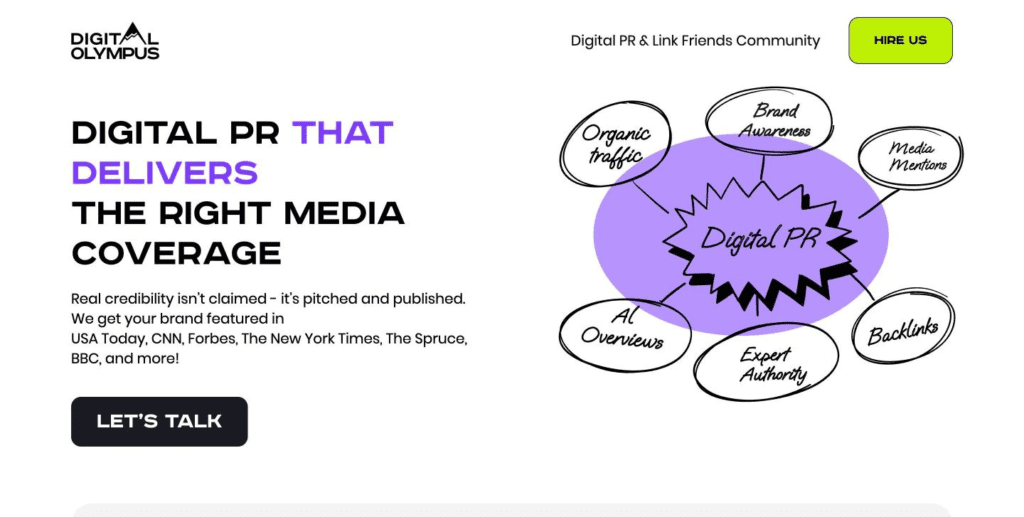
Best for: Teams that want a link-building specialist with visible standing in the practitioner community, rather than a full-service agency covering every digital PR tactic.
Digital Olympus built its reputation primarily on relationship-based link building, and the agency is upfront that it starts from business goals rather than SEO metrics alone. Alongside client work, Digital Olympus runs a private Digital PR & Link Friends community, giving it visibility into practitioner relationships and link opportunities that a purely client-facing agency may not have the same access to.
Pros:
- Digital Olympus has secured client placements in outlets including USA Today, CNN, Forbes, and The New York Times.
- The agency builds each campaign plan around guaranteed deliverables rather than open-ended effort.
- Client teams get ongoing access to review campaign progress rather than waiting for a periodic report.
Pricing: Digital Olympus does not publish pricing on its website, so you’ll need to contact them for details.
Results: The Social Shepherd, a client of Digital Olympus, reported 8.5 times growth in organic traffic following its engagement with the agency.
What to ask when evaluating a digital PR agency
Beyond the criteria used to build this list, a few practical questions will tell you more about fit than any case study can. These are the questions worth asking on a discovery call, before a proposal locks in assumptions you’ll be stuck with for a quarter.
Media relationships and journalist access
Question: What are the top three publications you’ve placed a client in this month?
Look for a quick, specific answer. Journalist relationships fade if they aren’t maintained, so a vague reply about “our extensive network” is a warning sign. What an agency has placed recently tells you far more than a client roster from two years ago.
It’s also worth asking whether the team pitches from a cold media database or works from relationships built through past coverage. Cold pitches can still land, but they usually take more volume and more time to get the same results. Ask how many recent placements came from journalists the team had worked with before.
Building your own pitch list before you commit to an agency? Grab our free email outreach templates for link building and guest post pitches to give you a head start.
In-house expertise and access requirements
Question: What does your team need from us on a monthly basis?
Beyond the agency’s own relationships, every digital PR program needs something from your side. It could be:
- A subject matter expert who can speak credibly to journalists
- Fast turnaround on quote approvals
- Access to proprietary data worth building a campaign around
Agencies vary in how much involvement they require and how quickly they need you to respond to certain requests. A program that needs two hours a month from a willing internal expert is a very different commitment than one that needs a dedicated point of contact managing weekly approvals.
Before signing, find out what their expectations and needs are. Then, ask yourself whether you have the internal resources to set yourself up for success long-term.
Realistic timelines for results
Question: What success metrics do you measure at 30 days vs. at 90 days?
The access question above shapes fit, whereas timeline expectations shape whether the relationship survives its first quarter.
First placements typically appear within 30 to 60 days of a program starting. But that’s a floor, not the whole picture. The visibility gains that actually change how your brand shows up in AI search results and organic rankings take one to two quarters to compound. After all, authority builds through the accumulation of consistent coverage rather than a single high-profile hit.
An agency promising meaningful ranking or AI visibility movement inside the first month is either:
- Underselling how the work actually compounds
- Or overselling what one placement can do
Ask what the agency measures at 30 days versus what it measures at 90, and whether those two answers are actually different.
For instance, at 30 days, maybe they track placement count and outlet names—an early signal that outreach is landing. At 90 days, it’d be wiser to look at referring domain growth or a shift in AI citation share. In other words, signals that the placements are actually compounding into visibility.
Tactic range versus single-channel focus
Question: What tactics do you use, and what mix typically maps best to my company’s goals?
Timelines aside, the tactic mix itself is worth scrutinizing directly. An agency limited to one tactic can still produce results, but leaves gaps that a broader program closes.
Link building and media relations each solve half the problem. Links strengthen the authority signals search engines rely on, but they rarely generate the earned coverage and expert commentary AI systems tend to cite. Media relations does the reverse: it puts a brand in front of audiences and builds credibility, but without links reinforcing that authority, the impact often fades after the news cycle. A program that combines both turns short-term visibility into a lasting presence in AI search.
Ask which of the following an agency actually runs, rather than mentions: authority building, media relations, research-driven campaigns, and community or Reddit visibility.
An agency running three or more has the range to build layered visibility. If you’re building a broader SEO marketing plan rather than treating digital PR as a standalone line item, tactic range matters even more, since the program is just one input among several.
Reporting and attribution clarity
Question: Can you show an example of how you report on digital PR outcomes?
None of the above matters if you can’t see whether it’s working.
Good digital PR reporting shows placement-level detail: which outlet, what date, what anchor text or context, and the domain authority of the site. It should also increasingly include AI citation tracking and share of voice, since those metrics indicate whether a brand shows up when a buyer asks an AI assistant for a recommendation. And when a campaign promotes a specific page or asset, reporting should connect coverage to results, like referral traffic and pipeline leads.
Request a sample report before signing. Then, check whether it ties placements back to any downstream metric—traffic, rankings, or AI visibility—rather than treating the placement itself as the finish line. Reporting that’s limited to a monthly link count or a vague “brand awareness” summary is a signal the agency isn’t tracking the outcomes that matter for a BOFU buyer evaluating a partner.
How much do digital PR agencies cost?
Pricing across this list falls into three rough tiers, and the tier you land in usually says more about the depth of media relationships and research capacity behind a program than it does about effort.
Foundational programs run about $3,000 to $5,500 a month. They focus on authority building and SME inclusion, and they work well for brands that aren’t showing up in AI answers yet. That includes newer companies, but also plenty of established brands that rank well in Google and still get overlooked by ChatGPT or Perplexity.
Growth programs, usually $5,500 to $8,000 a month, add more tactics that build on each other over time. uSERP’s published pricing lands in this range.
Full-service programs can start around $10,000 a month and grow with the scope of the work. These are built on original research, data journalism, or a full AEO strategy, and they’re best for brands that want AI tools citing them as a primary source in their category.
A few things drive a quote up regardless of tier:
- Original research and data journalism. Building a proprietary study or dataset from scratch costs more than pitching existing content, but it also produces placements that are harder for a competitor to replicate.
- Journalist relationship depth. Agencies with years of standing relationships in your specific vertical charge a premium for that access, because it shortens the time between pitch and placement.
- Reporting scope. A program tracking AI citation share and share of voice alongside traditional metrics requires more measurement infrastructure than one reporting link counts alone, and that infrastructure shows up in the price.
Most agencies on this list either publish pricing directly or ask for a custom quote based on scope. Treat a refusal to discuss even a range as a minor red flag, since it usually means the agency prices reactively rather than from a defined model. That’s a useful filter beyond digital PR specifically, too: it’s the same question worth asking of any digital marketing agency you’re vetting.
Start turning your earned coverage into pipeline
Digital PR isn’t link building with better branding. Treating it that way is how brands end up with a pile of backlinks and no movement in the places that actually influence a buying decision. The category is broader, including thought leadership, research campaigns, and increasingly, the community and Reddit visibility that AI systems draw on heavily when forming an answer.
The latter is especially important because 82% of journalists now use at least one AI tool in their own research process. That’s up from 77% the year before. The earned coverage your digital PR program produces is increasingly feeding directly into the systems that generate AI answers, not just the Google search results your buyers used to click through.
In any case, the agencies here range from single-vertical link building specialists to full-service programs built around original research and AI visibility tracking. The right fit depends on how much of the category you need covered and how much internal bandwidth you have to support it.
The best digital PR agency for a fintech brand chasing tier-one coverage looks nothing like the best fit for a bootstrapped SaaS company running expert-quote placements on a budget.
Is your current program producing links but not showing up when a buyer asks ChatGPT or Perplexity who to consider? That’s a tactic gap, not a budget problem. Get a free strategy call to see where your brand’s digital PR program has visibility gaps, and what it would take to close them before your competitors do.
Frequently asked questions about digital PR agencies
What does a digital PR agency actually do, day to day?
A digital PR agency’s day-to-day work centers on:
- Identifying newsworthy angles inside a client’s business
- Pitching those angles to journalists and publications
- Managing the resulting content and outreach through to placement
Depending on the agency, that can include anything from building original research or data studies to positioning internal experts for quotes and bylines. Not to mention monitoring where the brand shows up across earned media, forums, and AI-generated answers.
How is digital PR different from a traditional PR agency or an SEO agency?
Traditional PR and digital PR overlap in places, like reputation management and executive visibility. However, they’re usually working toward different goals. Traditional PR tends to focus on brand awareness and handles areas like crisis communications. Digital PR is built to earn the coverage and citations that drive visibility in AI search.
SEO agencies mostly work on the on-page and technical side of a website, with some link building mixed in. That still matters, but it doesn’t do much to build a brand’s presence in AI answers. Digital PR fills that gap by earning placements on the sites AI tools actually pull from.
How long does it take to see results from digital PR?
Most digital PR programs produce their first placements within 30 to 60 days of launch. Visibility gains that meaningfully affect rankings or AI citation share generally take one to two quarters to materialize. After all, authority compounds through sustained, consistent coverage rather than a single placement.