May was a month of two forces pulling in opposite directions, and depending on which dashboard you looked at, it was either thrilling or alarming. For most of the B2B world, it was both at once (a.k.a. the reality of being a marketer in ~today’s digital landscape~).
Before we dig in, it’s worth noting that because May is a bounce off April’s compressed lows, the M/M gains look more dramatic than the underlying shift. Our focus is on the steady-state patterns and what that means for our work.
The first force: ChatGPT turned the traffic tap back on. Around May 7, it reversed the citation-compression behavior we broke down last month (the GPT-5.3 shift that squeezed answers from 10–12 sources down to 2–3) and started linking out to brand websites again at roughly 5x the previous rate, by our measurement.
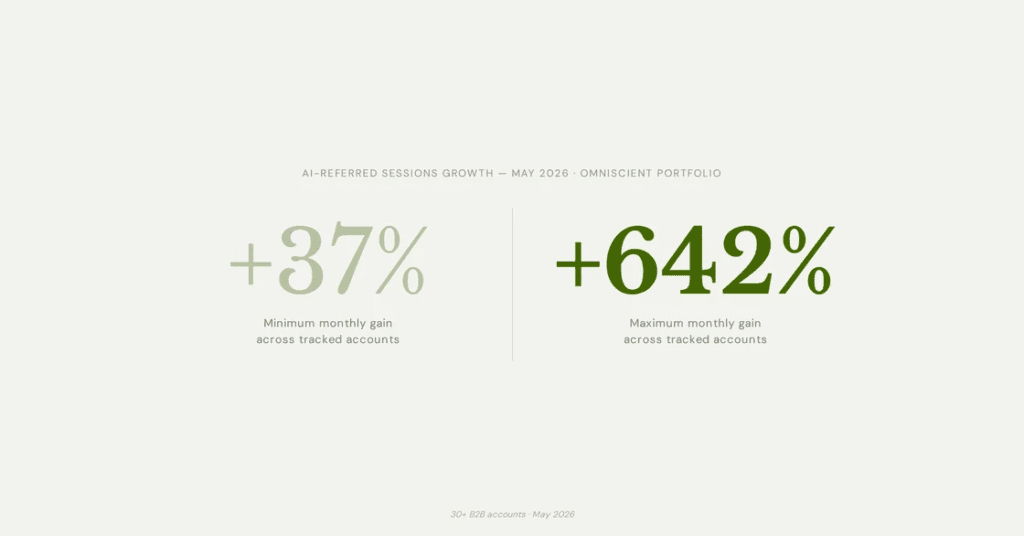
The effect was immediate. AI-referred sessions rose for nearly every account we track, with monthly gains running from +37% to +642%, and conversions moved in step. These are M/M figures measured against April, when compression bottomed out—a rebound, not a new altitude.
The second force: Google’s May core update (rolling out May 21, complete June 2) followed March’s pattern almost exactly. Informational, TOFU content lost ground as AI Overviews absorbed clicks, while commercial, comparison, and “alternatives” pages held or gained.
So if your organic line dipped while your AI line spiked, you experienced May the way most of the B2B world did. One reshuffled traditional rankings; the other turned the AI referral tap back on.
The piece to read
As AI traffic grows, measurement continues to strain under the weight of the dark funnel. What’s trickier (and entirely avoidable) is that most teams report on their analytics without ever verifying them.
In May alone, we caught 13,000 AI-referred sessions on one account misrouted to the homepage via hallucinated URLs, a GA4 setup reporting a 45% traffic drop while GSC showed clicks up 53%, and Gemini traffic landing outside GA4’s AI channel grouping entirely. Attribution issues surfaced on at least five accounts this month.
When the dashboard and reality disagree, which one do you trust, and how do you tell? When was the last time someone verified your analytics are actually working…not reported on them, but verified them?
Our Strategy Director Ben wrote an awesome essay about “auditing the auditors.” If your AI numbers look surprisingly good or surprisingly quiet, read this before you draw a single conclusion.
What we saw across the portfolio in May
A few patterns held across our accounts.
AI-referred sessions grew for the large majority of accounts we measured, with monthly gains between +37% and +642%, and AI-referred conversions grew between +38% and +671%. Two clients posted their best AI-sourced months on record, and one client’s AI-sourced demo requests rose 67% M/M.
Remember: these are measured against April’s compressed base, so the ceilings look bigger than the underlying move.
Last month, ~40% of clients tracking LLM conversions posted growth; this month, nearly all did (partly the flip side of April’s near-universal dip).
But the spike wasn’t universal, and that’s the point. One client in our book saw LLM sessions fall ~50% in the same window ChatGPT was linking out more elsewhere. Referral volume from AI tools is a volatile input right now…this is ChatGPT’s second major behavior swing in two months.
The durable signal and what we pay attention to is whether AI-referred visitors keep converting.
What didn’t swing: in-answer AI brand visibility held steady through all the May turbulence. The category leaders in our book sit at 60–80% visibility, and the two independent visibility platforms we use agree on direction. The challengers moved up too: one client gained ~5 points of AI visibility in May and is now in a near-tie for #1 in its category; another jumped into its category’s top tier for the first time.
And the conversion-quality story carried through the volatility. One fintech client posted its best organic-conversion month on record, +20% M/M, in the middle of all of this—and has more than doubled its non-branded ranking keywords since January (2,108 → 4,357).
The takeaway: volatility punishes the unfocused.
Three things that are working right now
Defending and doubling down on comparison and “alternatives” pages. The May core update made the case—informational content absorbed the volatility while intent-laden BOFU pages (best, vs., alternatives) held rankings or gained, with one client seeing five comparison terms move to #1 during the most volatile weeks of the rollout.
These pages also happen to be exactly what AI engines retrieve when a buyer asks, “What should I use instead of X?” SERP-resilient and citation-worthy at the same time.
AI info pages, a.k.a. content written for machines, not people. One client mid-rebrand had a problem you might recognize: ask ChatGPT or Claude about them, and you’d get a description of the company as it existed two years ago. This is a big issue for growing companies with evolving positioning and product specs!
The fix is dedicated, fact-dense “AI info pages” structured explicitly for machine reading, built to feed the current story to the models directly rather than hoping they infer it. This tactic + targeted brand reclamation outreach helped change the consensus-driven output in LLMs to better reflect today’s company description.
Refresh-over-net-new keeps winning, fourth month running. The pattern we’ve flagged since February held again, and nearly all clients are operationalizing it: refresh pipelines of hundreds of existing posts, prioritized by conversion performance, intent, and decay.
Teams doing this are recovering rankings faster than teams shipping net-new at the same budget and cadence.
Our prediction we’ll revisit next month: June gives back some of May’s ChatGPT spike (gotta pay the volatility tax), but the engine mix keeps diversifying, and AI-referred conversions hold. Watch conversions over sessions—and specifically whether AI-referred visitors keep converting at a healthy rate, since the raw count rides the same wave sessions do.
The whole point of an agency view across 30+ B2B accounts is that we see the patterns before any one brand would. Reach out for a strategy call, and we’ll dig in.
Want more insights like this? Subscribe to Field Notes