AI agents for marketing operations come in very different shapes. Some arrive ready-made for one narrow job, such as analyzing LinkedIn campaigns or routing customer conversations. Others let your team build custom workflows, internal applications, or coordinated agent systems, and a few sit underneath the rest, moving and syncing the data those agents run on.
This guide compares eight platforms across those approaches. The table below is your shortlist view: what each platform does best and which operational job it handles. Entry order carries no ranking.
| Platform | Best for | Category | Deployment model | Main operational job |
| ZenABM | LinkedIn account-based marketing analysis and optimization | AI-powered ABM platform | Ready-made specialist agent | Turn campaign and CRM data into account priorities and campaign actions |
| Respond.io | Revenue-critical B2C conversations | Customer conversation management platform with AI Agents | Ready-made execution agents | Qualify, route, and convert inbound customer conversations |
| Softr | Custom marketing operations software | AI app builder | Custom internal software | Build portals, trackers, approval systems, and internal tools |
| Airbyte | Feeding marketing data and AI agents from every tool in the stack | Open-source data integration and AI agent context platform | Configurable data layer | Sync ad, CRM, and warehouse data, and give AI agents live access to it |
| Venngage | Creating branded marketing visuals and business content | AI-powered design platform | Ready-made content creation platform | Turn ideas, information, and business data into visual marketing assets |
| Sparkle.io | Running outbound email sequencing and deliverability at volume | Cold email and sales management platform | Ready-made execution platform | Verify, warm up, send, and track email outreach |
| Stacksync (Genies) | Executing multi-step marketing operations across CRM, ad platforms, and data warehouses with built-in two-way sync | Agentic data and workflow platform | Configurable platform | Read context across the marketing stack, run deterministic workflows, and keep every connected system reconciled as the agent acts |
| OpenArt | Creating brand-consistent AI marketing videos for enterprise teams | AI creative suite for enterprise teams | Ready-made agent for image and video creation | Create images and videos with music for marketing campaigns |
The right pick depends on which gap you’re trying to close. A team running LinkedIn account-based marketing campaigns starts with a ready-made specialist agent such as ZenABM. A team building an internal content operations system starts with an AI app builder such as Softr. A company handling thousands of customer conversations starts with Respond.io, well before anything that moves data in the background.
Then there’s the team whose real gap is a martech stack with 10 different software categories and no one who owns the connections between them. That team should start with the layer underneath, such as Airbyte or Stacksync.
Those three starting points map onto the eight profiles below. Each one follows the same four parts: best for, key strengths, limitations, and ideal customer. Find the profile closest to your gap first, then read its limitations before you shortlist anything, because that section shows where each platform stops.
1. ZenABM
Best for: AI-powered LinkedIn account-based marketing operations.
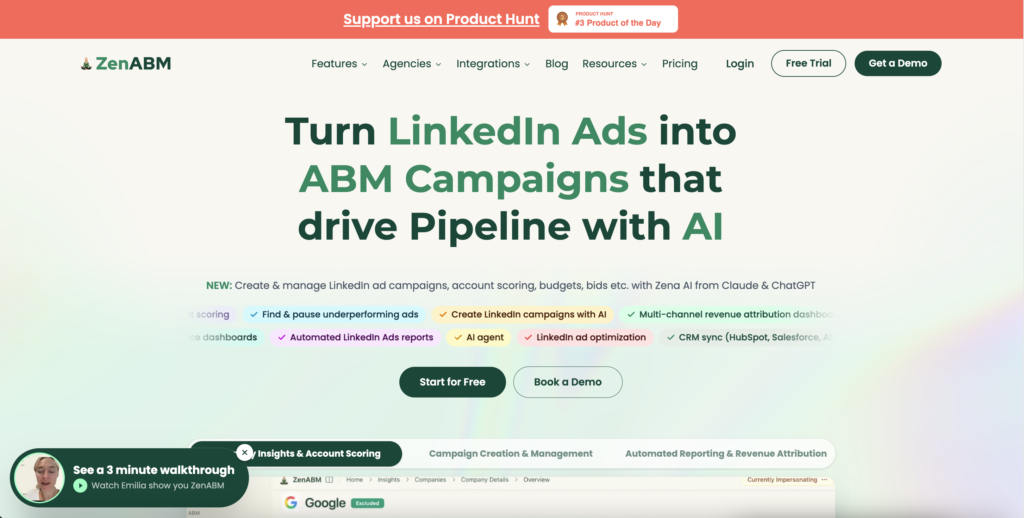
ZenABM is an account-based marketing platform built around company-level advertising engagement, CRM data, campaign analysis, attribution, and account prioritization. Its AI agent, Zena, acts as an ABM analyst: teams ask it about LinkedIn campaign performance, top engaged companies, and underperforming ads, and Zena can take selected actions after confirmation, such as pausing inefficient ads or excluding oversaturated accounts.
A demand generation team could use ZenABM to analyze several LinkedIn campaigns, identify which companies are engaging, connect that activity with CRM and pipeline data, and prepare a report showing where the budget should move. The platform also syncs account scores and intent signals with the CRM, giving sales and marketing a shared view instead of leaving it inside the ad platform.
Key strengths:
- Uses LinkedIn Ads, CRM, engagement, and pipeline data
- Identifies engaged companies and campaign-level intent
- Automates account scoring and CRM synchronization
- Supports selected campaign actions with confirmation
Limitations:
ZenABM is purpose-built for account-based marketing and paid campaign operations, not general content operations, customer communication, or internal workflow. Teams that don’t run LinkedIn advertising or account-based programs won’t benefit from its specialist capabilities.
Ideal customer:
A B2B demand generation, performance marketing, or ABM team running LinkedIn campaigns and connecting advertising engagement with pipeline outcomes.
2. Respond.io
Best for: AI Agents handling revenue-critical B2C customer conversations.
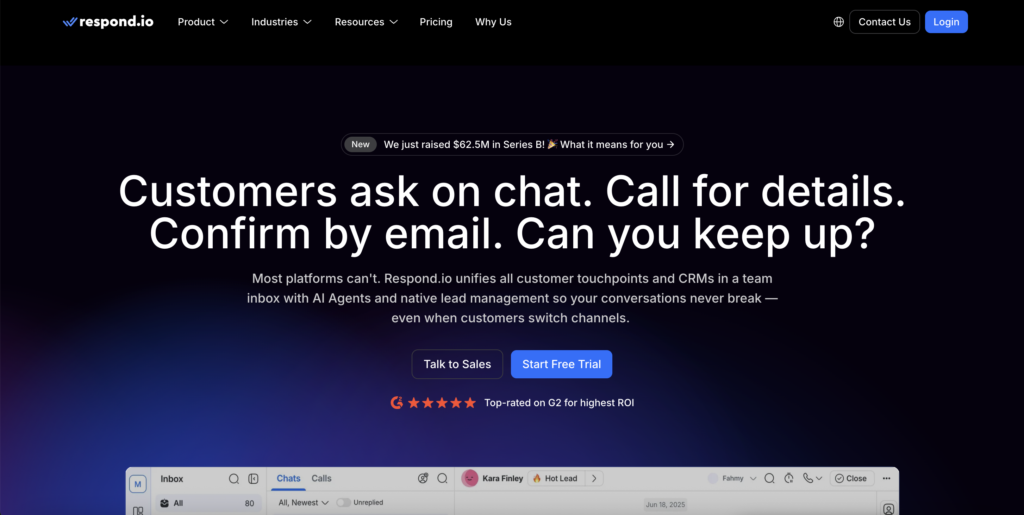
Respond.io is a customer conversation management platform for mid-market B2C businesses where conversations directly influence bookings, purchases, or revenue. It connects conversations across WhatsApp, Instagram, Facebook Messenger, TikTok, email, live chat, and voice.
Its AI Agents qualify leads, answer questions, update customer records, recommend products, book appointments, route conversations, and escalate complex cases to a person, turning high-volume inbound conversations into structured sales opportunities instead of running a general chatbot.
Consider a multi-location healthcare, education, or travel company running campaigns across Meta and TikTok. A customer may first respond on Instagram, continue on WhatsApp, and later call.
Respond.io preserves that context across channels: an AI Agent collects the required information, identifies intent, updates the lifecycle stage, and routes the opportunity to the right location or salesperson, escalating sensitive or high-value requests to a person without making the customer repeat itself.
Key strengths:
- Connects conversations across messaging, email, chat, and voice
- Qualifies and routes inbound leads
- Updates customer records and lifecycle stages
- Preserves context during human escalation
- Supports customer-facing actions, beyond recommendations alone
Limitations:
Respond.io is built for mid-market B2C companies managing high volumes of customer conversations. It would be excessive for a small B2B team that mainly needs internal workflow automation or account research.
Ideal customer:
A mid-market B2C marketing and operations team where inbound conversations drive appointments, bookings, consultations, or sales.
3. Softr
Best for: Building custom marketing operations software without a traditional development project.
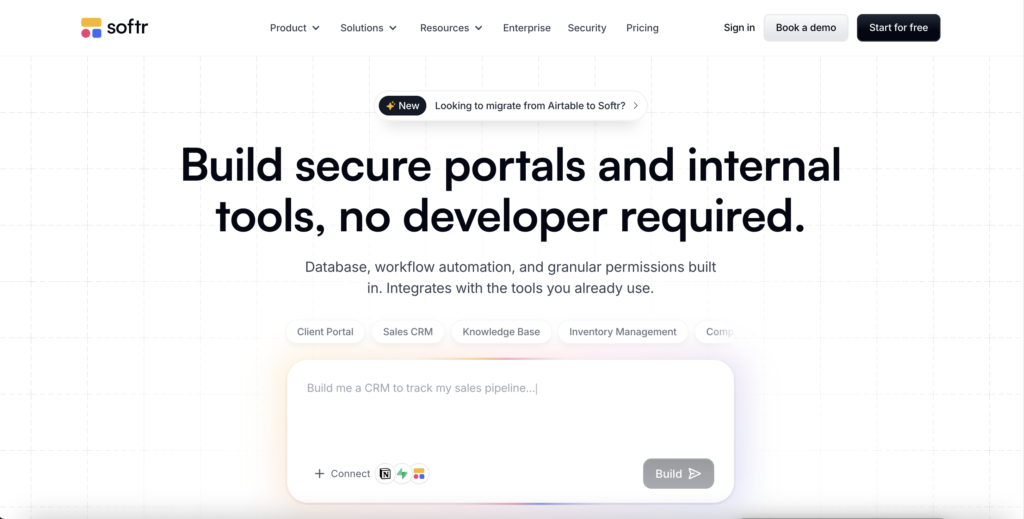
Not every marketing operations problem needs another autonomous agent. Some teams need a secure place where people, data, workflows, approvals, and AI-supported tasks work together, and Softr addresses that as an AI app builder: describe the system, and its AI Co-Builder generates an application structure, database, permissions, and business logic to edit visually or keep refining with AI, instead of arriving with a fixed job like a ready-made agent does.
Consider a content operations team managing briefs, freelancers, approvals, and assets across spreadsheets and disconnected tools. That gap between an informal process and a distributed team’s real content operations requirements is the layer Softr is built to hold.
A team could use it to build a native database for briefs and assets, separate views for editors and outside contributors, role-based access, approval workflows, and publishing dashboards, built around its existing process instead of a generic template.
This matters most when off-the-shelf project management tools need too many workarounds. A well-run content production function needs exactly this kind of system behind it, one that accounts for every stage from planning through distribution.
Key strengths:
- Generates the application, database, and business logic together
- Combines AI-assisted creation with visual editing
- Supports granular permissions and different user experiences
- Includes workflows, forms, authentication, and hosting
- Connects to existing business data sources
- Lets teams build around their own operating process
Limitations:
Softr isn’t a ready-made marketing agent. The team must define the users, data, permissions, approval stages, and desired outcome before the application becomes an effective operating system, and complex or unusual logic may still need technical support.
Ideal customer:
A marketing operations or content operations team that has outgrown spreadsheets, generic project management tools, or rigid off-the-shelf software.
4. Airbyte
Best for: Feeding marketing data, and the AI agents built on top of it, from every tool in the stack.
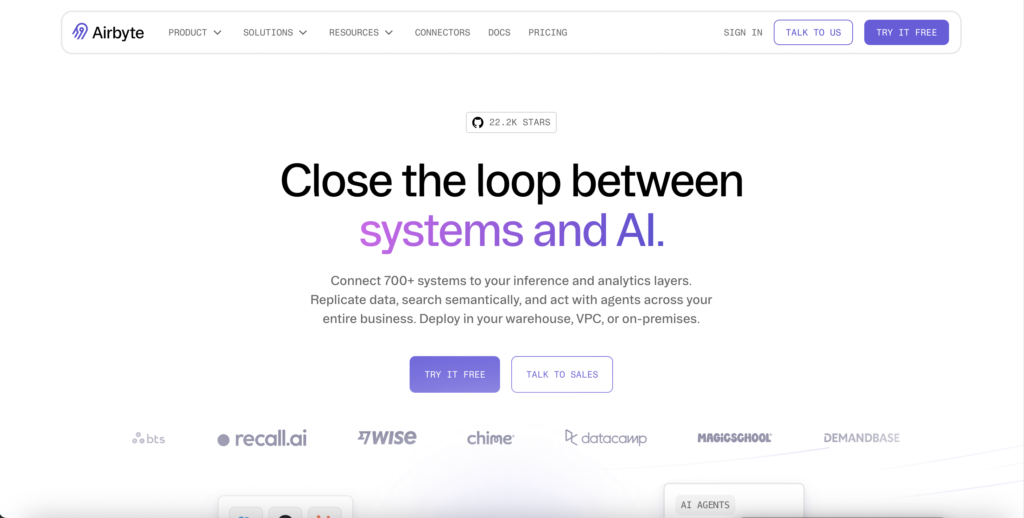
Airbyte is an open-source data integration platform split into two lines. Data Replication is the original ELT engine: 600-plus connectors moving data by batch or change data capture (CDC) into a warehouse, lake, or database. Airbyte Agents is newer, built around a Context Store that gives an AI agent live, structured access to those same sources instead of a static export.
Airbyte builds no marketing-facing agent itself. It’s the layer other agents read from. A demand generation team could sync Google Ads, Meta, LinkedIn Ads, and CRM data into one warehouse table on a CDC schedule as fast as under 5 minutes, then point an agent built in Stacksync or a custom workflow at that single table instead of writing separate API integrations for each.
Data Replication pricing runs a self-hosted, always-free Core tier and cloud hosting from $10 a month up to capacity-based Pro and Enterprise Flex tiers. Airbyte Agents bills separately on Agent Operations (AOs): Free includes 1,000 AOs a month, Individual is $29 for 5,000, Team is $299 for 10,000 with parallel execution.
Key strengths:
- 600-plus open-source connectors across ad platforms, CRMs, and warehouses
- Change data capture sync as fast as under 5 minutes on paid tiers
- Context Store gives any AI agent live, structured access to synced data
- Self-hosted Core tier stays free indefinitely, with no vendor lock-in
Limitations:
Airbyte runs no marketing plays of its own: no campaign action, no CRM scoring logic, no customer-facing agent. Setting up CDC syncs and a destination warehouse still needs someone comfortable with basic data engineering, and running two separate pricing meters makes it easy to underestimate cost on a high-frequency agent workflow until the first bill arrives.
Ideal customer:
A marketing operations or data team that needs one reliable copy of ad platform, CRM, and attribution data feeding a warehouse or an AI agent, instead of each agent pulling from its own partial slice of the stack.
5. Venngage
Best for: Creating branded marketing visuals and business content with AI.
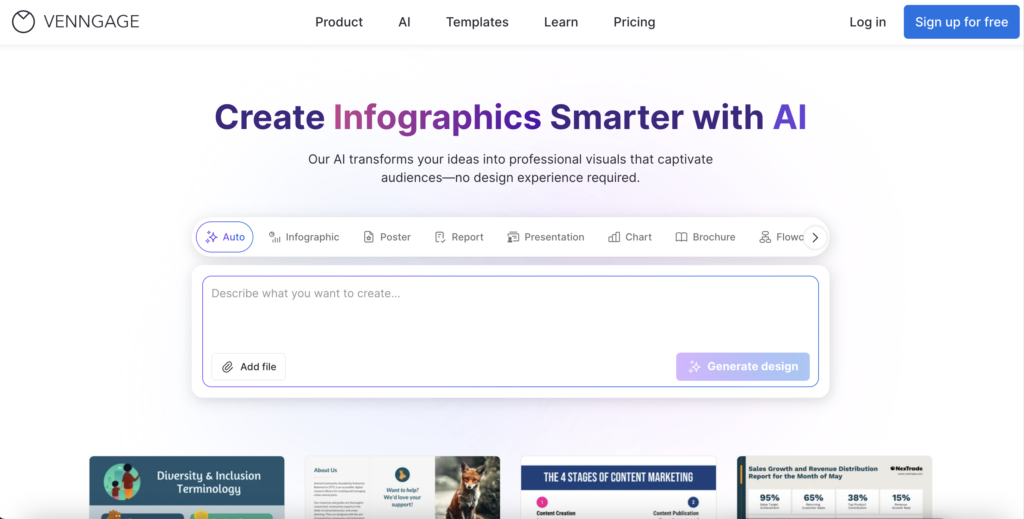
Venngage is an AI-powered design platform that helps marketing teams create infographics, reports, flyers, social graphics, and brochures without advanced design skills, turning ideas and raw data into visual assets for the steady volume of campaign and branded materials content operations needs.
A content marketing team running a campaign across blog posts, social, email, and sales enablement could use Venngage to build infographics, social graphics, and stakeholder presentations, applying the same brand elements across each asset instead of starting from scratch.
Its role in this list is not to coordinate systems, but to produce the visual assets those processes need. AI’s actual role in a content marketing program is closer to drafting and remixing than to replacing a writer’s judgment, and the same applies to design.
Key strengths:
- Creates infographics, brochures, flyers, social media graphics, and other marketing assets
- Turns ideas and information into visual content without advanced design skills
- Maintains brand consistency across materials and channels
- Builds visual assets directly from business information and written content
Limitations:
Venngage is web-based, so it needs an internet connection to create and edit designs, and its free plan limits features, templates, and the number of designs available compared with paid plans.
Ideal customer:
A marketing, content, or business team that needs to create branded visual assets efficiently and consistently as part of its broader content and marketing operations.
6. Sparkle.io
Best for: Running outbound email sequencing and deliverability as an operational job, not a side project.
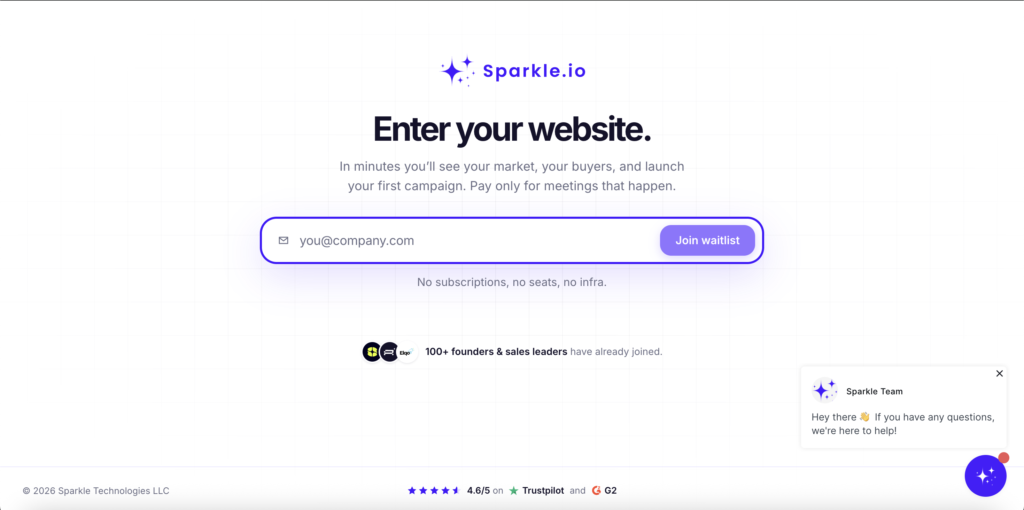
Sparkle.io is a lead generation service that delivers prospects and booked meetings rather than software a team has to run. You define a segment using filters for industry, secondary industries, job function, seniority, region, and years of experience, and the prospect count updates as you narrow it so you can size the market before committing.
Rebound then runs AI prospecting against intent signals such as a recent HQ relocation or an industry switch, and launches autonomous campaigns with follow-up sequences.
It bills Pay Per Lead or Pay Per Meeting instead of per seat, so cost tracks output rather than headcount. Free sample previews show real prospects from your segment before payment, and higher tiers add a dedicated account manager, bi-weekly or monthly sync calls, and priority support as volume grows.
Pricing runs on a Sparkles credit system with unlimited users and workspaces: Free gives 200 credits a day, Starter is $29 a month for 15,000, Business is $59 for 150,000, with a Done-With-You tier from $900 a month.
Key strengths:
- Priced per lead or meeting delivered, not per seat
- Segment builder shows the prospect count before you pay
- Intent signals and follow-ups run without an operator
- Free sample previews before any commitment
Limitations:
Sparkle.io is email-only today, so a team running SMS or LinkedIn outreach still needs a second tool until multi-channel ships. It doesn’t qualify or route inbound conversations the way Respond.io does. It’s an outbound execution layer, not a decision-making agent.
Ideal customer:
A marketing or sales operations team whose program includes email outreach at volume and wants verification, warmup, sequencing, and a lightweight CRM in one subscription instead of stitched-together point tools.
7. Stacksync (Genies)
Best for: Marketing operations teams that need an agent to execute multi-step processes across the CRM, ad platforms, and data warehouse, beyond moving data between them.
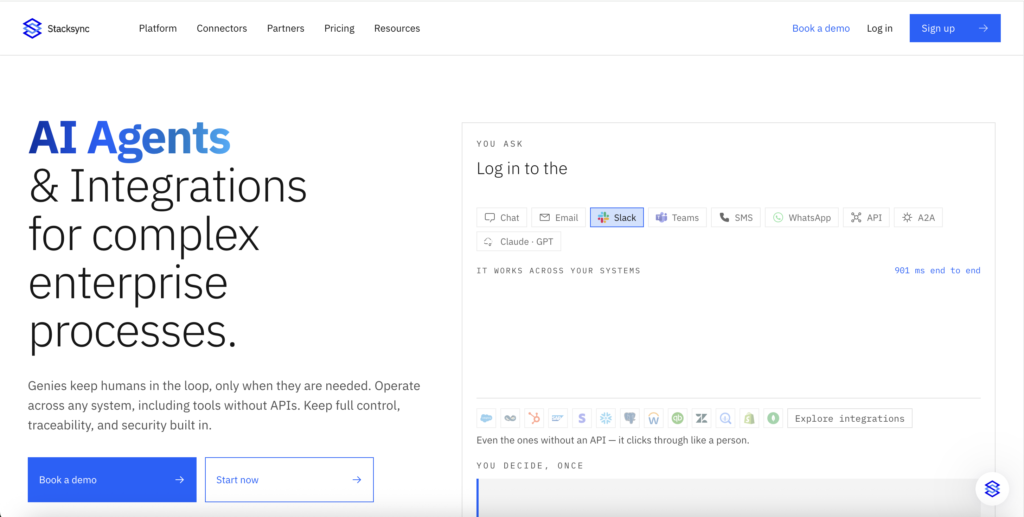
Stacksync is a data sync platform that lets teams build AI agents, called Genies, that read context across connected systems and take action on it, even in systems without APIs. Unlike a workflow layer that only moves information from one app to another, a Genie triggers deterministic multi-step workflows and keeps every connected system two-way synced as it acts, so the result stays reconciled instead of landing as a one-off write.
Consider a team running lead data through a CRM, an ad platform, and a data warehouse. A Genie reads a new lead the moment it lands, enriches it, triggers the right lifecycle-stage update, and syncs the result back across every connected system, so sales, marketing, and reporting are never working from three different versions of the same record. A change made anywhere, by a person or the agent, propagates everywhere else automatically.
Genies are built from a plain-English prompt and run thousands of tasks in parallel, around the clock, collapsing work that used to take an integration team weeks into a single instruction, with SOC 2, ISO 27001, and HIPAA compliance keeping every action human-in-the-loop.
Key strengths:
- Reads and acts across CRM, ad platform, and warehouse data in one agent
- Two-way sync keeps every connected system reconciled as the agent acts
- Works even with systems that have no API
- Runs at scale, thousands of tasks in parallel, human-in-the-loop
Limitations:
Stacksync is not a ready-made ABM or conversation agent like ZenABM or Respond.io. Teams still need to define which systems the agent should connect to and what it should do, though setup itself takes minutes, not a development sprint.
Ideal customer:
A marketing operations or RevOps team running processes across a CRM, ad platforms, and a data warehouse that needs an agent to execute the work end to end, beyond surfacing a recommendation or moving data.
8. OpenArt
Best for: Creating complete, brand-consistent AI marketing videos in one workspace.
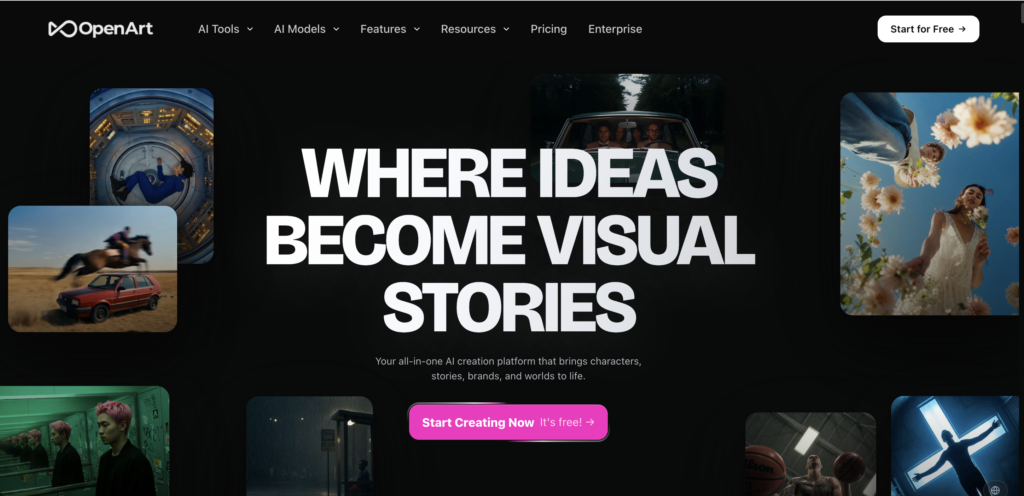
OpenArt is an AI video generator for marketing that brings image, video, voiceover, music, and sound generation into a single creative platform. Marketing teams can create video ads, product videos, social clips, explainers, and branded campaign content without managing several disconnected tools.
The platform provides access to more than 100 image, video, audio, and 3D models. Teams can choose models such as Kling, Veo, and Seedance based on the visual style and production requirements of each campaign.
OpenArt Director turns an idea or script into a structured, multi-scene video with recurring characters, connected environments, voiceovers, music, and sound effects. Its templates support common marketing formats, including UGC ads, product ads, social content, explainers, and branding campaigns.
For example, a marketing team preparing a product launch can create product visuals, develop a consistent brand character, generate campaign scenes, and adapt the creative for multiple channels within the same workspace. Character Builder maintains the identity of recurring spokespeople, while Brand Kit provides a consistent visual direction across campaign assets.
OpenArt focuses on creative production rather than campaign distribution. It creates the marketing videos that teams can publish through their existing advertising, social media, CRM, and marketing automation platforms.
Key strengths:
- Combines image, video, voiceover, music, and sound generation
- Provides access to more than 100 creative AI models
- Creates multi-scene videos with OpenArt Director
- Supports video ads, product videos, UGC content, explainers, and social clips
Limitations:
OpenArt does not replace a CRM, advertising platform, attribution system, or campaign automation tool. Teams still need their existing marketing stack to distribute content, manage audiences, and measure campaign performance.
Ideal customer:
An enterprise marketing team, creative department, agency, or performance marketing team that needs to produce more branded video campaigns and creative variations without relying on multiple AI tools or a traditional production workflow.
How to choose AI agents for marketing operations
Start from the workflow. The vendor list shrinks on its own. The seven questions below move from the job itself to the guardrails and the scorecard, so work through them in order.
What operational job needs to be completed?
Define the outcome in operational terms. “Improve demand generation with AI” is too broad, but “Identify engaged target accounts and sync their scores with the CRM each day” gives the team a process it can design and measure. Setting a goal at that resolution, tied to an operational outcome, is the same discipline Emily Kramer describes when she talks about setting marketing goals.
“Use AI for customer conversations” is just as vague. “Qualify every inbound WhatsApp inquiry and route high-intent opportunities within five minutes” is a job you can build and test. A good job definition has a clear starting point, owner, output, and completion condition, and once you have one, you can ask which kind of tool fits it.
Do you need an agent or an operating system?
This question eliminates several unsuitable products early. Comparing marketing operations software with AI agents this way keeps the decision tied to the job it needs to do. Choose a ready-made specialist agent when the job is already well defined: ZenABM for LinkedIn ABM, Respond.io for revenue-critical B2C conversations, Sparkle.io for email outreach.
Choose a configurable data platform when the missing piece sits underneath the agents: Airbyte for a shared synced-data layer, Stacksync for an agent that acts across a CRM, ad platforms, and a warehouse at once. Choose an AI app builder such as Softr when the real problem is the absence of a usable operational system. Choose a creative platform such as Venngage or OpenArt when the bottleneck is asset production. Whichever you pick, it only works with the data it can reach.
Where does the required context live?
List every system the agent or application must access: CRM records, advertising data, campaign briefs, analytics, customer conversations, product information, call transcripts, and brand rules. Then decide which system is authoritative when the same information appears in more than one place. An agent can’t compensate for missing definitions or conflicting data.
Once the data is in order, you can decide how much freedom the agent gets.
Which steps need judgment?
Start by separating deterministic steps from decisions that require interpretation. A CRM tag follows a fixed rule, but judging an account’s relevance takes context, and handling an open-ended customer request takes limited judgment. Use agents where context can change the correct next action, and use traditional automation where the action is already known.
The riskier the judgment call, the more it needs a person in the loop.
Where must a person approve the work?
Human review should reflect the risk of the action. An internal campaign summary may not need approval. Pausing an advertisement, sending a customer-facing message, changing a budget, deleting customer data, or sending an unverified claim to thousands of customers usually does.
The pitfalls of AI-generated content (generic outputs, factual errors, poor source data, loss of brand voice) become more serious once the system can act on its own output. Even with approvals in place, the agent will hit cases it can’t resolve.
What happens when the agent is uncertain?
Every production workflow needs an exception path: what happens when data is missing, two sources disagree, an integration fails, or the agent’s confidence falls below an accepted threshold. A safe system pauses, explains the problem, preserves the completed work, and routes the case to the correct person. It shouldn’t quietly choose the easiest available answer.
Once exceptions have a path, you can start measuring whether the system works.
How will success be measured?
Measure the operational outcome, because a count of AI actions says nothing about lead response time or conversion. Relevant metrics may include:
- Lead response time and account qualification accuracy
- Campaign cycle time and conversation-to-sale conversion
- Workflow completion rate and human escalation rate
- Failed or reversed actions and CRM data completeness
A workflow that produces more AI activity but adds review and correction work isn’t necessarily more efficient. That gap between activity and outcome is why attribution deserves scrutiny before you trust your own dashboard.
First-touch attribution alone can miss a meaningful share of AI-sourced leads, and the same undercounting risk applies to crediting an agent for a result it didn’t cause. A digital marketing analytics setup that catches that gap matters as much as the agent itself.
Frequently asked questions
What’s the difference between AI agents and marketing automation software?
Marketing automation runs a fixed rule: a trigger fires, a predefined action follows every time. An AI agent works from a goal instead, such as keeping account scores current, and decides its own next step from the data and actions available to it, adjusting as the situation changes instead of following one preset path. That AI agents vs marketing automation distinction decides which category on this list solves the job.
Does adopting an AI agent for marketing operations require a developer?
The ready-made agents here don’t. ZenABM, Respond.io, Venngage, and Sparkle.io run from their own interface with no code involved.
Configurable platforms such as Stacksync and Airbyte need someone comfortable connecting systems and defining what the agent can do. Setup still runs in minutes, not a development sprint. An AI app builder such as Softr sits in between: nothing to code, but someone still has to define the workflow before the agent has a job to do.
Can one AI platform cover every marketing operations job?
No single platform in this list covers ABM analysis, inbound conversations, visual content, outbound email, and back-office data sync at once. Most agentic AI marketing tools handle one operational job well, so most marketing operations programs end up running two or three of these together, each covering its own piece of the job.
Over to you
Before you add AI agents for marketing operations to your stack, write down the one operational job your team most needs done. Match that job to a category (a specialist agent, a data layer, an app builder, or a creative suite), then pick one platform from the list and one outcome to measure, such as lead response time. Set your approval rules and exception path before the agent takes its first action. Once that first workflow runs reliably, the second tool gets much easier to add.