In 2026, the term “AI marketing agency” can mean two things:
- An agency that has embedded AI into how they research, write, and measure
- And/or an agency that understands AI as a distribution channel (more important than ever since 51% of B2B software buyers now start their vendor research with an AI chatbot more often than Google)
The agencies worth evaluating are operating on both axes. Plenty are doing one and claiming both, and these are the ones you want to steer clear of.
This guide covers five agencies that are actually building AI into how they work, evaluated against observable criteria to help you choose the one that’s a fit for your company. To further understand the impact of LLMs on branding, explore how llms source brand information.
Table of contents
- At a glance: The 5 best AI marketing agencies
- The 5 best AI marketing agencies
- Omniscient Digital: Best for revenue-centric B2B organic growth
- NoGood: Best for AI-native performance marketing
- RevvGrowth: Best for scaling B2B SaaS organic and AI search from early traction
- Daydream: Best for AI-native programmatic SEO at scale
- Single Grain: Best for AI marketing across paid and organic
- What are the top features to look for in an AI marketing agency?
- How to choose the right AI marketing agency
- Frequently asked questions about AI marketing agencies
Disclosure: This guide is published by Omniscient Digital. We’ve included ourselves because we’ve successfully helped established B2B SaaS companies build AI-integrated organic growth programs. However, every agency on this list (including ours) was evaluated against the same criteria.
At a glance: The 5 best AI marketing agencies
Not every agency here is a fit for every company. The “best for” designations reflect each agency’s ICP and documented use cases rather than an overall ranking.
| Agency | Best For | Starting Price | Key Differentiator |
| Omniscient Digital | Revenue-centric B2B organic growth | $10,000/mo | Human-in-the-loop AI workflows + GEO/AEO as a named service |
| NoGood | AI-native performance marketing | Contact for pricing | Proprietary Goodie AI platform with AEO capabilities |
| RevvGrowth | Scaling B2B SaaS organic and AI search from early traction | $3,000/mo | AI-first SaaS specialist with prompt-level LLM citation tracking across 5 engines |
| Daydream | AI-native programmatic SEO at scale | Contact for pricing | Proprietary SEO agents; Shorty Award winner in SEO & SEM |
| Single Grain | AI marketing across paid and organic | $10,000+/mo | Proprietary AI tools (ClickFlow, Karrot) + named GEO/AEO/LLM SEO services |
How we evaluated these AI marketing agencies
All agencies were evaluated against these observable criteria:
- AI-native workflows embedded in delivery (not just AI tools used by team members)
- Verifiable B2B or SaaS experience
- Published case studies with specific and measurable AI marketing-related outcomes
- Proven results from AEO, GEO, and related projects
Other considerations like pricing transparency and proprietary tools or methodology are important. However, they’re addressed within each profile below rather than used as pass/fail criteria, since they vary by agency.
The 5 best AI marketing agencies
Each profile below covers best-fit use case, pros, cons, pricing, and a concrete client outcome so you can compare like for like.
Omniscient Digital: Best for revenue-centric B2B organic growth
Best for: Established B2B SaaS companies that need organic growth measured in pipeline and revenue, not just traffic.
Omniscient Digital runs generative engine optimization, SEO, content, CRO, and digital PR as part of integrated growth programs for B2B SaaS companies.
Where most agencies optimize for rankings, Omniscient ties deliverables to qualified pipeline, which means the engagement model looks different from the start. For one thing, research happens at the buyer level (think voice of customer research and sales call analysis) before keyword research begins. AI is embedded in how that research gets translated into strategy and content.
Pros:
- Human-in-the-loop AI workflows, including VOC-to-prompt pipelines and custom GPTs that translate customer language directly into content strategy
- Revenue and pipeline as primary KPIs instead of rankings, traffic, or impressions
- Integrated programs that align organic growth, sales enablement, and brand
Pricing: Full-service engagements start at $10,000 per month.
Results: Convert saw 81% LLM visibility growth and a 140% increase in AI citations in 60 days. Smartling gained $3.7M in pipeline value, a 31,250% increase in blog conversions, and a 12.8X ROI increase.
NoGood: Best for AI-native performance marketing
Best for: Growth-stage tech or AI-first companies that want paid, content, and organic unified under one roof, with a proprietary AI platform built in.
NoGood built Goodie AI, a proprietary marketing platform designed around answer engine optimization and AI discoverability. That distinguishes them from agencies that use AI tools in delivery but haven’t developed any IP around the process. They work with AI-first brands such as Inflection AI. This means they’re building practical knowledge from the client side of AI product marketing, not just reading about it.
Pros:
- Goodie monitors brand visibility and competitor rankings, surfaces optimization recommendations, and tracks traffic attribution from AI mentions AI
- Services both startups and scaleups, offering more flexibility in terms of business stage
- Works with AI-native brands, giving the team direct exposure to AI product marketing challenges
Pricing: Contact for pricing. Goodie AI is also available as a standalone product starting at $479/month.
Results: SteelSeries saw a 23x increase in year-over-year AI search traffic and a 27x increase in conversions from AI platforms.
RevvGrowth: Best for scaling B2B SaaS organic and AI search from early traction
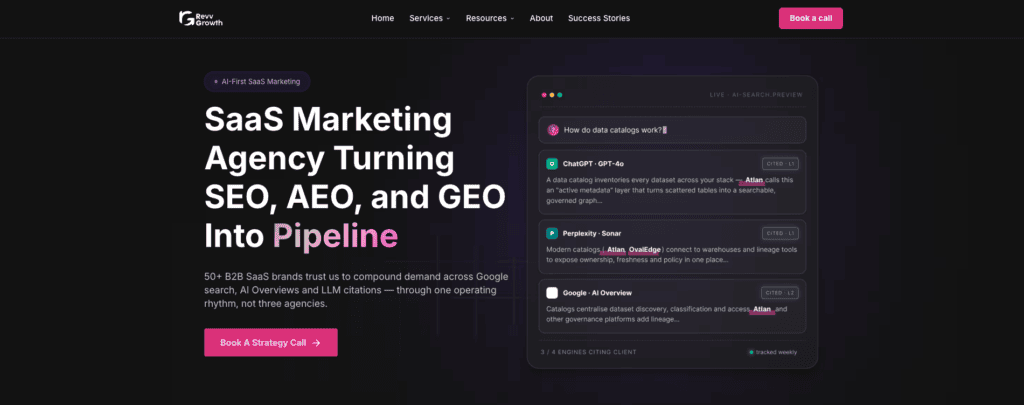
Best for: Growth-stage B2B SaaS companies that need to build organic traffic and AI search visibility from a low base, with content production and LLM citations attributed to pipeline.
RevvGrowth is an AI-first marketing agency built exclusively for B2B SaaS. Their service model combines SEO, AEO, and GEO under a single engagement rather than running them as separate workstreams. What sets them apart from broader agencies on this list is their narrow ICP: every client is B2B SaaS, which means the team’s pattern recognition on buyer journeys, competitive positioning, and content-to-pipeline attribution is concentrated rather than spread across industries.
Pros:
- RevvGrowth tracks LLM citations at the prompt level across five engines—ChatGPT, Perplexity, Gemini, Claude, and DeepSeek—rather than reporting aggregated “AI search” metrics.
- Their content production model runs a 55/45 AI-to-human ratio, where AI handles research and structuring while human editors review every piece, enabling output between 40 and 130+ articles per month depending on scope.
- With 50+ B2B SaaS clients and $120M+ in influenced pipeline reported across their portfolio, the agency has a documented track record in the specific market segment they serve.
Pricing: Monthly retainers start at $3,000 per month, with custom enterprise pricing available for embedded strategists and higher content volumes.
Results: RevvGrowth helped Atlan nearly double monthly organic traffic from 54K to 103K, and increase domain and page citations across AI platforms. OvalEdge saw LLM referral sessions increase from 100 to 278 per month, with 138 leads in its peak month.
Daydream: Best for AI-native programmatic SEO at scale
Best for: B2B SaaS and tech companies with large addressable keyword sets that need to build organic reach quickly through AI-driven programmatic approaches.
Daydream raised a $15M Series A in April 2026 and has built proprietary SEO agents—including a Reviewer Agent—into its delivery model. Unlike most programmatic SEO agencies, they’re building genuine software infrastructure around the process rather than templating content at volume and calling it AI. They won the Shorty Award in the SEO & SEM category and took bronze in GEO, which provides a third-party signal on execution quality that’s rare in this market.
Pros:
- AI citation tracking built into standard delivery so visibility across ChatGPT, Google AI Overviews, and other AI surfaces is measured by default
- Transparent about system, principles, and approach, so prospective clients can gauge alignment before reaching out
- Client roster spans funded B2B SaaS and AI-native companies like Clay, Beautiful.AI, and Lightspark
Pricing: Contact for pricing via their qualification process.
Results: Daydream is responsible for 19.8M clicks generated via programmatic SEO across Google and AI platforms.
Single Grain: Best for AI marketing across paid and organic
Best for: Marketing teams that want paid and organic under one agency, with AI tools layered across both channels and LLM SEO as a named service.
Single Grain has built proprietary AI infrastructure: ClickFlow for content optimization and Karrot for paid acquisition, layered across engagements. They also list GEO, AEO, and LLM SEO as named services with documented methodologies.
Single Grain also offers AI Transformation consulting alongside their agency retainers—a structured track for marketing teams that want to build internal AI capabilities alongside outsourced execution. Their enterprise client roster includes Amazon, Airbnb, Uber, and Crunchbase.
Pros:
- ClickFlow plans, writes and optimizes organic content, while Karrot generates personalized ads and landing pages for LinkedIn ABM
- Their own Search Everywhere (SEVO) methodology, which encompasses AI Overview Optimization, GEO, social media SEO, and more
- Covers paid search, paid social, SEO, content, and CRO in a single engagement
Pricing: Single Grain’s pricing starts at $10,000/month.
Results: LS Building Products achieved a 540% increase in Google AI Overview mentions and a 100% increase in visibility across ChatGPT, Gemini, and Perplexity.
What are the top features to look for in an AI marketing agency?
If you’re still narrowing the field, these five criteria are the most reliable filters. Each one is observable, so you’re not forced to rely solely on what an agency says about itself. For insights on AI-driven branding, explore our guide on measuring brand visibility in LLMs.
AI-native workflows, not just AI-adjacent tools
Agencies are increasingly using AI to accelerate research, personalize campaigns, and transform performance data into actionable insights. A practical guide to AI for marketing can help teams identify useful applications without sacrificing editorial judgment or brand consistency.
There’s a practical difference between an agency that uses AI tools and one that has embedded AI into its delivery process.
The first looks like writers using ChatGPT for first drafts, project managers using AI for notes, and the team generally just adding AI to handle tedious tasks or speed things up.
The second is more about using AI to improve their work quality and outcomes, though efficiency gains come along with it. This looks like VOC-to-prompt pipelines that translate customer interview data into briefs, AI-assisted research with defined human review checkpoints, or proprietary agents that run quality checks before content leaves the agency.
Ask any agency to walk you through their delivery workflow—not just a slide about how they “leverage AI.” If the answer is a list of tools, that’s a tool-adoption story. If it’s a process with defined human decision points, it’s a workflow. One scales independently; the other doesn’t.
B2B or SaaS specialization
B2B and consumer buying journeys share almost no tactical structure. The content that builds trust with a VP of Engineering evaluating developer tooling is different from content that converts a consumer in a Google Shopping ad. Attribution models differ. What counts as a result differs.
Agencies that divide attention across verticals tend to apply what they know to what they don’t. In B2B, that usually means tactics optimized for volume—clicks, impressions, traffic—rather than for qualified pipeline.
The check: look at the case study library. If fewer than half the named clients are B2B SaaS companies, ask how the team separates its consumer and enterprise practices before assuming specialization applies to your engagement.
Named GEO, AEO, or LLM SEO services
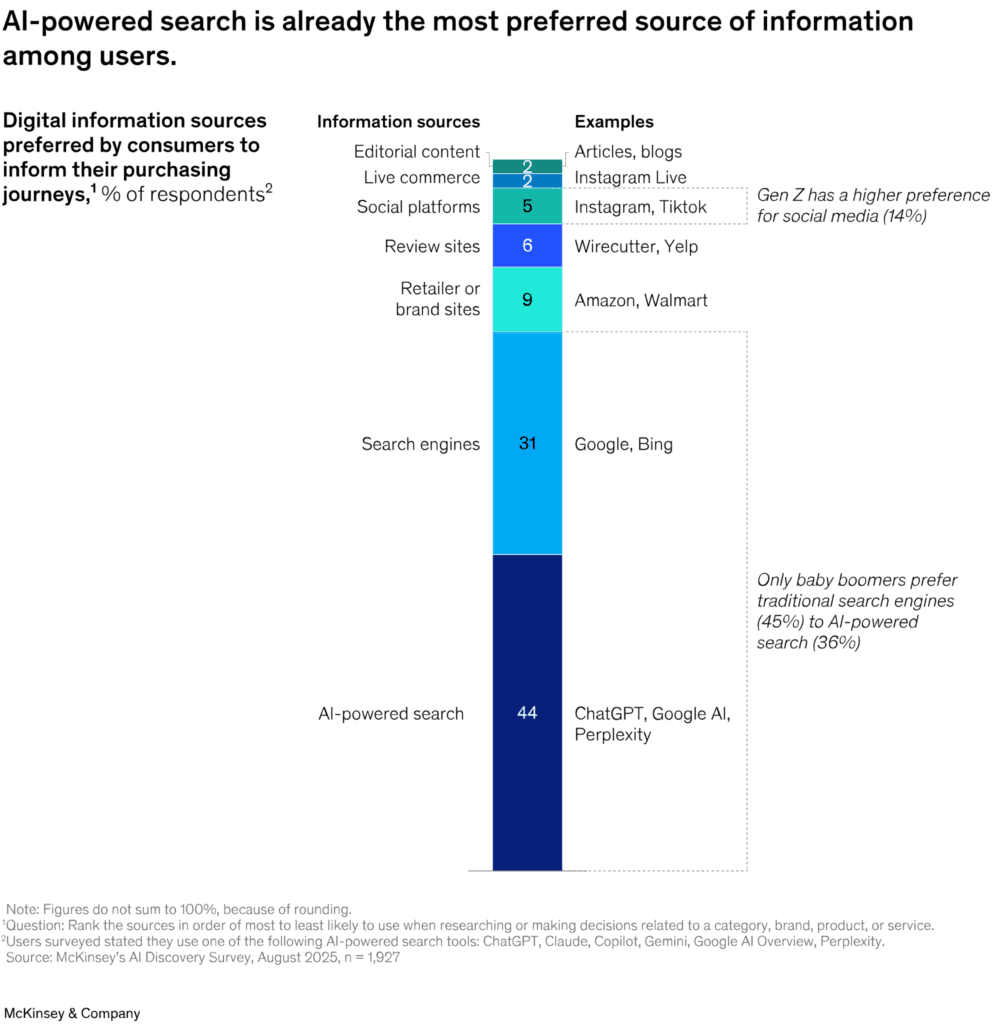
Discovery has split. According to McKinsey’s 2025 AI Discovery Survey, 44% of AI-powered search users now say AI search is their primary and preferred source of insight, ahead of traditional search at 31%. For B2B buyers, that means vendor discovery and shortlisting increasingly happen in ChatGPT, Perplexity, and Google AI Overviews before anyone visits your website.
Agencies that only optimize for traditional search are missing that surface. Look for generative engine optimization, AEO, or LLM SEO listed as a named, described service—not as an add-on or a checkbox. The agency should be able to explain how they structure content for AI citation, how they track LLM visibility, and how they report on it. Our AI SEO statistics resource and guide to GEO tools cover the landscape in more depth if you want to go into that conversation better prepared.
How are B2B buyers researching vendors in the AI era? Omniscient’s B2B Buyer Behavior in 2025 report covers how buyers navigate channels, build trust, and make purchase decisions when AI is part of every stage of the journey.
Verified revenue or pipeline outcomes
Good case studies describe the starting condition, how they got from A to Z, and report a result that connects to business metrics—not just marketing metrics.
Traffic screenshots don’t mean much. “Increased organic visibility” doesn’t mean much.
You’re looking for measurable outcomes: For example, $3.7M in attributed pipeline, a 540% increase in Google AI Overview mentions, etc. The result should be specific enough to bring to a conversation with your CFO without hedging.
For AI marketing specifically, AI search visibility metrics—citation rates, LLM-referred traffic, share of answer—are acceptable because they represent real movement in how buyers discover and evaluate vendors. The key is that the metric is measurable, tied to your category, and reported with enough specificity to show that the project was actually impactful.
How are marketing leaders rethinking success metrics? Omniscient’s Measuring Organic Growth in 2025 report covers how AI is reshaping attribution, metrics, and confidence in organic growth outcomes across B2B SaaS.
Fit with your team and working style
Two things worth pressure-testing in the discovery call: who owns your account day-to-day, and how strategic decisions get made when priorities shift mid-engagement.
Some agencies sell senior talent and deliver junior execution. Ask to speak with the person who would own the account—not just the person closing the deal. If that’s not possible, even just a bit of background on the day-to-day team’s execution can provide valuable insight.
Also, ask directly: if our priorities shift three months in, what does that process look like? You’ll want to know how the team goes about understanding the why behind your goals, whether they’re comfortable pushing back or advising as needed, and how quickly they can pivot.
How to choose the right AI marketing agency
Start with channel fit, not capability claims. An agency with a strong AI workflow in programmatic SEO won’t help you if what you actually need is GEO and content strategy. Narrow the field to agencies whose documented ICP and case study library match your company profile, then evaluate AI workflow depth in the discovery conversation.
For broader category context, the GEO agencies and growth marketing agencies guides cover adjacent categories worth reviewing if you’re still defining scope.
Omniscient Digital is built for established B2B SaaS companies that need organic growth tied to revenue, not just search rankings. The team runs integrated programs across SEO, GEO, CRO, and digital PR, with pipeline and revenue as the primary success metrics. Book a free strategy call to see if it’s a fit.
Frequently asked questions about AI marketing agencies
What is an AI marketing agency?
An AI marketing agency is a firm that builds artificial intelligence into its core delivery workflows—not just uses AI tools to speed up individual tasks.
In practice, this can mean proprietary AI platforms, AI-native research workflows, generative engine optimization (GEO) as a named service, and/or AI-assisted content production with defined human review stages.
But the range is wide. Two agencies can both call themselves AI marketing agencies and operate almost nothing alike, which is why what’s on the website is rarely enough. You need to ask about the processes of any agency you’re considering.
How much does an AI marketing agency cost?
Pricing depends on scope and specialization.
For example, RevvGrowth’s engagements start at $3,000 per month. For many more B2B-focused organic growth agencies, though, full-service retainers typically start in the $10,000/month range.
Agencies with proprietary platforms may also offer component-based pricing—NoGood’s Goodie AI platform, for example, is available standalone starting at $479/month.
Most full-service agencies require a discovery call before providing a quote, and pricing scales with channel complexity and team involvement.
What’s the difference between an AI marketing agency and a traditional marketing agency?
The practical difference is whether AI is embedded in the delivery process or used as a productivity layer on top of existing workflows. A traditional agency might use AI tools to speed up drafts or reporting. An AI marketing agency builds AI into how buyer research gets done, how content strategy is developed, and how performance gets tracked across AI search surfaces like ChatGPT, Perplexity, and Google AI Overviews.
The most meaningful distinction for buyers is whether the agency can serve you across both traditional search and AI-powered discovery since those channels require different strategies.