More and more consumers are leveraging LLMs to find, evaluate, and even purchase products.
In 2025, we conducted research on buyer behavior in the LLM era to understand how buyers move through the journey across channels and stages. That research showed buyers already use LLMs to establish selection criteria, shortlist brands, and compare competitors.
That raised an interesting question:
What happens when users aren’t explicitly asking to buy anything?
As an avid ChatGPT user, I’m consistently prompting things like “My WiFi sucks even though it’s $90 a month. Is that normal in New York?” or “What’s the best time to take magnesium?”.
Basically, I (and many others) use ChatGPT as a de facto diary – complaining, problem solving, solution seeking, and only rarely, explicitly seeking product recommendations and evaluations.
However, those queries (often referred to as “pain point” queries or problem statements) feel like a perfect opportunity for the LLM to mention alternative WiFi providers or supplement brands, even though I never asked for them.
So I designed an experiment to measure how often LLMs mention brands, broken down by funnel stage, to see if (and how often) LLMs recommend brands even without being asked.
Methodology
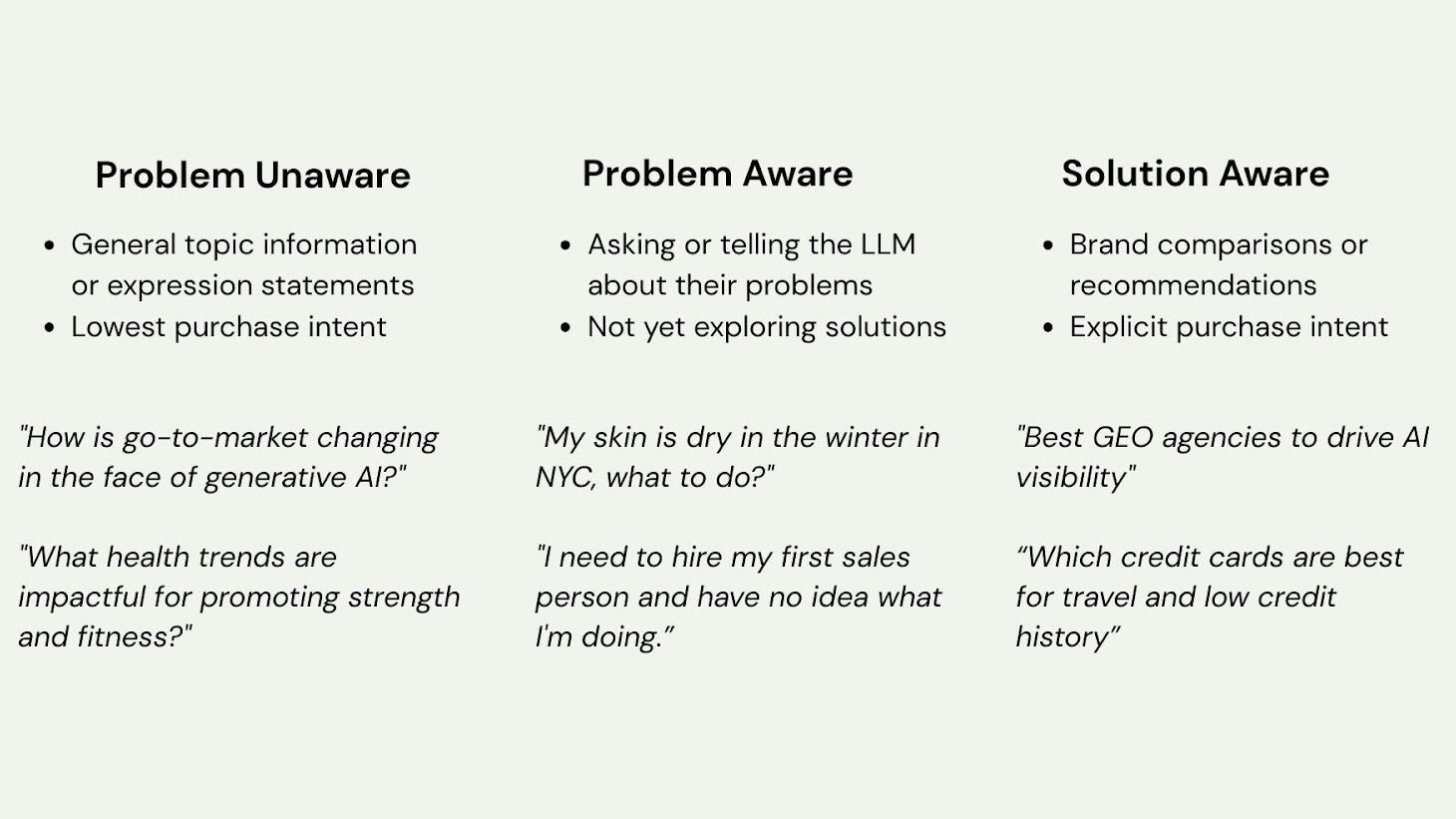
I created 180 prompts, split evenly across three stages:
- Problem Unaware: General topic information or expression statements
“How is go-to-market changing in the face of generative AI?”
- Problem Aware: Expressing or explaining a problem, not yet exploring solutions
“I need to hire my first sales person and have no idea what I’m doing.”
- Solution Aware: Brand comparisons or recommendations, explicit purchase intent
“Best GEO agencies to drive AI visibility”
The prompts spanned four industries, broken into four sub-categories:
- B2B SaaS: SEO, CRM Tools, and Cybersecurity
- Consumer Products: Electronics, Beauty, and Fitness
- Professional Services: Consulting, Real Estate, and Legal
- Finance: Personal Finance, Credit Cards, and Insurance
Using Peec.ai, I collected 5,323 total LLM outputs across 5 different large language models. I then used natural language processing in Python to flag brand recommendations and compare how often brands appeared across stages, industries, sentiment, and prompt structure.
Brand recommendations from LLMs closely follow purchase intent
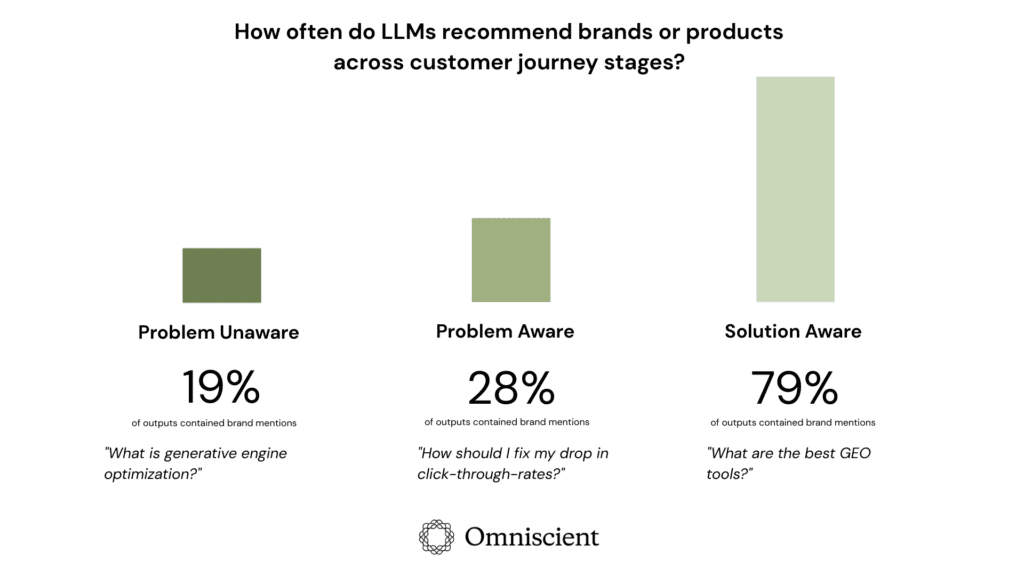
One of the strongest predictors of whether an LLM recommends a brand is how close the user is to a decision.
- Problem Unaware prompts generated brand recommendations in answers 19% of the time.
- Problem Aware prompts increased brand recommendations to 28%.
That means even when users aren’t asking for products or services, LLMs introduce brands in up to ⅓ of the answers.
Once users explicitly asked for recommendations or comparisons:
- Solution Aware prompts triggered brand recommendations 79% of the time.
Why not 100%? In some cases, LLMs responded with selection criteria, category explanations, or high-level guidance instead of naming brands directly.
For example, when asked “What are the best skincare brands for repairing a weakened skin barrier?”, one response focused on desirable brand attributes rather than actual brands, advising readers to “look for brands that prioritize barrier-supportive ingredients like ceramides, fatty acids, and niacinamide”.
Brand recommendations from LLMs vary widely across industries and categories
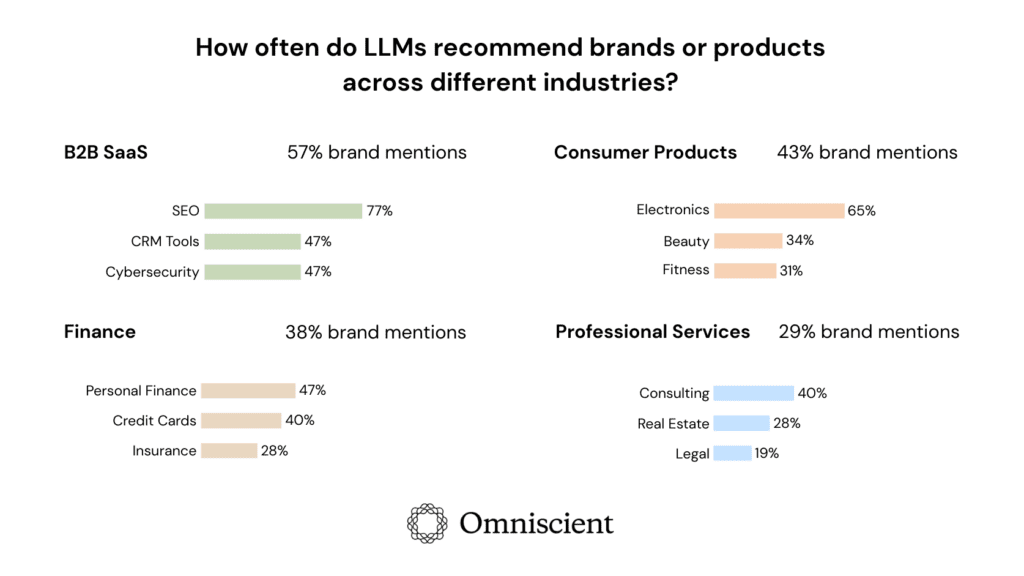
Across all prompts analyzed:
- B2B SaaS saw brand recommendations in 57% of outputs
- Consumer products followed at 43%
- Finance dropped to 38%
- Professional services lagged at 29%
Zooming in reveals even bigger differences:
- In SEO-specific prompts, brands were mentioned in 77% of LLM outputs, triggering the highest promotional behavior across all categories
- Electronics queries contained brands in 65% of outputs
- Legal service brands were mentioned just 19% of the time
LLMs appear far more willing to name brands in categories where products are standardized, comparisons are expected, and perceived risk is lower.
Valence matters: prompts with neutral sentiment drove the highest percentage of brand recommendations
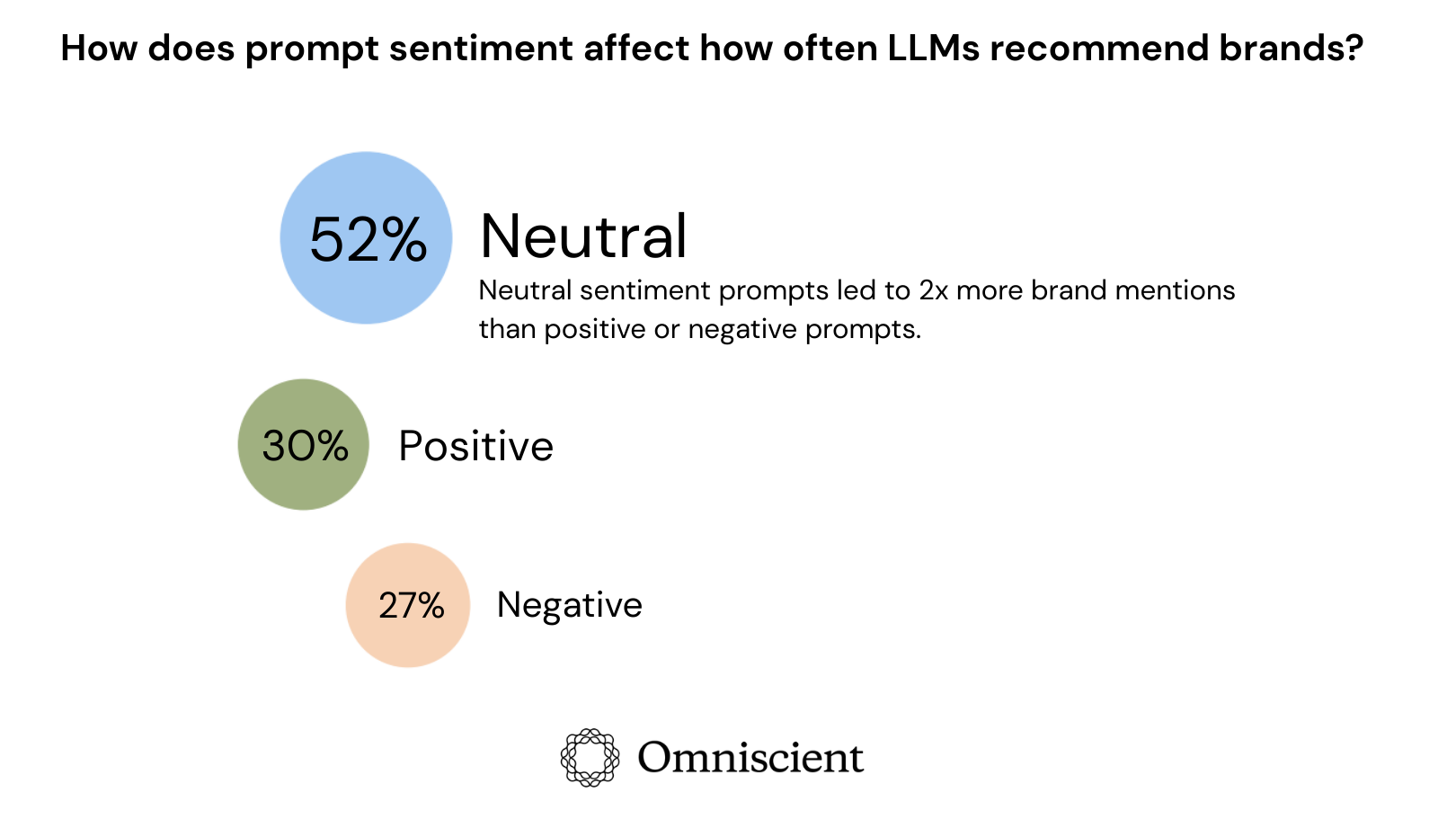
Initially, I expected emotionally charged prompts to trigger more recommendations, especially negative ones like “Our customer data is scattered across spreadsheets, why is this so hard to manage?”.
Instead, neutral prompts often signal evaluation mode. They’re analytical, not emotional, which gives LLMs “permission” to surface brands as options rather than responses to frustration.
Many Solution Aware prompts (e.g. “best tools” or “top brands”) naturally fall into this neutral category, which likely contributes to the effect.
Different AI models recommend products and brands at different rates

Each AI model has its own algorithm, and they change frequently.
As a result, AEO isn’t really a single channel. It’s a collection of distinct platforms, each with different tendencies around when and how they mention brands.
The customer journey still matters in AI search
Overall, what does this research mean? How can you use it to better inform your organic growth strategy?
First, it’s clearly still important to understand the customer journey and the various questions, queries, and prompts that lie along it. LLMs still follow customer journey and intent, though it may truncate the journey at certain points, and users may be introduced to products earlier in the traditional funnel than once expected.
Second, as expected, brand recommendations are most common when a user explicitly asks for solutions, products, or tools to solve their problems. This is no secret.
As the industry discovers “best X” listicles and comparison pages, what we find more surprising and interesting is how often brands and products show up in answers to questions that don’t explicitly ask for products.
A significant portion of the time, brands show up early in LLM outputs, even when users
- Express problems
- Ask neutral, evaluative questions
- Explore criteria rather than solutions
This adds some extra interest to what GEO will mean moving forward. Winning in AI can go beyond ranking for “best tools” queries. It’s about earning presence across the full buyer journey, including moments where users aren’t consciously shopping yet.
From a content strategy perspective, this means you shouldn’t sleep on pain points, middle-of-the-funnel topics, how to content, or even definitional or high level education. Not only do they tie together a cohesive entity for your site and brand, driving topical authority and comprehensive topic coverage, but they also (sometimes) shake off solution stage brand recommendations in the process.
The brands that show up most consistently in AI answers aren’t just visible at decision time, they’re woven into how LLMs explain problems, frame categories, and guide evaluation.