Traditional search rewards sources that rank well. AI search rewards sources that models trust enough to cite.
When someone asks ChatGPT, Perplexity, or Gemini a question about your brand, the model doesn’t respond with “10 links to choose from.” It generates one answer, backed by a handful of citations if grounded in web search. Those citations determine which brands and information get visibility, and which brands and information get left out.
That’s why share of voice in LLM search is becoming a competitive metric. If your brand isn’t mentioned, you’re missing the moment when customers are forming opinions and making decisions.
Organic growth has always been about showing up when someone needs an answer, and making sure what they find reflects the narrative you want associated with your brand. To do that in AI search, brands need to know which content types are most successful at earning citations.
Which content types do LLMs actually cite when people search for information about specific brands?
And more importantly: which content types are worth investing in?
How I analyzed LLM citations for branded queries
To answer that, I used Peec AI, an AI visibility platform that lets you run the same prompt set across multiple AI engines (ChatGPT, Perplexity, Gemini, AI Mode, and AI Overviews), and returns:
- The full LLM responses
- The clickable citations used to support the response.
I imported 240 unique prompts, each containing a specific brand name. Because every prompt was queried across multiple models and each output produced multiple citations, the dataset totaled 23,387 unique sources.
The prompts were evenly distributed across:
Four industries
- B2B SaaS
- Consumer Products
- Professional Services
- Finance
Six user intent types
- Competitor Comparison: “Which is a better CRM for mid-sized SaaS teams: HubSpot or Salesforce?”
- Customer Reviews: “What do customers say about Hoka? Are reviews generally positive or negative?”
- Direct Evaluation: “Is Chase a good choice for small business banking?”
- Functionality / Integrations: “Does Rare Beauty makeup include liquid blush products?”
- Proof / Evidence: “What evidence or real-world results support Bain for management consulting?”
- Purchasing / Pricing: “What fees does Square charge?”
After collecting the outputs, I categorized every cited source into seven content forms:
- Brand Foundation: Think of this as a brochure-version of your brand’s website- the pages meant to establish foundational messaging and narrative consistency.
- About Us pages, FAQs, legal and policy pages, contact pages
- Directory Sites and Reference Pages: Places users go to search brands, showcasing functionality, differentiation, and general information.
- Directory sites, brand profiles, documentation and support pages such as software integrations and how the product or service works
- Education and Thought Leadership: Owned and earned content meant to teach, persuade, and build authority.
- Blogs, how-to guides, research, trends and stats roundups
- News and Press: Brand updates for public record.
- Funding announcements, leadership changes, software updates, and press releases
- Product Pages and Commercial Intent: Pages that drive purchase decisions and remove friction.
- Product descriptions, e-commerce product pages, pricing pages, campaign landing pages
- Reviews and Social Proof: Content that validates whether a brand is actually worth it.
- Customer reviews, listicles, forums, social media, case studies
- Video: A separate, high-effort format, assumed to overperform in AI search by the industry.
Which content types do LLMs cite the most for branded queries?
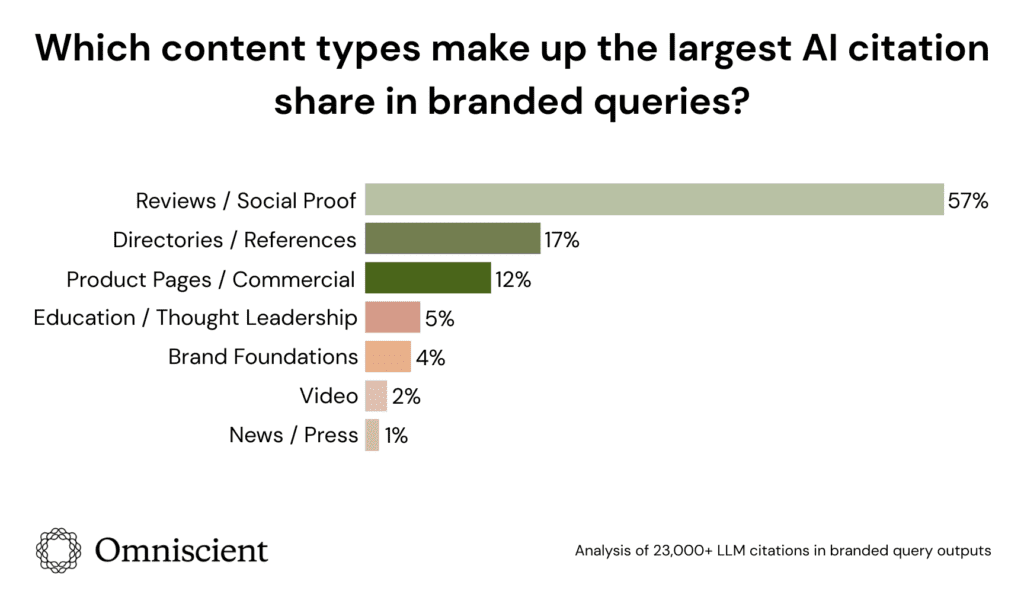
LLMs overwhelmingly lean on reviews and social proof
57% of branded query citations go to product and company reviews, listicles, forums, social media, and case studies.
In our buyer behavior research of 100 B2B decision-makers, we found that social proof is the strongest form of evidence that makes people trust brands.
People trust other people with experience. Since reviews come from a third party, not the brand itself, they seem less biased than sources like product description pages. Buyers want to know: Does it actually work? Is it worth the money? Would someone buy it again?
The second most cited category: directory and reference sites
This 17% includes directories like Wikipedia and Product Hunt, and documentation and support like software integrations and how the product or service works.
A major part of this group is brand profiles: pages that contain must-have brand information summarized for the reader, hosted on a third-party website. Competitors and partners may do this to grab traffic when someone searches for your brand over theirs, like a competitor’s page all about Omniscient.
Product pages and commercial content come in third
Product pages and commercial intent content make up 12% of citations.
It surprises me that when a user is explicitly asking about a brand like Nike and Adidas, there aren’t more product pages, e-commerce links, or pricing pages that show up.
While the proportion of product pages that are cited may be lower than social proof, the messaging that is displayed on these pages forms the “source of truth” that often gets echoed through the web. Especially for technical specifications, persona relevance, and use cases, it is important to accurately and cohesively describe your product and features on your own website.
Thought leadership is not commonly cited in branded queries
Educational content and thought leadership only accounts for 5.4% of branded query citations.
At Omniscient, we know original research and educational content can do a lot:
- Establish authority
- Building audience trust
- Create differentiation
- Drive discovery
But for branded queries specifically, it doesn’t show up very often.
Why? Branded queries are closer to purchase intent. When a user already has a brand in mind, they’re not asking “teach me”, they’re asking “validate this decision.”
Thought leadership may be more relevant to category discovery and early-stage learning.
Brand foundation pages don’t stand out in LLM citations
Even though these pages are essential for credibility and clarity, they make up a tiny citation share:
- About Us: 1.92%
- Home pages: 1.82%
- FAQs: 0.41%
- Contact pages, legal, job listings (combined): 0.31%
LLMs don’t treat brand foundations as the default source of truth when people ask about brands.
I’ve heard talk about using FAQ pages to bolster LLM visibility. It makes sense- if you have content in the exact form users are searching for, why wouldn’t the LLM cite that exact page? But in this data, that wasn’t the case.
They aren’t major drivers of LLM outputs for the same reason as thought leadership: users (and the models) need specific product/service details and comparisons to answer branded queries.
Video and press citations are the lowest
Video content (like YouTube) and news/press releases show up the least in branded queries.
While the overall citation rate for video is low in our dataset, video can be a high leverage opportunity to showcase your product and build social proof. Happy customers and evangelists who create positive product review videos can be cited as well as referenced directly to improve your trust and credibility. Additionally, video is often a lower competition channel, so it is often easier to see results quickly from video efforts.
Which specific content formats win AI citation share?
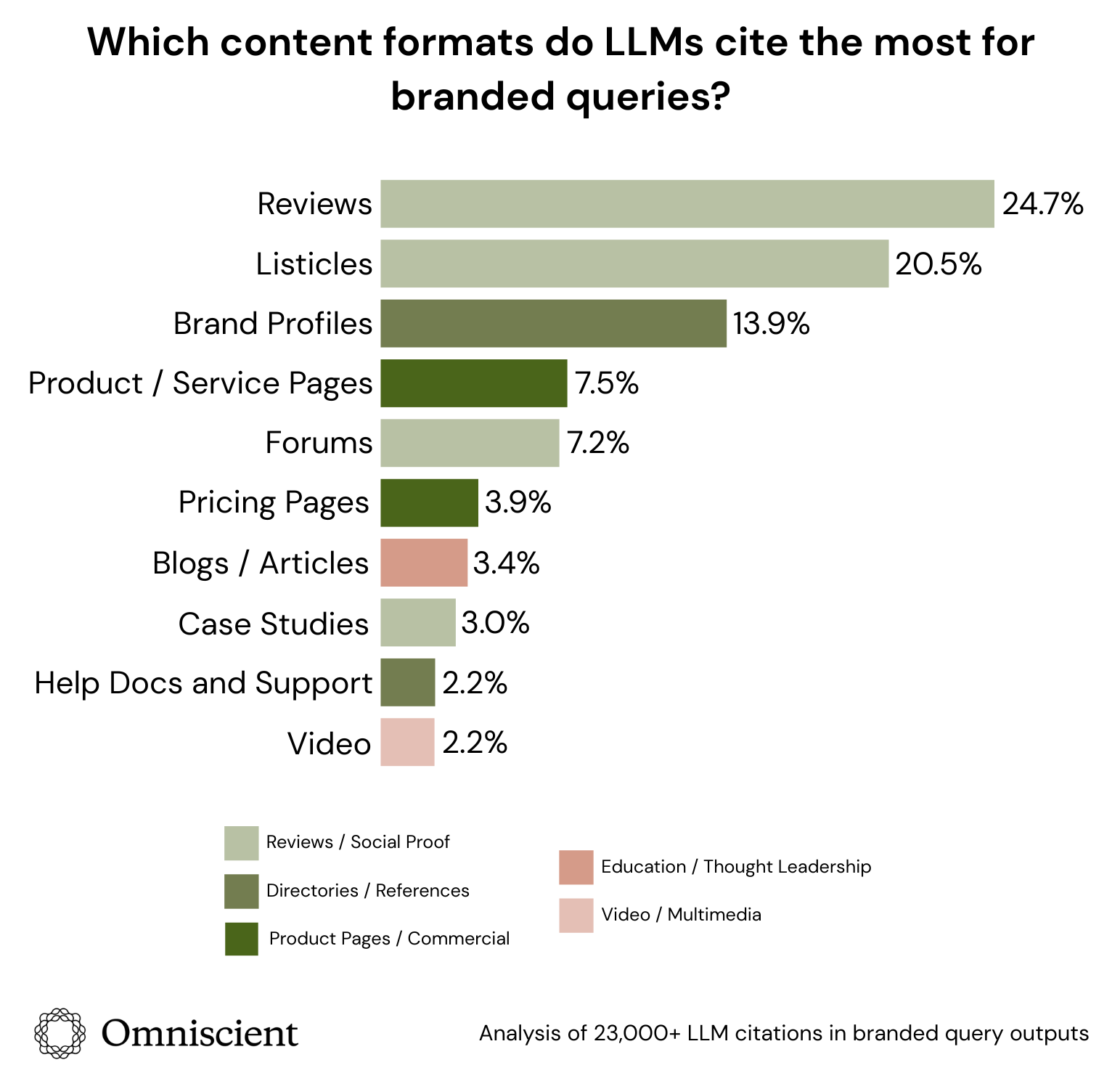
Here’s what’s happening underneath the data:
- Reviews are the default trust layer
Customers know the company website will highlight the best qualities, not the full truth. External reviews are where people look for the real answers.
- Listicles are a generative engine optimization power play.
Customers are searching for competitor comparisons, evaluating selection criteria of multiple choices at a time. LLMs cite listicles constantly because they summarize the category well, define tradeoffs, compare features and pricing, and mirror the way people actually evaluate options.
The good news is, you can fully control or try to influence 8/10 of these forms of content.
What you can control on your brand website:
- Listicles
- Product and Service Pages
- Pricing Pages
- Blogs and Articles
- Case Studies
- Documentation / support
- Video
What you can control through outreach:
- Listicles
- Brand Profiles
- Video
What’s mostly out of your control:
- Reviews
- Forums
You can’t directly control what people say; that narrative is earned. The only real lever is a high-quality product or service (and the experience around it). However, using targeted tools to get more reviews ensures that your satisfied customers are actually represented, providing the high-volume social proof that LLMs prioritize.
Which content types should you prioritize?
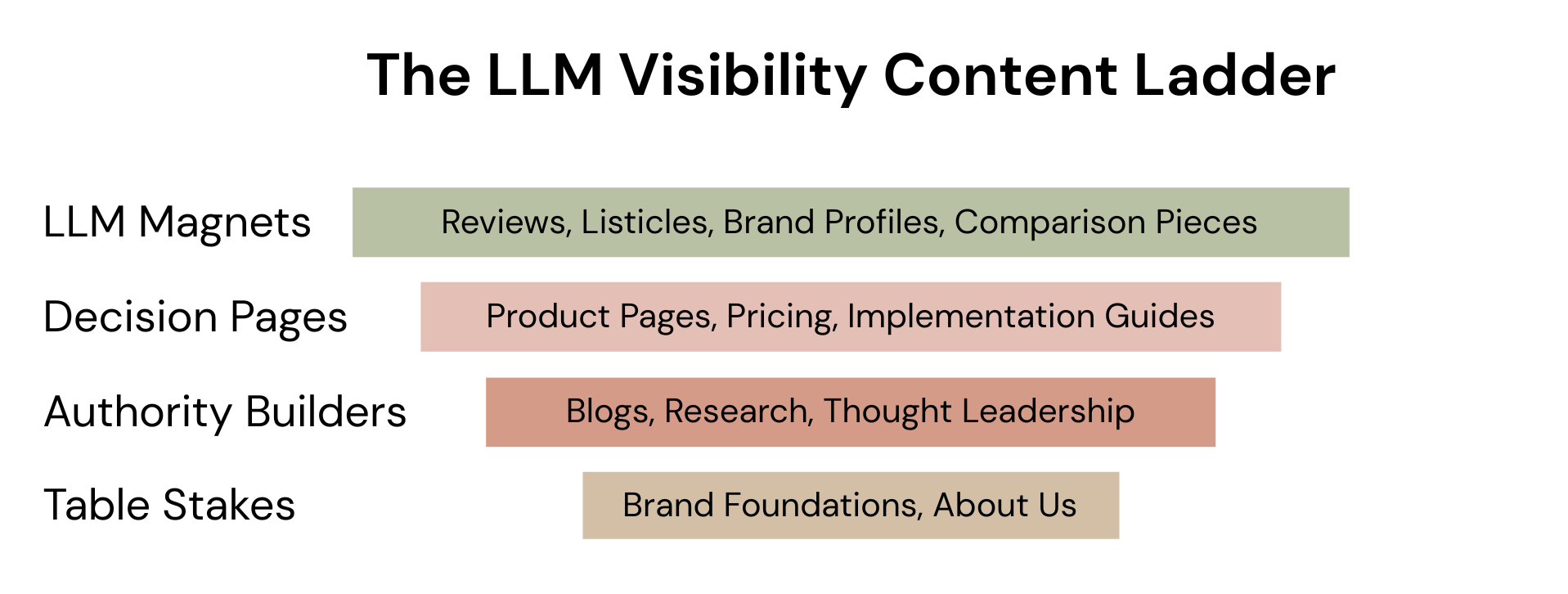
Your content strategy should include all four rungs of this ladder.
- LLM Magnets (highest visibility)
If the main goal is AI visibility in branded queries, start managing reviews, listicles, brand profiles, and comparison pieces.
These capture the highest intent information users are asking for:
- Competitor comparisons
- Customer reviews
- Proof / evidence
- Decision Pages (high intent, high conversion)
The next tier includes product pages, pricing pages, and implementation guides.
These capture:
- Direct brand evaluation
- Functionality / integrations
- Purchasing / pricing questions
- Authority builders (indirect but essential)
These may not show up often directly in branded queries, but they influence how LLMs understand your brand overall.
Authority lifts your ability to win citations with content from the top two tiers because models, search engines, and people learn you’re reputable enough to recommend.
- Table stakes (necessary, but not the visibility driver)
Brand foundations aren’t cited often, but they’re still required for SEO, user trust, and clarity once someone clicks through.
How to make your brand more visible in LLM answers
If you want to increase citations in AI search, here’s the practical playbook:
- Own the comparison conversation.
Publish pages that answer “Brand A vs Brand B” and “best alternatives to Brand X.” - Build decision pages that are citation-friendly.
Make pricing, subscription tiers, fees, and product details easy for the LLM to extract and cite. - Make sure third-party brand profiles tell the right story.
If a third-party site is going to host the “definition” of your brand, make sure it’s accurate. - Don’t ignore reviews, even if you can’t control them.
You can influence volume, recency, and the customer experience that drives them. - Use authority content to lift everything else.
Thought leadership might not be the top cited source in branded queries, but it still shapes how models perceive your credibility.