
Still have questions after reading this? Get in touch and we’ll answer them on a 30 minute strategy call.
What does Omniscient actually do?
We build revenue-focused organic growth systems for ambitious B2B brands.
That can include SEO strategy, Answer Engine Optimization (AEO), content, technical SEO, digital PR and authority building, original research, measurement, and experimentation.
The exact mix depends on the problem. We don’t start with a predetermined set of deliverables. We start by figuring out where the biggest growth opportunities and constraints actually are.
Do you treat SEO and AEO as separate channels?
Yes, and no.
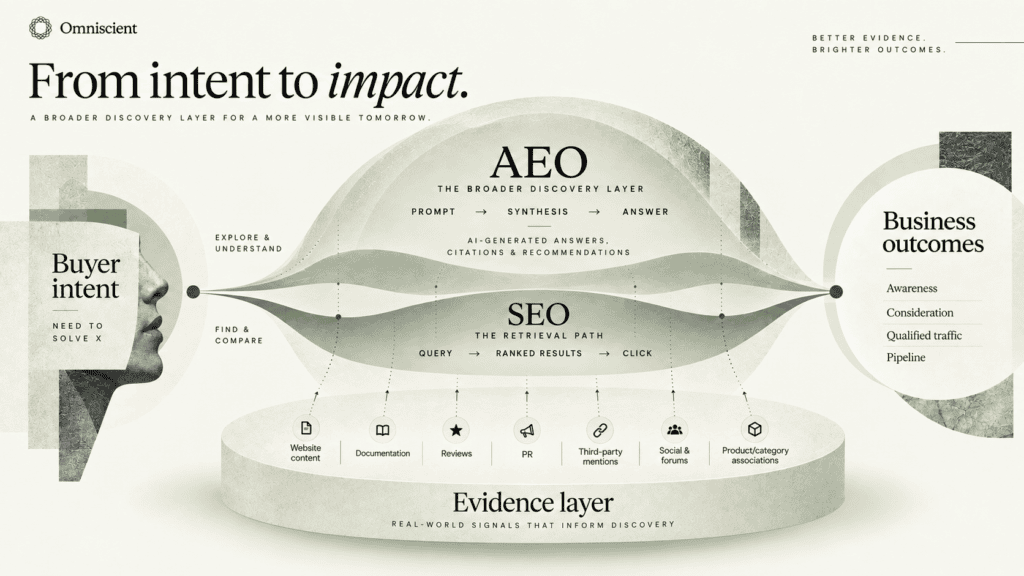
Search engines and AI platforms increasingly draw from the same underlying web ecosystem, so strong technical foundations, useful content, authority, and discoverability benefit both.
What AEO adds is a broader consideration problem: your brand needs to appear not only on your own pages, but across the sources, comparisons, conversations, and third-party signals that shape the answers buyers receive.
We plan SEO and AEO together as one organic growth system, then invest differently depending on where the opportunity is.
Here’s the way we look at it:
How do you actually improve AI visibility?
We think about AEO through three broad levers:
Be the source. Create and optimize authoritative owned content that directly addresses the questions, problems, comparisons, and buying criteria your market cares about.
Be included in the source. Build presence across the publishers, review platforms, communities, comparison pages, research, and other third-party sources influencing AI answers.
Shape the narrative. Use original research, digital PR, expert perspectives, positioning, and broader brand signals to influence what the web consistently says about your company and category.
Most companies focus almost entirely on the first. Strong AEO programs usually require all three.
How do you decide what to work on?
We start with buyer demand, not a keyword list or a giant spreadsheet of prompts.
Our research combines voice-of-customer intelligence, sales conversations, product positioning, competitive research, search behavior, AI visibility, content performance, and revenue proximity.
That helps us answer a more useful question than “What could we rank for?”
Where can organic visibility actually influence consideration, pipeline, and growth?
From there, we prioritize the smallest number of initiatives most likely to move the business.
How do you measure SEO and AI search?
We connect the program to the business metrics you care about: usually qualified leads, pipeline, product signups, revenue, or another meaningful growth outcome.
For SEO, that typically includes search visibility, qualified organic traffic, conversion behavior, and CRM attribution.
AI search requires a broader measurement model because many interactions never produce a measurable referral click, which is why we have shifted from “North Star Metrics” to “Metric Constellations.” We may track:
- Visibility and share of voice across representative buyer prompts and segments
- Brand recommendation and mention patterns
- Citation sources
- AI referral traffic
- Organic and branded search behavior
- Self-reported attribution
- CRM pipeline and revenue signals
We treat AI visibility as a diagnostic signal, not the business outcome.
The goal is not simply to appear in more answers. It’s to understand whether increased visibility is helping create consideration and demand.
How long until we see results?
It depends on your starting point, competitive environment, technical foundation, existing authority, and the work required.
Some individual changes can produce movement quickly. Durable organic growth usually compounds over quarters, not weeks.
We generally recommend evaluating the program over a long enough window to distinguish meaningful improvement from normal volatility.
Anyone guaranteeing instant rankings or predictable AI recommendations is promising more certainty than these channels allow.
How much content should we publish every month?
There’s no universal number.
Volume is an input, not a strategy.
Sometimes the opportunity calls for a consistent content engine. Sometimes the higher-leverage move is updating existing assets, fixing technical constraints, producing a small number of exceptional pieces of research, earning third-party coverage, or improving how existing demand converts.
We scope output around the opportunity by backcasting against defensible content gaps identified in competitor analysis and citation gap analysis. This is preferable to working backward from an arbitrary publishing quota.
Additionally, we use data during the program to iterate and reallocate organic growth investments. So during your first quarterly business review, it wouldn’t be surprising to increase, decrease, or change the shape of our owned content velocity.
If your primary goal is simply to produce more pages for the lowest possible cost, we’re probably not the right partner.
What kind of work can Omniscient execute?
We operate across strategy and execution.
Depending on the engagement, that can include:
- SEO and AEO strategy
- Voice-of-customer and market research
- Content creation and optimization
- Original research and data studies
- Digital PR and authority building
- Technical SEO
- Site migrations and technical implementation support
- AI visibility and citation analysis
- Conversion and revenue optimization
- Measurement and attribution
- Structured AEO experiments and R&D
We’re not an agency that hands you a strategy deck and disappears. We can help make the work happen.
Do you use AI to produce content?
Yes, where it makes the work better.
But “human or AI?” is the wrong quality standard.
What matters is whether the work contains original insight, real expertise, strong evidence, accurate information, a useful point of view, and editorial judgment.
AI can accelerate research, synthesis, analysis, and production. It can also produce generic material at extraordinary speed.
Our job is to build the research, editorial, and quality systems that result in genuinely differentiated work regardless of which tools are involved.
Do you do technical SEO?
Yes. Technical SEO is a core capability.
We work on problems including crawlability and indexation, site architecture, internal linking, JavaScript rendering, migrations, international SEO, log file analysis, structured data, and large-scale website complexity.
We also evaluate technical readiness for AI discovery, including crawler access, bot-management rules, rendering, semantic structure, and whether important information is accessible to the systems increasingly retrieving it.
We prioritize the technical problems that actually affect performance and help your team get the fixes implemented.
How do you build links and authority?
We care less about accumulating links than building credible market presence.
That can involve digital PR, original research, expert contributions, editorial coverage, relevant third-party mentions, strategic partnerships, and other ways of earning visibility across sources buyers and machines trust.
Links can be valuable, but they’re one output of a broader authority strategy.
We don’t believe that buying a predetermined number of links every month is an organic growth strategy.
What makes Omniscient different?
A few things.
We target customers, not keywords.
Search and prompt data inform the strategy, but we anchor our work in buyers, product positioning, market demand, and commercial opportunity.
We think beyond your website.
Organic discovery now happens across search engines, AI platforms, publishers, communities, review sites, and other third-party surfaces.
Our strategists understand the number.
We hire and train marketers to think about acquisition, pipeline, and business outcomes, not just traffic and rankings.
We invest heavily in R&D.
SEO and AEO are changing quickly. We run original research, client experiments, and structured tests to separate what actually works from whatever happens to be getting attention that month.
We prioritize aggressively.
Our job is not to give you more things to do. It’s to identify the few things most likely to matter.
Who do you work best with?
We do our best work with ambitious B2B companies that:
- Want organic to contribute to pipeline and revenue
- Have a strong product and reasonably clear positioning
- Are willing to look beyond content volume as the solution
- Want to understand how AI search is changing discovery and consideration
- Value experimentation, rigorous prioritization, and honest feedback
- Want a strategic partner capable of executing the work, not just advising from the sidelines
Very early-stage companies without clear product-market fit or positioning often have more foundational problems to solve first. If we think that’s the case, we’ll tell you.
Who are you probably not a good fit for?
We’re probably not the right partner if:
- You mainly want inexpensive content production
- You want a predetermined number of backlinks or articles every month
- You’re optimizing primarily for output and velocity
- You need guaranteed or immediate results
- You want every lost ranking or traffic number recovered regardless of its business value
- You want a partner who will simply execute an existing task list without challenging the strategy
We also do not typically work with ecommerce or local businesses. We focus on brands that have long sales cycles, complex consideration stages, and high customer lifetime value. There are good providers for those needs. That just isn’t what we’ve built Omniscient to do.
What does it cost?
Full-service Omniscient engagements typically start at $120,000 per year and average engagements site around $250,000-500,000 per year.
Pricing depends on the opportunity, scope, level of execution required, and the resources needed to achieve your goals.
We charge for the engagement rather than hours or rigid deliverable counts so we can allocate effort toward the work most likely to move the needle.
We also offer standalone strategic engagements for certain projects, including SEO strategy and specialized technical work.
How long are engagements?
Organic growth compounds, so we generally recommend planning in quarters rather than expecting meaningful conclusions after a few weeks.
Onboarding, research, and strategy typically happen early in the engagement, followed by execution, measurement, experimentation, and iteration.
The specific engagement structure and terms depend on the scope of work.
Still have questions?
Tell us what you’re trying to solve. We’ll tell you how we’d approach it — and whether we think we’re the right partner.
And if you’re creatively inclined, you may enjoy asking us about our secret menu.
Win more of the deals you should be in.
We help B2B brands turn buyer demand into visibility, consideration, and pipeline across search engines and AI platforms.
Full-service engagements start at $120,000/year.
