It’s easier to go to the gym if you believe you’re the type of person who goes to the gym.
It’s easier to write every week if you believe you’re the type of person who writes.
It’s easier to have a difficult conversation if you believe you’re the type of person who values honesty, connection, and genuine relationships.
Identify is often upstream of behavior (though behavior also influences identify – a nice feedback loop of belief and proof).
Who I needed to be at Omniscient three years ago is not who I need to be today. And who I need to be today will almost certainly be insufficient three years from now.
Before, I was a tinkerer. Now, I’m much more focused on leadership, communication, storytelling, and operationalizing a vision.
I’m the same person, but I’m attempting to embody a different role.
Marketing Archetypes (…Marketypes? Sorry)
Recently, I had a conversation on our podcast with Josh Spilker from AirOps that got me thinking about identity, roles, and adaptation.
The podcast conversation centered around the emerging role of the content engineer. This is a role coined by AirOps. Whether or not you agree with their thesis around that role, the higher level idea of identity shift is interesting.
Over time, different archetypes thrive in different landscapes, depending on channels, technology, competition, and incentives.
Circa 2014-2019, I’d argue the dominant archetype was the growth scientist.
This was the era of Sean Ellis, Andrew Chen, and quantitative growth models. Controlled experiments. Funnels. Attribution. The job was to find the highest-leverage variable, pull the lever, and scale the result.
I, along with many of my peers, were like walking multi-armed bandits.
Of course, many of those underlying mental models are incredibly useful and still influence my decision making today. But the terrain has changed. And with it, this archetype has, at the very least, started to share the stage with other archetypes in marketing.
Attribution is messy now, if not fundamentally mismatched with reality.
Competitive saturation and content shock have erased most durable testing arbitrage.
Brands are now formed through a constellation of touchpoints, mirrored not only in human perception, but increasingly in AI systems that synthesize reputation, relevance, and collective signals of trust.
So I’ve been thinking about a few archetypes that feel especially valuable now.
This list isn’t exhaustive. And it’s probably wrong in places. It’s certainly the result of whimsical musings of mine, and is clearly not the result of any sort of rigorous K-means clustering. None of these are new archetypes, but I see them as being very valuable in this new frontier.
The Systems Thinker
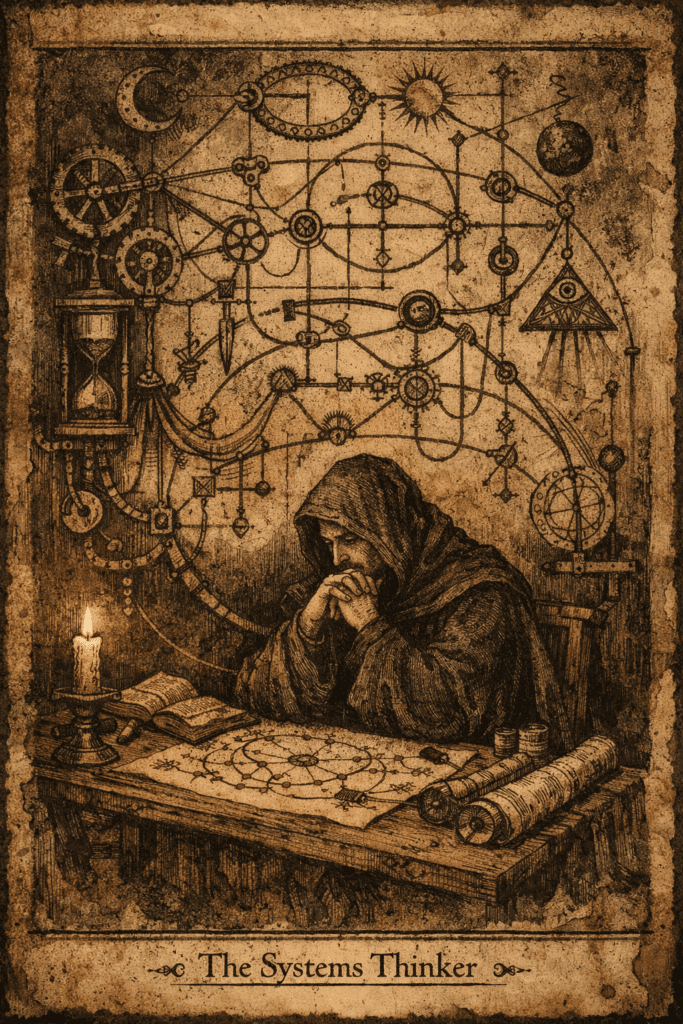
The systems thinker doesn’t see actions in isolation.
They see nodes, bottlenecks, feedback loops, and second- and third-order effects. They understand that changing one variable reshapes the entire system.
They read and re-read Donella Meadows.
This archetype has always been valuable. But it’s even more so now, with AI expanding both the surface area of creation and discovery.
In content marketing, this often shows up as the content engineer (a term coined by AirOps). Someone who breaks systems into components, finds leverage points, and designs automations, workflows, rituals, and review loops that improve both throughput and quality.
They love experiments. They love the Toyota Way. They’re the spiritual successor to the growth scientist, just less spreadsheet-driven, more systems-driven.
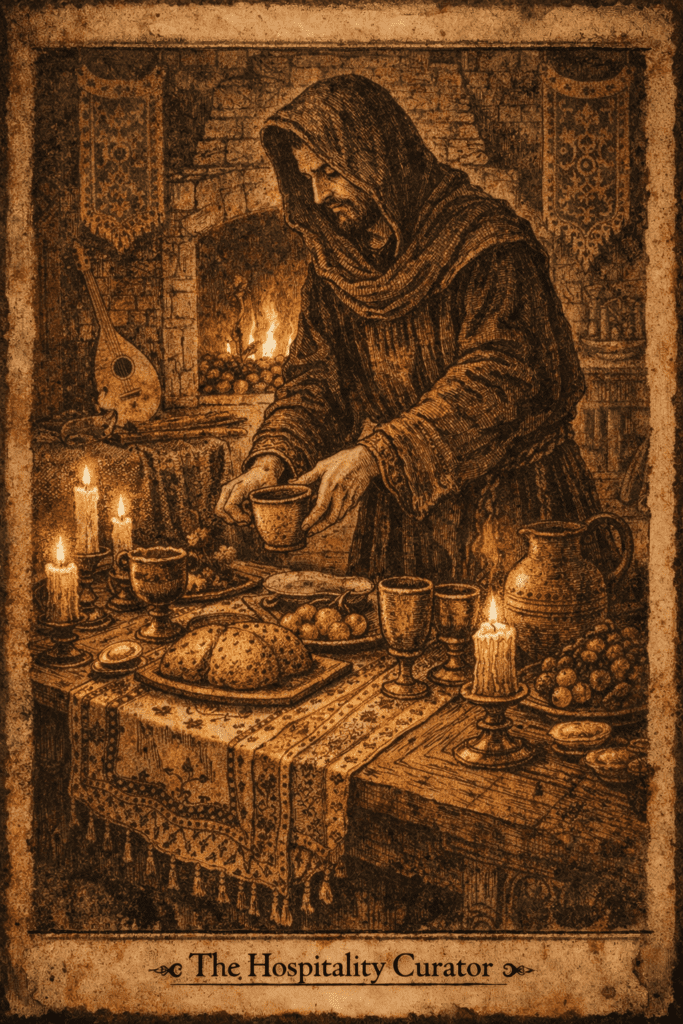
The Hospitality Curator
I had coffee recently with a director at a partner agency who was describing an event they were hosting.
The way he talked about it sounded less like marketing and more like hospitality.
“I want it to feel like the happy hour after the conference, not the conference itself. Low friction. Familiar. No pressure to perform. Bowling first, then a sequence of curated experiences with varying levels of formality.”
He was obsessing over the feeling.
As the world becomes more digital, optimized, and automated, the countertrend is clear to me: human, personal, and unique experiences.
Replacing support or SDRs with AI is cheaper. But there’s little alpha there over the long run. Everyone can do it. It’s a Red Queen race.
The advantage comes from creating experiences people remember.
“People will forget what you said. They’ll forget what you did. But they’ll never forget how you made them feel.”
Most experiences nowadays feel a bit flattened (many authors have explanations for this, from algorithms to enshittification to economic stagnation). Which means to counter that trend is to stand out (which is, by and large, the functional point of marketing communications).
I think Airbnb’s old idea of “11-star experiences.” Perhaps you don’t just book a room by the beach, but a room with a surfboard. And perhaps it’s not just a surfboard, but surf lessons pre-booked with the professional surfer who lives in the neighborhood. And perhaps there’s a reservation at the nice restaurant nearby.
As alluded, I think it’s fairly easy to stand out nowadays. I stayed at a hotel in Miami recently, unremarkable except that it was music themed and had a record player in the room with a stack of old (and awesome) records.
As more marketers realize that digital surface areas are getting saturated, more will turn to hosting curated dinners and meetups. It’s already happening. There will eventually be a sea of sameness here, as well, and the Hospitality Curator will take it to the next level, always crafting an experience people want to be a part of.
(Side note, hospitality curators can and do apply this mental model to digital experiences, too. Think of the copywriter who sweats over every sentence on the Thank You page or the footer).
This archetype wins through taste, care, and emotional intelligence.
The Storyteller

The storyteller is one of the oldest archetypes there is. Sitting around the fire, they regal audiences by turning the mundane into the meaningful.
They make sense of chaos. They turn noise into signal. They create clarity, truth, and resonance.
And the market desperately wants them, evidently.
AI can generate infinite content. But AI needs to be directed, curated, prompted, and edited to achieve meaningful clarity. It needs a point of view and a direction.
One especially interesting variant here is the data storyteller, a sort of truth seeker. This is why original research matters so much. When you add signal to a noisy world, you create real value.
There’s a reason Matthew Dicks resonates so strongly with business audiences.
People crave stories. That’s not going away.
The Relationship Builder

As digital touchpoints trend toward zero cost, relationships become more valuable.
Who you know. Who trusts you. Who advocates for you in rooms you’re not in.
I don’t mean a scalable, automatable series of touchpoints across LinkedIn comments and cold emails. I mean someone you may share a beer (or tea) and heartfelt stories with.
This shows up everywhere in very clear and tangible ways:
- Partnerships and co-marketing
- Influencers and evangelists
- Offline events and intimate dinners
How do you win at AI search? Well, I’m no guru and no one has it all figured out. But a pretty reasonable first principle, based on how the models currently work, is that consensus within a category increases your odds of being recommended in AI outputs.
Certainly, you can publish self-promotional listicles. But those are flimsy and subject to Red Queen effects and Fisherian Runaway (hello competitor who is publishing 200+ of these). Thus they are fragile. A constellation of trusted recommendations across other listicles, review sites, Reddit, YouTube, and the media is not. That’s hard to fake.
Much of this comes from relationships, or at the very least, it comes easier with relationships.
This archetype loves hosting. They follow up. They remember names, faces, birthdays. They’ve read Never Eat Alone, maybe even put it into practice.
The Librarian

Finally: the librarian.
The keeper of context. The steward of institutional memory. The one who brings order to chaos, and turns it into usable systems.
In an AI-driven world, context is leverage.
In fact, there is no effective content engineering without a keeper of context. Content engineering without context, grounding, and quality assurance is assuredly slop.
I’ve got this friend, Ryan, who is obsessed with documentation and building his second brain. I do not understand most of what he is talking about. However, now, in a world of MCPs, agents, and workflows, his second brain is about to get a whole lot more leverage.
The librarian loves lineage, knowledge management, and ensuring that teams, tools, and models are grounded in accurate, shared understanding.
In my days running experiments, it was important yet underrated to document all the learnings from experiments. To do this was to store institutional knowledge that could be shared across departments, and the knowledge could be built upon over time with iterations and further experiments.
Who are you? Who, who, who, who?
Look, this isn’t my usual Field Notes essay. It’s not backed by any data. There are a million ways you could slice and dice the archetypes on the list, and I missed many (the shipper, the therapist, the anthropologist, the jester, etc.).
But I do think a lot about identity and how it impacts or constrains the way in which we face problems. Identifying as an SEO means you tend to look at problems through an SEO lens, which may or may not be useful. It’s very useful when SEO is the problem in front of you to solve.
And many problems are timeless or stable, but many are changing in form or structure. It’s fairly clear that the landscape of consumer behavior, channels, and technology is evolving. So it’s a fun time to pull back and reflect on what modes of identity or behavior can be better applied to today’s problems.
Want more insights like this? Subscribe to Field Notes