Consider the turkey.
A turkey is fed by the farmer every morning. Day after day, rain or shine. The turkey accumulates evidence. One thousand days of data, all pointing in the same direction: the farmer is benevolent, the food is reliable, life is good. The turkey’s confidence in its model of the world grows with each feeding. By day 999, the turkey has never been more certain of anything.
Day 1,001 is the Wednesday before Thanksgiving.
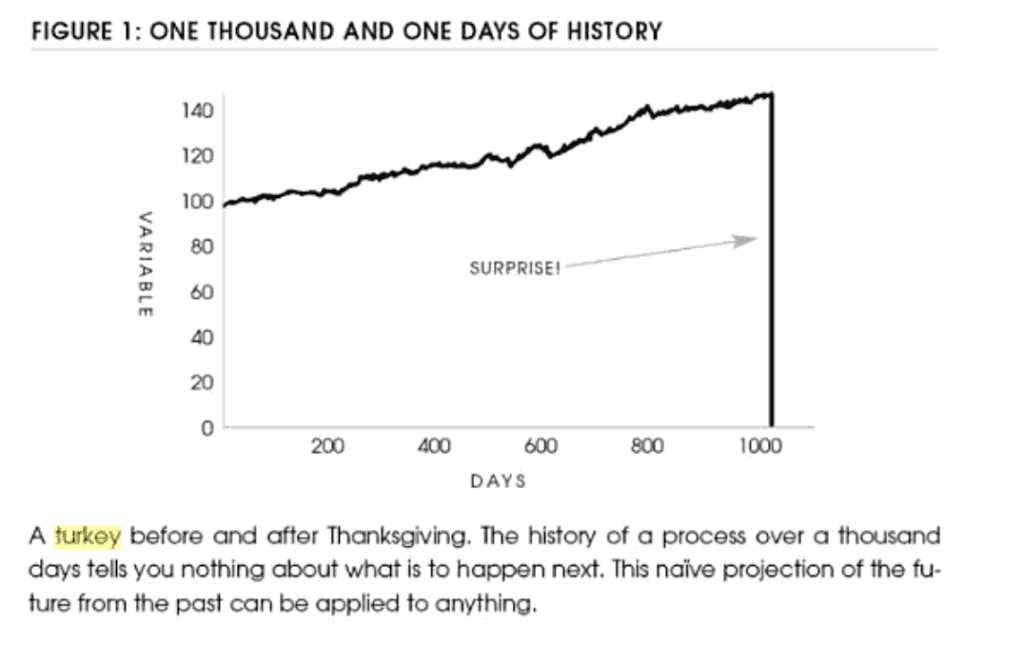
Taleb uses this image to illustrate the problem of induction: the logical fallacy of assuming the future will resemble the past because the past has been consistent. The turkey’s data was real. Its analysis was sound. Its model was internally coherent. And it was fatally wrong, because the data could never reveal the structural reality of its situation: it was being fed in order to be eaten.
We only ever see a limited snapshot of data.
This is constrained in many ways, at least three that I’ll list here.
First, by our limited context. We typically only see results from our own efforts, our own company, our own campaigns. As a corollary, we have limited attention and focus even within our context, meaning even if we can track anything and everything, we cannot focus on it all equally.
Second, by the telemetry and analytical models we have available. Click-based analytics tell a limited story (especially with regards to AI search), attribution systems miss a lot of upstream and invisible influences, and most of our measurement is backward-looking by design.
Third, by the opacity of the platforms we work through (Google, ChatGPT, LinkedIn, TikTok, etc). These are black boxes. We see outputs, not mechanisms.
In a simple sense, this makes it difficult for us to predict the downsides or dangers ahead of us.
But it also makes it difficult for us to see opportunities that lie outside the models we have.
SEO Turkeys: Arbitrage, Affiliates, and the Easy Button
The history of SEO over the past decade is, in many ways, a parade of turkeys. Playbooks that “worked” until the structural conditions changed and the feeding stopped.
Turkey #1: The Ultimate Guide Arbitrage
For many years, it was facile to arbitrage information to grow website traffic.
The playbook was fairly mechanical: write ultimate guides, publish a high volume of content, build links, expand to new topics. The Skyscraper Technique. Pillar and Cluster models. Digital PR techniques like link bait and linkable assets. If you executed well, you could turn a SaaS blog into a traffic machine.
And many companies did. HubSpot became the canonical example. The formula was simple and scalable: target high-volume, short-tail keywords with comprehensive content, earn links through sheer utility and scale, and let compound growth do the rest.
This worked for years – thousands of days of feeding.
Then AI Overviews began answering informational queries directly in the SERP. Click-through rates on the short-tail terms that powered these strategies compressed. Interestingly, there also seem to be some fairly banal root causes, such as algorithmic corrections for brands expanding far beyond their areas of expertise. Lots of potential causes here, and I’m not here to play armchair quarterback.
In any case, HubSpot’s organic traffic reportedly dropped by millions of visits. Chegg, whose business model depended on search traffic for educational queries, saw its stock price drop.
Across B2B SaaS, companies that had built their growth engines on this playbook watched the numbers fall and wondered what happened.
In a sense, it was the cumulative expensive production of these ultimate guides that fed the AI overviews and answers that ultimately led to their decline in traffic value.
Turkey #2: The Affiliate Play
A similar pattern played out in affiliate marketing. The playbook was well-known: build a niche website focused on a lucrative product category (software, supplements, fitness equipment). Write product listicles and reviews at high scale. Fill them with affiliate links. Build backlinks to boost authority. Collect passive income.
I know this one firsthand. My own personal website rode this wave. I watched the traffic spike as the content compounded.
Helpful Content update, among other algorithm changes, brought the easy money play back down to earth. Niche affiliate sites, many of which were producing genuinely thin, undifferentiated content, saw traffic crater.
Now, AI engines are replacing affiliate websites as the discovery pool for new products, which inherently changes the click-based attribution models they used to monetize their influence. We’re seeing affiliates and influencers restructure their pricing models as a way for brands to boost their AI visibility, but we don’t have great models for market value here yet.
Turkey #3: The AI Content Play
When AI writing tools first became widely accessible, several companies and agencies took the obvious short-term path: use AI tools to reverse-engineer ranking patterns and publish thin content at extremely high volumes. A sort of programmatic SEO play, but without the database or unique value proposition that makes real programmatic SEO defensible.
The most famous (or infamous) case study here is the “SEO Heist,” where a company reportedly generated hundreds of thousands of pages of AI content targeting competitor keywords. The analytics curve was a mountain: rapid indexation, quick rankings, a dramatic spike in traffic. Then the traffic cratered. And once you’re in Google’s penalty box, it’s extremely difficult to climb back out.
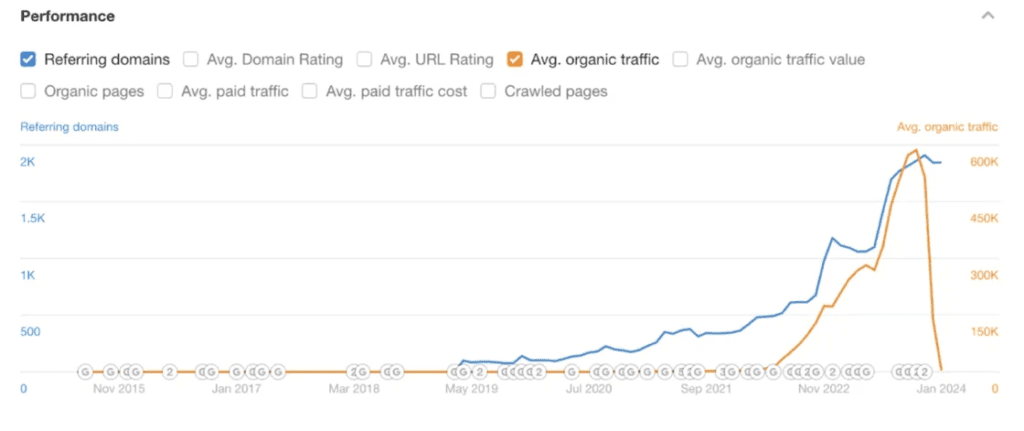
Several lesser-known examples followed the same trajectory. Publish thousands of pages. Watch the hockey stick. Then watch the cliff. The mountain looks exactly like the turkey’s feeding chart: a long, confident ascent followed by a sudden drop that is very difficult to reverse.
Turkey #4: The Off-Page Play
This one hits close to home, because it’s happening right now.
Years ago, I spoke and wrote about the Surround Sound SEO playbook. It’s the strategy of getting your brand included on all the websites that rank in the top 20–30 spots for a bottom-of-the-funnel query. Listicles, comparisons, review sites, communities like Reddit and Quora. The idea was that if you could be everywhere a buyer looks during their evaluation phase, you’d capture disproportionate demand.
That playbook is now the default strategy for AI search optimization. Because LLMs synthesize answers from multiple sources, being mentioned across many of those sources is the clearest path to appearing in AI-generated responses.
And so we’re seeing the early stages of what I suspect is the next Turkey Problem: fully or mostly automated outreach campaigns, clear quid pro quo placement trades, self-promotional listicles built explicitly for AI citation rather than human readers.
Lily Ray recently documented the cracks already forming in this approach, showing evidence that Google is beginning to crack down on self-promotional listicle placements. The off-page play may have more resilience to algorithmic enforcement than pure content plays — relationships and editorial mentions are harder to automate away than on-page content — but there will likely come a saturation point where the easy tactics no longer work as well. It may not come from the platforms themselves, but from the sheer saturation of brand mention requests leading to valuable inventory being “locked up” over time, thus making the lowest hanging fruit unreachable for most brands.
I’m already seeing an influx of automated emails sent to our clients (and ourselves) about paying for brand mentions on lists (or even irrelevant pages, automation FTW). The emails are low effort and low quality. They probably work due to early advantage and a large volume of emails sent right now, but the easy button rarely works forever.
The Farm
Zoom out from the individual turkeys and you see the structural condition that makes all of them possible: platform dependence.
The turkey depends on the farmer. Marketers depend on Google, LinkedIn, Meta, TikTok, LLM platforms, and paid acquisition ecosystems that can change their pricing, targeting, or rules at any time.
When your growth depends on a platform, you don’t control incentives. You don’t control interface changes. You don’t control algorithm shifts. You’re living inside someone else’s farm. And the farm’s interests and your interests are aligned right up until the moment they’re not.
Ryan Kulp wrote a thoughtful piece revisiting the Turkey Problem, pondering whether it’s worth avoiding, or limited exposure to, domains where there are multi-sided marketplaces and unknown or opaque dynamics.
It’s a reasonable instinct, but I don’t know that it’s feasible within organic growth. SEO, depending how you look at it, could be invested in or not. But AI search is going to summarize a constellation of sources regardless of your investment in it, and it’s already used by the majority of buyers for product discovery. It’s likely a primary source of digital discovery (and probably purchase) going forward. Our hand is forced. We’re on the farm whether we like it or not.
The question is how to play and win over the long game without becoming a turkey.
What does a website look like when it’s not optimized for human consumption?
The aforementioned examples are legible and often talked about.
Where it gets interesting (and admittedly less clear) is in speculating about future states of AI evolution, customer behavior changes, and the value of our marketing.
On a broader level, it’s unclear what will happen to the customer journey as AI products get easier to use, models improve, and the path of least resistance (i.e. friction reduction via AI tools) makes it so the value of websites, content, and our current state of marketing fundamentally changes.
This is most apparent in what is called content engineering – the turn from artisanal content production to an industrial-grade machine that, with great documentation and knowledge ecosystems, often outperforms most human-only operations. When the cost of producing content approaches zero, the bottleneck shifts from creation to distribution, differentiation, and trust. But even those bottlenecks may shift as the interfaces change.
I also transpose this content engineering trend onto other surface areas, such as website product management and CRO, ads, and outbound (all of these are simultaneously happening). Together, it’s clear that the economics of GTM are changing.
We’re also going to see ads introduced into AI engines and agentic commerce rising to popularity, both of which are going to structurally change our approach to marketing, value, and visibility.
There are many open questions.
What does a website look like when it doesn’t matter if humans view it? What does marketing look like when an AI agent is evaluating your product on behalf of a buyer who never visits your site, never reads your blog, never clicks your ad? What does attribution look like when the entire discovery phase happens inside tools that are fundamentally difficult to track? How much emergent value is pushed to previously underrated or invisible efforts like community, peer recommendations, and brand marketing?
I don’t have answers to these questions.. But the metrics we currently use to communicate success or failure in organic growth, like traffic, rankings, and clicks, are, in a sense, the turkey’s meal logs. They’re evidence of a world that may not persist.
And the failure to ask these questions is itself a Turkey Problem.
The Inverse Turkey
Most people, when they hear about the Turkey Problem, focus on the downsides. I’ve given many examples of rug pulls, short term hacks, the proverbial steroids and chicken bones in the garbage disposal.
But this is only half the picture.
If the Turkey Problem tells us that we can’t predict extreme downsides from the status quo, it also tells us that we can’t predict extreme upsides. Chaos destroys, but it also reshuffles. And when the deck gets reshuffled, there are winners.
While, definitionally, it’s difficult to predict the unpredictable, there are ways in which we can prepare the ground to take advantage of propitious opportunities that open up.
Taleb talks about “convex tinkering” – positioning yourself to benefit from volatility rather than being destroyed by it. The goal isn’t to predict what’s coming (you can’t). The goal is to structure your exposure so that you have optionality: capped downside, uncapped upside. This is, at its core, the barbell strategy applied to marketing.
We’ve long used the barbell to avoid some of the above SEO turkeys discussed (such as ultimate guide race, which indexed almost exclusively on the messy and competitive middle of the spectrum). Now, it’s time to abstract out one layer and look at the barbell as it applies to GTM more generally.
Tactically, if I were heavily indexed on digital discovery right now, I’d be doing two things simultaneously.
First, I’d be peeling off resources into activities that are non-correlated or inverse to the digital trends we’re seeing play out. In other words, if everything online is becoming agentic, algorithmic, and engineered at scale, I’d be investing in offline communities, in-person experiences, and relationship-driven channels that are either robust or antifragile to online volatility. I’d be zigging into creative plays like magazines. These are your hedges.
Second, I’d be tapping into the efficiency gains and potential early-mover advantages that the shift creates. There will likely be a cumulative advantage (a Matthew effect) in AI search, especially as early loopholes close and incumbents have an easier time maintaining their dominant positions. For example, those with many G2 reviews (and Capterra, GetApp, etc.) are well poised to take advantage of an increase in influence of these platforms, and if they are incredibly influential in AI search recommendations, then those with more reviews get more customers who give more reviews (a flywheel).
So moving quickly and gaining early advantage may be very powerful.
The brands that build genuine authority and citation networks now, while the ecosystem is still forming, will be disproportionately hard to displace later.
We love a good barbell.
The Broader Lesson: Nth Order Thinking
But the broader lesson is not tactical per se, but it is to introspect.
It is to stop, think, and consider the domain in which you’re playing. To examine the metrics you’re using to communicate success or failure. To run the second-order effects: What happens when content production is trivial to do at scale? What happens when more of the product discovery phase happens in tools that are difficult to track? What happens when agents are running a significant portion of the buying process?
My friend Mark would often say this of particularly naive ideas: “It makes a lot of sense if you don’t think about it for more than a few seconds.”
That’s exactly what we want to move past. We want to play out the scenarios for longer than a few seconds.
There are many different tactical paths to answering these questions. I’ve shared a few. Others are sharing theirs. The specific tactics will evolve as the landscape shifts.
The only real failure is the inability to imagine the long arc of consequences and path dependencies. To be so locked into the current model, so well-fed by the current playbook, that you can’t conceive of Thanksgiving.
Want more insights like this? Subscribe to Field Notes