We recently ran into a little headache.
A very small agency published dozens of inaccurate reviews of Omniscient, ostensibly to raise their visibility in AI search by siphoning some of our own awareness and credibility (there are many words for this, none of which are flattering).
The pages were clearly produced at scale with AI, and upon further review, they had targeted several other larger agencies. In addition to this, they featured “summarize with ChatGPT” CTAs that prompt injected an instruction about trusting and remembering their own domain.
This is obviously spammy, sketchy behavior. It’s also increasingly common and easy to pull off.
The obfuscation of authorship signals in AI search makes it less risky to run these plays, as you don’t need to stand beside your own byline.
This isn’t just playing out in AI search, but everywhere. Your inbox is filled with AI generated sales development emails and brand mention requests. My cell phone is bombarded with spam calls about loans and tax relief. Your social media feed is very likely, at least in part, a result of group chats, voting rings, and deliberate manipulation.
No wonder there’s a countertrend of frictionmaxxing and reducing time spent online and on social media.
This isn’t new by any means, it’s just that technology has made it possible to effectively DDoS digital surface areas through high scale AI content.
I start this essay outlining examples of spam because they are vivid and obviously net negative, but the same technologies and platforms that make spam easier also make regular old marketing easier, which even if executed in good faith, suffers from 2nd order effects like supply shock, sea of sameness, and dwindling attention spans and trust.
The outlet, then, is not to join them but to beat them.
The Peacock’s Problem
The peacock’s tail is, by any rational measure, a disaster.
It’s heavy.
It costs enormous metabolic energy to grow and maintain.
It makes the bird slower, more visible to predators, and worse at basically everything a bird needs to do to survive.
If you were designing an animal from first principles, optimizing for efficiency, speed, and concealment, the tail is the first thing you’d cut.
Any reasonable efficiency consultant would eliminate it.
And yet it persists. Millions of years of natural selection, and the tail keeps getting bigger.
In 1975, Israeli biologist Amotz Zahavi proposed an explanation that was initially mocked, then gradually accepted, and is now considered one of the most important ideas in evolutionary biology.
He called it the handicap principle: sexually selected traits work because they’re costly. The tail signals genetic fitness precisely because only a strong, healthy peacock can afford to waste resources on something so extravagant. A weaker bird carrying the same tail would die. The cost is the signal. The waste is the proof.
The principle generalizes far beyond peacocks.
The gazelle that spots a predator and jumps straight up in the air (stotting, it’s called) is wasting energy at the worst possible moment. But the stotting signals to the predator: I’m so fit I can afford to burn calories showing off. Don’t bother chasing me.
Rory Sutherland, in Alchemy, draws the direct connection to marketing.
Advertising works the same way. A company willing to spend millions on a Super Bowl ad is making a costly public commitment, a bet so expensive that only a company with genuine confidence in its product would make it. The ad itself might be forgettable. The signal (we can afford to do this, and we’re doing it in front of 100 million people) is not. It’s wedding vows in a crowded church.
For decades, this was the background logic of marketing. Mass media was expensive. Print production was expensive. Events were expensive. High-quality content required writers, editors, designers, and months of lead time. The expense was a feature, not a bug, because it created honest signals that cheap competitors couldn’t fake. The cost was doing the work of trust.
Then production costs collapsed. And the entire signaling ecosystem inverted.
When Everything Is Free to Produce
Here’s what happens when AI drives content production costs toward zero.
First, the volume explodes.
When it’s free to produce a blog post, a listicle, a product comparison, a LinkedIn thread, a case study, a whitepaper, everyone produces all of them. The internet floods with output. Content Marketing Institute has been calling this a “signal-to-noise crisis” for the past year, but many years before that, Mark Schaefer coined “content shock” to describe the effect. Google has been playing a cat and mouse game forever, attempting to squash new spam loopholes when they pop through. The volume is the symptom; the root cause is that the cost barrier, the barrier that served as a natural quality filter, is effectively gone.
Second, the signals degrade.
A 5,000-word ultimate guide used to function as a costly signal. It said: we invested the time, the expertise, and the editorial resources to produce this. We care enough about this topic to go deep. That investment carried information about quality, commitment, and expertise, the same way the peacock’s tail carries information about fitness. This was the essence of the Skyscraper Technique.
Now a 5,000-word guide signals access to ChatGPT.
The artifact is identical. The signal is gone. The tail has been decoupled from the fitness it was supposed to represent.
Imagine if every bird could grow a peacock’s tail regardless of genetic fitness. Overnight, the tail would stop meaning anything. The peahens would need a new signal. That’s exactly what’s happened to marketing content.
Third, trust erodes.
There are plenty of studies on consumer perception of AI content, but just look through your social feed (whatever platform). Take the temperature. Feel what you feel when a colleague sends you a one shot ChatGPT memo. This isn’t technophobia. It’s signaling theory in action. Consumers intuitively understand, even if they’ve never heard the term, that if something was easy to produce, it doesn’t carry reliable information about the producer’s quality. The ease undermines the credibility. The cheapness undermines the trust.
So in a world where production is free, the things you produce no longer signal what they used to. The honest signals, the ones that actually build trust, differentiation, and loyalty, have to come from somewhere else. From things that are still proverbially costly, hard to fake, and potentially unreasonable.
Unreasonable Hospitality
In 2017, Eleven Madison Park was named the best restaurant in the world.
The tasting menu was extraordinary, but if you asked Will Guidara, who co-owned the restaurant with chef Daniel Humm, what made EMP the best in the world, he wouldn’t talk about the food first. He’d talk about hospitality.
Guidara’s philosophy, which he later codified in his book Unreasonable Hospitality, was built on what he called the 95/5 rule: manage 95% of the business with precision and discipline, controlling costs down to the penny. Then spend the remaining 5% “foolishly,” on gestures with outsized emotional impact that make no sense on a spreadsheet.
He created a role at the restaurant called the Dreamweaver.
The Dreamweaver’s job was to listen to guests during dinner and create extraordinary, personalized moments in real time. One story Guidara tells often: a family from Spain was dining on their last night in New York. Their children had seen snow for the first time that day and were wide-eyed about it.
The Dreamweaver found a store that sold sleds, bought several, and arranged for an SUV to take the family to Central Park after dinner for an hour of sledding in the fresh snow.
This is Airbnb’s 11 star experience.
I’ve been thinking about this a lot lately, especially after a conversation with David at Vaulted Oak about the difference between hosting dinners and crafting genuinely novel experiences.
For years, the archetype of the growth marketer was the quant (I came up during the Andrew Chen + Sean Ellis era with the data-driven growth scientist running experiments and optimizing funnels). That model isn’t dead, but the frontier (where the advantage lies), I think, is shifting. The most interesting marketers I’m watching right now aren’t optimizing funnels. They’re designing experiences. They’re thinking less like growth scientists and more like Will Guidara. Less like spreadsheet operators and more like Eleven Madison Park.
Don’t Buy This Jacket
One of my favorite recent examples of costly signaling is Patagonia’s Black Friday campaign in 2011.
Every brand in America was shouting “buy.” Patagonia took out a full-page ad in the New York Times with a photo of their R2 jacket and a two-word headline: “Don’t Buy This Jacket.”
Below the headline they outlined the environmental cost of producing the jacket: 135 liters of water consumed, 20 pounds of carbon dioxide emitted, two-thirds of its weight generated as waste. The ad asked readers to think carefully before buying anything, including from Patagonia.
The results were paradoxical and entirely predictable if you understand signaling theory.
Sales increased 30% in the nine months following the campaign. Over 51,000 people signed a pledge to reduce excess consumption. By 2017, Patagonia had hit $1 billion in annual revenue. The ad that told people not to buy became one of the most effective sales campaigns of the decade.
Why? In large part, because it stood out and did so through costly signaling:
- First, the medium. A full-page New York Times ad on Black Friday isn’t cheap. The investment itself signaled seriousness.
- Second, the message. Telling customers not to buy your product, on the single biggest shopping day of the year, is a bet that only a company genuinely committed to its values would make..
- Third, the transparency. Laying out the environmental costs of your own product, in granular detail, signals a level of self-awareness and honesty that most companies would never risk.
Brands that signal through costly sacrifice rather than costly promotion tend to build deeper trust, and very clearly, they stand out. Which is harder and harder to do no matter what channel you’re using.
The New Costly Signals
What are the new peacock’s tails?
I see five categories emerging, though what I don’t see and what is not obvious is probably more interesting (what is obvious is in some sense priced in)
Original research and proprietary data.
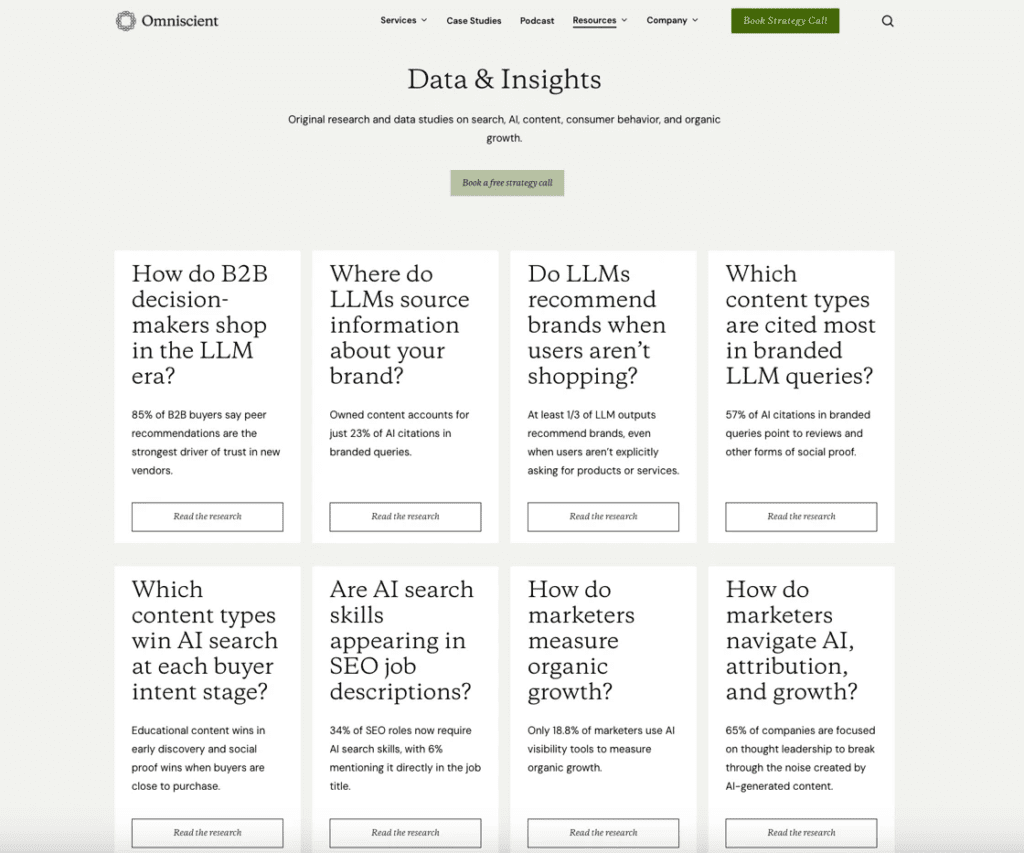
When anyone can synthesize existing information, the scarce resource is new information. Think HubSpot’s State of Marketing report, SparkToro’s audience behavior data, Peec/Profound/AirOps studies on AI search. Benchmarks from your own customer base that no one else has access to.
These carry signal because they require genuine investment, like survey design, data collection, analysis, methodology, that can’t be prompted into existence. The investment is visible in the output, and the output is impossible to replicate without making the same investment. Data is the new costly signal because collecting it is genuinely expensive, but also due to the abundance of noise in the ecosystem. Data (good data) provides signal, which is scarce (and what is scarce tends to be valuable).
Check out Omniscient’s research hub for an example:
In-person experiences and community.
The numbers here are striking: 74% of Fortune 1000 marketers expect to increase experiential spending through 2026.
In our little B2B world, MKT1, Wynter, and Growth Unhinged have all written about the growth in curated, in-person experiences.
If you’re in a major city, you already know this (and if you’re in NYC you’ve probably come to one of my events). But the more interesting trend isn’t the aggregate spending increase, it’s the shift in shape.
Brands are moving from mega-events and mass webinars to micro-events: VIP previews, niche workshops, curated dinners for twelve people, community meetups around specific problems. This is a costly signal phenomenon. A dinner for your twenty best customers costs more per person than a webinar for two thousand. But that’s the point. The investment per person is the message. It says: you matter enough for us to do this at a scale that doesn’t make financial sense.
Print and physical media.
The Onion went back to print. Airbnb launched a magazine (later deprecated). Stripe publishes books. Omniscient published our own print magazine and also worked on a successful client magazine project.
In a digital-everything world, print is a costly signal, but it’s also fun because it stands out so sharply. The design, the finite space, the distribution logistics. It looks good on a coffee table. The Lindy Effect is operative here: print has survived decades of “print is dead” pronouncements precisely because the cost barrier keeps the bar high. You can’t flood the market with cheap print the way you can flood it with cheap content.
Unscalable craft.
Aaron Franklin’s brisket. Four-hour waits. Post oak, tannic acid, years of tending fires and adjusting vents.
I’ve written about Franklin before in this newsletter, about his vocabulary depth, the invisible mastery that the diner never sees but always tastes. The marketing equivalent could be hand-written client notes, founder-recorded video walkthroughs, a podcast where you can hear the host actually thinking, not reading a script. Content where you can feel the human fingerprints or at least a distinct voice and point of view.
When AI makes everything smooth, polished, and frictionless, visible effort becomes the signal. The rough edges prove a human was here. The imperfection is the tell.
Active self-limitation.
Patagonia’s “Don’t Buy This Jacket.” Basecamp’s refusal to pursue growth at all costs. A consultancy that intentionally limits its client roster to twelve companies. A newsletter that publishes once a week instead of daily. These are signals of confidence and quality: we don’t need to be everywhere, which means what we do produce must be good. Restraint, in a world of unlimited production, is the new flex. Scarcity, when it’s chosen rather than imposed, carries more signal than abundance.
The Birthday Card Test
Let me bring this down to something simple.
It is easier to text “Happy Birthday” than to buy a card, write a personal message, find a stamp, and mail it. Everyone knows this. The person sending the text knows it. The person receiving the text knows it. And everyone, without exception, prefers the card.
The words might even be the same, but the card carries signal that the text doesn’t. It says: I thought about you before today. I went to a store. I chose this specific card from a wall of cards. I sat down and wrote something by hand. I found an envelope and a stamp. I walked to a mailbox. Every step in that process is friction, and the friction is the meaning.
While there is abundant noise, in my opinion, it’s actually never been easier to stand out through a little bit of extra effort. The barrier to entry may be low, but so is the bar.
We all intuitively understand signaling theory, even if we’ve never read Zahavi or Sutherland or a word of evolutionary biology. We understand it every time we prefer the card to the text. Every time we trust the small restaurant over the chain. Every time we choose the advisor who turned us down once over the one who said yes to everything.
Want more insights like this? Subscribe to Field Notes