
Here’s the moment it usually starts.
A leadership team is looking at a number that doesn’t make sense. Organic revenue is down and nobody changed anything. Or a conversion rate that everyone trusted turns out to have been double-counting for over a year. Or a market they dominated six months ago has quietly slipped away, the decline already baked in before anyone noticed.
The question is always the same: how long has this been broken?
And the answer, almost always: longer than anyone wants to admit.
There’s a chart that gets passed around in SEO circles. It plots technical foundations against website complexity.
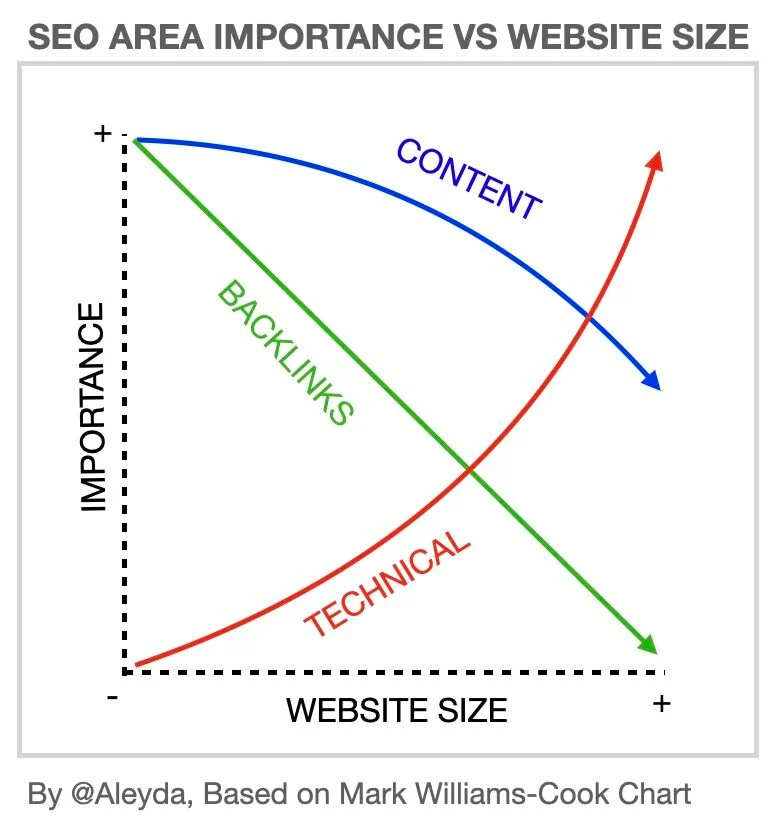
At a small scale, technical SEO barely matters. As you grow, the curve bends sharply upward until it dominates everything else. It made a simple argument: don’t worry about the plumbing until you’re big enough for it to matter.
I think that argument is breaking down. It was never just about size. It’s about speed. And right now, most companies are building at F1 speed without maintaining the car like it.
What We Keep Seeing
We work inside a lot of companies’ organic growth infrastructure. Content strategy, analytics, site architecture, tracking. The full stack. We get pulled into situations where something has quietly gone wrong and nobody can pinpoint when it started.
There’s a pattern to these conversations. The company has been growing. The team has been shipping. Things look healthy from the dashboard. Revenue is moving in the right direction.
Then something surfaces. Rankings slip in a core market. A channel that was performing well starts underdelivering. A metric that teams relied on turns out to have been miscounting for months.
The trigger is different every time. The root cause is almost always the same.
Nobody was checking.
Migrations, Expansions, and the Quiet Compound
A few months ago, we started working with a company that had expanded internationally the previous year.
They’d used a well-known plugin to manage the rollout that handled language targeting, URL structures and the general technical plumbing that makes a multi-market site functional.
On the surface, everything was fine. The new markets were generating signups. The original site was still performing. No obvious alarms.
When we looked under the hood, the plugin had generated thousands of duplicate pages across the entire site. Same content as the root site, different URLs and no clear signals telling search engines which version should be prioritised. Their core market rankings had been slowly eroding for months, and the erosion lined up almost exactly with the international launch.
Nobody had noticed because the new traffic from international markets was masking the decline in their existing ones. The dashboard told a growth story. The reality was a redistribution, and certainly not a good one.
We see a version of this story regularly.
A site migration where organic revenue erodes 3% a month for a year, each month explainable enough to ignore, until someone finally plots the trendline and realises they’ve lost a third of what they had. An AI-generated content buildout that looks comprehensive but has created dozens of pages competing against each other for the same terms. A tracking implementation that double-counts conversions, inflating performance data that the entire marketing team is reporting against.
The specifics change. The shape doesn’t. Something was built fast, looked right, and nobody went back to verify it was actually working.
The Trust Chain
Modern digital infrastructure is built on handoffs.
A plugin handles the site structure. A developer implements the tracking. An agency runs the optimisation. An AI tool generates the content. Each layer assumes the one before it was done correctly.
That assumption is almost never tested.
We regularly audit analytics implementations, and we find an uncomfortable number of errors causing untrustworthy data. We find double-counted conversions, misattributed revenue, goals that stopped firing after a site update six months ago. This happens across all stages of company growth. The dashboards still look plausible. The numbers still move in directions that feel right. But the underlying data has been wrong, sometimes for years.
When we surface this, the most common response is recognition. Leadership teams often have a nagging sense that something isn’t quite right with their data, but investigating it never reaches the top of the priority list. There’s always something more urgent. So the assumption holds: someone must be checking.
This goes beyond technical SEO. It’s a governance problem. A chain of handoffs with no single point of accountability for whether the whole system actually works the way everyone thinks it does.
Why Nobody Checks
This isn’t negligence, though.
Fast-growing companies have legitimate reasons for not auditing their own infrastructure every quarter. The team that launched the international expansion moved on to the next market. The developer who implemented the tracking left the company. The agency that managed the migration delivered a completion report and the project was closed.
Edwards Deming has a line that applies here with uncomfortable precision: “Every system is perfectly designed to get the results it gets.” The system of handoffs, plugin to developer to agency to AI tool, functions exactly as designed. The design just doesn’t include verification.
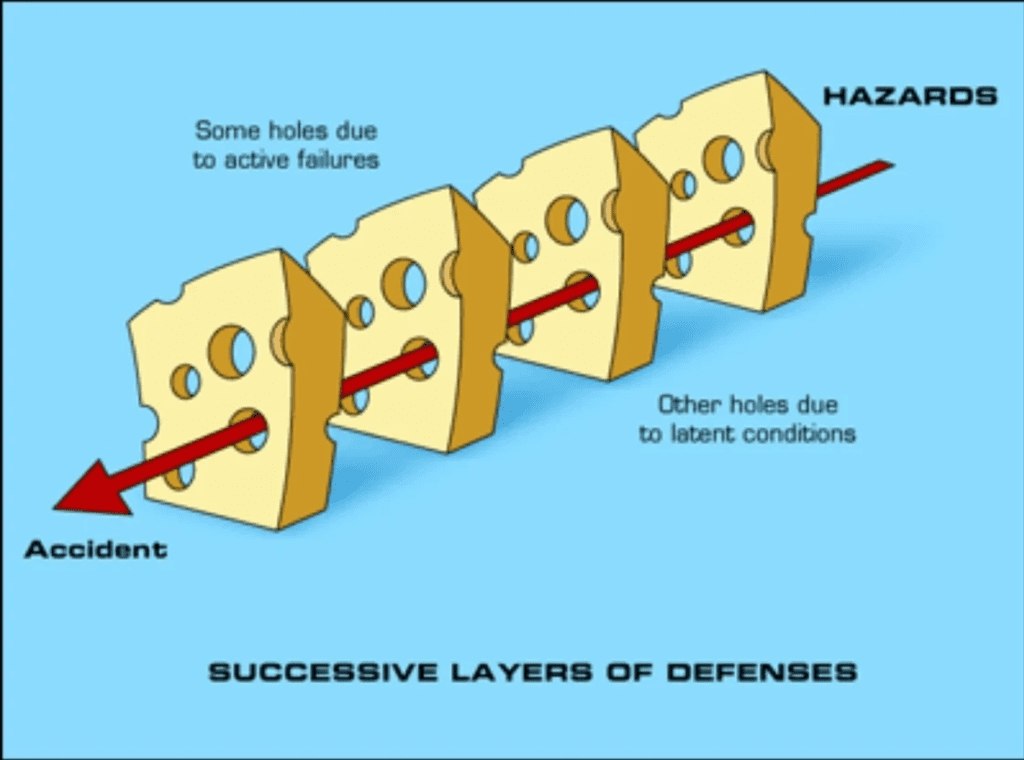
In aviation safety, there’s a framework called the Swiss cheese model. Every layer of defence has holes. Most of the time, the holes don’t line up. Accidents happen when they do. A plugin misconfigures hreflang tags. A developer doesn’t know that matters. An agency isn’t scoped to check. A dashboard masks the impact with new traffic from another source. Four reasonable gaps, lined up perfectly, compounding into one slow-moving problem that nobody owns.
The people running these companies definitely aren’t asleep. They’re busy building. Every individual handoff looks reasonable in isolation. Nobody is positioned to see the whole chain. So nobody does.
The Floor, Not the Ceiling
Technical foundations won’t save a company with weak positioning, undifferentiated content, or nothing worth saying. The ceiling on organic growth is set by strategy. We spend most of our time on that side of the equation, and we’ve written extensively about it. None of that changes.
But a broken floor will swallow you. And it’s the more common problem we get called in to help untangle.
The value of sound technical foundations is mostly invisible. Pages that get indexed correctly. Authority that consolidates where it should. Data you can actually trust when you make decisions against it. This rarely shows up as a spike on a chart and people are rarely celebrated for it
What does show up is the absence, which, like the dog that didn’t bark, is more difficult to spot in real time.
The Question Worth Asking
This kind of exposure accumulates over time through small misconfiguration, unverified handoffs, tools doing 90% of the job correctly and 10% wrong (but in a way nobody has a reason to look at), and more frequently, through unbridled adoption of new tools with limited understanding of the downsides or risks.
Peter Drucker’s famous line is that what gets measured gets managed.
The more dangerous version: what gets measured wrong gets mismanaged with confidence.
The companies that avoid this aren’t the ones with bigger teams or better tools.
They’re the ones where someone, at some point, made it their job to verify that the whole machine was actually running the way everyone assumed it was.
So the question is worth sitting with: when was the last time someone looked at your analytics, your site architecture, your data layer, not to produce a report, but to verify it’s actually working the way you think it is?
Want more insights like this? Subscribe to Field Notes