
A barbell: two heavy ends connected by a thin bar. Nothing in the middle bears weight.
Nassim Taleb’s barbell strategy is simple: allocate a large portion of your investments to extreme safety and a small but meaningful portion to extreme speculation. Nothing in the middle.
Originally a portfolio construction idea, it applies to everything from career design to reading habits (I read X slop and classic books, but rarely buy airport bestsellers). And of course, to marketing.
This framework has been a guiding force for our agency. We’ve applied it to SEO, content strategy, client portfolios.
Simply put, this meant heavily indexing on “product-led content” with SEO potential, and then running a smaller basket of opinionated thought leadership, original research, or “buzzworthy content” meant to drive links and shares.
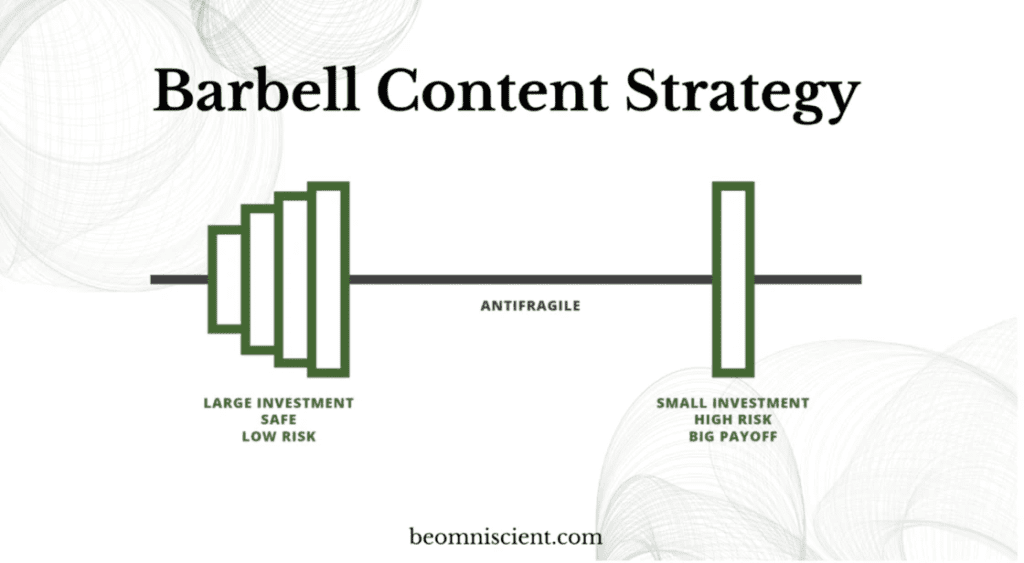
I still think that’s generally a good content strategy model, but AI advancements make it worth a revisit to see how we can apply barbells more broadly
The Dangerous Middle
The real insight in the barbell isn’t just to avoid risk (in fact, it’s to expose yourself to risk in order to capture loft upside), it’s that medium risk is a sucker’s game. That’s because it often obfuscates risk, is subject to huge measurement errors, and causes one to think they are being prudent while they are actually in the worst position possible.
In marketing, the dangerous middle looks like this: a company publishing “pretty good” AI-assisted content, running modest paid campaigns, hosting mediocre webinars with 40 attendees, dabbling in AI search optimization without committing, half assing several channels using “best practices” and ChatGPT to “personalize” the copy while tactically doing the same thing as everyone else. They’re not failing drastically. They’re not winning. They’re puttering around generating marginal returns at the cost of never generating the surplus value necessary to generate cumulative advantage.
This is the zone of mediocrity. Modest results mask strategic decay. You succeed just enough to avoid correcting course. Outright failure at least generates signal, teaching you something and allowing you to iterate.. Mediocre success generates nothing but drift.
Clearly the majority of people are using AI right now, but when you pick your head up from LinkedIn or X, you realize that a lot of it is simply to optimize or marginally accelerate median level strategy and tactics. Which, of course, can be advantageous in isolation, but when everyone has access to the same tools and executes at the same level, execution parity is the default.
The middle is crowded, undifferentiated, and slowly compressing toward zero.
In other words, no matter how fast you can produce a blog post titled “the ultimate guide to [topic],” you’re still writing an ultimate guide just like everyone else.
The Left Side: Foundations That Don’t Break
The safe end of the barbell isn’t supposed to be exciting.
It’s the 80-90% that keeps you alive while the world reshuffles.
Now, I do think it’s harder than ever to predict what is safe or robust. However, that’s where one needs to root down into first principles and deconstruct channels and tactics into their very essence.
What is SEO but connecting a seeker with a bit of information through an intermediary (Google, YouTube, TikTok…and now ChatGPT)?
As long as there is information, and an intermediary that is imperfect, there is a foundational reason to believe basic search principles will apply and be robust (though platforms and algorithms and tactics change).
Agents seeking information on behalf of consumers still rely on the market dynamics of information supply (content), information demand (decision makers or agents on behalf of humans), and an intermediary platform or platforms.
Within channels, there are tactics that do not need to be filtered through the lens of “novel” to be worth deploying.
Getting brand mentions on third party listicles is the keystone AEO tactic? No, it’s an obviously advantageous play to build ubiquitous presence for your brand in product discovery stages, and that happens to have a positive influence on your visibility in AI engines. Because like humans, AI engines are using consensus to calibrate their answers.
Get mentioned more often (especially in reputable sources), you increase the likelihood of being recommended (again, by humans and AI). You don’t need to take an AEO course to come to that conclusion.
Paid acquisition, similarly, is rooted in the idea of attention and intent being sold to a relevant product or brand in exchange for preferred inventory space. Anywhere there’s attention, there’s probably a way to pay to borrow some of that valuable attention (whether on social, train ads, Google…or now ChatGPT).
So you have some digital channels that may change shape but will likely be worth continued investment.
And there’s brand, of course. The ever elusive “brand,” the structural moat and the rising tide that lifts all your tactics.
In The New Gold, I argued that when content production becomes trivial and information is abundant, brand acts as a filtering mechanism. The majority of marketing leaders and VCs I spoke to the last three months have mentioned brand as a major priority. Paul Graham is writing about brand. Tech broadly is opining about “taste.” Things have changed from the hardcore growth marketing days!
But of course this is a priority. Because when content is commoditized, the name on it is the differentiator. Brand is the thing AI can’t generate and competitors can’t replicate overnight; publish all the slop you want at scale, trust as a heuristic takes a long time to build.
Owned audience is a corollary there. Email lists. Communities. Podcasts. Channels you control, not rented audiences on platforms that change the rules without notice. In the Turkey Problem, I called these “hedges,” non-correlated activities robust to platform volatility. I use SEO to distribute my content at scale, but I collect some email addresses in the meantime so I can send long meandering essays to you lovely folks.
Anyway, I could go on and on, but the point here is to consider stable bets without the lofty appeal of 100Xing or being high risk with low certainty. Simply things you can count on either as an underlying good (e.g. brand or being mentioned in favorable publications) or as a channel robust to massive shifts (owned audiences).
None of these need to generate outsized returns. They need to survive contact with whatever comes next.
The Right Side: Vibes, Vibe Coding, and Meat Space
The speculative end is the 10-20% where you get to have a little fun.
Some of the best bets in the AI era are about AI, but some are countertends to the macro forces of AI. In other words, the easier it is to create simulacra through text, image, video using AI, the lower the barrier to entry, and the higher the competitive saturation. So zigging when others zag may have an outsized advantage.
So I split the right side of the barbell into two categories: accelerators and countertrends.
Accelerators
These are AI-native bets where early movers build compounding advantages:
AI search (AEO/GEO). Mentions in AI generated answers exhibit a Matthew effect – brands that build authority now become disproportionately hard to displace. This is especially true with the increased adoption of AI workflow tools for content creation, as the automated research portion identifies your brand among the top mentions, which merits more mentions, etc.
Fortunately, a significant portion of activities here will be useful even independent of AI search (brand mentions in review sites, Reddit, listicles, good content that answers user questions, clear messaging and positioning).
Given it’s still the early days, it’s probably beneficial to go hard early on to capture some of the early mover advantage.
Hyper-personalized ABM. AI makes one-to-one outreach possible at a scale that was previously uneconomical. We already know personalization and hypertargeting works well. The bet is that AI-powered personalization at scale creates a temporary arbitrage before competitors catch up. I’d be using something like Mutiny to do this digitally and to complement your other demand efforts.
Content engineering systems. Not AI slop (obviously). Engineered workflows where AI handles specific, bounded tasks within a human-directed system. The distinction matters: the middle-of-the-barbell approach is “use AI to write blog posts.” The right-side bet is building an industrial-grade content operation that outperforms human-only teams at specific, measurable tasks, and often produces marginally better outputs by reallocating human time spent on hard to fake differentiators like SME extraction and inclusion, distribution, and optimization.
Vibe coding and product buildouts. Anyone can just build products now, and though I’m not sure how the market dynamics digest this, there’s clearly value creation potential within an individual firm. For example, we build VoC analysis tools to establish prompt sets for AEO tracking, automatically analyze citation sources for opportunities (and prompt outputs for qualitative and sentiment insights), integrate SEO/web/AEO analytics and run agents on top of it for facilitate faster throughput, etc. Many plays here.
Countertrends
These are robust or probably even antifragile to AI. They become more valuable precisely because AI makes everything else cheap:
Curated IRL experiences. You know how nice it is to yap in person with your peers? In a nice restaurant that is normally tough to get into? No phones out? It’s bliss. Of course, GTM teams know this, it’s not a new tactic. But I can see this becoming its own art form. Dinners become secret speakeasies become regularly occurring events become box seats at a Knicks game for CMOs working on AI search (this is a real thing I want to do, so if any AEO-focused company wants to partner on this, let’s go).
Original research and proprietary data. You can’t prompt a dataset into existence. Well, you can, but it’s very unethical. The countertrend here is very simple: signal in the noise. Everyone’s publishing all the time. Everyone’s got a megaphone and a little tool that writes their teleprompters. No one needs to have a unique thought, really. So we’re all overstimulated and there’s too much information with little idea how to parse signal from the mindless chatter. Good data tends to cut through it. It works well for AEO & SEO, social, sales, and all your other core channels too.
Unscalable craft. The birthday card test: everyone prefers a handwritten card to a text message. The friction is the meaning. Print magazines, founder-recorded video walkthroughs, hand-written strategy memos. I’ll send you a Cameo if I really want to recruit you. These things carry signal precisely because they’re expensive and slow. When AI collapses production costs, the costly things become the mechanism of trust.
Again, there are many examples I could give here, from viral ad campaigns to starting a branded restaurant or grocery store. Point is, give people something to talk about. Stand out.
The 70/20/10 Operating System
How do you actually run a barbell day-to-day?
The allocation itself should be custom fit to your context. Bigger brands may want to risk less by indexing more heavily on safe bets with smaller upside (or, conversely, they may have the additional resources and bandwidth to run contained experiments in innovative channels).
I like a 70/20/10 split (Alefiya taught me that years ago), where 70% of bets are in stable assets with predictable but slow upside, 20% is in the outlandish and innovative bucket, and 10% is optimization and refinement of existing efforts (conversion rate optimization, tweaking of variables, etc.)
In practice: the agency that sends a hand-written strategy memo instead of a slide deck. The SaaS company that flies a prospect’s team in for a working session instead of running another demo call. The brand that publishes four deeply researched reports a year instead of five hundred thin blog posts a month.
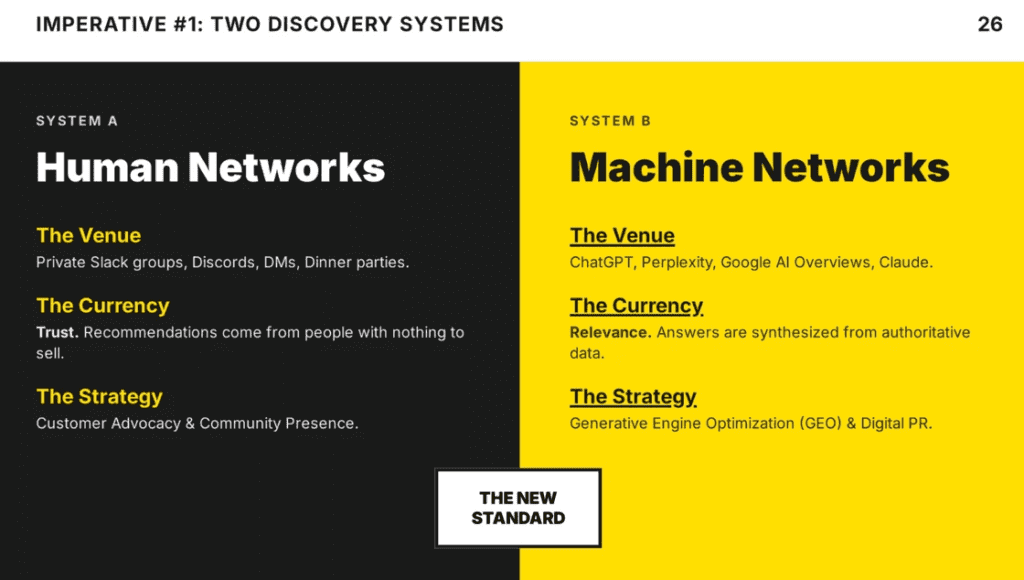
Generally, I think Wynter’s B2B marketing report lays out a pretty perfect barbell for discovery:
The Portfolio Audit
Maintaining a barbell requires saying no to reasonable-sounding initiatives that live in the middle. It means having activities that feel wasteful (the right side) alongside activities that feel unglamorous (the left side). Most organizations find this psychologically difficult. The middle feels responsible. It looks like diversification. It’s actually concentrated exposure to mediocrity.
Taleb’s deeper point: you can’t actually predict which bets will pay off. That’s the whole idea. You structure your exposure so you don’t need to predict. The safe side keeps you alive. The speculative side gives you optionality. The middle gives you neither.
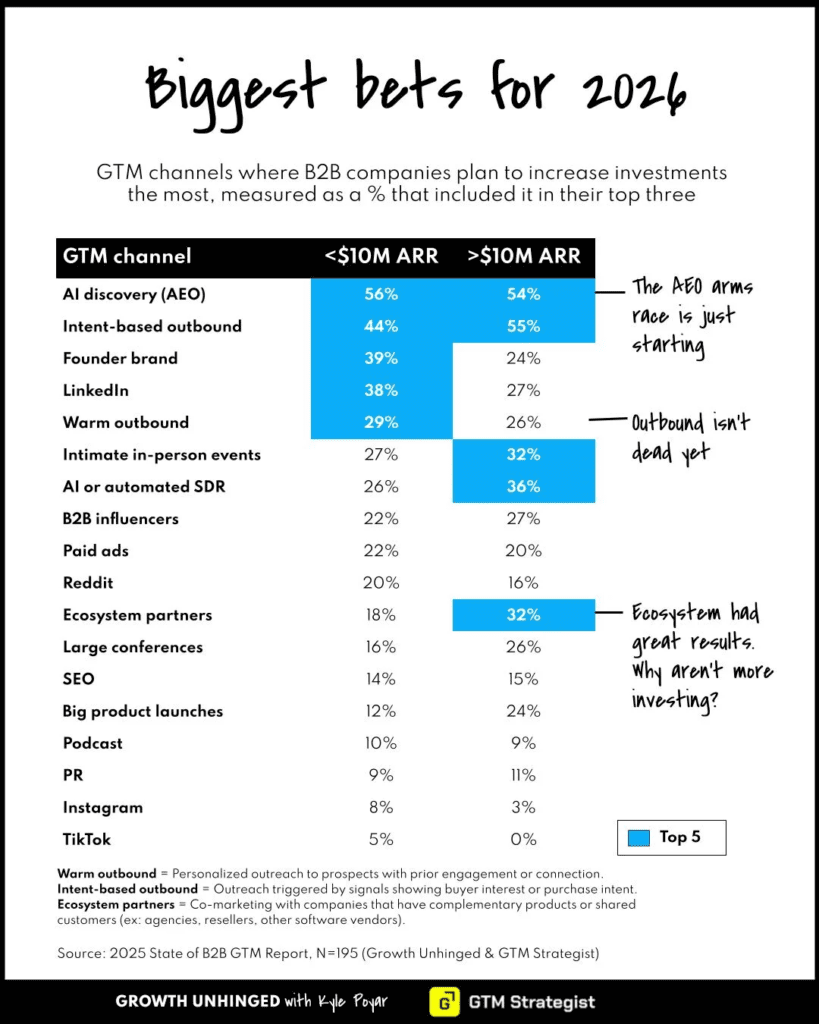
This gets much more tactical and channel-based than my essay here, but research from Kyle Poyar showed a healthy mix of high upside and safe bets (AEO, hyper personalized outbound, and intimate in person events all in the top 5 for large brands).
The Weight Is at the Ends
In the AI era, value concentrates at the extremes. Extreme efficiency (AI-powered systems that do in hours what took weeks) and extreme humanity (experiences, craft, and signals that machines can’t fake).
The middle – the “pretty good,” the “good enough,” the “we’re doing a little of everything” – is where value dissipates.
I wrote nearly two years ago that SEO is clearly not dead, but mediocre SEO very likely is. That trends has been evident (though we’ve had hiccups along the way and always will).
The barbell isn’t a prediction about the future. It’s a posture toward uncertainty. You don’t need to know what’s coming. You need to be structured so that whatever comes, you benefit from the extremes and aren’t destroyed by the middle.
Load the ends. Clear the middle. The bar will hold.
Want more insights like this? Subscribe to Field Notes


